Loading...
Please wait for a bit
Please wait for a bit
Click any word to translate
Original article by Kate Connolly in Hofsgrund. Photography by Stefan Pangritz
On 17 April 1936, the bells of St Laurentius church in the Black Forest rang out to guide to safety a group of London schoolboys trapped in deep snow on a mountain hike gone very wrong. Ninety years on to the day, as the bells sounded again, there was hardly a dry eye in the congregation of British relatives and German villagers remembering the night that had brought together their parents and grandparents.
The people of Hofsgrund risked their lives heading out with sledges and lanterns in the deadly weather to rescue the party of 27 and their teacher after two boys, fumbling though fog and frozen to the bone, had reached a farmhouse and told its startled inhabitants there were many more of them strewn over the Schauinsland mountain.
The Daily Sketch from 20 and 29 April 1936
But it was the Hitler Youth Organisation that would claim credit for the action, in a propaganda coup ceremoniously flanking the coffins of the five boys who perished in what local people refer to as the Engländerunglück (English Misfortune) before they were transported on trains back to London. Those images dominated the headlines and went around the world.
Jenny Davies, the daughter of Douglas Mortifee, who as a 17-year-old had reached the farmhouse clad in shorts and sandals – dressed the same as the other boys when they had set out from their hostel with just two buttered rolls and nothing to drink – said it was finally time to pay tribute to the villagers of Hofsgrund and correct the historical record once and for all.
Jenny Davies (right), the daughter of Douglas Mortifee, who was one of the boys to raise the alarm
“Without your help we would not be here now,” she said in an emotional address from the church pulpit, speaking on behalf of relatives of five of the 22 survivors and a niece of one of the deceased at a ceremony to mark the anniversary attended by the parish priest and a village brass band.
The Nazis’ hijacking of the narrative, in which they were able to feign feelings of friendship towards Britain, was supported by promoters of Britain’s appeasement efforts to prevent the second world war.
It also allowed the boys’ teacher, Kenneth Keast, then 27, to get off the hook. Equipped with a tiny scale 1:100,000 map and a compass he did not know how to use, he had set out on the hike despite minus temperatures, snowfall and repeated warnings from local people who knew their weather and urged him to turn back.
Afterwards, charges were dropped in Germany, and British newspapers portrayed him as the “man of the hour” without whom more boys would have died, although UK authorities did ban him from taking further school trips abroad.
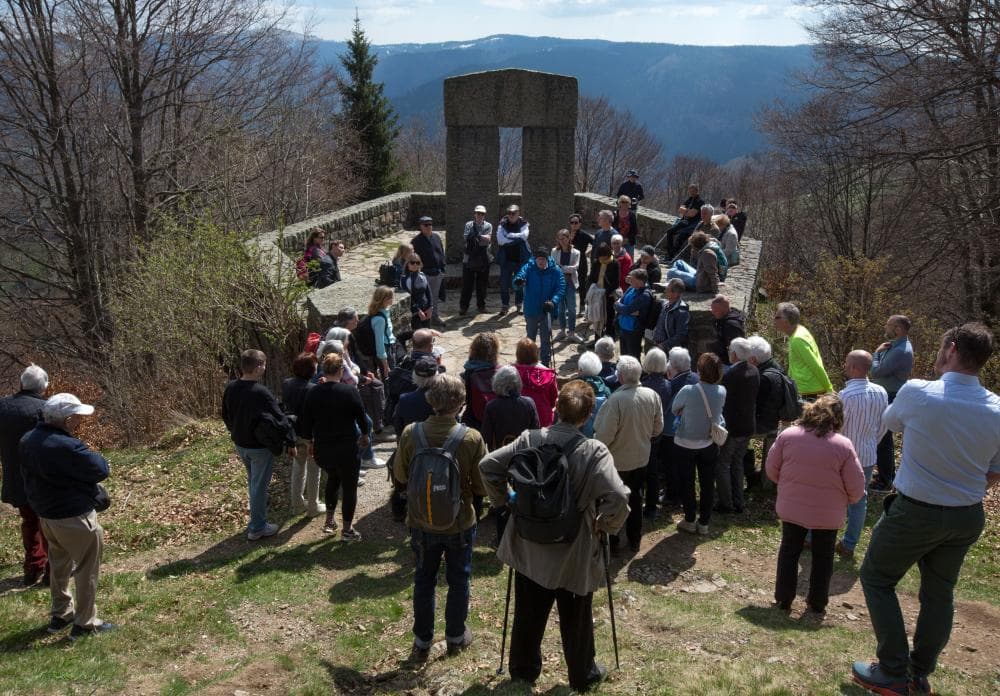
Ninety years on, and in better weather, relatives and villagers retraced part of the boys’ route on the mountain path, visiting a bombastic, rune-style monument erected by the Nazis as well as a modest stone cross on a grassy slope close to the spot where Jack Eaton, 14 years and 10 months old, had collapsed and died metres from the village.
That cross has slowly gained recognition as the true memorial to the boys of Strand school in Brixton Hill, south London. It was commissioned by the father of Jack, the school’s boxing champion, who had flown to Germany determined to find out who was responsible for the death of his only son.
Nancy Whelan, Jack’s niece, visited the spot for the first time on the anniversary, touching its lichen-mottled inscription as she fought back tears. “My nan [Jack’s mother] and my mother, Jacqueline, who was named after Jack, always said they just wanted the truth to come out,” she said. A blank space on the cross shows where Nazi authorities forced Jack’s father to remove words blaming the teacher, as it impugned the official narrative.
Nancy Whelan (right) and three relatives of Norman Hearn study the Eaton memorial
Ewald Lorenz welcomed the boys’ relatives at the Dobelhof farmyard where Douglas Mortifee and RGS Farrants had sought help. His grandparents, Elisabeth and Bernhard Lorenz, had brought the hypothermic boys into the safety of their wood-panelled parlour and urged them to stand some distance from the dark green ceramic oven, which still dominates the room, so as to not rewarm too quickly.
Ewald Lorenz at the front door of the Dobelhof farmhouse in Hofsgrund
The grandparents of Ewald Lorenz
Everyone in the village has their own story to tell of that night. “We know to always have an open door and an open mind,” Lorenz said.
In the wood-beamed village hall, local people and the families swap stories after the hike. The rescuers included Bruno Lorenz, the village cobbler, who, his son Kurt recalled, said of that night: “The snow and wind was monstrous.”
Kurt Lorenz, whose father, Bruno, the village cobbler, was involved in the rescue effort, listens to speeches at the Hofsgrund community centre
Marius Buhl, a local journalist, said he wished he had had the chance to ask his grandfather Reinhold Gutmann about his role in the rescue, but the village had only truly realised the significance of the event after the publication of research byBernd Hainmüller, a retired teacher from nearby Freiburg, who spent 26 years unearthing the real story behind the tragedy. “We lived with the towering monument right in front of our noses, but it took an outsider to really bring the story to our attention,” Buhl said.
Marius Buhl, a Hofsgrunder whose grandfather was involved in the rescue effort, speaks during the memorial service in the local Catholic church
“The rescuers never talked much about it,” said Paula Gnaehrich, whose grandfather, Ignatz Schelb, had carried the boys on a horn sledge back into the valley. “But it was always something of interest to us youngsters. We often thought of the children, and I was always shocked that the teacher might have ignored the warnings of Black Forest locals who are always going to know their heimat and its weather better than a visiting Londoner, however clever he thinks he is.”
Vanessa Barton, the daughter of Russell Petty, who was 16 at the time, quoted her father’s account of the hike and how “the wind and snow together were felling small trees”. She said: “On family holidays he never took us anywhere it was snowing, and certainly not up a mountain.”
Julia and Lucy Warner had brought with them the pencil-written diary of the youngest survivor, their grandfather Ken Osborne, and donated it to the local museum along with the postcard he had sent to his parents after the event. “We got lost. It might be in the papers and so we have been told to write and say that I am quite safe,” it said.
A Guardian long read published soon after the 80th anniversary brought Hainmüller’s work to a wider audience, prompting many relatives of the schoolboys to contact him – connections that eventually led to the memorial meeting. Research by the Guardian’s Richard Nelsson in UK archives also uncovered a paper trail now central to the understanding of events.
The Catholic church of Hofsgrund
Over kaffee und kuchen the families swapped stories and shared photos, letters, diaries and newspaper cuttings, piecing together details such as who carried whom off the mountain, and where and when the boys subsequently served in the war. Russell Petty had carried Peter Ellerkamp, who was one of those to die. Stephen Hearn said he was reasonably sure his father, Norman Hearn, had put Ken Osborne, the smallest boy, on his shoulders.
“My dad only ever gave us snippets of information when we were young,” Hearn said. “He simply told us he had nearly lost his thumbs due to frostbite trying to rescue a boy off the top of a mountain.”
It was only 27 years after his father’s death that Hearn looked through two boxes of documents from his life, found the Guardian article through a web search and “realised what I’d stumbled across”. In October 2024 he sent the information to Hainmüller, who helped him piece together the puzzle.
Speeches at an exhibition on the tragedy in the community hall
Norman Hearn, like one other survivor, Stanley Few, refused to fight against the Germans when war broke out, insisting it was Germans who had saved their lives. Both were sent to Asia instead. It was noted also that several of the rescuers went to war and never came back, two of them killed at the Battle of Stalingrad.
Kevin Mitchell, visiting Hofsgrund with his father, Max, whose late brother Hubert had survived the hike, said he felt a great sense of satisfaction. “Most of us had the big picture, but the pleasure has been in the minutiae we’ve been able to share.”
The parlour of the Dobelhof farmhouse with the original oven. Apart from the kitchen, this was the only heated room in the house.
In a video message from Perth, Australia, Debra Cadee, the daughter of Donald Hooke, another survivor, said: “I can remember Dad telling us ‘the tolling of the bells saved us’.” She said he suffered from the effects of frostbite for the rest of his life.
The local mayor, Hanspeter Rees, has promised that Jack Eaton’s father’s inscription – “their teacher failed them in the hour of trial” – will soon be re-engraved on the monument.
Whelan said: “After nine decades, I feel my family’s painful attempts to get to the truth have finally paid off.”
• This article was amended on 25 April 2026. The mayor is Hanspeter Rees, not Klaus Vosberg as stated in an earlier version. Also, the spellings of Paula Gnaehrich and Ignatz Schelb’s surnames were corrected.