Loading...
Please wait for a bit
Please wait for a bit
Click any word to translate
Original article by Dan Sabbagh Defence and security editor
Russia’s embassy in London has accused the UK of “deliberately opting for an escalation of the Ukraine crisis, while hypocritically professing a desire for peace” after it emerged over the weekend that Britain was supplying attack drones to Kyiv.
Ministry of Defence sources indicated that a report in the Sunday Times, that two drones made by British companies had been used by Ukraine’s military to attack targets inside Russia, was true, although only one, Nyan, made by BAE Systems, was named.
The Russian embassy, seeking to maximise the impact of its remarks, added in a widely reported statement on Telegram: “London’s actions will inevitably carry consequences for which it will have to answer”.
Britain has been supplying weapons and providing financial support to Ukraine since before Russia’s full-scale invasion. It has committed to providing £3bn a year in military aid until the end of the decade and to joining the EU’s €90bn loan scheme, which bankrolls Kyiv’s military effort, though many of the details of UK support are kept secret.
The £100,000 Nyan drone is a medium-sized, jet-powered delta wing drone capable of delivering relatively small attacks at distances greater than 150 miles. However, while it looks hi-tech, it is not a munition that appears to be militarily significant.
Britain has in the past supplied £1m-plus Storm Shadow missiles with a similar operating range that were used by Ukraine to launch attacks into Russia, but stocks have run short. Meanwhile, Ukraine has developed and manufactures its own Flamingo cruise missiles and longer range drones that it uses to attack Russia daily.
It is as good an opportunity as any for the Kremlin to make a political point.
Western financial support is critical for Ukraine’s war effort and anything that might undermine public confidence in countries such as the UK is, from Moscow’s perspective, worth making, particularly in the summer when there is less domestic political news to crowd out the embassy’s remarks.
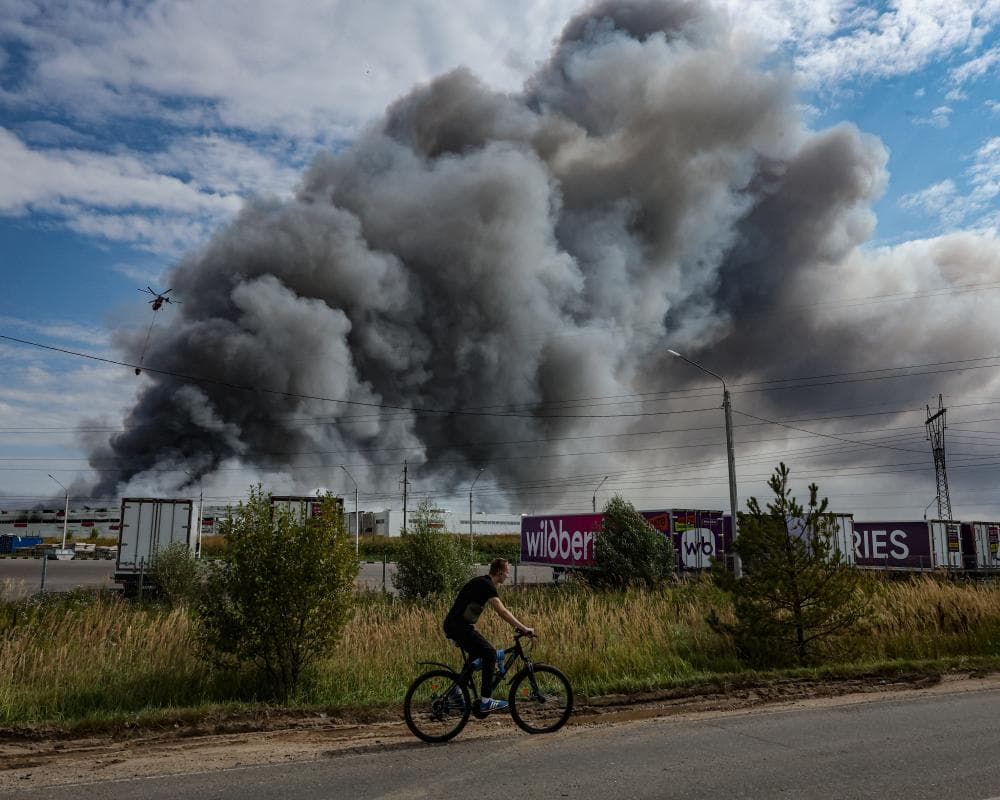
Russia is also hurting economically from Ukraine’s sustained deep strike campaign that has targeted oil refineries and, more recently, ecommerce distribution warehouses on the outskirts of Moscow. Attacks are taking place on a near daily basis.
It is the first time in the war that Ukraine has been able to hit targets in and around Moscow, more than 300 miles from its border, deploying a long-range capability that western leaders had refused to supply until Kyiv developed it for itself.
Russia has been engaged in hostile behaviour towards the UK for years, including conducting two poisoning operations on British soil of defectors: Alexander Litvinenko in London in 2006, and Sergei Skripal and his daughter Yulia in Salisbury in 2018. Russian hackers routinely target the UK, and regularly mount online disinformation campaigns.
However, as the war in Ukraine remains almost deadlocked, and as Kyiv strikes closer and closer to home, Russia has become more reckless across Europe. It has conducted arson attacks using incendiary devices hidden in DHL parcels, including in the UK; flown 20 drones into Poland, and conducted an aerial harassment campaign across the continent.
Moscow was almost certainly behind an attempt to attack Ukrainian cargo planes at Leipzig airport in Germany earlier this month with a small quadcopter drone armed with plastic explosive. It appears willing to spread the Ukraine war into Europe, including the UK.
John Foreman, a former UK defence attache to Moscow, said he thought Russia was likely to engage in “more of the same” given its track record of hostility to the UK.
“Russia is ‘relentlessly targeting’ the UK’s critical infrastructure, democratic processes, supply chains and public trust. It has run sporadic campaigns of arson, sabotage, assassination and disinformation,” he said.
“We know Russia is an aggressive, antagonistic and revisionist state. It has the intent to continue to target us unconventionally and will continue to do so.”
An obvious concern is whether Russia’s brinkmanship spirals out of control; it will be for the UK and Nato to ensure that does not happen.