Loading...
Please wait for a bit
Please wait for a bit
Click any word to translate
Original article by Graham Readfearn Environment and climate correspondent
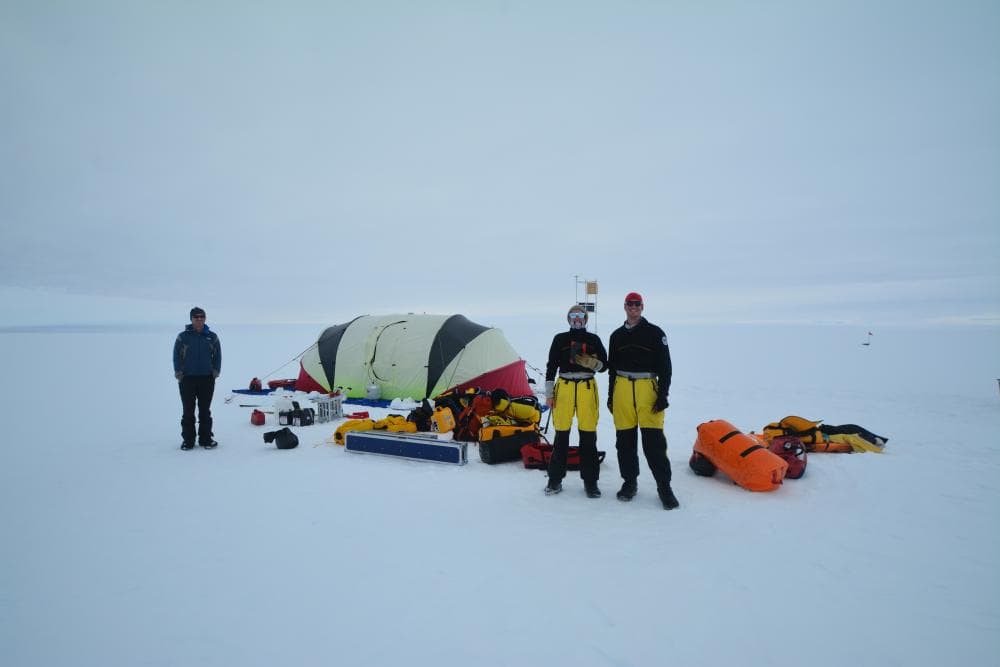
On one side of Dr Ben Galton-Fenzi’s view across the vast Totten ice shelf, the sun sat low on the Antarctic horizon. On the other, a full moon.
The ice shelf is “flat and white”, says Galton-Fenzi. “If there’s cloud around, you lose the horizon.”
With temperatures at -20C and a wind chill threatening frostbite, Galton-Fenzi was there in the summer months of 2018-2019 to retrieve radar instruments that were checking the thickness of the ice.
But Galton-Fenzi’s concern isn’t what’s happening on top of the ice. It’s what is happening almost two kilometres below his feet where the ocean meets the ice he is standing on.
For Antarctic scientists, getting a handle on what’s happening under the ice shelves is urgent because the fate of the planet’s coastlines will depend on how fast they melt.
Antarctica has more than 70 ice shelves that extend the continent’s vast ice sheet out over the ocean.
Covering about 1.5m sq km, ice shelves float on the water and don’t by themselves push up global sea levels if they melt.
But if global heating of the ocean melts them from underneath they could become unstable, allowing the ice sheet to slide faster into the ocean, pushing up global sea levels by several metres.
The continent’s most vulnerable regions alone have enough ice to push up sea levels by about 15 metres if they all melt.
Galton-Fenzi, a principal research scientist at the Australian Antarctic Division, led new research bringing together modelling work on this “basal melt rate” from nine groups around the world.
“We need to know because the ocean-driven mass loss is one of the biggest uncertainties in Antarctica ice sheet projections and, therefore, in global sea level rise,” says Galton-Fenzi.
Taking the nine different models together, Galton-Fenzi and colleagues estimate that over recent decades the continent’s ice shelves lost about 843bn tonnes of mass every year from melting underneath.
That is the equivalent of 843 giant ice cubes – each a kilometre long, wide and deep – all melting. It is about the same amount of water that flows from the Nile River into the ocean each year.
The results of the analysis – which took a decade to pull together – will help refine future modelling.
Antarctica’s ice shelves lose mass when the edges calve into the ocean, but they also gain it from snowfall. Confusing matters even further, there is evidence global heating has caused higher snowfall over the continent.
One comprehensive analysis of Antarctica’s entire ice sheet found that, on balance, satellite data suggested the continent lost 93bn tonnes of ice between 1992 and 2020.
Galton-Fenzi says: “Knowing the role of the ocean in driving the mass loss and how that feeds back into the flow of the ice into the ocean is a key problem that a lot of nations are working on.
“We do know with very high confidence what the sign of the change will be. The ice sheets will keep losing mass. It is how fast and how much is where the uncertainty is.”
At the ocean surface, seawater freezes at about -1.9C but under an ice shelf where the water can be a kilometre or more down, the pressure means the ocean water doesn’t freeze until about -2.2C.
“The coldest water anywhere in the ocean is beneath the Antarctic ice shelves. There is no light,” says Dr Steve Rintoul, an oceanographer and leading Antarctic expert at the Australian government’s science agency, the CSIRO.
“All our conventional tools to measure the ocean can’t reach it,” he says.
“Satellites can’t reach it because it’s covered in ice. Ships can’t get in. The shelves are surrounded by heavy sea ice and they’re often heavily crevassed on the surface. Even if you could drill a hole, it’s challenging to get people there.”
Only a handful of holes have been drilled and they can only provide data on what conditions look like in one place amid a vast undersea freezing landscape.
But Rintoul’s team got lucky. Scientists use autonomous floating instruments known as Argo floats to measure ocean temperatures and salinity around the world. Rintoul and colleagues deployed one underneath the Totten ice shelf but it drifted away, spending nine months instead under two other ice shelves more than 300 metres thick.
The float’s data showed that one of those shelves – the Denman – was being exposed to warm water that was melting it from below.
Rintoul says the Denman catchment holds enough water to cause 1.5 metres of global sea level rise.
“Its configuration is such that once it gets past a certain point it can retreat in an unstable way without any more [influence] from the ocean.”
In the geological past when the Earth was covered by more ice than today, the glaciers of Antarctica carved giant canyons as they expanded.
“They were seeding their own demise, because that’s a deep channel that the warm water can come into,” says Rintoul.
Dr Sue Cook, a glaciologist at the University of Tasmania, says in any normal healthy ice sheet, there would be melting from below.
But the relative shortage of data means there are large uncertainties about how quickly the ice shelves will change, which means some of the more extreme impacts on the planet are difficult to rule out – not just those that could alter coastlines.
Cook points to another “really urgent question” around Antarctica: how the increasing amounts of meltwater could slow down major ocean circulations that could have profound impacts around the world.
“That could disrupt some of the very large scale ocean currents, but we really don’t know if it will happen or not. So the models can help us to look into the future.
“This ocean conveyor belt is what helps the climate to stay relatively stable. If it gets disrupted, then the consequences could be dramatic.”
Cook adds: “We don’t have the full understanding that we need to predict the future changes.”
Rintoul says while some of the impacts – such as extreme sea level rise – could take centuries of melting, “we commit to that ice loss much sooner than that”.
“It depends how much greenhouse gas we emit. There’s a reason the international community came up with temperature targets – they came in large part because of the risk of destabilising the Antarctic ice sheet.
“It changes the map and we can’t put the genie back in the bottle.”