Loading...
Please wait for a bit
Please wait for a bit
Click any word to translate
Original article by Hannah Ellis-Petersen and Aakash Hassan in Andhra Pradesh
The morning air was already hot and cloying when Palli Mahalaxmi rose at about 5am. It was May, and in the summer heatwave that had engulfed this corner of southern India, even night-time did not give the villagers respite.
A single ceiling fan hung above Mahalaxmi, her husband and her son as they slept in a small windowless room made of thick concrete. Mahalaxmi set about preparing breakfast, and the family ate together from steel plates, just as they did every morning. Sweat dripped from their foreheads as the sun rose higher.
Just before 6am, Mahalaxmi filled up her water bottle and headed out to work. As others filed out of their small, brightly painted houses on to the dusty village road, Mahalaxmi greeted them, smiling and exuberant as always. Chatting as they walked towards the fields where they would be working that morning, the women covered their faces; it would be another painfully hot day.
Like many in Busabhadra, an impoverished rural village in the south Indian state of Andhra Pradesh, Mahalaxmi relied on a government scheme to provide her with work. The rural employment scheme, introduced 20 years ago, guarantees 100 days of paid work to poor households outside of cities and employs more than 80 million people across India.
Though the work was tough, manual labour in fields, on construction sites and in road building for just 180 rupees a day (£1.41) was still a lifeline to 50-year-old Mahalaxmi. With her husband unable to work, a disabled son and debt from her daughter’s wedding, the scheme kept them alive. She could not afford to miss a day.
That day Mahalaxmi and a group of women were digging a water reservoir by the river in rice fields with no trees to provide shade even as the temperature soared above 40C.
Working alongside Mahalaxmi was her friend Parvati Purilla, 45, who recalled that the only thing anyone could speak about that day was the heat, most of them exhausted before they got to work. “The heat was terrible and that makes the work very difficult,” said Purilla. “When you drink water, you just sweat it out immediately. Sometimes we got dizzy – but what choice do we have?” It did not take long for the women to run out of drinking water.
However, Mahalaxmi was not disgruntled. “She was the most active person in our group and always seemed happy,” said Purilla. “She never seemed to run out of energy and never complained of any aches or illnesses. She worked more than most of us.”
By 11am, the first shift of their day was over. The women headed home, exchanging few words due to their exhaustion. Mahalaxmi did not speak when she got home, but went straight to the bedroom where she collapsed in apparent sleep.
Unable to rouse her hours later, her husband, Palli Shyam Sundha Rao, rushed to find a doctor. Examining her lifeless body, the doctor concluded Mahalaxmi had died from heatstroke.
“It was such a shock to all of us,” said Purilla. “She always seemed so strong. If the heat can take her like this, then it could take any of us.”
The family say the government should take responsibility for her death. They have received no state help or compensation and are living on handouts from neighbours. “We are helpless without her,” said Rao.
Mahalaxmi’s death is one of many thousands to have occurred as the climate crisis engulfs India and temperatures rise to increasingly dangerous, even lethal levels. Experts warn that heatwaves, which are becoming more frequent, are already reaching temperatures close to the human survivability limit; this year temperatures have risen as high as 48C in one town, and on one day in April, the world’s 50 hottest cities were all in India.
Ninety percent of India’s workforce is in the informal sector with few protections against the heat. Millions of farmers, construction labourers, street vendors and security guards work outside in temperatures that regularly exceed 44C during the summer months, while women are forced to spend hours in boiling hot kitchens. The heat exposure often continues into the night, particularly in big cities, where temperatures no longer fall significantly, leading to loss of sleep and vital recovery time. Heatstroke, if untreated, has an 80% mortality rate.
But in one way Mahalaxmi’s death is an anomaly; heat being the official cause. In India, the exact number of people dying from extreme heat remains unclear, and experts say the true toll is being dangerously undercounted. According to India’s official statistics, there were 460 heat-related deaths in 2024, when record-breaking heatwaves swept the country, and only 84 in 2025. By contrast, Europe – which has half the population of India’s 1.5 billion people – records an average of 175,000 heat deaths every year, according to the UN.
A new report by researchers at the University of California, Berkeley recently tried to quantify India’s heat mortality, which estimated that a single day of extreme heat could cause approximately 3,400 excess deaths nationally and a five-day heatwave could kill nearly 30,000.
However, Ashok Gadgil, a co-author of the report, said their research had been impeded by a deliberate attempt by the Indian government to conceal data.
For more than a year, Gadgil and his co-author tried to obtain official country-wide data on deaths during India’s heatwaves, but their efforts were systematically blocked by the government at every turn.
“Heat deaths are a catastrophic disaster that are avoidable, predictable, and are steadily going to get worse,” said Gadgil.
In the end, they had to rely on a small pool of public data from 10 Indian cities. He acknowledged the deaths from heat in remote rural areas, where people are poorer, work out in the open, are less protected from extreme heat and have much worse access to healthcare, could be higher than their estimates.
Gadgil was surprised by the backlash in India over their report, which some senior figures claimed was stirring up panic. “At least accurately measure the problem and then everyone can be alert, early warning systems can be put in place and lives will be saved,” he said.
Experts say it can be difficult to declare a “heat death” from just looking at a body, and official heat death cases are notably hard to find in India. Unlike a heart attack, or drowning or a fall, lethal heatstroke does not leave a single visible marker. Instead, as the core body temperature begins to rise from extreme heat and dehydration, blood is pushed to the surface of the skin, eventually causing collapse, organ failure or a heart attack. Long-term heat exposure can also drive chronic diseases, particularly in the kidneys.
Doctors across India said heat deaths were widely being recorded under other causes, particularly in rural areas where people are often unable to access medical help. In Ranganathapuram, a remote tribal village in Andhra Pradesh, the villagers are convinced the heat killed 39-year-old Nadupooru Krishnarao, who died in late May. The night before his death had been so hot that everyone slept outside under the trees, but it made little difference. By the time Krishnarao left in the morning at 7.30am, taking no water with him, to collect and chop firewood in the dry open fields, the sun was already scorching.
When he returned at midday the temperature was about 45C. Neighbours heard him complain that he felt hot, dizzy and unwell. After bathing in the river, he said he still could not cool down and went inside to rest, but never got up. When paramedics came to collect his body, no questions were asked. His official cause of death was left empty on his certificate. But his wife, Rekha Naduputri, 31, says she knows: “The heat took him from me.”
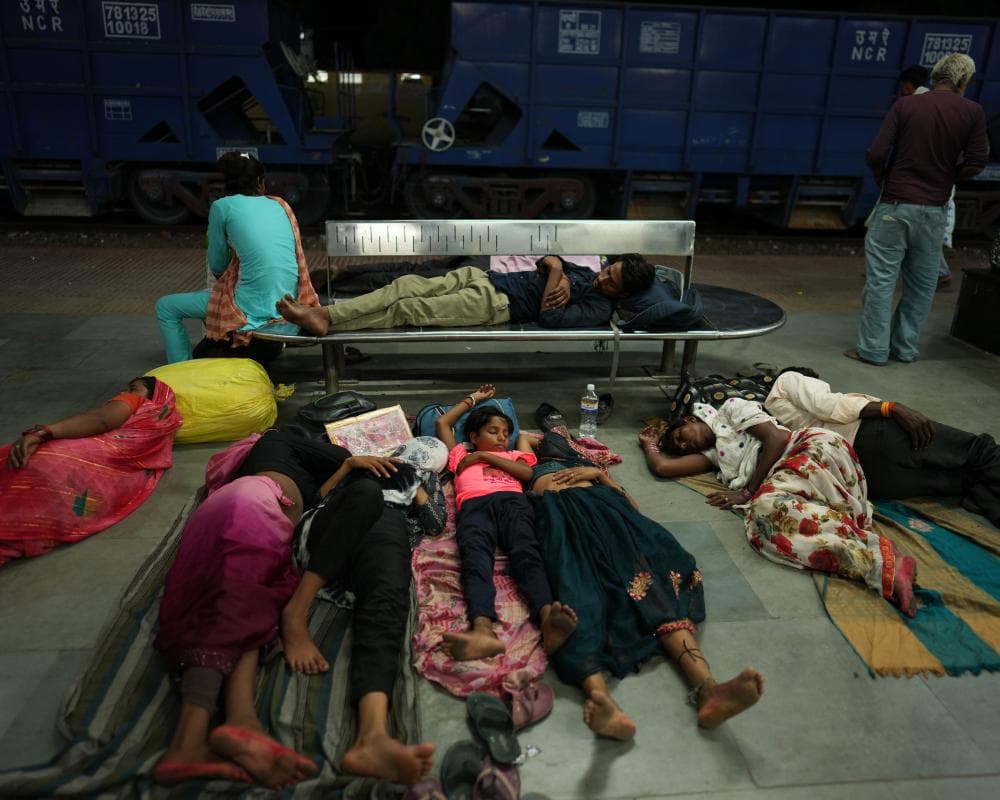
In India’s capital, Delhi, a recent report warned the city was suffering from an “escalating urban heat crisis”, with 76% of areas persistently heat stressed. In 2025, the “feels like” temperatures, which measures how the weather will actually feel when you step outdoors, passed 52C. Official figures of heat deaths this year are murky, but one 24-year-old man suffered heatstroke after he spent more than 20 hours on a crowded train from the eastern state of West Bengal to Delhi. He was brought to the Ram Manohar Lohia hospital’s specialist unit with a body temperature of 41C. Despite efforts to cool him down, he went into lung and renal failure. He died four days later.
Dr Amlendu Yadav, the head of the heatstroke unit at the hospital, said he was certain heat deaths were being undercounted. He observed that during heatwaves, the number of patients brought to the hospital already dead rose by three to five times. Many of the victims were destitute or homeless. “Their postmortem reports are submitted directly to the ministry of health, so I do not know the final conclusions,” he said. “But I do suspect that many of those additional deaths are related to heat.”
Action to tackle extreme heat is being adopted in India. This year, heatwaves were finally recognised as a national disaster by the finance ministry. However, while the health ministry heat action plan does address “health risks” it does not mention mortality. The ministry of environment and national disaster management authority were contacted for comment, but did not respond.
Experts and doctors have emphasised that accurate mapping of heat mortality could lead to crucial interventions and early warning systems to stop deaths happening on a mass scale.
Yadav said: “Considering the pace of climate change, and the heatwaves we are seeing in Europe and even parts of the US, India could face an epidemic of heatstroke if we do not prepare ourselves in time.”