Loading...
Please wait for a bit
Please wait for a bit
Click any word to translate
Original article by Tom McIlroy Political editor and Ben Doherty
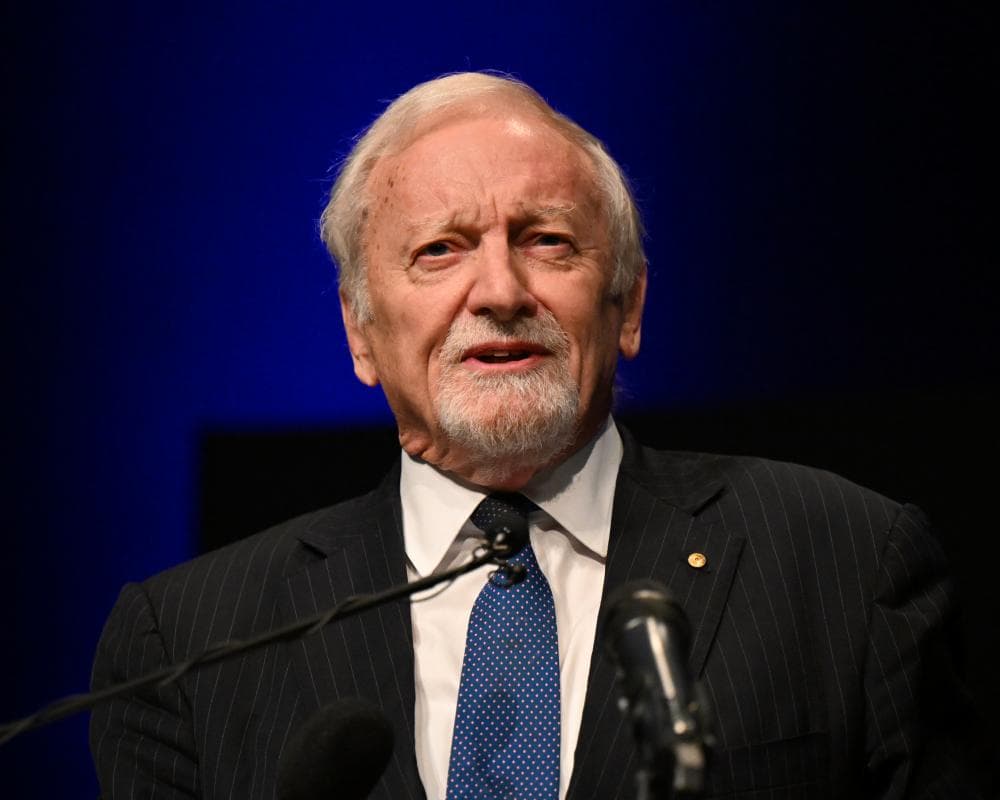
Aukus will prove to be one of the worst defence and foreign policy decisions ever made by an Australian government and is only being permitted by Donald Trump in order to destroy Chinese nuclear threats to the US mainland, former foreign affairs minister Gareth Evans has said.
In evidence to an independent public inquiry into the $368bn nuclear agreement with the US and UK on Thursday, Evans, a cabinet minister in the Hawke and Keating governments, warned the transfer and construction of submarines to Australia from the early 2030s was effectively only an extension of the American military fleet.
He said a future US administration would not come to Australia’s aid in the event of an “existential attack” and would only assist in a military conflict if its own assets on Australian soil were threatened.
“The notion that extended nuclear deterrence justifies our prostration – that the US really would be prepared to sacrifice San Francisco for Sydney, let alone Miami for Melbourne – is, and always has been, a ludicrous delusion,” Evans told the inquiry.
Sign up for the Breaking News Australia emailForeign affairs minister from 1988 to 1996, Evans told the committee hearing in Melbourne the delivery of three Virginia-class submarines from the US starting in 2032 was unlikely, because of construction delays and existing shortages in the US fleet. And he argued the complexity and timeline of the second phase of Aukus – the UK-designed, Australian-built Aukus class submarines - required even more “heroic levels of optimism” than was needed for the American vessels.
“Every report coming out of the UK indicates that its defence-industrial base is presently under extraordinary stress, with submarine building schedules tightening and costs increasing, and with every prospect of further deterioration, notwithstanding Australia’s commitment to spending $4.5bn over 10 years to help boost production rates.”
Evans said the government’s expected price tag for the deal was “wholly speculative” and argued the US would view the submarines primarily as supplementary assets, effectively embedded into US military command, for the task of finding, tracking, attacking and destroying Chinese submarines seen as posing a risk to the US mainland.
Associate Professor Tilman Ruff, co-founder of the Nobel Peace Prize-winning International Campaign to Abolish Nuclear Weapons, told the inquiry Aukus would exacerbate regional tensions, and, in the event of conflict, make Australia “a higher priority target, including for nuclear attack”.
He said the use of “weapons-grade, highly-enriched uranium” to power the Aukus submarines undermined global non-proliferation efforts, and said Australia had no solution for how it would deal with hundreds of kilograms of high level radioactive waste.
“It’s a very significant issue, because no country has resolved this huge problem, of how to manage this material. And there’s no guarantee, given the timeframes involved, and the hazards of the material over geological time, that any arrangement we come up could absolutely reliably isolate that material over hundreds of thousands or millions of years.
“The additional complication here is that it needs a really high level of security because in 10,000 years somebody could go and dig that stuff up and build nuclear weapons with it.”
Ruff said Australia had a poor track record, over decades, of attempting to “impose radioactive waste facilities” on unwilling communities.
“The potential for the Commonwealth to declare virtually anywhere in Australia as defence land and impose waste is a profound concern from a democratic and good governance point of view, as well as health and environmental and proliferation ones.”
Thursday’s first hearing of the public inquiry – which is not a parliamentary process and is being backed by trade unions and the Australian Peace and Security Forum – is being led by commissioners including the former Labor minister Peter Garrett and former defence boss Chris Barrie.
Current Labor ministers have accused the inquiry of being anti-Aukus from the outset.
Highly sceptical of the Aukus agreement, the inquiry’s commissioners will hold public hearings around the country before delivering a reporting in October.
The foreign minister, Penny Wong, said on Thursday she and Marles had discussed Aukus with their UK counterparts in regular talks overnight.
The UK government has confirmed the first steel for the newly built joint submarines will be cut next year, even as Britain’s existing submarine program runs years behind targets and billions over budget.
“This submarine capability is central to assuring Australian sovereignty in a much more contested world,” Wong said.
“It is a capability we need in a world that is more contested. There is no doubt that this project has its challenges. There is no doubt it is ambitious. But there is also no doubt that we do need this capability to assure our interests. And we are very focused on delivering it.”
Labor is pushing back on criticism of the plan, including from its own MPs, before the party’s national conference in Adelaide next month.