Loading...
Please wait for a bit
Please wait for a bit
Click any word to translate
Original article by Compiled by Richard Nelsson
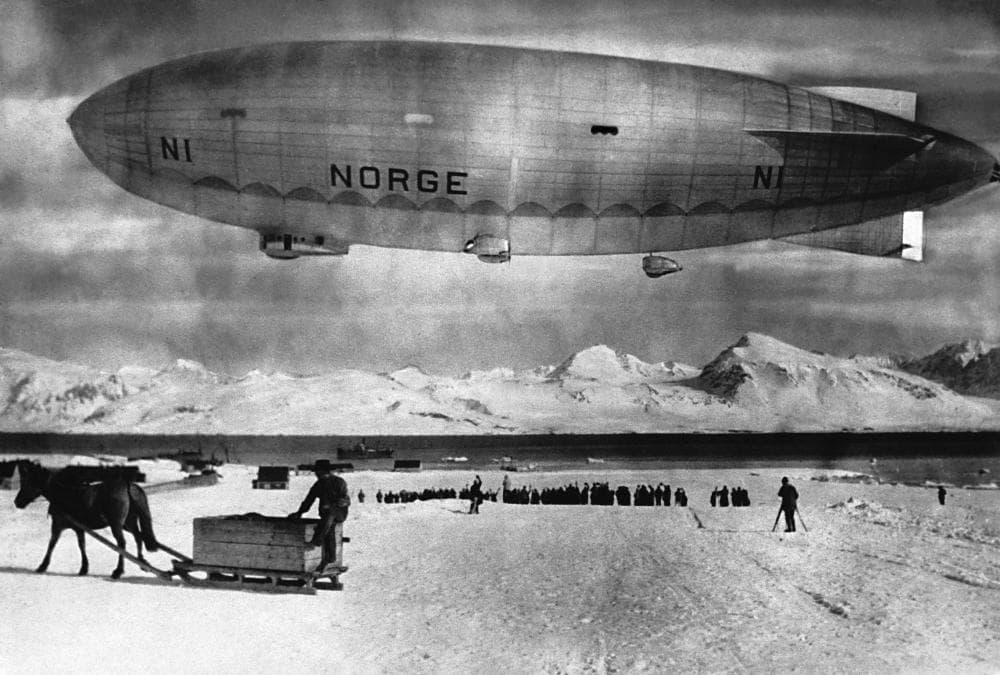
On 12 May 1926, the Norge, an Italian-built airship, made the first undisputed visit to the north pole. The crew on board included Norwegian explorer Roald Amundsen, Lincoln Ellsworth, his American financial backer, and Italian aviator and navigator Umberto Nobile.
After starting from Spitzbergen in Norway, and passing the pole, the Norge flew another 3,000 miles before landing at Teller in Alaska. At the pole national flags were dropped but Amundsen later claimed the Italian ones were larger than the others – a sign of the strained relations between the explorer and the navigator.
17 May 1926
Captain Amundsen and his airship have arrived safely at Alaska, having fulfilled his plan, according to his own wireless messages, of passing over the Pole in his flight from King’s Bay, Spitsbergen. He sailed last Tuesday, and made a forced landing at Teller, on the Alaskan coast, 73 miles north-east of Nome, at two o’clock on Saturday morning.
Amundsen and Commander Ellsworth and two companions reached Nome yesterday. The airship has been deflated at Teller and will be shipped to the United States. On the arrival at Nome one of the party is reported to have stated that no Polar land was discovered.
The landing
On the arrival of the Amundsen party at Nome, Mr Omdahl said: “No land was discovered, but the Norge acted wonderfully under trying conditions, though it was impossible to reach Nome, and we had to make a forced landing at Teller. The weather was foggy and snowy, and we were very fortunate to sight Teller. Tho Norge landed on the ice at Teller, and the gas was immediately released from the airship, which was practically dismantled. Riiser Larsen, the second in command, was left in charge.”
Reception of the news in Norway
The news of the Norge’s arrival at Teller spread like wildfire in the capital and throughout the country. The papers immediately published special editions, while the streets were decked with flags and thronged with enthusiastic crowds. There was great excitement in the Storting when the announcement was made, and the government and many corporations have sent their hearty congratulations to the expedition, paying tribute to the great achievement. The Norwegian prime minister has instructed the Norwegian Legations in Washington and Rome to tender congratulations to the American and Italian governments
Rejoicing in Rome
The news of the arrival in Alaska of the Norge gave rise to delirious demonstrations of joy and relief here after the anxious period of waiting. The streets and public buildings were immediately adorned with flags, and the bell in the Capitol rang for a long time. A crowd assembled in front of the house where Colonel Nobile’s family lives and held an enthusiastic demonstration. Mme Nobile appeared on the balcony and thanked the crowd. A deputation composed of managers and workmen of the aircraft factory then visited Mme Nobile who was weeping with joy, and congratulated her warmly.
17 May 1926
Amundsen certainly has a way with him. He is the shrewdest and by far the luckiest of Polar explorers. His shrewdness took him successfully to the south pole and back, but his safe return in his seaplanes from the neighbourhood of the north pole last year was due to unprecedented luck, and he showed his recognition of the fact by changing to an airship for this year’s expedition. The venture of the Norge was exposed to the risks of blizzard and intense cold, but, considering the shorter distance, it was probably not more dangerous than that of the R34 when it crossed and re-crossed the Atlantic. After this there will probably be a slump in Poles.
Polar exploration derives its interest, apart from contributions to knowledge, from the experiences and sufferings of the exploring parties. The wireless messages sent out by Amundsen suggest that the first half of his journey at least was uneventful and even dull; nothing was seen but pack-ice, and fog sometimes prevented even a good sight of that. There are two points to be cleared up: the next few days should tell us whether Amundsen sighted any land between the north pole and Alaska and what the conditions are like for the airship service “over the top” of which some people dream. But what is Captain Amundsen to do now for adventures? Has he thought of Everest? It is a little out of his usual beat, but a man must have a job.
18 May 1926
Mr Riisar Larsen, describing the epoch-making voyage of the Norge, said in an interview last night that thin ice and open water had been found at the Pole, but that no land was discovered in the Arctic wastes. The Norge was in the air for 72 hours, and a considerable time was spent at the Pole making observations, for which the airship descended to within 630ft, of the ice.
Over Point Barrow occurred an accident which might have led to a disaster. Owing to the intense cold ice formed on the whirling propellers and then suddenly flew off like a stone from a sling, tearing a rent in the gas-bag. The helium within began to escape, and the airship became extremely heavy, but fortunately Teller reached before the loss of gas could become fatal.
Open water and rocky islands
Commander Lincoln Ellsworth stated to-day that he saw a large quantity of open water at the north pole when the party sailed over there on Tuesday night in the Norge. This statement has provided the answer to the question which has puzzled geographers and explorers for many years past, and which had not been completely settled by the visits of Captain Peary or Lieutenant Byrd because of the limited area which they were able to see.
Commander Ellsworth added that he also saw some rock islands, but these could not be considered properly as land. The party dropped an American flag at the Pole, it being the third with the American colours which had been placed there, including those dropped by Captain Peary and Lieutenant Byrd.