Loading...
Please wait for a bit
Please wait for a bit
Click any word to translate
Searching for the body of his wife in the mud, Dil Bahadur Shrestha lamented that he did not even have a shovel left. For now, he has been using his hands to try to find her as he picks through the ruins of his house.
On Wednesday morning last week, Jamuna Shrestha, his wife of 50 years, had been at home in Betrawati on the banks of Nepal’s Trishuli River, feeding her beloved chickens and goats.
As deadly flash floods coursed down the river valley, Jamuna was last seen going back into her house, trying to usher her chickens to safety, while others fled uphill. Now that house stands like a muddy carcass, everything inside it destroyed or washed away by the violent force of the water and debris that killed more than 1,200 people in Nepal and Tibet.
Dil Bahadur Shrestha, 70, had been tending to his rice fields and feeding his cows on the opposite bank when he felt the ground tremble and saw a black wave, hundreds of metres high, coming down the valley. He ran to safety in the forest, but not before watching two bridges get swept away behind him. “When it hit, everything was destroyed within two minutes,” he said.
Dil Bahadur Shrestha, who is searching for his wife of 50 years, Jamuna.
He knows in his heart that his wife is gone, but like thousands caught up in the disaster, her body has yet to be found and she is counted among the missing. More than 5,000 people are reported missing in Nepal and a further 546 in the Tibet region of China.
Rescue workers have still not reached Dil Bahadur Shrestha’s home, so he returned to try to retrieve her body himself. “Maybe she thought the flood wouldn’t reach inside the house,” he said, wiping away tears.
The couple had already rebuilt their home once after an earthquake in 2015 that killed about 9,000 people. As he spoke, his frail body collapsed to the barren, muddy ground where his neighbour’s house once stood.
“Even now, I cannot believe that she is gone,” he said. “I cannot forget her. That’s why I keep walking around looking for her. I still feel as if she might be walking around somewhere here. I keep getting this feeling that she might still be here, looking after the chickens and the goats.”
A Rasuwa district sign in the flood debris in Betrawati.
The scale of the tragedy in Betrawati is unfathomable. It was 8.37am when a melting glacier high up in the Himalayas on the border between Nepal and Tibet crashed into the valley below, setting off deadly flash floods down Nepal’s Bhotekoshi and Trishuli rivers. By 8.50am, with only a few minutes’ warning, the settlement of Betrawati was engulfed.
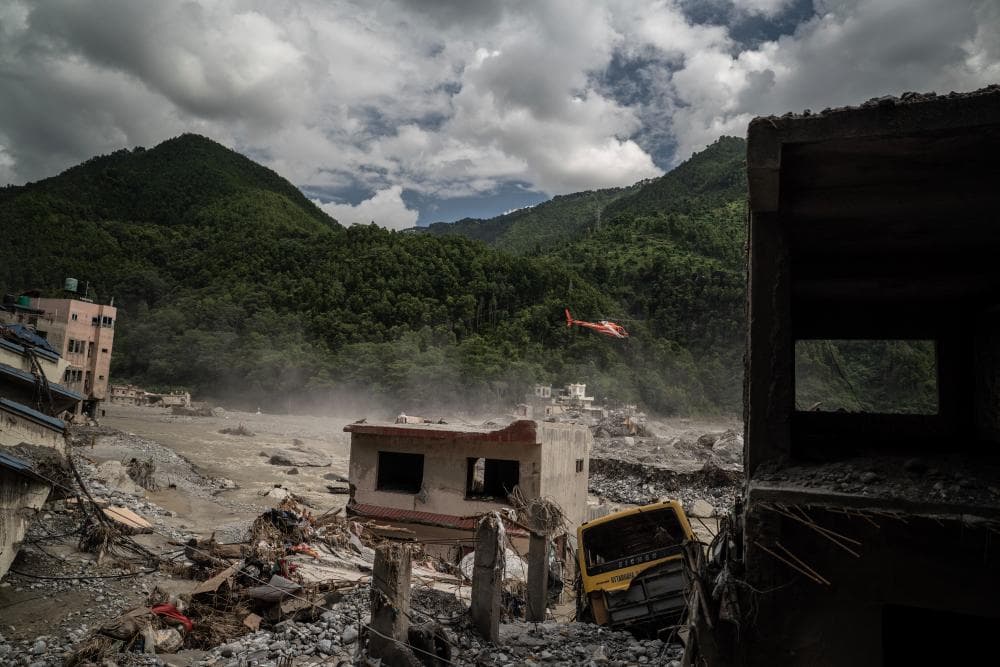
This once-thriving market town was submerged in mud so thick that only the top two floors of a six-storey building are visible. Most houses were washed away entirely or flipped on their sides by the sheer force of the floods. School buses lie overturned. A grocery shop was swept 200 metres from its original location and lies in ruins. The river itself has diverted to a new path that cuts through where the highway once was.
An overturned school bus hit by the flood water.
Fragments of the lives of the thousands who lived here lie scattered in the debris: kettles, teddy bears, a record-keeping book, saucepans, medicine packets, a pair of glasses. At least 250 people are missing, Dil Bahadur Shrestha’s brother and sister-in-law among them.
As Dil Bahadur Shrestha surveyed the ruins of his life, search and rescue teams stood on the opposite bank, looking for the dead. By the end of the day, they had pulled 24 bodies from a single house. A helicopter thundered overhead, white body bags swinging underneath.
“I feel there could still be hundreds of bodies here,” said Dil Bahadur Shrestha. “So many people were swept away all at once, carried off by the raging water.” His voice broke: “Now I’m alone. I am completely alone.”
Santamaya Lawat tries to retrieve some of her belongings.
A few metres away, Santamaya Lawat, 57, stood shaking a thick cake of dirt from the few clothes and blankets she had been able to retrieve from her brother’s home, now only partly standing, with a gaping hole in the side. Her own house, built just 10 months ago with her life’s savings, was still so filled with mud she had not yet been able to get inside. Five members of her family are gone.
Santamaya Lawat has lost five members of her family as well as her home and her brother’s home next door.
“My heart broke when I came back,” she said. “This was supposed to be the house I lived in for the rest of my life, but everything is gone. It was like heaven here and now it has been turned into hell.”
***
Further up the river, in the district of Rasuwa, on the border with Tibet, the scale of destruction only gets worse. Many of the villages here were swept away entirely and are only accessibly by army helicopter. Some are still so cut-off and the ground conditions so precarious that the fate of hundreds of people remains unknown. On Tuesday, police search and rescue teams confirmed they had finally been able to begin ground operations in the border village of Timure, recovering 90 bodies so far.
A week after the disaster, survivors who fled up mountainsides were still being collected by army helicopters and evacuated to the army base in Dhunche, Rasuwa district’s administrative headquarters.
The mountain village of Syabru Besi was among those wiped clean away, with even the road to the village gone. According to local government officials, at least 500 people there are missing, a quarter of the population. The village resembles nothing more than a muddy riverbed, just one building left standing.
Chhiring Dorje, a 50-year-old farmer, was among those who managed to escape Syabru Besi, but five of his family are missing. “There were 15 or 16 of us from the village who made it safely to the forest,” said Dorje. “We stayed there for two days before the army came in a helicopter. We had nothing to eat. We survived by drinking water from the forest.”
He stood tightly holding the hand of his nine-year-old granddaughter, Ritu Tamang, who wore a big pink rucksack as they waited at Dhunche army base for a ride down to Kathmandu. Rescue helicopters thundered in and out every few minutes. She said quietly that there was “nothing left where our house used to be. I used to go to school and was in Grade 1. Now the school is gone. There are no teachers either.”
Chhiring Dorje, a 50-year-old farmer, was among those who managed to escape Syabru Besi, but five of his family are missing.
Chhiring Doreje’s granddaughter Ritu Tamang – waiting to be taken to Kathmandu.
With the highways washed away, the only road from Kathmandu to Rasuwa is a perilous unpaved track of mud and stones, weaving through tiny mountain villages. The journey often takes more than 12 hours. The treacherous conditions have made it difficult for aid to reach the worst-hit areas and hindered the rescue and relief operations. Many aid trucks are now stuck in Dhunche, unable to drive further north.
At a small relief camp on the road between Betrawati and Dhunche set up by Nepal’s Dhulikhel hospital, people collected medicine and food supplies. Doctors said dozens of the children here had lost their parents in the floods. More than 200 children from the local Nilakantha school, most aged between five and 11, are also missing, believed to have been washed away as they walked to morning classes.
Prakash Nepal, a teacher.
Prakash Nepal, a teacher, said the school had received a warning just 10 minutes before the flood waters hit, when the school bus was already picking up students.
“Luckily, we immediately contacted the bus driver and the vehicle stopped midway so the students were able to survive,” he said. “The surge of water did reach the vehicle, but thankfully it did not cause much damage.”
However, many of the local families had been displaced by the 2015 earthquake and still lived in informal settlements along the riverbank. Most of those children had been walking to school when the flood struck. Prakash Nepal’s eyes welled with tears: “We could not save the students who were still on the road.”
Amid the tragedy, there were also small stories of hope. Sitting on the porch of their village home in Lachyang, Ram Krishna Neupane, 69, and his wife, Muiya Neupane, 66, said their only son had been working as a vet in Syabru Besi when the village was hit.
For two days afterwards they heard nothing and feared he was dead. Then they received a phone call. “He called up from a hospital in Kathmandu; he had been rescued by the army,” said Ram Krishna Neupane. “He could not speak, he was crying so much and we were crying.”
It was, added his wife, “a miracle”.