Loading...
Please wait for a bit
Please wait for a bit
Click any word to translate
Original article by Jakub Krupa
… and on that note, it’s a wrap for today!
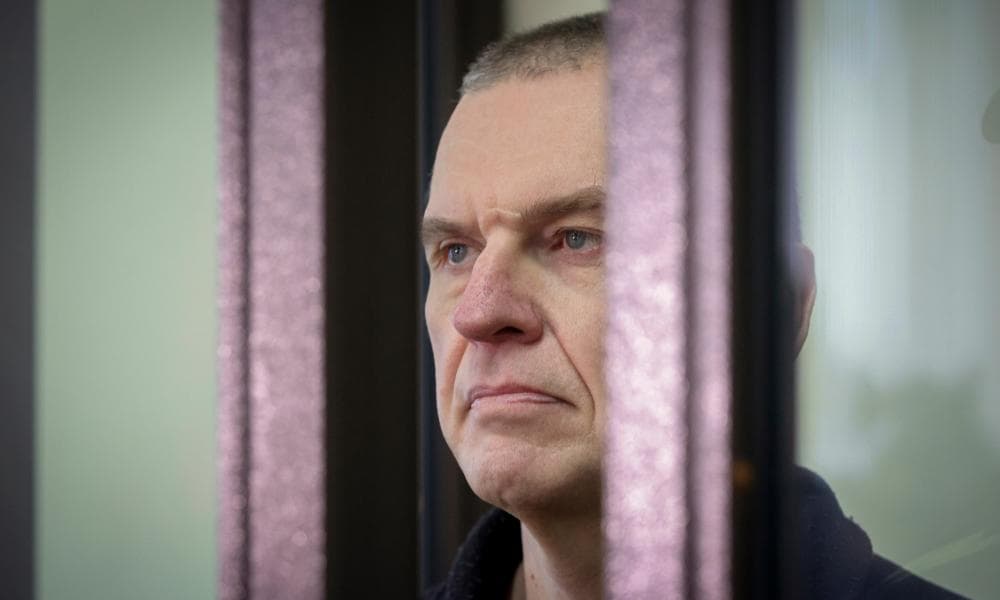
The Polish-Belarusian journalist Andrzej Poczobut, the 2025 Sakharov prize winner, has been freed after five years in a Belarusian penal colony as part of a US-brokered multi-country swap deal (13:19).
A prominent Polish community activist in Belarus and a journalist for Poland’s newspaper Gazeta Wyborcza, Poczobut was sentenced to eight years in a penal colony after a process widely condemned as a politically motivated attempt to silence the regime’s critics.
The release is part a US-brokered prisoner exchange involving several other countries: Belarus, Kazakhstan, Moldova, Poland, Romania, Russia and Ukraine.
The release comes as part of a broader attempt to bring Belarus closer to the west, with talks led by Donald Trump’s special envoy to Belarus, John Coale.
Two Moldovan citizens were also released as part of the swap (15:11).
In other news,
Andorra’s co-prince and France’s president Emmanuel Macron has backed proposed changes to the country’s draconian abortion laws in a speech during his two-day visit to the country, in which he also called for a swift implementation of an association agreement with the EU (10:42, 11:32, 13:01, 16:04).
Romania’s Social Democrats and far right on Tuesday said they filed a no-confidence motion against liberal prime minister Ilie Bolojan after his pro-EU ruling coalition broke apart, triggering a new political crisis in a turmoil-weary country (16:21).
Finland’s president Alexander Stubb downplayed recent warnings of a possible Russian attack on European Nato allies in the coming months, but urged Europe to be “prepared for the worst so you can avoid it,” as he confirmed some delays in US arms deliveries to the continent as a result of the Iran war (11:54, 11:58).
An 89-year-old man was arrested in Greece in connection with a reported shooting in central Athens which left five people injured (11:20, 16:17).
If you have any tips, comments or suggestions, email me at jakub.krupa@theguardian.com.
I am also on Bluesky at @jakubkrupa.bsky.social and on X at @jakubkrupa.
Back to Andrzej Poczobut’s release from a Belarusian penal colony, Poland’s prime minister Donald Tusk is now speaking about the process behind it.
He says today’s attempt to get him swapped for other prisoners was just the latest of many, with the Belarusian side previously once changing its mind less than 24 hours before an agreed date.
He also confirms that two other people were released to Poland: Grzegorz Gaweł, a Polish Catholic priest, and a Belarusian who helped Polish security services and whose name will not be revealed.
Meanwhile in Romania, the country’s Social Democrats and far right on Tuesday said they filed a no-confidence motion against liberal prime minister Ilie Bolojan after his pro-EU ruling coalition broke apart, triggering a new political crisis in a turmoil-weary country, AFP reported.
The Social Democratic party (PSD), the biggest in parliament, quit Bolojan’s coalition government last week after he took a series of unpopular measures as the eastern European country seeks to cut the biggest deficit in the European Union.
Far-right leader George Simion said his AUR party filed the no-confidence motion signed by 251 lawmakers in the 465-seat parliament, which will be voted on 5 May.
PSD leader Sorin Grindeanu on Monday said the motion “transcends political affiliations”.
“There are many things that divide us... but we share a common goal: to vote on this motion and bring down the Bolojan government,” he said.
We earlier brought you the news of reported shooting at a social security office and a court in Athens (11:20), which saw five people injured.
The Greek police has now arrested an 89-year-old man in connection with the incident as it continues to investigate his motives.
As reported earlier, state broadcaster ERT said that the gunman had reportedly left envelopes with documents after the shooting at the courthouse, saying those were the reasons for his actions, AP said.
Over in France, the National Assembly observed a minute of silence in tribute to French soldiers killed in Lebanon, Sgt Florian Montorio and Cpl Anicet Girardin.
A separate ceremony was also held in Suippes, during which Girardin – the second soldier killed in Lebanon in what is believed to have been a Hezbollah attack – was also posthumously awarded the highest French national order, Legion of Honour.
First, let’s catch up with Emmanuel Macron’s much-awaited speech in Andorra, where – as anticipated (10:42) – he has backed the push to reform the country’s draconian abortion laws.
The current laws include a total ban on abortion in Andorra, with the government pushing ahead with plans to decriminalise it by 2027 – but stopping short of legalising safe abortion.
Macron said he hoped to see the longstanding discussions on the issue come to fruition, “with respect for institutions, balances, conscience of every person,” but also for women’s fundamental rights.
He backed the government’s proposal, saying:
“From where I am, without pre-empting your future debates, I hope with affection that this debate progresses and that it allows us to respond to a request that I hear.”
On Andorra’s association agreement with the EU, he separately warned that further delay on its implementation could lead to a complete breakdown in negotiations.
“If in the end you say no, or not now, we will renegotiate … we will make a better negotiation – the door will not reopen …
I tell you in all sincerity: the European Commission and all the people who have been committed for years to reach this now concluded agreement will say ‘we are fed up with these people.’”
The deal, which would see Andorra participate in the EU’s single market, has been reached at the technical level in late 2023 with further process in 2024, but is yet to be ratified and would need to be approved in a referendum.
Let’s bring you other news from around Europe.
And so here’s out first story bringing all we know together in one place -
The Polish-Belarusian journalist Andrzej Poczobut, the 2025 Sakharov prize winner, has been freed after five years in a Belarusian penal colony as part of a US-brokered multi-country swap deal.
His release has been confirmed by Poland’s prime minister, Donald Tusk, who posted a picture of him on social media, saying: “Andrzej Poczobut is free! Welcome to your Polish home, my friend.”
The release comes as part of a broader attempt to bring Belarus closer to the west, after the US secured the release of 123 prisoners including the Nobel peace prize winner Ales Bialiatski and the opposition figure Maria Kalesnikava late last year and removed some sanctions, including on Belarusian potash, a key export.
Poczobut – a prominent Polish community activist in Belarus and a journalist for Poland’s newspaper Gazeta Wyborcza – was detained by the Belarusian authorities in 2021. He was sentenced to eight years in a penal colony after a process widely condemned as a politically motivated attempt to silence the regime’s critics.
The release is part a US-brokered prisoner exchange involving several other countries: Belarus, Kazakhstan, Moldova, Poland, Romania, Russia and Ukraine. Tusk said it was “the finale of a two-year complicated diplomatic game, full of dramatic twists and turns”.
Poczobut’s longtime employer, Gazeta Wyborcza, celebrated the release on its website, saying: “Andrzej Poczobut is finally free! The dictator has released our colleague from the penal colony.”
The newspaper’s deputy editor-in-chief, Bartosz Wieliński, posted a picture with Poczobut, captioned: “The first kilometres of freedom. We’re heading to Warsaw.”
In a first report filed from the prisoner’s swap at the Polish-Belarusian border, Gazeta Wyborcza’s editor Wieliński said that Poczobut spoke at length about the persecution and intimidation he faced in the Belarusian penal colony as he lost 20 kg during his imprisonment.
But he insisted he would want to return to Belarus in future.
Recalling his conversations with other Polish minority leaders, he said:
“They said that the Lukashenko regime would not forgive them for their Polishness. I can’t leave them.”
Poland’s PM Tusk also recalled this moment in his earlier social media post, summing up their conversation:
“‘Will I be able to return there?’ – those were his first words. ‘Only you decide. You are a free man now,’ I replied.”
Meanwhile, Moldova’s pro-European president Maia Sandu confirmed that two Moldovan citizens were also released as part of the swap.
In a post on X, she said:
“Today, we are bringing two Moldovan citizens home from Russian captivity. This would not have been possible without @realDonaldTrump and the US administration, and our partners in Poland and Romania. We are deeply grateful. They’re coming home!”
Poczobut’s friend and editor at Poland’s Gazeta Wyborcza, Bartosz Wieliński, has just posted a picture with the released journalist on X, saying:
“The first kilometres of freedom. We’re heading to Warsaw.”
Poland’s prime minister Donald Tusk said “the exchange at the Polish-Belarusian border is the finale of a two-year-long intricate diplomatic game, full of dramatic twists.”
“It succeeded thanks to the outstanding work of our services, diplomats, and prosecutors, as well as the tremendous help from our American, Romanian, and Moldovan friends.”
Poland’s president, Karol Nawrocki, also welcomed the news, pointedly thanking the US president, Donald Trump, for his help.
The Russian state media reported that as part of the swap, Poland released a jailed Russian archaeologist, Alexander Butyagin, who was wanted by Ukraine.
“As a result of an exchange carried out on the Belarusian-Polish section of the border, two citizens of our country were returned to their homeland,” state media cited the FSB security service as saying, naming one of them as Butyagin.
The head of the archaeology department at the famed Hermitage Museum in Saint Petersburg, Butyagin faced extradition to Ukraine for conducting excavations in Crimea, which has been occupied by Russia since 2014, AFP reported.
Trump’s special Belarus envoy John Coale ends the press conference declaring:
“The United States has a lot to do on this issue, there’s 800 to 900 political prisoners left to get out of Belarus, and we haven’t stopped our work at all until we get every last one of them.
So the United States is very committed to have this happen, and hopefully we get them all out.”
Poland’s foreign minister Radosław Sikorski says Warsaw will always “respond with goodwill to gestures of goodwill,” but then caveats that by saying he doesn’t want to “overpromise, because we have had these false doors before, but we think it’s a move in the right direction.”
US Belarus envoy John Coale says he is going back to Belarus in “two or three weeks,” so will hold further talks.
He says he also keeps raising Lithuania’s concerns about meteorological balloons flying from Belarus into Lithuania’s airspace and disrupting airports, saying “we are getting very good progress” on this issue.
US special envoy to Belarus John Coale offers a bit more detail of the discussions with Belarus’s Lukashenko.
“Basically an argument with Lukashenko is, what are you getting out of this? You’ve got these people or this person in prison, and what are you really getting out of this.
It doesn’t help you, internationally, it hurts you, internationally, and if Belarus, wants to join the family of nations, this kind of things have to stop. If you want to put people into prison for good reason, great, that’s your business, but not for these types of crimes.”
Poland’s Sikorski adds that “the fact that we had people to exchange helped, but it would not have happened without the United States.”
He says seven countries were involved in the process in total: Russia, Belarus, Kazakhstan, Romania, Moldova, Ukraine, and Poland.
Poland’s foreign minister Radosław Sikorski is speaking at a press conference, responding to the news of Poczobut’s release.
He says it is a great example of the Polish-US alliance at work, crediting the US president, Donald Trump, and special Belarus envoy John Coale.
“Poczobut is not the only released Pole, but we all know he is a symbol of commitment to Polishness and the freedom of the media and journalists.”
He says Poland will push for more Polish political prisoners to be released as he calls for further work on relations with and towards Belarus.
Speaking alongside him, Coale similarly says the US had been working on this issue for “some time” with “complex negotiations” involved, as stresses the role of the US president, Donald Trump, and the Polish president, Karol Nawrocki.
Sikorski confirms the process involved “a prisoner’s exchange,” and says one of the people released by Poland was a Russian historian who was facing extradition to Ukraine.
Updated
Earlier this month, in an article marking Poczobut’s 53rd birthday, Poland’s Gazeta Wyborcza said that he was “sentenced for allegedly inciting ethnic hatred and acting to the detriment of Belarus,” but “in reality, dictator Alexander Lukashenko’s men decided to punish Andrzej for being a defiant activist of the Polish minority and a steadfast, independent journalist.”
Separately, a UN-mandated report released last month warned about “deeply alarming detention practices” in Belarus’s prison system, warning specifically that the Novopoltsk colony in which Poczobut was held saw detainees “subjected to prolonged solidary confinement, disciplinary sanctions and physical punishments after suicide attempts” with reported “denial of essential medical case and reprisals for attempting to raise complaints.”
The US special envoy to Belarus, John Coale, has just offered a bit more detail on the operation, confirming that three Poles and two Moldovans were released as a result of US efforts.
“Today, in my role as President Trump’s Special Envoy for Belarus, my team and I helped secure the release of three Poles and two Moldovans. This historic outcome was made possible thanks to @POTUS Trump’s leadership, @ChrisWelbySmith and his team @StateDept, and close coordination with several trusted partners.
We thank Poland, Moldova, and Romania for their invaluable support in this effort, as well as President Lukashenka’s willingness to pursue constructive engagement with the United States.
Under President Trump, America shows up for its allies and delivers diplomatic victories no one else can.”
Poland’s daily record newspaper and longtime Poczobut employer, Gazeta Wyborcza, has welcomed the news of his release with a splash:
Andrzej Poczobut finally free! The [Belarusian] dictator has released our colleague from the penal colony.
The news of Poczobut’s release comes just hours after Poland’s foreign minister, Radosław Sikorski, published a picture of his meeting with the US special envoy to Belarus John Coale, saying secretly the pair discussed “important issues.”
Polish-Belarusian journalist Andrzej Poczobut, the 2025 Sakharov prize winner, has been freed from Belarusian prison.
His release has been confirmed by Poland’s prime minister Donald Tusk, who posted a picture of him on social media saying: “Andrzej Poczobut is free! Welcome to your Polish home, my friend.”
Detained by the Belarusian authorities in 2021, Poczobut was sentenced to eight years in a penal colony after a process widely condemned as politically motivated to silence critics. In recent years there were growing warnings about his deteriorating health.
Awarding him the Sakharov prize in 2025, the European Parliament president Roberta Metsola hailed Poczobut and co-winner Mzia Amaglobeli from Georgia as “two journalists whose courage shines as a beacon for all who refuse to be silenced.”
“Both have paid a heavy price for speaking truth to power, becoming symbols of the struggle for freedom and democracy.”
His release comes as part of a reported prisoners swap between Poland and Belarus; the details of which are yet to be reported or confirmed.
Updated
Back to Andorra, Macron is now speaking during a ceremonial sitting at the Casa de la Vall, the historical seat of the local parliament.
He speaks about the importance of looking at crises around us and rejecting “the temptation of withdrawal,” but instead of seeking new partnership to strengthen itself, as he hails Andorra’s transition “from an agrarian economy to a thriving service sector, but without ever renouncing its roots.”
On Andorra’s relationship with the EU, he says he is committed to making that relationship closer, as he says that “the European space is, in essence, Andorra’s natural space.”
He also specifically endorsed Andorra’s association agreement with the EU at an earlier meeting with students.
On other political issues, he’s more vague, as he says he is “aware” of “ongoing debates,” and says that the country’s institutions “must remain attentive to the everyday expectations of Andorran citizens,” referencing housing among other issues.
But we are likely to hear from him again later today.
Updated
Separately, Finland’s Stubb confirms that Europe faces some delays in stock deliveries from the US as a result of the Middle East war.
He says:
“It is a public secret that some of the stocks and delivered systems in the US are either going elsewhere or being delayed. But I don’t see any need for alarm here in Finland.”
Estonia’s Karis confirms this, too:
“We are in a same position in the sense I know that there is a delay – it is probably a question to our minister of defence what kind of missiles or ammunition we are missing – but as far as I know, its [tactical ballistic missiles] Himars.
But it’s a signal that in Estonia and in Europe in general, we should much much faster develop our defence industry, not relying on different countries in the world.”
Updated
In the meantime, let’s check in on what’s happening in Helsinki where Finland’s president Alexander Stubb – often dubbed as Europe’s Trump whisperer because of his close relationship with the US president – is hosting his Estonian counterpart Alar Karis.
The leaders are facing questions about Poland’s prime minister Donald Tusk’s comments in the FT from late last week (£), suggesting that a Russian attack on some Nato countries in Europe could come in months, not years.
But it’s probably fair to say they are both not entirely convinced by Tusk’s alarmist claims.
Finland’s Stubb says:
“We work on different type of scenarios, but I come back to the stay cool, calm, and collected [message]. I don’t see an incentive for Russia to test Nato’s Article 5.
There will be always hybrid tests, I don’t deny that. But if you look at the eastern flank, starting from north-east, north-eastern Scandinavia, Norway, Finland, the Baltic states, Poland, then down to Ukraine, I don’t think there will be a test.”
He then says the Americans “are telling us it is for Europe to take more responsibility for our own defence” and to shift conventional forces burden sharing from “60-40 US Europe to probably more closer to 50-50.”
“Where then it’s going to end up, we don’t know. But I do think it’s a good thing that many other European countries are now starting to spend sufficient amounts on their defence,” he says.
He says European countries should draw a lesson from “the Finnish mentality: don’t faff too much about what might happen; prepare for the worst so you can avoid it.”
Karis adds:
“I’m pretty much convinced that the US presence in Europe is as important for the US as [is for us as] well. So we should work on it make sure that the troops remain on the ground at the same time we should put more money on defence in Europe.”
On Tusk’s warnings, he says:
“These ideas that who’s next, Estonia’s next, or the Baltics are next, or Finland is next… these narratives come and go, it’s not the first time … this is a tactic of the Russian Federation to make us a bit anxious but we should stay calm as it’s for an very common the Nordic people.”
Just checking in on Macron in Andorra, just look at how happy he is there!
I keep an eye on his visit there, but so far the ceremonial part mostly involves walking around (the beautiful) Andorra and high-fiving people.
His speech is expected later today
Updated
I am also keeping an eye on an incident in Athens where a gunman – identified locally as an 89-year old man – opened fire at a social security office and a courthouse in the city centre.
At least five people are reported to have suffered minor injuries.
State broadcaster ERT said that the gunman – who remains at large - had reportedly thrown envelopes with documents on to the floor after the shooting at the courthouse, saying those were the reasons for his actions, AP reported.
Updated
Europe correspondent
Journalists in the EU face increasing levels of harassment, threats and violence, while news outlets are owned by a shrinking number of proprietors and public trust in the media has plummeted, a report has found.
The Civil Liberties Union for Europe (Liberties) said the findings of its fifth annual media freedom report, released on Tuesday, should place EU officials “on high alert”, with media freedom and pluralism “under sustained attack” across mainland Europe.
Europe’s leading civil liberties group also warned public media independence was being steadily eroded by political interference and budget cuts, and journalists were being increasingly hampered by restrictions on free expression and access to information.
“A healthy, pluralistic media system is a litmus test and mirror of democracy,” said Eva Simon, Liberties’ senior advocacy officer. “Where the rule of law weakens – through deliberate government action or neglect – media freedom is undermined.”
Journalist safety in particular reached what the report called “a crisis point” in Europe in 2025, with reporters and media workers facing “extreme physical violence and systemic legal harassment”, including bomb attacks targeting investigative reporters.
As we wait for Macron’s speech, let’s bring you some other news from around Europe.
Meanwhile, Macron is visiting the Andorran primary school in Santa Coloma and absolutely loving spending his time with kids, happily posing to pictures with the Andorran flags.
Last week, he suggested he would quit politics at the end of his term in May next year, and so we should expect to see more of this sort of legacy-building trips and interventions as he enters the final year in office.
France’s president Emmanuel Macron is in Andorra, performing his duties as the state’s co-prince, alongside the Catholic Bishop of Urgell, Josep-Lluís Serrano Pentinat.
That in itself could be at best a factoid for your next politics geek pub quiz, but – as briefly covered in yesterday’s Europe Live – there is a serious element to it as his visit comes at a time of policy debate on abortion in the country, which continues to have some of the most restrictive laws in Europe.
Radio France International reported that Andorra’s prime minister Xavier Espot Zamora has “indicated he hopes to decriminalise abortion within a year, though not necessarily legalise it,” but the microstate’s governance setup involving a Catholic bishop makes it tricky.
During today’s speech as Andorra’s co-prince, Macron is expected to speak frankly about the issue and back the changes, as well as endorse plans for Andorra to ratify its association agreement with the European Union, which could be done as early as in July.
Last night, Macron raised a toast “from heart” to celebrate Andorra’s unique history and international position, with political talks only taking place behind the closed doors, but today we should hear more.
Andorra’s public broadcaster RTVA reported on Monday that Macron confirmed that abortion would feature in his speech, with the Catholic co-prince conceding that “we must move forward without breaking the institutional seams.” Let’s see what that means.
I will bring you the key lines from Macron’s speech later.
Separately, the European Parliament is expected to discuss the next EU budget, and the European Commission to talk about reforming its regulatory environment.
Again, I will keep an eye on this for you.
It’s Tuesday, 28 April 2026, it’s Jakub Krupa here, and this is Europe Live.
Good morning.