Loading...
Please wait for a bit
Please wait for a bit
Click any word to translate
Original article by Joe Coughlan (now) and Jakub Krupa (earlier)
This blog will be closing shortly, but you can still keep up with the latest updates coming from the World Economic Forum in Davos here.
Here is an overview of today’s key developments:
Donald Trump has stepped up his demand to annex Greenland in an extraordinary speech in Davos, but said the US would not use force to seize what he called the “big, beautiful piece of ice”. Addressing thousands of business and political leaders at the World Economic Form in the Swiss ski resort, the US president said he was “seeking immediate negotiations to once again discuss the acquisition of Greenland by the United States”.
The European parliament has formally suspended the ratification process on its US trade deal, in protest against Donald Trump’s threat to impose 10% tariffs on EU exports unless the bloc agrees he can take over Greenland. Bernd Lange, head of the European parliament trade committee, said until “the threats [on Greenland] are over there will be no possibility for compromise” on ratifying the US deal, which promised Americans a new era of 0% tariffs on many industrial exports.
At several points during his speech, Trump appeared to confuse Greenland with Iceland, claiming “Iceland” had caused a drop in stock prices on Tuesday – when markets fell as a result of his threat to impose new tariffs on eight European countries.
The US president claimed Nato has treated the US very unfairly, and “it’s time that Nato steps up” as “we are helping them with Ukraine”. He said Greenland costs Denmark “hundreds of millions a year to run it”, and while Denmark is “a small country and wonderful people, it is very expensive” for “a very big piece of ice”.
Danish foreign minister Lars Løkke Rasmussen said it’s “positive in isolation” that Trump pledged not to use force over Greenland, but it doesn’t change the fact that he seems to be determined to take control of the territory. He added that Denmark will continue diplomatic talks with the US, but it’s not negotiating or willing to compromise on its fundamental principles about territory.
Greenland’s government announced a new brochure on Wednesday offering advice to the population in the event of a “crisis” in the territory, which Trump has repeatedly vowed to seize from ally Denmark. This document is “an insurance policy”, said self-sufficiency minister Peter Borg at a press conference in Nuuk, the Greenlandic capital.
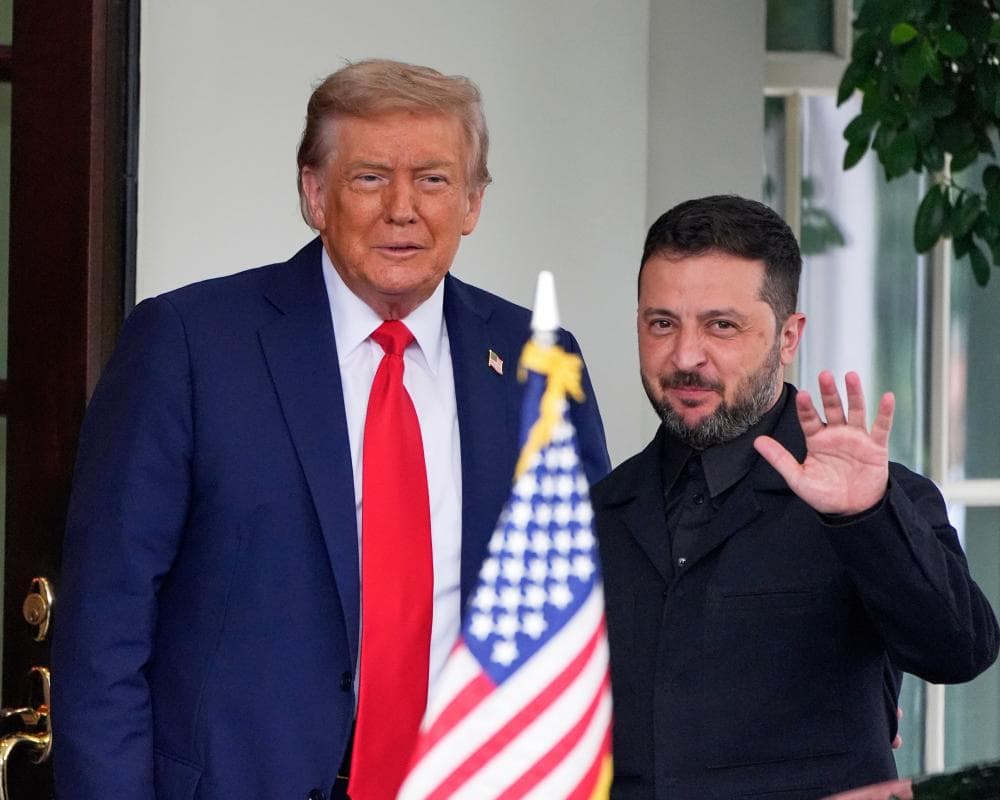
A meeting between Trump and Ukrainian president Volodymyr Zelenskyy is expected to take place tomorrow, with the US president saying on Wednesday that “we are reasonably close to deal on Ukraine”.
The European parliament voted on Wednesday to refer a freshly signed trade deal with South American bloc Mercosur to the EU’s top court, casting a veil of legal uncertainty over the accord. In a close ballot, lawmakers in Strasbourg voted 334 to 324 in favour of asking the Court of Justice of the European Union (CJEU) to determine whether the highly polarising deal, which sparked protests on the sidelines of this week’s sitting, is compatible with the bloc’s policy.
European Commission president Ursula von der Leyen reiterated that “the future of Greenland is only for the Greenlanders to decide” as she warned that Europe needs to “transform the ways in which we think and act” to step up to challenges posed by the rapidly changing world order. She said that Europe needed to realise “we now live in a world defined by raw power,” adding that “in this increasingly lawless world, Europe needs its own levers of power” and abandon its “traditional caution” to build on its economic might and become more independent.
Poland’s president Karol Nawrocki has defended his recent comments suggesting that the issue of Greenland should be primarily resolved bilaterally between Denmark and the US. Speaking in Davos, he said he “recognised some problems about Greenland,” but said he looked at it in the broader security perspective as Poland was acutely aware of the Russian threat in particular and the US played an important role “on the eastern flank of Nato.”
A major power cut affected the Danish Bornholm island after local power supplier Trefor El-Net Øst said that a submarine cable linking it with Sweden failed this morning. The island, which has nearly 40,000 residents, was cut off this morning after a reported overload, but the company insisted in comments to Danish media that there was no reason for concern.
Jakub Krupa will be back tomorrow with more coverage the latest events in Europe.
Donald Trump’s speech in Davos on Wednesday proves the EU needs to “toughen up”, Sweden’s deputy prime minister told Reuters.
The US president said he wanted immediate negotiations on a US acquisition of Greenland, which is a Danish territory.
Swedish deputy prime minister Ebba Busch said after Trump’s speech:
In many ways, [it is] not surprising.
This once again proves the EU needs to toughen up, we need to hold the line.
US president Donald Trump’s threats to annex Greenland and impose tariffs on its backers pose a challenge to Europe’s security, principles and prosperity, European Council president António Costa said on Wednesday according to the Associated Press (AP).
“All these three dimensions are being tested in the current moment of transatlantic relations,” said Costa, who has convened an emergency summit of the leaders of all 27 EU member states on Thursday.
Costa said EU leaders are united on “the principles of international law, territorial integrity and national sovereignty,” something the bloc has underlined in defending Ukraine against invasion by Russia, and which is now threatened in Greenland.
In a speech to EU lawmakers in Strasbourg, France, he also stressed that only “Denmark and Greenland can decide their future.”
Costa said that “we stand ready to defend ourselves, our member states, our citizens, our companies, against any form of coercion. And the European Union has the power and the tools to do so.”
He also insisted that “further tariffs would undermine transatlantic relations and are incompatible with the EU-US trade agreement.”
The lawmakers must endorse that deal made last July, but it’s now been put on hold.
US president Donald Trump has reiterated his claim that the use of the US military will not be necessary when it comes to Greenland.
Trump said before a meeting with Egypt’s president Abdel Fattah al-Sisi at the World Economic Forum in Davos on Wednesday:
The military’s not on the table.
I don’t think it will be necessary, I really don’t.
I think people are going to use better judgment … and I don’t think – that will not be necessary.
The head of a Swiss cantonal government said it was a “relief” that US president Donald Trump would not use force to seize Greenland, Reuters reports.
Conradin Cramer, head of the cantonal government of the city of Basel, Switzerland, said:
We live in such crazy times that it is kind of a relief to hear that.
If the president of the leading Nato country has to say he will not use force against another Nato country, and the world is relieved about that, that shows how crazy things are going now.
US president Donald Trump met Polish president Karol Nawrocki on Wednesday after his address to the World Economic Forum in Davos, the White House told Reuters.
Nawrocki said earlier on Wednesday that he hoped the issue of Greenland could be resolved “in a diplomatic way”.
Trump also had meetings scheduled with the leaders of Switzerland, Egypt and Nato secretary general Mark Rutte.
He is due to meet Ukrainian president Volodymyr Zelenskyy on Thursday.
Updated
Greenland’s government announced a new brochure on Wednesday offering advice to the population in the event of a “crisis” in the territory, which US president Donald Trump has repeatedly vowed to seize from ally Denmark.
This document is “an insurance policy”, said self-sufficiency minister Peter Borg at a press conference in Nuuk, the Greenlandic capital, shortly after Trump demanded “immediate” talks on his bid to control Greenland but said he would not use military force to take the island.
“We don’t expect to have to use it,” Borg emphasised, in comments reported by Agence France-Presse (AFP).
Trump said suring his speech in Davos on Wednesday that the US would be “unstoppable if it used eccessive strength to seize Greenland.
Updated
Germany and Italy will urge fellow members of the EU at an informal summit next month to deliver reforms to simplify procedures and improve competitiveness or risk falling further behind the US and China, according to a policy paper reviewed by Reuters.
The paper reportedly says Europe’s living standards and sovereignty are at stake as new competitors increase their global influence and the growth gap between Europe and the US and China has widened.
“Continuing on the current path is not an option. Europe must act now,” the joint statement said.
The policy paper was drawn up for the Leaders’ Retreat in Alden Biesen in Belgium on 12 February, where German chancellor Friedrich Merz and Italian prime minister Giorgia Meloni will press for a coordinated EU strategy to support businesses, attract investment and strengthen the single market.
It urges leaders to use the meeting and a EC gathering in March to agree upon concrete commitments.
Meloni and Merz are also reportedly scheduled to meet on Friday in Rome for a bilateral summit, where the Italo-German document is set to be presented, according to an Italian government source, who spoke to Reuters on condition of anonymity.
Updated
Norway’s government said on Wednesday it would not join the “board of peace” initiated by US president Donald Trump, who has vented his frustration at the Nordic country after being snubbed for the Nobel Peace Prize.
“The American proposal raises a number of questions” requiring “further dialogue with the United States”, state secretary Kristoffer Thoner said in a statement.
He added:
Norway will therefore not join the proposed arrangements for the Board of Peace, and will therefore not attend a signing ceremony in Davos.
Thoner said Norway would continue its close cooperation with the US.
The US administration has asked countries to pay up to $1bn for a permanent spot on the board, on which Trump will serve as chair.
“For Norway, it is important how this proposal is linked to established structures as the UN, and to our international commitments,” Thoner added.
The government representative added that Norway shared Trump’s “goal of lasting peace in Ukraine, Gaza and in other situations”.
Updated
And that’s all from me, Jakub Krupa, but Joe Coughlan is here to keep you up to date on the fallout from Trump’s speech in Davos and other key European lines.
Danish foreign minister Lars Løkke Rasmussen and defence minister Troels Lund Poulsen are now briefing the media after a meeting with the foreign policy committee at the Danish parliament.
Rasmussen notes they didn’t watch Trump’s Davos speech, but only got briefed on the top lines.
He says it’s “positive in isolation” that Trump pledged not to use force over Greenland, but it doesn’t change the fact that he seems to be determined to take control of the territory.
Rasumussen says that Trump’s ambitions continue to pose open questions given Denmark’s – and by extension, Greenland’s – Nato membership.
He also pushed back on Trump’s criticism, saying Denmark has kept Greenland free from Chinese influence, for example.
In 2026, “you do not trade people, but between people,” he says, and adds Denmark will continue diplomatic talks with the US, but it’s not negotiating or willing to compromise on its fundamental principles about territory.
Updated
We are getting a bit more clarity now as Reuters and CNN are reporting that the Trump/Zelenskyy meeting will take place tomorrow, not today – and the Ukrainian president will travel to Davos for that meeting.
It means that he will be meeting the Ukrainian president just as his peace envoy Witkoff will be in Moscow for talks with Russia’s Vladimir Putin.
Trump earlier said that he was planning to meet Ukraine’s Volodymyr Zelenskyy in Davos later today, saying he “might be in the audience right now.”
There is just a tiny problem with that: according to his senior adviser, Zelenskyy is actually … in Kyiv as was widely reported before the summit started, as he is responding to the recent Russian airstrikes on the Ukrainian capital.
“The president is in Kyiv,” Zelensky’s adviser Dmytro Lytvyn told journalists after Trump’s speech, as reported by AFP.
Awkward.
Updated
On his way out from the main auditorium, Trump picks up some questions from journalists.
Asked about Greenland, he says he made his views very clear and adds that “Nato has to step up.”
Asked if his comments about Europe and the UK aren’t disrespectful, he says he is not disrespectful.
But adds:
“Between immigration and energy if they don’t change, bad things will happen.”
In the meantime, after a quick final question on the Middle East, Trump ends his Davos appearance.
Now breathe.
But he will no doubt also have bilateral meetings on the sidelines of the main conference, so it’s something still worth keeping an eye on.
in Brussels
Bernd Lange, the chair of the international trade committee said, is now speaking about the parliament’s decision to freeze the implementation of the EU-US trade deal.
He says representatives of the political groups have just met and decided until “the threats [on Greenland] are over there will be no possibility of compromise”.
“We decided just a few minutes ago that we will really put on hold this legislation … it’s totally clear that there was a breaking of the Scotland deal by President Trump, announcing 10% tariff European goods.”
He said they had listened to Trump’s speaking at Davos and there was no indication he had changed his mind on Greeland.
Updated
On Ukraine, Trump says “we are reasonably close to deal on Ukraine.”
He says he is going to meet with Zelenskyy later today, and “they are at a point now where they can come together [with Russia’s Putin] and get a deal done.”
“And if they don’t they are stupid, that goes for both of them” he says.
“I don’t want to insult anyone, but you got to get this deal done. Too many people are dying.”
We are back on Europe as Trump gets asked what’s the end game on Greenland.
He says Greenland costs Denmark “hundreds of millions a year to run it”, and while Denmark is “a small country and wonderful people, it is very expensive” for “a very big piece of ice.”
He then repeats that Nato has treated the US very unfairly, and “it’s time that Nato steps up” as “we are helping them with Ukraine.”
He says that without him, the Russian invasion of Ukraine could “could have ended up in World War Three.”
So essentially he doesn’t answer the question, though, just as before, he links it with Nato.
Just as Trump keeps talking in Davos, the chair of the European parliament’s trade committee Bernd Lange confirms that “the EU-US deal is on hold until further notice” as the lawmakers pause its implementation process.
In a social media post, he added:
“Our negotiating team just decided to suspend work … on the legal implementation of Turnberry deal. Our sovereignty and territorial integrity are at stake. Business as usual impossible.”
Trump is now talking about his experience of discovering about Covid – “pandemic, not Covid, they came up with that name” – from satellite pictures of “bodies lying all over Wuhan,” and “right around from that certain building we talk about.”
(He keeps repeating this alternative and unproven theory of how the pandemic started, and has been for years.)
He then goes on a tangent about the the first world war and the Spanish flu to then go back discussing to economic growth.
Updated
Trump ends on a somewhat positive note as he says:
“We’re in a position to do things that nobody else has ever even thought of before, and many of the people in this room are the ones that are doing it. And I want to congratulate you, and I’m with you all the way.
You can do things that nobody else can even think about. So I congratulate you on your tremendous success.
And, the United States is back. Bigger, stronger, better than ever before. And I will see you around.”
And we go into Q&A.
Trump is now saying that “we have to defend the culture” that built the collective west and “rediscover the spirit that lifted the west from the depths of the Dark Ages to the pinnacle of human achievement.”
He then praises the audience for being “true pioneers” and “brilliant,” but justifies that with their “ability to get a ticket, … because you have about 50 people for every seat” for his speech.
What?
Trump is now discussing what he thinks of the Somali people and submarines, but if and when he reverts to Europe, I will pick it up here.
Updated
Also worth mentioning, as I did the other day, that in 1916 the then US state secretary Robert Lansing issued a statement saying the US “will not object to the Danish Government extending their political and economic interests to the whole of Greenland.”
It was part of a broader deal in which the US and Denmark agreed to trade West Indies.
“In proceeding this day to the signature of the Convention respecting the cession of the Danish West-Indian Islands to the United States of America, the undersigned Secretary of State of the United States of America, duly authorized by his Government, has the honor to declare that the Government of the United States of America will not object to the Danish Government extending their political and economic interests to the whole of Greenland.
Robert Lansing.
New York, August 4, 1916”
Updated
Throughout his speech today, Donald Trump has repeated a baseless claim that the US returned Greenland to Denmark after the second world war.
“We already had it as a trustee, but respectfully returned it back to Denmark not long ago,” the president said.
It’s a common refrain from the president, but it’s worth noting that the United States has never owned the autonomous territory.
It’s been a part of the Kingdom of Denmark for centuries, a fact that is established under international law, and recognised by the US.
While the US did set up military bases in Greenland (via a wartime security agreement with Denmark) during the second world war, it didn’t confer any actual ownership.
In 1946, then-president Harry Truman secretly pitched to buy Greenland, but it was ultimately rejected by the Danish.
Trump is kind of back on Europe as he discusses his trade negotiations with Switzerland, saying it’s “an incredible place,” but “I then realised they were only good because of us, and there are many other examples.”
He says he wasn’t happy with the conduct of the Swiss officials in the negotiations as they “rubbed him the wrong way.”
“I realised that without us, it’s not Switzerland any more.”
He says “without us, most of the countries don’t even work,” and that’s before you account “the protection factor” with the US military.
If you’re joining us now, the key line is that US president Donald Trump has said he wants to open “immediate” negotiations over the acquisition of Greenland from Denmark (15:06).
He insisted that he needed “right, title, and ownership” to defend the territory from China and Russia (15:14) and build “the greatest Golden Dome ever” to protect from intercontinental missiles (15:17).
He insisted that only the US can “secure” Greenland as he repeatedly criticised Denmark for the lack of investment in the territory (15:04).
He pledged to not use force in his mission to take over Greenland (15:14), but repeatedly appeared to link the US protection for Nato members with securing the territory (15:21, 15:23).
He’s now briefly off Europe, and back talking about the US, housing, how much he dislikes Biden, crypto and other related and unrelated issues.
Take a breath, because it may not last long.
Updated
Trump then talks about cost of living and other related issues as he says “because basically America was subsidizing every nation in the world because presidents allowed them to get away with it.”
He then out of nowhere mentions France’s Emmanuel Macron and mocks him for his dark glasses in Davos (because of an eye condition).
“I watched him yesterday with his beautiful sunglasses. What the hell happened?!,” he asks.
He then says how he spoke with Macron some time back about the need to raise the price of prescriptions and drugs, as “they have been getting away with this scam for a long time.”
He says Macron repeatedly refused to do that, but he threatened him with punitive 25% tariffs on “everything that you sell into the US and a 100% tariff on your wines and champagnes” and it took him “three minutes” to get him to say he would comply.
He says he asked Macron to double the cost of prescriptions because “you have been screwing us for 30 years.”
Trump repeats time and time again that he wants Greenland in exchange for US protection.
“We want a piece of ice for world protection, and they won’t give it,” he laments.
“You can say yes, and we will be very appreciative or you can say no, and we will remember.”
Sounds like a threat about the extent of US protection in the future if he doesn’t get his way, if you ask me.
But Trump is back to Greenland, saying that all he is “asking for is a piece of ice, cold and poorly located, that can play a vital role in world peace and world protection.”
“It’s a very small ask compared to what we have given them for many, many decades,” he says.
He then questions again if Nato would help the US if needed, despite specific and direct assurances on this from the alliance’s secretary general earlier today (11:05), and, erm, the actual historical experience of post-2001 “war on terror.”
He also randomly references to Greenland as Iceland briefly.
“So with all of the money we expend, with all of the blood, sweat and tears, I don’t know that they’d be there for us.
They’re not there for us in Iceland.
I can tell you, our stock market took the first dip yesterday because of Iceland, so I sure it’s already cost us a lot of money.”
Updated
Trump is back talking about Ukraine.
He says it’s a “bloodbath” – “worse than the second world war” – and he wants it to stop, as he notes mounting number of dead in the conflict.
He says he is “dealing with president Putin and he wants to make a deal,” and adds he is also “dealing with president Zelenskyy” and meeting with him later today.
Trump says that if there’s ever a nuclear war, “those missiles will be flying right over the center of that piece of ice” (that’s Greenland) and he says he needs it to build “the greatest Golden Dome ever built.”
He also adds that the installation would also protect Canada, saying “Canada gets a lot of freebies from us,” saying it’s prime minister Mark Carney should be “grateful”.
There is also a random shout out to Israel’s prime minister Benjamin Netanyahu telling him not to claim credit for the Golden Dome technology, as it’s American.
Trump says he won’t not use force in securing Greenland from Denmark.
“We probably won’t get anything unless I decide to use excessive strength and force where we would be, frankly, unstoppable. But I won’t do that.”
He then notes the relief of some in the audience.
“That’s probably the biggest statement I made because people thought I would use force. I don’t have to use force. I don’t want to use force.”
But then he repeatedly says he wants the ownership of Greenland, “right, title, and ownership.”
You cannot defend it on a lease.
Updated
Trump moves on to Ukraine, repeating his usual line that “it’s a war that should have never started,” as he adds that “it wouldn’t have started if the 2020 US presidential election weren’t rigged.”
Somewhat out of nowhere, he says “people will soon be prosecuted for what they did.”
He then moves on to his great relationship with Russia’s Vladimir Putin, saying he knows him “very well.”
He says he settled a number of wars, including Armenia’s with what sounded similar, but not quite, like Azerbaijan.
“President Putin called me, he said, ‘you know, I can’t believe I’ve worked in that war for ten years trying to settle it, I couldn’t do it.’ I said, do me a favor. Focus on settling your war. Don’t worry about that.”
He then turns back to Nato, gives a somewhat random shout out to secretary general Mark Rutte in the audience.
Trump then moves on to Nato, saying that the US has “been treated very unfairly” by Nato, as she claims that despite “being a critic of Nato for many years,” he “has done more to help Nato than any other president, by far” by pushing them to increase defence spending.
“You wouldn’t have Nato if I didn’t get involved in my first term,” he says.
(For what it’s worth, Nato secretary general Mark Rutte and Finland’s Alex Stubb also gave him credit in their speeches earlier.)
And there it is.
Trump confirms that he is “seeking immediate negotiations to once again discuss the acquisition of Greenland by the United States, just as we have acquired many other territories throughout our history, as many of the European nations have.”
Updated
Trump says that his thinking on Greenland is not new as “it’s been our policy for hundreds of years to prevent outside threats from entering our hemisphere.”
He says “there is no sign of Denmark” in Greenland, as he criticises them for not investing enough.
Curiously, he says he “says that with great respect for Denmark, whose people I love, whose leaders are very good.”
Trump then turns to Greenland, teasing the audience that he wasn’t planning to talk about it, but hey.
He says he has “tremendous respect” for the people of Greenland and Denmark – although he says Greenland “is a piece of ice” and it’s difficult to call it land – but he insists that no one else than the US can secure Greenland.
He then takes a further swipe at Denmark, saying they “fell to Germany after just six hours of fighting and were totally unable to defend either itself or Greenland.”
He says:
“After the war, we gave Greenland back to Denmark. How stupid were we to do that? But we did it. But we gave it back. But how ungrateful are they now?”
He says as a result the US and the world “face much greater risks than they did before,” partially because of the rise of nuclear weapons.
He says Greenland is a “key strategic location” between the US, Russia and China, “right smack in the middle” between the three, and the US needs it as its “core national security interest.”
Trump says the US “takes great care” about the people Europe, mentioning his Scottish and German heritage within family, and says “we believe deeply in bonds we share with Europe as a civilisation.”
But, BUT, he says:
“That’s why issues like energy, trade, immigration and economic growth must be central concerns to anyone who wants to see a strong and united west, because Europe and those countries have to do their thing.
They have to get out of the culture that they’ve created over the last ten years.
It’s horrible what they’re doing to themselves. They’re destroying themselves. … We want strong allies, not seriously weakened ones.”
Updated
Talking about green energy, Trump takes another swipe on Europe as he says “the US avoided the catastrophic energy collapse which befell every European nation that pursued the ‘green new scam’”, which he blames on “the radical left”.
He says Germany is a prime example of how it went wrong, generating 22% less energy than it did in 2017 (he says it’s not the current chancellor Friedrich Merz’s fault, though and praises him for moves to reverse it).
He also points to the UK, as he laments “they don’t let anyone drill” in the North Sea, “one of the greatest reserves anywhere in the world.”
He says he wants Europe to do great, and the UK to do great, though.
He also talks about windmills:
“There are windmills all over Europe. There are windmills all over the place and they are losers.”
He says “stupid people” buy them.
Updated
in Davos
Modesty is not high on the agenda for this speech.
Citing the new “100% expensing” rules brought in to support company investment, Trump declares “a miracle is taking place” in the US economy, which “no-one thought it would ever be done by any country”.
He adde that his first term as president was the “most successful term ever” from a financial perspective.
Trump now talks about his trade deals, including with the EU, Japan and South Korea, stressing they are “partners.”
He repeats what seems to be the key line of his narrative about the central role of the US in global trade.
“These agreements raise growth and cause stock markets to boom – not only in the US, but virtually every country that came to make a deal – because, as you’ve learned, when the United States goes up, you follow.”
Trump is now back talking about the US, and how he sees his track record, including his determination to lower taxes, cut bureaucracy, and says experts were wrong in their predictions about what would be consequences of his policy.
We didn’t have to wait long for a first swipe at Europe.
Trump says he wants to share his recipe for the US success for others to follow, as he says “certain places in Europe are not even recognisable.”
“We can argue about it, but there’s no argument. Friends come back from different places – I don’t want to insult anybody – and say, I don’t recognise it. And that’s not in a positive way, that’s in a very negative way.
And I love Europe and I want to see Europe go good, but it’s not heading in the right direction.”
Trump opens with a zinger that it’s good to be back in Davos to “address so many respected business leaders, so many friends, a few enemies.”
He gets a laugh from the audience.
He then opens with a long list of what he claims to be numerous successes of his US presidency, one year on – from the economy and productivity to border security.
You know the drill: the US was “a dead country” under the Democrats, and it’s now “the hottest country” anywhere, “the economic engine of the planet.”
“The USA is the economic engine on the planet. And when America booms, the entire world booms. It’s been the history.”
Updated
What to watch out for? God knows what to expect.
But you can imagine Trump will want to make his views on Greenland clear, including any potential impact on Nato as a knock-on effect, and he can also be expected to touch upon the related issues, such as the US trade and wider relationship with Europe.
Be in no doubt about the seriousness of this moment: most political Europe will be on very high alert for his every word on these issues.
US president Donald Trump is about to speak in Davos.
I will bring you the key European lines here on Greenland, Nato, and European security here on Europe live.
For more business-focused coverage, head to our business blog led by Graeme Wearden in Davos here:
You can also simply watch it along here:
in Brussels
Meanwhile, we are getting more reactions to the European parliament’s decision to send the Mercosur trade deal to the EU’s top courts for another legal check.
The German car industry has said the EU has “weakened itself” after MEPs voted, by a margin of 10, to refer the Mercosur trade deal with South American countries to the European court of justice.
The industry was one of the sectors, outside farming, that were looking forward to the Latin American market opening with the promise of sales there countering problems back in the EU where Chinese manufacturers are gaining ground.
The resolution adopted by MEPs “could now significantly delay the entry into force of the agreement, possibly even by years,” said VDA president Hildegard Müller.
She added:
“There is a real risk that the Mercosur states will lose patience with the EU in this case, jeopardising the agreement as a whole.
Despite the Parliament’s decision, a ruling by the European Commission on the provisional application of the agreement is both possible and necessary. The Commission is therefore urged to quickly clarify its position on the provisional application of the agreement.”
Officials at the European Commission have already indicated that they will not be making any “rapid decisions” on the provisional application in the current political climate (13:39).
Echoing earlier comments from Nato’s secretary general (11:14), Norway’s defence minister Tore O. Sandvik said that while the situation in Nato was difficult due to the crisis over Greenland, western allies must remember that Russia remains their main common adversary, Reuters reported.
“These are demanding times. The situation in Nato is difficult,” Sandvik told a meeting with foreign correspondents in Oslo.
“The dimensional threat for the west, for Nato, (for) all members of Nato, still is Russia,” he said.
US president Donald Trump has just arrived in Davos.
Can he just about make it for his original slot on the main stage in just under half an hour?
in Brussels
German chancellor Friedrich Merz has denounced as “regrettable” the decision by MEPs to refer the Mercosur trade deal signed on Saturday in Paraguay to the European court of justice.
The vote in parliament was passed by just 10 votes but could delay the implementation of the deal by years.
“The European parliament’s decision on the Mercosur Agreement is regrettable. It misjudges the geopolitical situation. We are convinced of the agreement’s legality. No more delays. The agreement must now be applied provisionally,” Merz said.
Bernd Lange, chair of the European parliament’s influential trade committee blasted MEPs who voted for the legal challenge as a cop out.
MEPs should instead have gone down the routine route of voting for or against a deal as they are doing so, for example with the US-EU tariff deal, he indicated.
“Absolutely irresponsible. This is an own goal. Those against #EU #Mercosur should vote against in consent procedure instead of using delaying tactics under the guise of legal review. Very harmful for our economic interests and standing. Team Europe putting itself offside,” he posted on social media.
Technically, the deal also needs ratification in each of the Mercosur countries before it enters into force, a process that could also take months.
This gives the Commission breathing space. And with the vote 344 in favour of legal challenge, 324 against and 11 abstentions, the gap to be closed in the parliament is small.
Officials in Brussels have said, however, that the deal could still be implemented provisionally by the European Commission which has sole competency over trade and the Mercosur deal was accepted by EU leaders.
However, given the huge political backlash this would inevitably trigger, this is highly unlikely.
“I do not think there will be any rapid decision [on this]”, said one senior official with the ramifications of the European parliament decision now certain to be put on the agenda of the European Council summit on Thursday night.
The European parliament said in a statement that “the interim trade agreement will now be reviewed by the ECJ” but the parlimant “will continue its examination of the texts, while awaiting the opinion of the EU Court”.
“Only then, parliament will be able to vote to grant consent (or not) to the Agreement.”
Updated
Meanwhile, the European parliament voted on Wednesday to refer a freshly signed trade deal with South American bloc Mercosur to the EU’s top court, casting a veil of legal uncertainty over the accord, AFP reported.
In a close ballot, lawmakers in Strasbourg voted 334 to 324 in favour of asking the Court of Justice of the European Union (CJEU) to determine whether the highly polarising deal, which sparked protests on the sidelines of this week’s sitting, is compatible with the bloc’s policy.
The European Commission said it “regretted” the decision, and insisted “the questions raised in the motion by the parliament are not justified.”
UK prime minister Keir Starmer has been asked in the UK parliament if the US president Trump agreed with him when they spoke over the weekend and he made a point that the future of Greenland should only be decided by the people of Greenland.
He doesn’t really answer the question, although he strongly reiterates his support for Denmark and Greenland and says that “Britain will not yield on our principles and values about the future of Greenland under threats of tariffs” from Trump.
But he reveals the Danish prime minister, Mette Frederiksen, will be coming to the UK tomorrow for talks, which can only be seen as an expression of solidarity over Greenland.
Her visit will come just hours before the emergency EU council meeting in Brussels on the issue, and will be the third UK-Danish ministerial meeting this week after Monday’s visit of the foreign minister Rasmussen to London, and today’s trip of the UK’s defence secretary over to Denmark.
Follow the UK blog with my colleague Andrew Sparrow for more news lines coming from the House of Commons:
Updated
Oh, there’s a bit of a correction from Reuters and its German sources that the Trump/Merz meeting has not (yet?) been cancelled (12:38), but is “unlikely to take place”.
That’s the line for now.
I will keep an eye on that.
Meanwhile, the Danish frustration with the US takes new forms.
The Danish public broadcaster DR says that a number of mobile phone apps allowing customers to scan supermarket products to check they were not produced in the US are gaining popularity amid growing frustrations with Trump’s Greenland ambitions.
While only about 1.1% of products available in Danish supermarkets are actually produced in the US, according to a Danske Bank analyst quoted by DR, the apps – such as UdenUSA and Made O’Meter – allow consumers to vent their frustration as the standoff over the territory continues.
Pelle Guldborg Hansen, a behavioural researcher at Roskilde University, told DR that “a lot of people watch the news and see something they don’t like and get angry about it,” and the apps let them “do something with their anger.”
Separately, broadcaster TV2 quoted a survey from mid-2025 saying that 47 percent of Danes said they have deliberately refrained from buying American goods as a result of tensions with the US administration.
Trump’s (temporary) Air Force One has just landed in Zurich, Switzerland ahead of his Davos appearance later today, according to FlightRadar24.
Updated
It’s now emerging that a planned meeting with Germany’s chancellor Friedrich Merz has also been cancelled due to the US president’s expected late arrival in Davos.
That’s from a German diplomatic source talking to Reuters.
It’s worth keeping an eye on this to see who actually gets to meet Trump in the end, as at the moment there is a growing list of senior EU politicians not doing that.
in Brussels
Back to Brussels, the commission’s deputy chief spokesperson Olof Gill confirmed that the EU continues conversations with the US at the “technical and political levels” to discuss transatlantic trade amid Trump’s tariff threat over Greenland.
Earlier today, EU’s trade commissioner Maroš Šefčovič met with the US trade representative Jamieson Greer in Davos.
Gill said:
“That’s as it should be because, as we have said from this podium, as our political principals … have said, now is the time for engagement, not escalation.
We want to resolve this, in a respectful, mature way, but, should that not be possible, we have options on the table.”
Updated
Separately, we are getting a news line that the US special envoy Steve Witkoff is going to meet Russia’s president Vladimir Putin on Thursday for another round of talks on Ukraine.
Witkoff has confirmed that he intends to discuss Ukraine-Russia peace negotiations, and plans to meet with the Ukrainians, too.
Speaking to CNBC television, Witkoff claimed there has been “lots of progress in the last six to eight weeks,” and “hopefully we’ll have something good to announce soon.”
He said the talks at the moment focused on “land deals now,” which he called “the 800 lb elephant in the room”, but insisted there were “some very, very good ideas around that.”
The European Commission’s midday briefing is now under way and we have just had a confirmation that its president, Ursula von der Leyen, will travel from Strasbourg, where she was this morning “directly” back to Brussels for tomorrow’s European Council.
What that essentially means is she’s not going back to Davos to meet US president Donald Trump.
“The president made the strategic and political assessment that’s the best use of her energies was to return to Brussels to focus on preparation for what is a very important European Council meeting where she will engage with EU leaders to take stock of where we stand in geopolitical terms and then look at possible next steps,” her spokesperson, Olof Gill said.
Pushed on whether there was any genuine prospect of a meeting with US president Trump, he said “as far as I am aware, no invitations were issued in either direction.”
The spokesperson did not directly answer a question on whether the EU will join his “board of peace” for Gaza, saying merely the EU is “in close contact” with partners.
There will also be a special meeting of the college of commissioners on Friday to discuss the outcomes of the EU summit tomorrow, he added.
Donald Trump’s stand-in plane is about 20 minutes away from Zurich, Switzerland, as the US president continues his delayed trip to Davos, where he will address the World Economic Forum this afternoon.
The US president’s main plane, Air Force One, has been forced to abort its flight to Switzerland and turn back after what officials described as a “minor electrical issue”.
If you want to follow his back-up plane, aAir Force C-32, a modified Boeing 757 normally used for domestic trips to smaller airports, you can do it here.
But as he is likely to be late in Davos, so the timing of his speech is very much still TBC.
Updated
While Greenland is still dominating the headlines in Denmark, the country is also following the reports about a major power cut affecting the Bornholm island after local power supplier Trefor El-Net Øst said that a submarine cable linking it with Sweden failed this morning.
The island, which has nearly 40,000 residents, was cut off this morning after a reported overload, but the company insisted in comments to Danish media that there was no reason for concern.
Separately, Denmark’s energy infrastructure company, Energinet, denied that the power outage was linked to the submarine cable, suggesting a fault in the island’s system.
The process of restoring energy could take until late afternoon, it was reported.
Former Nato secretary general and former Danish prime minister Anders Fogh Rasmussen warned that the “time of flattery has ended” as Europe needs to step up its response to Trump’s threats over Greenland – but still look for off-ramps to avoid escalation whereever possible.
Speaking to BBC News this morning, he warned that a US attack on Greenland “would be the end of Nato,” and push Europeans to urgently step up its defence in its own right, regardless of the US.
“It doesn’t make sense to have a collective defence organisation where one ally and in this case the major ally, attacks another ally to acquire territory,” he said.
But he joked that instead of the Nobel peace prize, Trump could be nominated for the European Schuman prize for promoting closer European integration, “because he has, more than anybody else, contributed to uniting the European continent.”
Rasmussen said that despite “outrageous” outbursts from Trump, the European should keep pushing for “off-ramps” to avoid conflict, including a renewal of the US-Denmark agreement going back to 1951 and “pave the way for a more permanent Nato presence in Greenland and the Arctic.”
But he said that the off-ramps could also involve new investment deals, including on Greenland’s rare earth and other critical minerals, and a new investment screening mechanism to prevent any Chinese or Russian money flowing to the territory.
“I think those three areas would accommodate the concerns of President Trump.”
But he said that if Trump followed through on his threat of imposing new tariffs on Europe, it should be met by retaliatory tariffs, and further trade measures.
“Time has come to stand up against Trump.”
Appearing on the same panel, Poland’s president Karol Nawrocki has defended his recent comments suggesting that the issue of Greenland should be primarily resolved bilaterally between Denmark and the US.
Speaking in Davos, he said he “recognised some problems about Greenland,” but said he looked at it in the broader security perspective as Poland was acutely aware of the Russian threat in particular and the US played an important role “on the eastern flank of Nato.”
Poland did not join the European reconnaissance mission to Greenland last week.
Nawrocki stressed that Poland hosts 10,000 American soldiers, and regularly buys American military equipment “which is the best” (although Stubb intervened there to say that Finnish tanks are also great), adding that the US-Polish relationship remains very close, based on elements of shared history and values, including “common independence heroes.”
Pushed on Greenland, Nawrocki said that there was need for solidarity in Europe, but “there is also the necessity to build good transatlantic relations” and “we know in Europe … how many mistakes had Europe done after and before 2022.”
“So I think that we should solve this problem in a diplomatic way. Of course, I appreciate Denmark’s voice, … it’s our partner, but I’m looking at the Greenland as a strategic point in a [broader] geopolitical issue between the free world of democracies … and Russia.”
Updated
Finland’s president Alexander Stubb, introduced as a European Trump whisperer, also insisted that Nato is doing well, despite the turbulences, as “we are creating a new Nato where Europe takes more responsibility.”
Asked who can defuse the tensions, he jokes “Mark” and points at Rutte.
More seriously, he says that the transatlantic relationship is “much more direct than it’s ever actually been” with “solid” channels of communications.
But he admits:
“At times there are curve balls flying in different types of directions. We try to catch them and we tried to solve them.”
He says there are “two schools” of thought on Greenland: “one is to de-escalate, and the other one is to escalate to de-escalate.”
“I think at the end of the day, we will find an off-ramp on this.”
But he also credits Trump for the push to increase defence spending in recent years.
He says:
“If someone would have told me, in Washington DC., for the 75th anniversary of the alliance that we’re going to increase our defence expenditure next year to 5%, I would have said you have no clue about international relations or [need to] seek help with a doctor.”
“But we did,” he says.
He adds that he hopes that a commitment to work on “a real problem” of Arctic security will allow all parties to find an “off-ramp” to resolve the standoff over Greenland.
Curiously, Rutte also pointedly says that “the main issue [for Nato] is not Greenland, … it’s Ukraine.”
“The risk here is that you focus, of course, on Greenland, because we have to make sure that that issue gets solved in an amicable way.
But the main issue is not Greenland. Now, the main issue is Ukraine.”
He says he is “little worried that we might drop the ball focusing so much on these other issues.”
“And as we speak, Russian missiles and Russian drones are attacking the energy infrastructure in Ukraine. We know that it is now -20 degrees in Kyiv. We know that Ukraine can only take care of 60% of its own electricity.
And yes, it is true the Russians have lost in December 1,000 people dead – not seriously wounded, but dead - a day. That’s over 30,000 in the month of December. In the 1980s, in, Afghanistan, the Soviets lost 20,000 in 10 years. Now they lose 30,000 a month in one month. But they still continue the attack, they still increase the attack.
It means that if we think that because of the €90bn the Commission has been able to bring together … or because the peace process is moving in the right direction, we can forget about the defence of Ukraine – don’t.
They need our support now, tomorrow and the day after.”
Rutte reiterates that Europe needs to ramp up its industrial base to be able to respond to any potential future challenge from Russia.
Updated
Rutte navigates his role skillfully, as he faces another question on the future of Nato and Europe’s role in the alliance.
He says Nato needs the US, as the EU countries only contribute 25% of Nato’s GDP spending, and so the US president remains the leader of the free world and a fundamental part of Nato.
But he also pushed back on Trump’s suggestions – repeated last night – that he wasn’t sure if the European allies would come to the US help if needed.
“So last night in his presser he was doubtful whether the Europeans would come to the rescue if Article Five will be trigger.
And I tell him yes, they will, as they did on the on the 11 September in 2001, when for the first and only time, the Article Five was triggered.
I’ve no doubt, the US will come to the rescue here, we will come to the rescue of the US and we need to each other for our collective protection.”
Meanwhile over in Davos, Nato secretary general Mark Rutte has been repeatedly asked for his comments on Greenland, but he insisted his role required him to keep his views to himself and work with other leaders in private.
“You can be assured that I’m working on this issue behind the scenes, but I cannot do that in public. So, I’m sorry, no comment from me on Greenland.”
He adds that Trump is right that Nato needs to do more on protecting the Arctic more broadly.
But Deutsche Welle’s moderator Sarah Kelly points out that “sometimes behind the scenes comments do become public,” alluding to Trump posting his text messages from Rutte.
Nato secretary general smiles in response, but doesn’t take the bait.
European parliament will discuss EU and US relations in parliament at its plenary session in Strasbourg this morning.
Later today, likely early afternoon, representatives from the political groupings will meet to confirm their decision not to go ahead with a vote ratifying last summer’s US trade deal in the wake of Donald Trump’s declarations will take over Greenland.
This is a significant move by the parties as, unlike the political statements denouncing Trump’s threats, it will delay the implementation of the 0% tariffs on many US imports to the EU, agreed in August.
MEPs had been arguing for changes to the deal including the reduction in the 50% tariffs on steel and the 15% tariff on drinks, which had previously been set at close to zero.
Nordic correspondent
in Copenhagen
As Greenland, Denmark and much of the world braces for Donald Trump’s address to Davos, Alaskan Inuit representatives have said that Inuit people across the Arctic “stand united” and that the region must remain a “zone of peace”.
Alaska-Inuit Circumpolar Council (ICC Alaska) said it stood in solidarity with “our Greenlandic relatives”.
Marie Greene, ICC Alaska President, said: “It is important that we go back to the founding purpose of Inuit Circumpolar Council, to stand united as Inuit, and that is the basis in which we stand united with our Greenlandic relatives.”
Robert (Bobby) Evans, an ICC Alaska board member, added: “Yes, we are Americans, but we were Inuit first, and always will be. It is part of our culture to take care of our people, and to stand beside our relatives, all across the Arctic.”
In a statement, the organisation reiterated the Inuit position “that the Arctic must remain a zone of peace” and called on the US government to “respect and uphold” international law that respects diplomacy and Inuit rights.
Vivian Korthuis, secretary of the ICC Alaska board, said: “For Inuit, peace in the Arctic is not an abstract principle; it is about protecting our homelands, our families, and the future of our children.”
Meanwhile, in Greenland, a tourism operator has withdrawn its controversial invite to Jeff Landry, the US special envoy to Greenland, to attend an annual dog sled race after criticism amid escalating tense US-Greenland relations.
Tourism operator Kristian Jeremiassen said he was “disappointed” that he had to withdraw the offer to visit Avannaata Qimussersua in March, reports Sermitsiaq.
European Commission president Ursula von der Leyen reiterated that “the future of Greenland is only for the Greenlanders to decide” as she warned that Europe needs to “transform the ways in which we think and act” to step up to challenges posed by the rapidly changing world order.
She said that Europe needed to realise “we now live in a world defined by raw power,” adding that “in this increasingly lawless world, Europe needs its own levers of power” and abandon its “traditional caution” to build on its economic might and become more independent.
Speaking at the European parliament’s plenary session in Strasbourg, von der Leyen also repeated the key lines from her Davos speech yesterday, warning that the US threat of tariffs on EU partners over Greenland could send the relations into “a dangerous downward spiral” and “only embolden the very adversaries we are both so committed to keeping out of the strategic landscape.”
“Greenland is not just a territory in a key region of the world map, and the land rich in critical raw materials, a strategic outpost on emerging global sea routes. It’s all of these things, but above all, Greenland is home to a free and sovereign people. It is a nation with its sovereignty and its right to territorial integrity, and the future of Greenland is only for the Greenlanders to decide,” she said.
Von der Leyen also said “it is more important than ever that we keep focusing on Ukraine,” continuing the bloc’s support for the wartorn country.
What is he going to say, then?
After days of speculations, today is the day, as Donald Trump is set to address the World Economic Forum in Davos, talking about his latest thinking on the emerging new global order, business, trade, the US role in the world, and, erm, whatever else he will come up with on the spot.
It’s fitting that his slot comes a day after Canadian prime minister Mark Carney warned in his now viral speech that the US-led global system of governance is enduring “a rupture,” defined by great power competition and a “fading” rules-based order.
“More recently, great powers began using economic integration as weapons. Tariffs as leverage. Financial infrastructure as coercion. Supply chains as vulnerabilities to be exploited,” he said.
Yes, he meant Donald Trump.
Let’s see what the US presidents wants to say in response.
There is a very long list of things that European leaders – some in the room, some glued to their computers and TVs (good morning, Copenhagen) – will be looking out for as they want to figure out Trump’s next steps on Ukraine, Nato, and EU-US trade.
And it’s more likely than not that they will not like the answers.
US treasury secretary Scott Bessent offered a taste of what is likely to come as he replied to a question on Danish investments in the UK last night by saying, in a bullish style that we have become accustomed to from this administration, that “Denmark’s investment in US treasury bonds, like Denmark itself, is irrelevant.”
Before then, we will also hear from a number of other key European leaders attending Davos, including Nato’s secretary general Mark Rutte and Finland’s influential president Alexander Stubb. Let’s see what they have to say.
I will bring you all the updates here. It’s a busy day ahead.
It’s Wednesday, 21 January 2026, it’s Jakub Krupa here, and this is Europe Live.
Good morning.
Updated