Loading...
Please wait for a bit
Please wait for a bit
Click any word to translate
Original article by Jakub Krupa
Authorities around the world are racing to trace dozens of passengers who disembarked from the cruise ship at the centre of a deadly hantavirus outbreak before isolation measures were implemented. It emerged for the first time on Thursday that at least 29 passengers of 12 nationalities left the MV Hondius on 24 April after the first fatality, prompting a scramble to identify and track their movements since then.
World Health Organization experts stressed the hantavirus cruise outbreak was “not the start of Covid pandemic” as they pointed several differences between the two viruses and insisted the public health risk remained low.
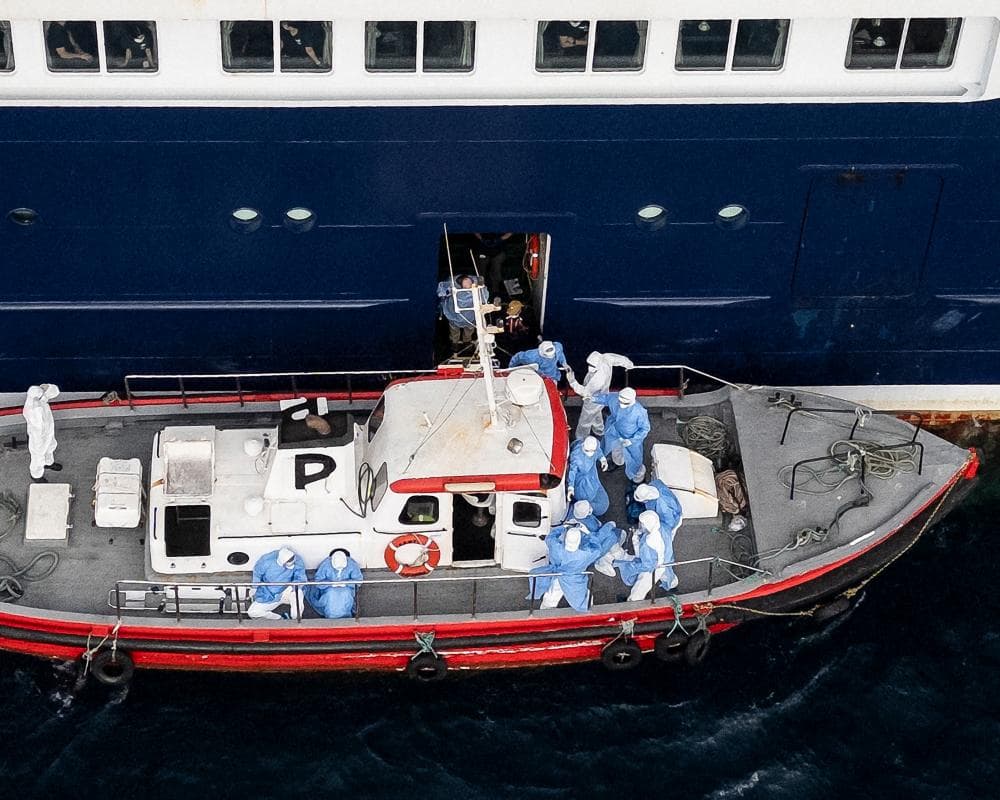
Spain’s head of civil protection, Virginia Barcones, provided details at a press conference in Madrid about what those on board the cruise ship can expect after arriving in the Canary Islands at around midday on Sunday. She said: “From the moment when we see that asymptomatic people are ready to be evacuated from our country, there will be a quick process. They will not leave the boat until the plane is there to take them to their countries. Once they leave the boat, they will be taken by road, it’s about a 10-minute drive.” Barcones added: “Mechanisms are being put together, but they will be completely isolated from the public.
Fernando Clavijo, the regional president of the Canaries, said he persuaded the central government not to allow the MV Hondius to dock in Tenerife. Clavijo had objected over the boat’s arrival, saying it could threaten public health in the archipelago, and had demanded a meeting with the prime minister, Pedro Sánchez.
After a meeting between Pope Leo and US secretary of state Marco Rubio earlier today, the Vatican said the pair “renewed the shared commitment” for good relations between the US and the Vatican.
Authorities around the world are racing to trace dozens of passengers who disembarked from the cruise ship at the centre of a deadly hantavirus outbreak before isolation measures were implemented, writes Rory Carroll and Sam Jones.
It emerged for the first time on Thursday that at least 29 passengers of 12 nationalities left the MV Hondius on 24 April after the first fatality, prompting a scramble to identify and track their movements since then.
However, the World Health Organization ruled out any Covid-scale crisis. “This is not the start of an epidemic. This is not the start of a pandemic. This is not Covid,” Dr Maria Van Kerkhove, the agency’s director for epidemic and pandemic preparedness and prevention, told reporters.
The WHO said that five of the eight suspected cases linked to the ship had been confirmed and that other cases may be identified.
“Given the incubation period of the Andes virus, which can be up to six weeks, it’s possible that more cases may be reported,” the organisation’s director-general, Tedros Adhanom Ghebreyesus, told a news conference. “While this is a serious incident, WHO assesses the public health risk low.”
Experts from the World Health Organization said at a press briefing on Thursday that the wider public health threat from the hantavirus outbreak linked to the cruise ship MV Hondius remained low.
Away from the hantavirus cases for the moment. European Union leaders are preparing for potential talks with Russian president Vladimir Putin, the Financial Times reported on Thursday, citing a senior official.
European Council president António Costa said he saw “potential” for the EU to negotiate with Putin and said the bloc had the backing of Ukrainian president Volodymyr Zelenskiy to do so, according to the report.
Two Britons who were medically evacuated are improving, global health officials said.
A British passenger, understood to be a 69-year-old man, was taken to South Africa on April 27 and is receiving care at a private health facility in Sandton, Johannesburg.
Another Briton, Martin Anstee, 56, was taken off the MV Hondius on Wednesday and flown to the Netherlands to receive specialist medical care.
Dr Maria Van Kerkhove, from the World Health Organisation (WHO), said two patients, known to include a Briton, remain in hospital in the Netherlands, and another Briton is in intensive care in South Africa.
She told a WHO press briefing: “I am very happy to say the patient in South Africa is doing better, and the two patients in the Netherlands we hear are stable. So that is actually very good news.”
The Irish government will do everything possible to make sure Irish citizens on a hantavirus-hit cruise ship get home safely, Ireland’s premier said.
Tour operator Oceanwide Expeditions said two Irish nationals are on board the MV Hondius, which is at the centre of an outbreak of the disease.
Speaking to reporters on Thursday, taoiseach Micheal Martin said health authorities are “working actively” to bring the Irish citizens home.
Asked if they will have to quarantine he said: “Health Service Executive and public health protocols will apply. Obviously, quarantine and isolation will be part of that.”
Spain’s head of civil protection, Virginia Barcones, provided details at a press conference in Madrid about what those on board the cruise ship can expect after arriving in the Canary Islands at around midday on Sunday.
She said: “From the moment when we see that asymptomatic people are ready to be evacuated from our country, there will be a quick process,” she says.
“They will not leave the boat until the plane is there to take them to their countries. Once they leave the boat, they will be taken by road, it’s about a 10-minute drive.”
Barcones added: “Mechanisms are being put together, but they will be completely isolated from the public.
“They will be taken to an isolated fenced off place, they will be in isolated vehicles, they will reach an area of the airport that will be completely isolated.
“There is no possibility of contact.”
Updated
That’s all from me, Jakub Krupa, for today, but I am leaving you with Nadeem Badshah who will keep you up to date with the latest news from around Europe.
in Madrid
The ship is due to anchor off the port of Granadilla in Tenerife on Sunday.
EU nations are expected to begin evacuating their citizens the following day.
As the Spanish health minister explained, “passengers will be evaluated on board the ship and will only disembark for transfer or repatriation with protective equipment, a specific health worker, and without contact with the population.”

As explained earlier, the current plan – that Clavijo fought for – is for the virus-hit cruise ship to go to Canary Islands, but not dock there, and merely remain at anchor.
The passengers will be allowed to leave it by boat only when their onwards transfers – to isolation or abroad – are ready so there is no risk to the local population (15:17, 15:48).
in Madrid
Back to the virus-hit cruise, Fernando Clavijo, the regional president of the Canaries, has said he persuaded the central government not to allow the MV Hondius to dock in Tenerife.
Clavijo had objected over the boat’s arrival, saying it could threaten public health in the archipelago, and had demanded a meeting with the prime minister, Pedro Sánchez.
He eventually got a meeting today with Spain’s health minister, Mónica García, who told him the boat would remain at anchor.
Here’s what he’s just posted on X:
“Collaboration can only happen with information, accuracy, and respect for the Canary Islands. Today I reiterated to the State our opposition to the cruise ship docking in the Canary Islands. We have succeeded in getting the national government to accept the proposal put forward by the islands that the ship not dock under any circumstances and remain anchored until the passengers have disembarked, ensuring all safety guarantees for the people of the Canary Islands and for those traveling on board.”
We also have a bit of an update from Hungary’s incoming prime minister Péter Magyar’s after he met with Italy’s Giorgia Meloni.
Their meeting also had the potential to be a bit awkward given Meloni’s vocal support for the outgoing prime minister, Viktor Orbán, but it looks like they got along just fine.
Magyar, who is becoming a bit of a social media sensation, walked into Palazzo Chigi with a cheery “Buongiorno a tutti” (“Good morning all”) as we can tell from a short video of his visit.
(I know this is not the most important thing here, but note the classic Italian hit his team chose to illustrate the visit with, which also – somewhat randomly – happens to also be a personal favourite of the Czech prime minister, Andrej Babiš.)
In their respective statements after their talks, Magyar said it was a “constructive” meeting which showed that “Italy and Hungary are closely aligned on many issues – from determined action against illegal migration, to the EU accession of the Western Balkans, and the strengthening of member states’ competitiveness.”
He also made an oddly specific reference to a Hungarian logistics hub in the Italian port city of Trieste, which he said he hoped to see completed as early as possible.
For her part, Meloni issued a courteous statement saying they “exchanged views” on key issues – competitiveness, migration and international crises – and that the bilateral relations between Italy and Hungary continue to be “strong.”
Sadly, her version of the video doesn’t include the same catchy Italian song (boo).
Magyar will be inaugurated in Budapest this Saturday, ending 16-year rule of Orbán, with a celebratory public event planned to usher the new era – and an EU flag expected to return to the country’s (stunning) parliament building.
Meanwhile, we have a bit more on the meeting between Pope Leo and US secretary of state Marco Rubio earlier today, with the Vatican saying the pair “renewed the shared commitment” for good relations between the US and the Vatican.
The US embassy to the Holy See said on X that Leo and Rubio had discussed “topics of mutual interest in the western Hemisphere” and “their shared commitment to promoting peace and human dignity.”
It was very notable that the WHO was keen to strike a reassuring tone in this press conference: yes, the outbreak on the ship is a serious public health situation and needs to be cautiously managed given its characteristics, but it remains mostly contained and the overall risk to the general public remains low as its transmission works very differently to Covid.
It was clear that the main point we were meant to take from this briefing is that, in the WHO’s view, the situation is nothing like the beginning of the Covid pandemic in 2020.
Well, let’s hope they’re right.
As the press conference wraps up, here is a summary of the key points:
World Health Organization experts stressed the hantavirus cruise outbreak was “not the start of Covid pandemic” (14:38, 15:44) as they pointed several differences between the two viruses and insisted the public health risk remained low (15:24, 16:17).
There are currently eight cases, with three people dead (15:20), but the situation is believed to be largely contained to the cruise ship with expansive public health operation under way to minimise risk of further transmission.
“We do not anticipate large epidemic,” the WHO’s senior expert said (15:40).
The new virus needs “close and prolonged” contact for transmission, such as among household members, intimate partners, and people providing medical care (15:20).
The incubation period of virus is expected to be “up to six weeks,” with WHO noting that more cases are “possible” (15:23)
The first confirmed case is believed to be linked to a birdwatching trip in Argentina, Chile and Uruguay (15:28).
Updated
WHO’s Maria Van Kerkhove is very clear though on the scale, as she repeats – time and time again – that the overall risk remains low.
“I do want to reiterate contextually what we’re talking about. The risk to the general public is low.”
WHO’s Anaïs Legand says in previous outbreaks a “high” mortality rate associated with the hantavirus was observed, as she talks up the importance of early supportive and intensive care to address the issue as early as possible.
“It is very important that any patient can be admitted to a safe and adequately equipped [space] with trained staff to ensure that patients can receive the level of care that is needed, in case they present severe presentation and deteriorate,” she says.
WHO’s Anaïs Legand says that the incubation of the virus takes up to six weeks, and during that time contact could be potentially exposed.
She says people need to monitor their health for any sign of symptoms.
But Maria Van Kerkhove adds that doesn’t necessarily mean people necessarily have to be in isolation for that long, and it depends on specific exposure.
Updated
The WHO also insists they are working on further sequencing of the virus, involving relevant experts from Argentina, and so far nothing unusual popped up.
“But that’s why we bring together the best minds to be able to do that,” WHO’s Maria Van Kerkhove says.
The WHO experts get asked about how long it takes to test for the new hantavirus.
They say the countries involved are scaling up to “ensure the adequate reagents” are available, but note “this is not a very common virus.”
But with the reagents available, the PCR test (brrrrr, I didn’t miss having to type this phrase) can be performed “in a matter of hours.”
“I can assure you that everybody that is involved with this is just as eager to do the testing as quickly as they can, as long as they have the right materials,” they add.
Updated
WHO’s head of department for Health Emergency Alert and Response Operations, Abdirahman Sheikh Mahamud, sends a further signal to reassure the public.
He says the system is “dealing” with the issue, and dismisses suggestion that some authorities – the question was about the US – should be much more aggressive in informing the public.
“This is a limited epidemic confined to a cruise ship, so [the] idea of sending messages across the world and panicking everyone is not required,” he says.
He insists all the right actions are being taken.
A reminder that you can follow along the WHO briefing with us here:
WHO experts got asked about the role of the US in all of it, given the country has citizens on the ship, but no longer considers itself a part of the body.
Abdirahman Sheikh Mahamud says they have been exchanging information well so far, with good flow of information.
WHO’s chief Tedros Adhanom Ghebreyesus later adds on to this, as he says:
“Viruses don’t care about our politics and they don’t care about our borders, and they don’t care about … all the excuses that we may have, so I hope this could be a good lesson for the whole world, because solidarity is our best immunity.”
Updated
So far, this is a clear attempt by the WHO to reassure the public that despite growing public scrutiny of the virus and understandable concerns about another global pandemic six years on from Covid, it is in fact a very different situation.
The experts are very clear that it is a completely different virus, with different forms of transmission, and while the number of cases may rise a bit, they do not expect the situation to get much worse and lead to a large epidemic.
They insist that it remains a largely contained outbreak on the ship and lots of public health measures are being implemented to stop further onwards transmission.
Updated
in Madrid
Meanwhile, Spain’s national health ministry has moved to reassure the regional government of the Canary islands that the MV Hondius will present no threat to public health when it arrives in Tenerife at around midday on Sunday.
The president of the archipelago, Fernando Clavijo, has voiced concerns over the central government’s decision to allow the ship into the Canaries, and had asked for a meeting with the prime minister, Pedro Sánchez. EU nations are expected to begin evacuating their citizens from the Canaries from Monday 11 May.
Clavijo met with the Spain’s health minister, Mónica García, on Thursday.
“In a public health situation such as this one, coordination and trust between different institutions are part of the health response,” she posted on social media after the meeting.
She said that the MV Hondius would remain at anchor and would not dock in port in Tenerife.
“Its stay in Canary island waters will be the minimum necessary from a health and logistical point of view, as planned from the beginning and as established by the protocols,” García added. “Passengers will be evaluated on board the ship and will only disembark for transfer or repatriation with protective equipment, with a specific health worker, and without coming into contact with the population.”
The 14 Spanish nationals aboard the ship – including one crew member – are set to be transferred from Tenerife to the Gómez Ulla military hospital in southwest Madrid.
Spain’s opposition conservative People’s party (PP) has criticised the socialist-led government for mixed messaging over the quarantine procedure for the 14 people after the defence ministry said it would be voluntary, while García said there were legal tools to make it mandatory.
After the PP suggested there was “no one at the wheel”, García hit back, saying:
“In the face of political noise that aims to sow mistrust, we won’t let ourselves be sidetracked for a minute from the task of working with the finest professionals and resources to protect public health.”
Meanwhile, let’s bring you a bit more on that dispute between Madrid and the Canary Islands government from our correspondent Sam Jones.
WHO expert Anaïs Legand says what makes this spread unusual is that it includes “a transmission on a boat,” which is “a very specific environment.”
“There is no indication to date that there is something further unusual, but obviously the fact that it happened in a cruise ship, with people from different nationalities, is something, that we haven’t seen before.”
Maria Van Kerkhove, WHO’s Acting Director of the Department of Epidemic and Pandemic Threat, goes further in her reassurances.
She says:
“This is not coronavirus. This is a very different virus. We know this virus, hantaviruses have been around for quite a while. … But I want to be unequivocal here: this is not SARS-CoV-2; this is not the start of a Covid pandemic.”
She says it’s an small outbreak in a confined area.
“We completely understand why these questions are coming, … but this is not the same situation we were in six years ago. …
It doesn’t spread the same way, like coronaviruses do. It’s very different. It’s that close, intimate contact that we’ve seen. And most hantaviruses don’t transmit between people at all.”
She stresses that lots of actions are being taken to prevent any onward spread.
Asked whether it should be classified as epidemic or pandemic, WHO’s Abdirahman Sheikh Mahamud says we are currently talking about “a cluster in a confined space with close contact.”
He says public health measures can break the chain of transmission and “this doesn’t need to be a large epidemic.”
“We don’t anticipate a large epidemic with experience our member states have and the actions they have taken. We believe that this will not lead to subsequent chain of transmission.”
Maria Van Kerkhove says there are currently no further symptomatic cases on board of the cruise, “which is a good sign, but of course, there is a long incubation period of the Andes virus.”
She says that there is regular disinfection of the rooms, with people contained to their cabins, and all leaving are told to wear a medical mask.
She sums up the current situation:
“There are the two patients that are in hospital in the Netherlands, and there’s a patient in ICU in South Africa – and I am very happy to say the patient in South Africa is doing better – and the two patients in the Netherlands, who are stable.”
She says the virus spreads “very, very differently” to Covid and influenza and requires much more prolonged contact.
“So this is not Covid; this is not influenza. It spreads very very differently. So there are different precautions that people are taking.”
WHO’s acting director for epidemic and pandemic management, Maria Van Kerkhove, says the WHO is “getting reports of suspect or potential suspect cases” and following them up with the relevant national authorities, pulling together all available expertise.
The first question is from the Spanish media, asking about the clear division between the Spanish and regional authorities in the Canary Islands.
WHO’s head of department for Health Emergency Alert and Response Operations, Abdirahman Sheikh Mahamud, he says he understands the concerns, but insists the risk remains “minimal.”
He says there is a “clear guidance” to plan, and the process of disembarkation “will not add additional risk.”
WHO chief Tedros Adhanom Ghebreyesus adds that the WHO made a formal request to Spain to accept the cruise under the international health regulations.
“I hope, those who have concerns at the Canary Island, will understand and support, and cooperate with the federal government. Of course we understand their concerns. But as I said in my statement, based on the risk assessment that we have, the risk to the people in the Canary Island is actually low.”
Updated
WHO chief says he is in touch with the ship’s captain regularly, including this morning.
“He told me morale has improved significantly since the ship started moving again. I thank him for everything he has done to protect those under his duty of care.”
And we’re moving to a Q&A.
WHO chief says the original pair affected is believed to have travelled through Argentina, Chile and Uruguay on a birdwatching trip, “which included visits to sites where the species of rat that’s known to carry Andes virus was present.”
WHO is working with Argentina to understand their movements and what needs to be done.
WHO chief says he asked Spain to accept the ship, and he thanks the country’s PM, Pedro Sánchez, for his help.
“The ship is now sailing for the Canary Islands, and we are confident in the capacity of Spain to manage this risk.”
He says the ship operator has been given detailed guidance how to manage the situation, with WHO and Dutch doctors now on board to help.
He says citizens of 12 countries earlier disembarked the ship in Saint Helena, and their authorities were informed about the potential risk and to trace their contacts.
These countries are: Canada, Denmark, Germany, the Netherlands, New Zealand, Saint Kitts and Nevis, Singapore, Sweden, Switzerland, Turkey, the United Kingdom, and the United States of America.
WHO chief Tedros Adhanom Ghebreyesus says:
While this is a serious incident, WHO assesses the public health risk as low.
WHO chief goes through the main reported and confirmed cases so far.
He says the first case was reported in a man who developed symptoms on the 6 April and died on 11 of April. No samples were taken at the time, as hantavirus was not suspected.
His wife went ashore when the ship docked at the island of Saint Helena, also symptomatic, and she deteriorated during a flight to Johannesburg and died on 26 April.
The third victim was a woman on the ship who reported symptoms on 28 April and died on 2 May.
Another case, a man who reported to the ship’s doctor on 24 April, was evacuated the next days and remains in intensive care.
Discussing the other confirmed cases, he says:
“WHO is aware of reports of other people with symptoms who may have had contact with one of the passengers. In each case, we are in close contact with the relevant authorities. Given the incubation period of the Andes virus, which can be up to six weeks, it’s possible that more cases may be reported.”
Updated
WHO’s Tedros Adhanom Ghebreyesus is speaking now.
He says the WHO was notified about the virus by the United Kingdom last Saturday after a cluster was reported on a Dutch flagged cruise ship, MV Hondius.
Eight cases – five confirmed, three suspected – have been reported, with three people confirmed dead.
He says people are usually infected through contact with infected rodents or their urine, droppings or saliva.
“The species of hantavirus involved in this case is the Andes virus, which is found in Latin America and is the only species known to be capable of limited transmission between humans.”
He says that in previous outbreaks, transmission between people has been associated with “close and prolonged” contact, such as among household members, intimate partners, and people providing medical care.
“That appears to be the case in the current situation,” he adds.
You can watch along below, but we will bring you all the key lines here.
Meanwhile, it looks like the Canary Islands government is doubling down on its refusal to allow the affected cruise dock there and insisting on maximum security measures to be adopted for the operation.
It will only just “anchor” in the archipelago’s waters, with the passengers set to be evacuated by boats for transfer or repatriation “without contact with the [local] population,” El País and ABC reported in the last hour.
El País also said that local port workers previously also warned they could go on strike and block the port if the cruiser was to be allowed to dock there.
We are expecting to hear from the director-general of the World Health Organization, Tedros Adhanom Ghebreyesus, shortly as he is expected to give us an update on the hantavirus situation.
We will bring you his press conference live in video and text.
Meanwhile, we are getting first details from Rubio’s meeting with Pope Leo at the Vatican.
The US state department said in a statement quoted by AP that the pair discussed “efforts to achieve a durable peace in the Middle East,” which obviously are at the heart of the disagreement between Donald Trump and Pope Leo.
The meeting showed “strong” relationship between the US and the Vatican, it added.
A US official further briefed reporters that the conversations were “friendly and constructive,” with AFP noting that Rubio – a devout Catholic who has sought to play down the rift – met both the pontiff and Vatican secretary of state (and de facto chief diplomat) Pietro Parolin.
Updated
Airlines that cancel flights because of fuel shortages this summer will still have to compensate passengers under European law, the EU transport commissioner has said.
Apostolos Tzitzikostas told the Financial Times that jet fuel prices or shortages do not meet the criteria that protect EU airlines from passenger claims.
“The price of jet fuel is the reason why we have cancellations of flights and if they cancel flights without extraordinary circumstances – jet fuel prices are not extraordinary circumstances – they will have to reimburse the people,” the commissioner said.
Although the EU law remains in place in the UK post-Brexit, Keir Starmer’s government is free to take a different position. Last week, it emerged that penalties for airlines that cancel UK flights because of jet fuel shortages have been eased.
Ryanair, the biggest airline in Europe, said this week it would not be cancelling summer flights because it had hedged its fuel contracts before the Iran war broke out.
However, other airlines have cancelled flights, including Germany’s Lufthansa and Ireland’s Aer Lingus.
Tzitzikostas’s remarks came as the boss of a large airline in Asia said the fuel crisis was worse than the Covid pandemic, when planes were grounded amid global travel bans.
“I thought I’d seen it all with Covid … but having seen jet fuel go up almost three times – this is much worse,” Tony Fernandes, the chief executive of AirAsia, told the Financial Times.
Meanwhile, US secretary of state Marco Rubio has now left the Vatican after meeting Pope Leo after some two hours there.
He met initially with the pontiff before sitting down with senior Vatican officials, including top diplomat Italian cardinal Pietro Parolin, Reuters reported.
The Vatican and the US state department did not provide any immediate details about the talks.
I will bring you more if/when we get it.
“Considerable progress” was made in crunch talks with MEPs to finalise the US trade deal that has been on the table since last summer, Maroš Šefčovič, the EU trade commmissioner has said after six hours of talks last night.
The so-called “trilogue talks”, involving the European Commission, the European Parliament and representatives of member states, are the final stage in the ratification system in the bloc, a process that is testing Donald Trump’s patience.
Although they failed to agree on amendments sought by MEPs, both the trade committee chair Bernd Lange and Šefčovič are indicating a compromise is not far off.
Talks last six hours, double the time scheduled for negotiations.
“This significant investment of time and effort suggests that we are making considerable progress and have already achieved a lot – although, of course, nothing is agreed until everything is agreed,” said Šefčovič.
He said in a post on LinkedIn that he had three objectives:
“To demonstrate that the EU is walking the talk and honouring its commitments”
To secure a result that fully respects the EU-US Joint Statement.
To preserve the interests of EU stakeholders, including by equipping the Commission with the instruments necessary to ensure that the EU-US Joint Statement is faithfully implemented by both sides.”
Last Friday Trump threatened to hike tariffs on EU cars this week, in contravention of the trade deal, in protest against the lengthy delays on the EU side.
The delays were partly a response to his foreign policy, with the European parliament twice pausing ratification process over his threat to increase tariffs in January, and then his threat to take control of Greenland.
MEPs are seeking three amendments to the implementation Brussels-side - including a sunset clause which will end the deal in March 2028 unless renewed, a sunrise clause ensuring the deal will come into force on the EU side if the US respects its commitments and a suspension clause.
Speaking at the European Commission’s midday briefing, the executive’s health spokesperson Eva Hrncirova insisted that the risk to Europeans posed by the new hantarivus remained “low.”
“According to the evidence that we have at the moment, the risk for the public in Europe, the risk for the Europeans is low. Health of the citizens in Europe is our absolute priority,” she said.
She stressed there was “no cause for concern,” and the EU was working closely with the World Health Organization and the European Centre for Disease Prevention and Control to monitor the situation.
Meanwhile in Brussels, the EU said it would not leave Kyiv after Russia warned of a possible retaliatory strike on the Ukrainian capital and urged foreign organisations to evacuate.
“As to us, the EU, we will not change our posture or presence in Kyiv. Russian attacks are... unfortunately, a daily reality in Kyiv and elsewhere in Ukraine,” EU foreign affairs spokesman Anouar El Anouni said in comments reported by AFP.
Russia’s public threats to attack Kyiv are part of its reckless escalatory tactics.
The European Union’s diplomatic mission in Kyiv was damaged in August last year after Russian missiles struck close to the building.
Meanwhile, Hungary’s incoming prime minister Péter Magyar has arrived for talks at Palazzo Chigi in Rome, where he is due to meet with Italy’s prime minister Giorgia Meloni.
Since he is not the Hungarian PM yet – he will take his role this weekend – he was officially welcomed outside the Palazzo by a senior adviser to the Italian PM instead.
Updated
Earlier today, Pope Leo welcomed Poland’s prime minister Donald Tusk in the Vatican, and going by Tusk’s press conference afterwards, it was a good geopolitical warm up act for the big transatlantic meet with Marco Rubio.
Speaking to reporters after the meeting, Tusk said the pair discussed a potential papal visit to Poland signalling 2028 as an option under consideration, but that a big chunk of their conversation focused on international affairs.
“Of course, the conversation was about Ukraine, … about the international order, the armament of Poland and Europe, and the armament of Germany. Well, you know how many hot topics there are.
As you know, I will also have a meeting with prime minister Meloni today and secretary of state Rubio is here too; he will have a meeting with the Holy Father right after me. So this also shows how much is happening and how difficult the issues are to discuss and solve.”
Later today, Tusk will also meet Italy’s Giorgia Meloni, who is also expected to welcome Hungary’s incoming prime minister Péter Magyar at some point today – and will see Rubio tomorrow.
Updated
in Palermo
Meanwhile, the US secretary of state, Marco Rubio, is to meet Pope Leo at the Vatican on Thursday in an effort to ease tensions after Donald Trump’s repeated criticisms of the first North American pontiff.
Amid unprecedented strain on relations between the Holy See and Washington, Rubio is expected to meet Leo at the Apostolic Palace in the morning, before holding a series of meetings with the Italian government.
Trump on Tuesday accused the pope of supporting nuclear weapons and “endangering a lot of Catholics’’ with his stance against the Iran war, in the latest attack by the US president on the pontiff.
On Wednesday, Leo responded:
“If anyone wants to criticise me for proclaiming the gospel, let them do so with the truth: the church has spoken out against all nuclear weapons for years, there is no doubt about that. I simply hope to be listened to because of the value of God’s word.”
Rubio downplayed the rift between Trump and Leo and told reporters at the White House on Tuesday that the president’s recent criticism of the pontiff was rooted in his opposition to Iran potentially obtaining a nuclear weapon, which could be used against millions of Catholics around the world.
Trump “doesn’t understand why anyone – leave aside the pope – would think that it’s a good idea for Iran to ever have a nuclear weapon,” Rubio said.
Relations between the Vatican and Washington have never been so fraught. In April, the US president lashed out at Leo over the pope’s criticism of the war in Iran, branding him “weak on crime” and “terrible on foreign policy”, and claiming he had only been elected pontiff because Trump himself occupied the White House. Trump later shared – before deleting – an AI-generated image depicting himself as a Christ-like figure.
Rubio’s likely goal is to try to smooth over Trump’s insults and repair increasingly damaged ties between the US and the Vatican. According to several analysts, the secretary of state is expected to defend Washington’s rationale for launching the war in Iran, while carefully avoiding a direct clash with the church’s position.
Rubio will also meet the Italian prime minister, Giorgia Meloni, on Friday as relations between Rome and Washington have also deteriorated.
At a separate press conference with Latvia’s defence and interior ministers, we are told broadly similar things that the incident is still being investigated.
I will return to this topic if we get something substantially new.
Meanwhile, Romania has just reported a brief violation of its airspace by drones taking part in a Russian attack on civilian and infrastructure targets in Ukraine last night.
The drone was monitored by two F-16 patrolling aircraft and tracked as it crossed into Romania’s airspace in the Chilia area, the country’s defence ministry said in a statement.
The ministry “firmly condemned the irresponsible actions of the Russian Federation, which contravene the norms of international law and pose risks to regional security and stability in the Black Sea.”
Flanked by senior police and army officials, the Latvian prime minister Evika Siliņa is just giving a brief update after this morning’s crisis cabinet meeting in Riga.
She says there is still no clarity on who directed the drones reported in the Latvian airspace, and this continues to be investigated.
She sticks to key lines that as she stresses that the incident is a consequence of Russia’s continuing war on Ukraine, and Latvia needs to be prepared for similar situations as it continues to support Ukraine.
She also warns about any disinformation attempts coming from Russia in response to the incident.
Siliņa also talks about some practical concerns about the way Latvia’s emergency alert system worked last night.
Meanwhile, the European Parliament has said it will work “expeditiously” to ensure the “spirit and the letter” of the EU’s trade deal with Donald Trump is sealed, after representatives failed to reach a deal in ratification talks with member states last night.
No deal is expected now until 19 May when talks with MEPs resume.
A timetable in Europe’s democratic process risks invoking the ire of Trump who on Friday said he would increase car tariffs from 15% to 25% because the EU were taking to long to implement its side of the Turnberry deal.
The parliamentary delegation in the so-called “trilogue” talks which also involved the European Commission were led by MEP Bernd Lange, chair of the trade committee.
Lange said in a statement last night:
“We have just concluded a constructive second trilogue during which we made good progress on the issue of the safeguard mechanism and the review and evaluation of the main regulation, but there is still some way to go.
We will continue to work expeditiously and responsibly on the two legislative proposals to ensure that the letter and the spirit of the Turnberry Deal are honoured, in full respect of our democratic norms, procedures and timelines. The next trilogue will take place on 19 May in Strasbourg.
We remain more committed than ever to advance and defend Parliament’s mandate so as to provide additional guarantees that will benefit citizens and companies in both the EU and the US.”
The 19 May date for next talks will be seen as a positive step however as yesterday Lange’s team were expecting the next date could be as far away as June.
Lange’s committee were looking for three key amendments to the deal hashed out at Trump’s golf course last July.
We should get more on the Latvian incident before long, as we are expecting to hear from the government after this morning’s emergency cabinet meeting.
Crucially, the crash site of the second drone reported within Latvian airspace is yet to be discovered, so let’s see if we hear more on this.
I will keep an eye on this.
Updated
Latvia is investigating two drones which entered its airspace from Russian territory overnight and crashed in eastern part of the country near an empty oil storage facility.
Four empty oil tanks were reported damaged, with minor smouldering reported in one of the tanks. The local public broadcaster captured a drone flying in the area on their camera.
Latvian prime minister Evika Siliņa convened a crisis management meeting for 10am local time. She earlier said she was “in constant communication” with relevant ministers and state institutions.
“After the incident concludes, I expect reports from the responsible ministers on what happened,” she said.
The investigation is still in very early stages, but the drones might have been Ukrainian units that lost their way due to signal jamming, defence minister Andris Sprūds said.
This would not be the first time that a lost Ukrainian drone attacking Russia’s oil terminals loses its way and ends up in a neighbouring Nato country, with similar incidents involving Estonia and Lithuania.
“As long as Russia’s aggression in Ukraine continues, the recurrence of such incidents when a foreign unmanned aircraft enters or approaches Latvian airspace is possible,” the Latvian army said in a statement.
The air warning in the country has now been lifted, but some flight restrictions remain in place.
Elsewhere, I will also keep an eye at US secretary of state Marco Rubio’s visit to see Pope Leo in the Vatican amid a bitter war of words between the US president, Donald Trump, and the pontiff. Before that, Leo – who will mark one year in office tomorrow – will also meet with Poland’s Donald Tusk.
Meanwhile, Hungary’s incoming prime minister Péter Magyar is also expected nearby, as he is due to meet with Italy’s Giorgia Meloni, formerly a close ally of Magyar’s arch-rival Viktor Orbán.
Elsewhere, I am expecting some developments in Bulgaria with Rumen Radev likely to be asked to form the next government, and obviously will continue keeping tabs on the hantavirus-hit cruise that electrified the public opinion worldwide.
Lots to cover.
It’s Thursday, 7 May 2026, it’s Jakub Krupa here, and this is Europe Live.
Good morning.