Loading...
Please wait for a bit
Please wait for a bit
Click any word to translate
Original article by Jakub Krupa
… and on that note, it’s a wrap for today!
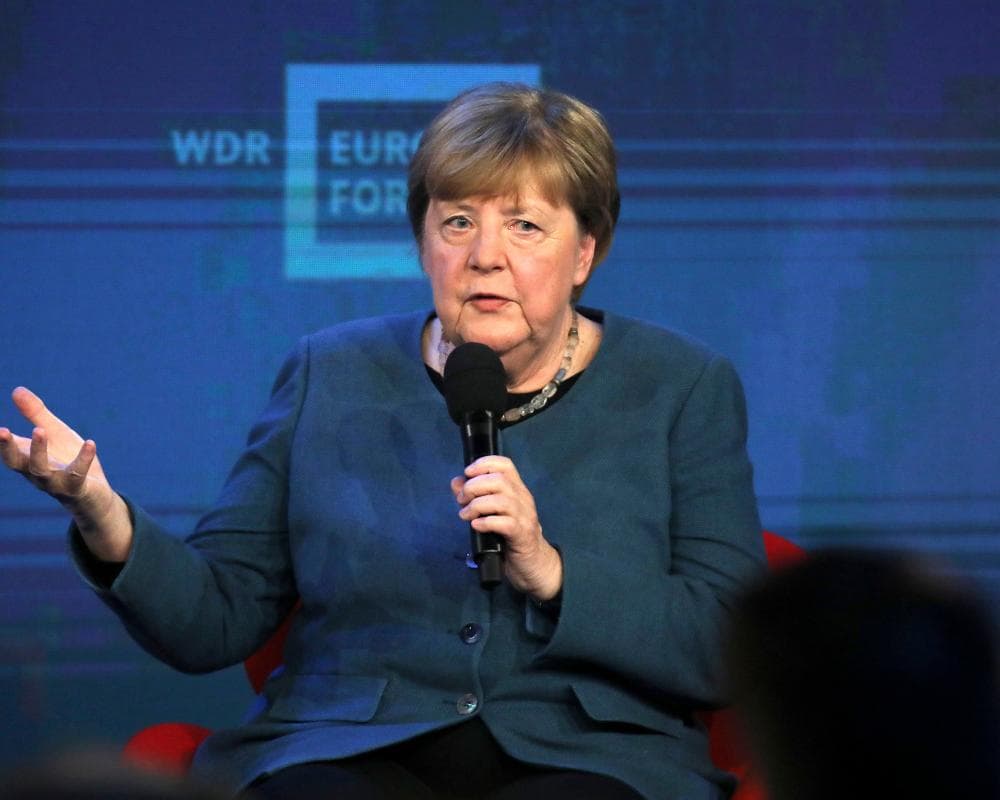
Former German chancellor Angela Merkel said the European Union was “not making sufficient use of its diplomatic potential,” as she supported the bloc’smilitary support for Ukraine, but suggested Europe should not cede the peace talks to US president Donald Trump and get involved diplomatically (18:09).
Her comments come after Ukrainian president Volodymyr Zelenskyy suggested last night that the time has come for Europe to pick its preferred negotiator for eventual peace talks with Russia (9:52, 11:32).
The discussion comes as experts point to Ukraine’s progress in the fight against Russia, with Moscow unable to advance significantly in recent weeks (11:10).
In other news,
Greenlandic prime minister Jens-Frederik Nielsen said the US position on Greenland has not changed after meeting with Donald Trump’s envoy to the island, Jeff Landry (16:54).
Poland has urged the US to provide clarity on its force posture in Europe amid confusion over its decision to cancel deployment of 4,000 US troops to Poland (14:03, 16:10).
The hantavirus-hit cruise ship MV Hondius has arrived at the Port of Rotterdam, where it will be disinfected and its crew members will go into quarantine (10:00, 10:32).
Latvian opposition leader Andris Kulbergs has been designated to try form a new government after Evika Siliņa’s resignation last week after a recent drone incursion incident (13:28).
If you have any tips, comments or suggestions, email me at jakub.krupa@theguardian.com.
I am also on Bluesky at @jakubkrupa.bsky.social and on X at @jakubkrupa.
Meanwhile, we seems to have a late addition to our opening debate on whether (and how) the EU should engage with Russia on Ukraine, with former German chancellor, Angela Merkel, saying the bloc is “not making sufficient use of its diplomatic potential.”
Merkel said she finds it “absolutely right” to support Ukraine militarily, speaking to public broadcaster WDR at the Re:Publica digital conference in Berlin, AFP reported.
But she added that “diplomacy has always been the other side of the coin, even during the cold war”.
Military deterrence plus diplomatic activity – that’s what I think is important.
Merkel said she considers it “insufficient” if only Trump maintains contact with Russia, saying that “we are also someone, as Europeans”.
“Underestimating [Russian president Vladimir] Putin would be a mistake, even now. And not having any confidence in ourselves would be just as much of a mistake.”
AFP noted that Merkel, who served as Germany’s chancellor from 2005 to 2021, has since been criticised for being too soft on Russia and making Germany dependent on cheap Russian energy sales for years.
Meanwhile, the Hungarian prime minister, Péter Magyar, said his government will start another round of talks on releasing suspended EU funds on Monday.
Magyar said he was still hoping to sign off on a political agreement about the reforms next week, getting the funds to flow by autumn.
Before then, he will be in Poland tomorrow on what will be his first foreign trip in the office, before travelling to Vienna later this week, and going to Brussels next week.
While in Poland, he will meet with Poland’s prime minister Donald Tusk and president Karol Nawrocki, and former president and Nobel Peace prize winner, Lech Wałęsa.
He will be joined by up to seven ministers from his cabinet in what is expected to be a show of renewed Polish-Hungarian cooperation after years of tricky relations under Viktor Orbán.
As we reported last month, Warsaw is helping Budapest officials behind the scenes, advising how to move quickly and get frozen EU money flowing again.
Updated
A 93-year-old Belgian former diplomat who in March year became the first person to be charged in the murder of Congolese leader Patrice Lumumba has died before he could stand trial.
The death of Étienne Davignon, an aristocrat who served as a European commissioner during a decades-long career as one of Belgium’s leading diplomats and industrialists, was confirmed by the Jacques Delors Institute thinktank, where he had served on the board.
In March, Davignon was ordered to stand trial for war crimes for alleged involvement in the extra-judicial killing of Lumumba 65 years ago, a final attempt to shed light on one of the 20th century’s most consequential political assassinations.
Lumumba, who was elected the first prime minister of the country now called the Democratic Republic of Congo upon its independence from Belgium in 1960, was ousted from power months later and killed by Belgian-backed secessionist rebels on 16 January 1961.
The murder was a dark chapter in Belgium’s colonial history and a watershed for the era’s liberation struggles in African countries.
Prosecutors said Davignon, a junior diplomat at the time, had participated in the unlawful detention or transfer of Lumumba and deprived him of his right to an impartial trial.
Davignon was also accused of involvement in the murders of two of Lumumba’s political allies, Maurice Mpolo and Joseph Okito. He had denied any wrongdoing and at the time of his death was awaiting the outcome of an appeal against the Belgian court’s decision to order him to stand trial.
Greenlandic prime minister Jens-Frederik Nielsen said the US position on Greenland has not changed after meeting with Donald Trump’s envoy to the island, Jeff Landry.
Nielsen said the meeting was “constructive,” but proved that there was “no sign … that anything has changed” in the US plans to control the territory, AFP noted.
“We clearly reiterated that the people of Greenland are not for sale and that Greenlanders have the right to self-determination. This is not a subject for negotiation,” Nielsen stressed.
Greenland’s foreign minister, Múte B. Egede, also told reporters after the meeting that the US has not given up on its aims to acquire the territory.
“We have our red line. The Americans’ starting point has not changed either,” Egede said.
In further comments reported by the Danish public broadcaster, DK, Nielsen said the meetings with the US will continue, but any closer cooperation would require the US to respect Greenland’s red lines and sovereignty first.
Landry, the governor of the US state of Louisiana, arrived in Iceland last night to attend the “Future Greenland” business conference. Reuters noted that he was not specifically invited, but the event was open for anyone to sign up.
Meanwhile, Poland continues to probe what happened with the cancelled deployment of 4,000 US troops to the country, which was pulled last week (14:03).
Well, for their part, the US insists it was not at all unexpected, despite the clear surprise of the Polish leaders.
Polish radio station RMF FM pressed the US on the matter and reported the following answer from the acting Pentagon press secretary, Joel Valdez.
“The decision to withdraw troops follows a comprehensive, multilayered process that incorporates perspectives from key leaders in EUCOM and across the chain of command. This was not an unexpected, last minute decision, and it would be false to report it as such.”
in Madrid
In other news, a court in Madrid has ordered Spain’s tax authority to pay Shakira back more than €55m after ruling that it had wrongly imposed huge fines on the Colombian singer and philanthropist because it had made mistakes over her tax status.
In a statement released on Monday, the Audiencia Nacional said it had accepted an appeal from Shakira against the fine she was handed five years ago after the Agencia Tributaria claimed she had not paid the necessary tax in Spain in 2011. At that time, the singer was in a relationship with the FC Barcelona player Gerard Piqué.
The court said the agency had failed to prove that Shakira had spent more than 183 days in Spain that year, which would have obliged her to pay personal income tax in the country.
“On the contrary, the court understands that Shakira’s stay in our country was 163 days and that the tax agency has therefore not proved that the singer had core economic interests in Spain … as set out in the terms established [by law],” the statement said.
The court ordered the tax agency to return the amounts it had fined Shakira and to pay her interest and costs.
However, it also pointed out that its decision – which can be appealed against in the supreme court – related only to the 2011 tax case.
In November 2023, the singer reached a settlement with prosecutors to avoid a trial in Barcelona over charges she had failed to pay €14.5m (£12.7m) in Spanish income tax between 2012 and 2014.
As part of the deal, she accepted the charges and a fine of 50% of the amount owed, more than €7.3m. She also accepted a further fine of €438,000 to avoid a three-year prison sentence. Shakira had previously accused Spain’s tax agency of waging “a salacious press campaign” against her and insisted she owed nothing.
In a statement issued by her lawyer after Monday’s decision, she said the court had recognised that no fraud had been committed in 2011.
“After more than eight years of enduring a brutal public shaming, orchestrated campaigns to destroy my reputation, and countless sleepless nights that ended up affecting my health and the wellbeing of my family, the Audiencia Nacional has finally set things right,” she added.
Updated
Ukraine’s foreign ministry has condemned nuclear weapons drills in Belarus, saying that deployment of tactical weapons in the country constituted an “unprecedented challenge” to global security.
“By turning Belarus into its nuclear staging ground near Nato borders, the Kremlin is de facto legitimising the proliferation of nuclear weapons worldwide and setting a dangerous precedent for other authoritarian regimes,” the ministry said in a statement.
Kyiv also urged its Western allies to tighten sanctions against Moscow and Minsk: “Such actions must face unequivocal and resolute condemnation from all states that respect the nuclear non-proliferation regime.”
Back to Ukraine, it looks like there is a political will in Kyiv and Budapest to resolve their longstanding differences on the rights of Ukraine’s ethnic Hungarian minority, which continues to pose an issue for any potential EU accession talks.
The countries’s foreign ministers issued encouraging statements today, saying they will start discussions to find a way forward, as they want to make the most of the momentum that comes with the new Hungarian government of Péter Magyar.
The previous prime minister, Viktor Orbán, repeatedly clashed with Ukraine, using it instrumentally in his failed re-election campaign and vocally opposed its plans to join the EU in the future.
AP helpfully reminds that Ukraine passed a law in 2017 that made Ukrainian the required language of study past the fifth grade, angering minorities and their home countries in the region. It was later suspended in 2023.
But Hungary’s foreign minister and deputy prime minister, Anita Orbán (no link with Viktor), said the talks between the two countries “can begin as early as tomorrow” after the latest political discussions as both sides appointed their negotiators to look into resolving these tensions.
“I trust that the dialogue will be constructive and productive, and that the negotiations will soon bring tangible progress for the Hungarian community in [Zakarpattia region],” she said.
Ukraine’s Andrii Sybiha struck a similarly hopeful tone, saying Ukraine “is ready to open a new, mutually beneficial chapter in Ukrainian-Hungarian relations without delay.”
“We agreed to hold a round of Hungarian – Ukrainian expert-level consultations as early as this week to find practical and robust solutions for the Hungarian minority in the Zakarpattia region, which will benefit both countries and our bilateral relations,” he said.
Meanwhile, Poland’s prime minister Donald Tusk said that “the task of all of us without exception is to ensure that transatlantic cooperation, despite political differences, survives this difficult time.”
His comments come amid confusion over the US decision to cancel deployment of 4,000 US troops to Poland as part of a broader reshuffle in its military presence in Europe, which prompted fears over decreased US involvement in the region (Europe Live, Friday).
Speaking at a ceremony marking a new contract between Poland and US military manufacturers, Tusk said that “transatlantic unity is not only a guarantee of security and peace here, on Polish soil, but it is also a guarantee of the international order, increasingly exposed to various risks, which protests our globe from a global conflict.”
“The task of all of us, here in Poland, Europe, on the other side of the Atlantic in the US, in Canada … the task of all of us – without exception – is to ensure that, regardless of various political variables, transatlantic cooperation survives this difficult period.”
Tusk warned that “there is no alternative to Polish-American, European-American friendship,” as he hailed Poland’s high defence spending, including on contracts with US companies.
But he said that Poland “will always expect the same as what we present to our closest allies: respect and predictability.”
Responding to the planned adjustments to US security strategy, he said:
“It is not Poland’s role to review [other country’s] new strategies or a different approach of diplomacy, but our role is to remind you that you have a friend here. You have only friends here on the Vistula, you have the most loyal ally. It is worth remembering this, because America will find no better ally anywhere.”
Poland’s defence minister, Władysław Kosiniak-Kamysz, went even further, stressing the Polish-American links, but also the need for “an honest conversation” between allies about the potential consequences of the US changes for Poland.
“We understand that a reorganisation of the presence of American troops in Europe is taking place, but this reorganisation cannot take place at the expense of the United States’ largest ally in Europe, Poland,” he said.
“It is difficult to be surprised by those whom we trust the most … I believe that all misunderstandings, or media noise [about deployments], will be explained in the coming days,” he said.
Over in Latvia, opposition leader Andris Kulbergs has been designated to try form a new government after Evika Siliņa’s resignation last week after a drone incursion incident.
Kulbergs was tapped by the country’s president, Edgars Rinkēvičs, during the pair’s meeting on Saturday, and given 10 days to form a new cabinet.
On Monday, Kulbergs told Latvian media he was looking at picking non-political appointees for key jobs in a bid to form a technical interim government.
The new government will still need to be approved by the parliament, and would only lead the country until the parliamentary election in October.
Updated
Elsewhere, we are getting a line from Rome, with the Italian foreign ministry confirming that rescuers have located the bodies of four Italian divers believed to be deep inside an underwater cave in a Maldive atoll, AP reported.
Five Italian divers are believed to have died while exploring a cave at a depth of about 50 meters in Vaavu Atoll on Thursday, according to Italy’s foreign ministry, way below the recreational diving limit of 30 meters.
The body of one Italian – a diving instructor – was found earlier outside the cave, AP said. Last week, a Maldivian military diver has died during a high-risk operation to find their bodies.
Italian newspaper La Repubblica reported that the first attempt to recover the bodies will take place on Tuesday. Corriere della Sera said the bodies were found by a group of Finnish expert divers involved in the operation.
The European Commission has been asked about its response to the renewed talk about Britain’s potential future attempt to rejoin the European Union – but chose not to get involved.
The question comes as the ruling Labour Party has reopened its debate on the EU membership after a presumed leadership contender, former health minister Wes Streeting, said the country should eventually seek to regain its place in the EU.
The commission’s chief spokesperson, Paula Pinho, said she would not want to comment “on the situation in Britain” and “the ongoing discussions when it comes too Britain … or any prospects of rejoining the EU.”
She stressed that the two had “an ongoing forum” for discussing progress in bilateral relations and “how we can come close … on a number of areas,” but she cautioned against drawing any far-reaching conclusions.
“At this stage, there are discussions on closer cooperation in a number of areas, that’s where we are, and that’s what we are doing precisely in preparation for the next summit rather than speculating about big or renewed issues,” she said.
The focus remains on “sectoral discussions” addressing “the reality of the United Kingdom not being an EU member any longer.”
Asked if she could speculate on potential future terms of EU membership should the UK reapply, she declined to engage on this point.
“We are not there. If we ever are in that situation, I will gladly reply to [this question,]” she said.
Updated
Meanwhile in Italy, the country’s interior minister said that a car-ramming and stabbing attack in the northern city of Modena or the weekend cannot be dismissed as an isolated act, warning it highlights deeper challenges around integration and social distress, AP reported.
Eight people were wounded, four critically, when a 31-year-old man – an Italian citizen of Moroccan descent – drove into pedestrians on Saturday before crashing into a shop window.
Italian authorities said the suspect, identified as Salim El Koudri, attempted to flee and slightly wounded a bystander with a knife before being overpowered by passersby and detained by police, AP said. Prosecutors arrested him on charges including massacre and aggravated injury. A court ruling on whether to validate his detention was expected later Monday.
But despite ruling out terrorism, interior minister Matteo Piantedosi said investigators must still fully examine the factors behind the attack, AP reported.
In an interview with daily Il Giornale, Piantedosi said the man is not suspected of a terrorist act, pointing instead to what he described as “a real and serious issue of social distress” and mental health concerns.
The minister described the assault on civilians as “of absolute gravity,” saying it raises “profound questions” about integration, identity and marginalisation, particularly among some second-generation immigrants.
AP noted that the case has fueled political debate in Italy, where controlling and limiting migration is a key priority in prime minister Giorgia Meloni’s right-wing agenda.
Updated
in Madrid
In other news, Spain’s conservative People’s party (PP) won Sunday’s Andalucían regional election, but lost its absolute majority, leaving it dependent on the support or abstention of the far-right Vox party to form a new government.
After the poll in Spain’s most populous region – which will serve as a barometer of wider electoral opinion before next year’s general election – the socialists slumped to an all-time low and Vox picked up one additional seat.
The PP took 53 seats in the 109-seat regional parliament, leaving them two seats short of an absolute majority and five down on the 58 they won at the last election in 2022.
The Spanish Socialist Workers’ party (PSOE), which is led nationally by the prime minister, Pedro Sánchez, dropped from 30 seats to 28, while Vox climbed from 14 seats to 15. The leftwing Adelante Andalucía party climbed from two seats to six, and the leftist coalition Por Andalucía held on to the five seats in won four years ago.
Sunday’s results mean that the regional PP leader, Juan Manuel “Juanma” Moreno, will have to negotiate his return to office with Vox – something he was keen to avoid during the campaign.
“I’m going to try to govern alone and I’ll work as hard as possible to so there are no constraints or conditions from Vox,” he told Cadena Ser radio last week. “I’ve said very clearly that I have no interest in governing with Vox. None at all.”
We are also getting some lines from the Kremlin, via Reuters, saying that they consider the peace process with Ukraine to be “on pause,” although they expect it to be resumed soon.
The Russian authorities also dismissed Zelenskyy’s warnings from last week that Russia could be preparing to fuel the conflict further by opening another front against Ukraine or attacking a Nato country, saying “this is an attempt to escalate the situation” and not worthy of a response.
Meanwhile, Estonia’s spy chief Kaupo Rosin told Reuters that Russian president Vladimir Putin has few good options in Ukraine with his armed forces unable to advance significantly on the battlefield while western sanctions are chipping away at his resources.
He told the agency that Russia was losing more men than it was recruiting in the fifth year of its full-scale war, and that a general mobilisation would be deeply unpopular and potentially undermine stability.
“All these factors together are creating a situation where some people in Russia including in the higher levels understand that they have a big problem. Hard to say what Putin thinks about it, but I think all these factors are starting to float into his decision-making.”
He said the west should “push forward” with sanctions.
This is not the time to hesitate, just let’s keep going.
Back to Ukraine, Russian drones struck critical infrastructure facilities of Ukraine’s energy firm Naftogaz in the Dnipropetrovsk region overnight, the company said.
Among the targets was a filling station, Naftogaz said, adding that the station’s premises and equipment had been completely destroyed and two employees had been injured, as reported by Reuters.
The cruise ship was carrying 25 crew members and two medical personnel as it reached Rotterdam, AP noted.
An AP journalist saw occupants wearing masks on the deck as the boat was escorted through the port by a tug boat and a Dutch police boat. Authorities say that the crew will enter immediate quarantine.
In other news, the hantavirus-hit cruise ship MV Hondius has just arrived at the Port of Rotterdam, where it will be disinfected and its crew members will go into quarantine.
Updated
Ukraine’s president Volodymyr Zelenskyy suggested last night that the time has come for Europe to pick its preferred negotiator for eventual peace talks with Russia.
After talking with the European Council president, António Costa, Zelenskyy said they agreed that “Europe must be involved in the negotiations,” and to “have a strong voice and presence in this process.”
“It is worth determining who will represent Europe specifically,” he said.
Easier said than done.
While the EU has no shortage of presidents – of the European Commission, of the European Council, of the European Parliament, to name a few – it still lacks a single figurehead that would make an obvious candidate for any tricky talks with Moscow.
Vladimir Putin’s cheeky suggestion of pro-Russian former German chancellor Gerhard Schröder was quickly shot down for his links with Moscow, but Europeans will have to reflect on who could represent its interests if and when the talks actually progress to that stage.
Meanwhile, Ukraine launched retaliatory strikes against Russia over the weekend, killing at least four, as it hit a number of strategic locations, including in Moscow.
“Our responses to Russia’s prolongation of the war and attacks on our cities and communities are entirely justified,” Zelenskyy said, adding that the strikes on Moscow showed Kyiv was “clearly telling the Russians: their state must end its war.”
But overnight Russia attacked again with over 500 drones and 20 missiles, with Zelenskyy urging Europe to do “everything possible to ensure reliable protection against this.”
I will keep an eye on this today.
Elsewhere, I will look at the US envoy Jeff Landry’s controversial visit to Greenland, bring you an update on the government formation talks in Latvia, and monitor several high-profile meetings of leaders across Europe, including new Bulgaria’s PM Ruman Radev’s visit to Germany.
It’s Monday, 18 May 2026, it’s Jakub Krupa here, and this is Europe Live.
Good morning.
Updated