Loading...
Please wait for a bit
Please wait for a bit
Click any word to translate
Confirmation by authorities that the alleged gunmen in the Bondi beach terror attack, Sajid and Naveed Akram, travelled just weeks ago to the southern Philippines has sparked questions about why they went and if there are any links to reported violent Islamist extremism in the region.
Authorities in the Philippines said the father and son arrived in Manila on 1 November, where they visited the city of Davao, on the island of Mindanao. Their activities in the country’s south are being investigated and it is still too early to draw any conclusions. They flew back to Sydney on 28 November.
The southern Mindanao region, roiled for decades by Islamist separatists, communist rebels and warlords, has long been fertile ground for jihadist groups, from those affiliated with al-Qaida, Jemaah Islamiyah and most recently Islamic State (IS). Driven by a combination of political and historical grievances and advantageous geography, Muslim separatists in the region have long sought to create an Islamic state. But analysts say most groups have been significantly weakened in recent years although there has been some sporadic clashes and incidents.
The last major flare-up was in 2017, when IS-aligned militants seized the city of Marawi, which they controlled for five months before the Philippine military regained control. The conflict attracted foreign fighters and cash, and resulted in dozens of people being killed, widespread destruction, and tens of thousands displaced. Mindanao is the only region in the largely Catholic country with a significant Muslim minority.
Mindanao is home to dense forests, rugged mountain areas and remote outer islands, that have proved conducive to guerilla warfare and foreign fighters seeking training with groups such as Abu Sayyaf and IS-linked factions. The area also has a porous maritime border that has enabled the flow of arms and foreign fighters from neighbouring countries such as Indonesia and Malaysia, as well as the Middle East.
Analysts say that while extremist activity has declined it has not entirely disappeared, with the remnants of IS in the Philippines largely based in Marawi and its surrounding areas. “Marawi is still a hotbed of jihadist support,” said Todd Elliott, a South-east Asia terrorism and security risk analyst with Concord Consulting.
Even with seriously weakened capacity, a range of militant groups remain active in the region. Abu Sayyaf, once notorious for kidnappings and bombings, has been neutralised, with most of its members having surrendered, an army spokesperson said. The Bangsamoro Islamic Freedom Fighters, a splinter of the Moro Islamic Liberation Front, still operates in Maguindanao but has been diminished by surrenders and raids. The Moro Islamic Liberation Front accepted a peace plan that created the Bangsamoro Autonomous Region of Muslim Mindanao in 2019 and formally renounced terrorism.
The Maute Group, also known as Daulah Islamiyah, has been reduced to what authorities say is a manageable number. Isis-East Asia, a loose network of groups that have pledged allegiance to IS, has about 300 to 500 mostly Filipino and some foreign fighters who have carried out sporadic attacks in Mindanao.
In December authorities killed Mohammad Usman Solaiman, an alleged high-ranking leader and bomb expert of the Daulah Islamiyah in Maguindanao del Sur. Authorities said his militant group was responsible for terror attacks, including several bus bombings in Mindanao in 2022.
Extremist attacks have decreased significantly since the fall of IS and the Covid-19 pandemic but some isolated activity remains.
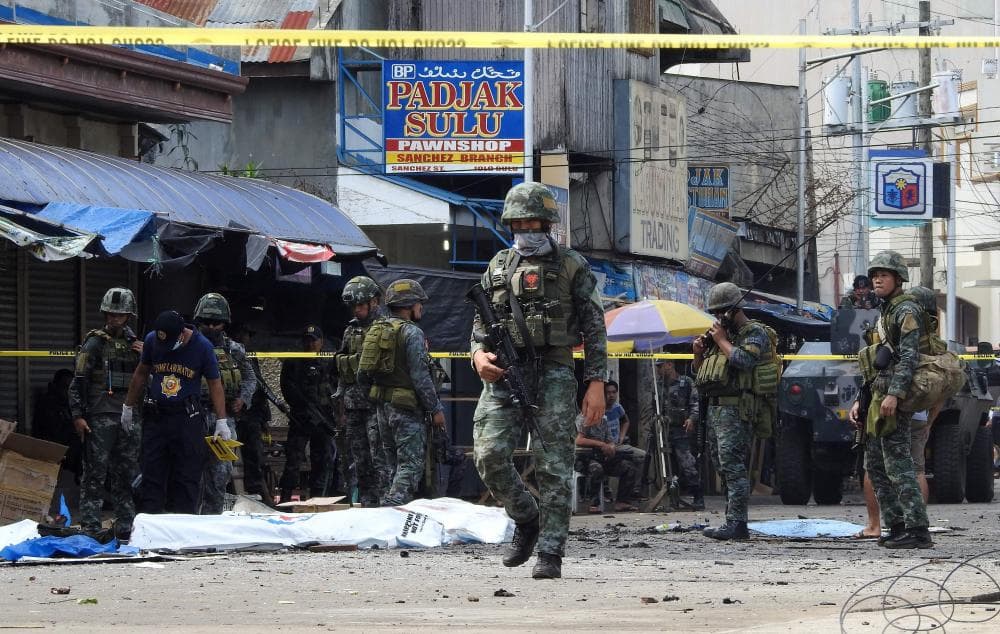
The most deadly recent attack was in 2019, when twin bombings of a Catholic church in Jolo, Sulu province, killed 20 people and injured 100 more. A 2020 bombing of a cathedral and town plaza in Jolo killed 14 people. A bomb that exploded during a mass at Mindanao University in December 2023 killed four people.
The Philippine government has worked to crack down on extremist groups, with a 2020 anti-terror law increasing its powers to counter violent extremism.
Operations in the country’s south have resulted in the death, arrest or surrender of key Islamist extremists in recent years, severely weakening their command structures and ability to operate, the Philippine military says. The groups that remain are fragmented with diminished operational reach.
With Reuters