Loading...
Please wait for a bit
Please wait for a bit
Click any word to translate
Original article by Ashifa Kassam
Rightwing leaders from around the world have come together to endorse Hungary’s Viktor Orbán, hinting at the symbolism that the country’s elections hold for global far-right movements even as the populist leader lags in the polls.
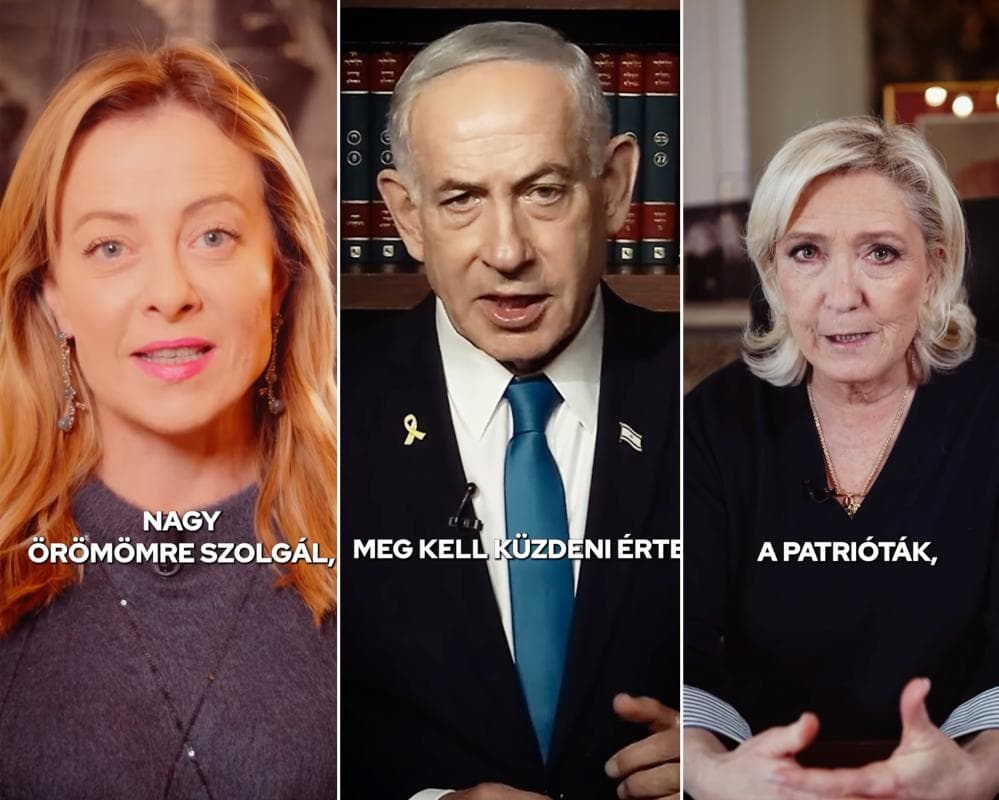
A campaign video published online by Orbán this week includes endorsements from nearly a dozen leaders including Italy’s Giorgia Meloni and Matteo Salvini, France’s Marine Le Pen and Germany’s Alice Weidel.
“Europe needs Viktor Orbán,” Weidel, a co-leader of the far-right Alternative für Deutschland (AfD), tells viewers.
Le Pen, the former leader of France’s far-right National Rally party, piles praise on the leader who once described Hungary as a “petri dish for illiberalism”. “Thanks to leaders like Viktor Orbán, the camp of patriots and defenders of nations and sovereign peoples is achieving ever greater success in Europe,” she says.
Meloni, in turn, seeks to highlight the similarities she shares with Orbán: “Together we stand for a Europe that respects national sovereignty [and] is proud of its cultural and religious roots.”
The show of support before the Hungarian elections on 12 April follows a year in which Orbán, the European Union’s longest-serving leader, made headlines over his government’s attempt to ban Pride events and clamp down further on independent media and NGOs.
Orbán, who has long faced criticism for weakening democratic institutions, eroding media freedom and undermining the rule of law, is facing an unprecedented challenge from a former top member of his own party, Péter Magyar.
As Hungarians grapple with economic stagnation, the rising cost of living and fraying social services, polls have suggested Orbán and his Fidesz party are trailing behind Magyar’s opposition Tisza party.
In response, Fidesz has sought to stress Orbán’s international connections, casting them as an asset for Hungary amid volatile and turbulent international conditions, according to Márton Bene, a political analyst at the TK Institute for Political Science in Budapest. “Something his opponent – as a political newcomer – simply does not have,” he said.
Magyar’s campaign, in contrast, has focused on domestic affairs, with pledges to stimulate the Hungarian economy by tackling corruption and unlocking billions of euros in frozen EU funds.
The election result is likely to hinge on how voters see these competing narratives and “whether they treat international challenges, or domestic governmental performance, as the election’s primary stake,” Bene said.
The campaign video includes a handful of references to Russia’s full-scale invasion of Ukraine. Orbán, the EU leader closest to Vladimir Putin, has repeatedly blocked efforts by Brussels to present a united front in support of Ukraine, leading some critics to refer to him as Putin’s Trojan horse in the EU.
The video shows leaders seemingly lauding these efforts, with Weidel noting that Orbán is “fighting for peace in Ukraine”, while Salvini says: “If you want peace, vote for Fidesz.”
Other leaders featured in the video include Herbert Kickl, the leader of Austria’s Freedom party (FPÖ); the Czech prime minister, Andrej Babiš; as well as the presidents of Serbia and Argentina, Aleksandar Vučić and Javier Milei.
Israel’s prime minister, Benjamin Netanyahu, also makes an appearance, saying that “security cannot be taken for granted, it must be won” and describing Orbán as someone who has the qualities needed to protect his country.
Netanyahu’s appearance comes despite Israel’s official boycott of two of the far-right parties represented in the video, Germany’s AfD and Austria’s FPÖ, due to their antisemitic roots, noted the Israeli newspaper Haaretz.
While US officials are conspicuously absent from the video, Orbán recently published a December letter in which Donald Trump wished him the “best of luck” in the election campaign. “You have always stood firm to defend the principles that make Hungary such a tremendous place – faith, family, and sovereignty,” the letter read.
Bene said the video was telling. “For this ideological camp, a potential collapse of the Orbán regime would be significant primarily in symbolic terms,” he said.
He pointed to last year’s global political discourse that centred on the advance of the “illiberal-populist right” in some countries. “One of the prototypes and early models of this wave – and, due to its perceived stability, a frequent point of reference – has been Viktor Orbán’s Hungary,” he said.
“Its downfall would therefore constitute a powerful symbolic counterpoint to this broader trend: it would become harder to frame the phenomenon as uniform and global, and the often-cited ‘success story’ underpinning it would be called into question.”