Loading...
Please wait for a bit
Please wait for a bit
Click any word to translate
Original article by Lorenzo Tondo in Jerusalem and Dan Sabbagh in London
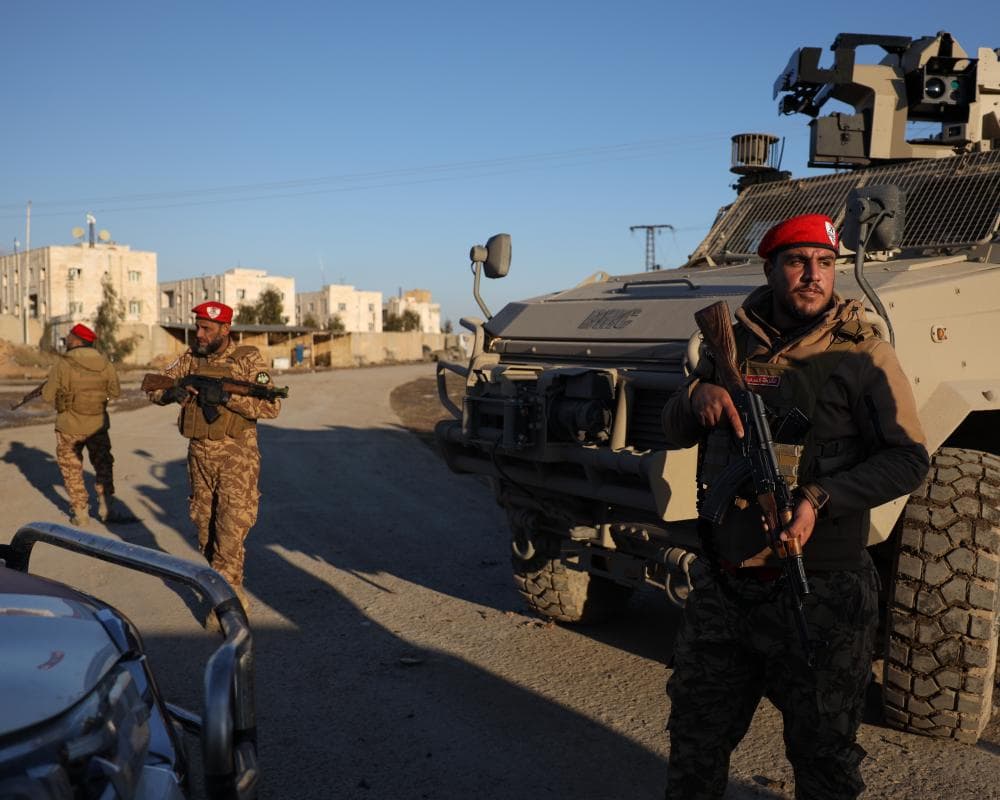
The Kurdish-led Syrian Democratic Forces (SDF) has said it is fighting Syrian government forces near a prison holding Islamic State detainees on the outskirts of Raqqa, in what it described as an “extremely dangerous development”.
The announcement came less than 24 hours after Syria’s president, Ahmad al-Sharaa, said it had agreed a ceasefire with the SDF and would move to dismantle the group’s decade-long control of the country’s north-east.
The SDF said the clashes were in the vicinity of al-Aqtan prison in Raqqa, one of several locations where IS prisoners are held. “The level of threat is escalating significantly, amid attempts by these factions to reach the prison and seize control of it,” the group said.
“Such actions could lead to serious security repercussions that threaten stability and open the door to a return of chaos and terrorism.”
The Syrian army said in a subsequent statement to the Sana state news agency that three Syrian servicemen had been killed and others wounded in two attacks, without saying where, adding that “some terrorist groups … are attempting to disrupt the implementation” of the ceasefire deal.
The sudden defeat of the SDF in Syria’s north raises questions about its ability to retain control of prisons and camps housing tens of thousands of male and female supporters of IS.
Two prisons in Raqqa city, Taameer and a juvenile detention centre, where members of IS and others were held, are said by Kurdish sources to have been emptied by locals after the Syrian government’s takeover of Raqqa.
Many other IS detainees, originally from 70 countries including the UK, are held further to the north-east in Kurdish majority areas, where many have been detained since the territorial defeat of the terror group in 2019.
The bulk of female detainees and their families are being held in al-Hawl, which holds an estimated 26,000, and the smaller Roj camp, where Shamima Begum is housed, while about 4,500 men are held at the Panorama or Gweiran prison.
According to the text of the deal, the administration responsible for the IS prisoners and camps, as well as the forces securing them, is to be integrated with the Syrian government, which will assume “full legal and security responsibility” for these facilities.
Kurdish-led forces backed by the US rounded up tens of thousands linked to IS after the group’s defeat. Washington later left responsibility for the camps to its Kurdish allies, but as US troops scale back, pressure is growing for Syria’s new authorities to take over.
The plan, also part of efforts to fold the Kurdish-led SDF into a reunified national military, is fraught with mistrust as many Kurds fear the government, led by Islamist former rebels once linked to al-Qaida, could loosen controls on IS networks.
Among the prisoners and detainees are an estimated 55 men, women and children from the UK, including Begum, many of whom have had their citizenship removed because of their IS links.
Reprieve, a UK based human rights campaign group, said the current situation was “a reality check” for Britain’s refusal to repatriate people held in Syria. Other countries, including the US, which has repatriated 28, have gradually brought back many of their citizens who were otherwise held in indefinite detention.
Maya Foa, the chief executive of Reprieve, said “volatility of the current situation demands an urgent rethink” and that “the only safe thing to do is bring British nationals home and prosecute the adults where there is a case to answer”.
Al-Sharaa’s jihadist career was forged in post-invasion Iraq, where he was drawn into al-Qaida’s orbit through its Iraqi affiliate and precursor of IS. Detained by the US in 2005, he deepened his militant ties and encountered Abu Bakr al-Baghdadi, who would later dispatch him to Syria to set up Jabhat al-Nusra.
The group rose quickly but split from Baghdadi in 2013, prompting Sharaa to first align openly with al-Qaida before severing that link in 2016 to present a more locally rooted insurgency that would ultimately become Hayat Tahrir al-Sham.
Since toppling Bashar al-Assad in December 2024, Syria’s new leaders have struggled to assert full authority over the country. An agreement was reached in March that was to have merged the SDF with Damascus, but it did not gain traction as both sides accused each other of violating the deal.