Loading...
Please wait for a bit
Please wait for a bit
Click any word to translate
Original article by William Christou in Beirut and Dan Sabbagh
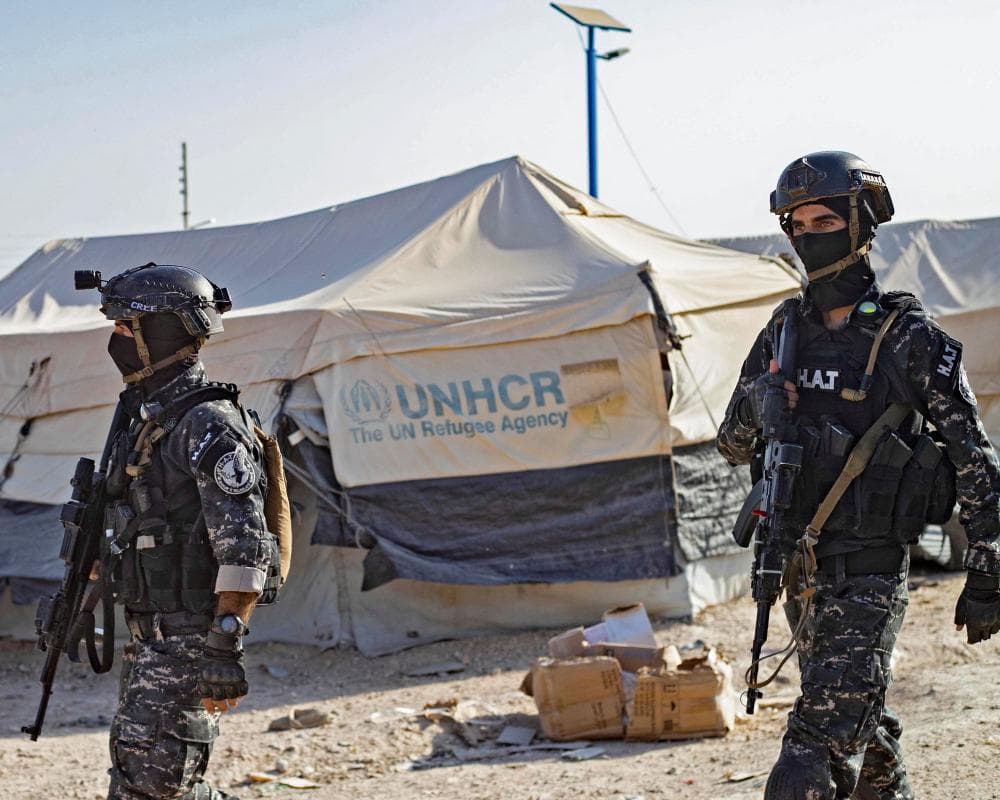
Kurdish-led forces in Syria have announced a withdrawal from a detention camp in north-east Syria housing tens of thousands of Islamic State-linked detainees, as the US declared it was no longer supporting them.
The fate of al-Hawl, which houses among others the most radical foreign women suspected to have been members of IS and their families, is of great concern to neighbouring states and the international community.
These states have warned for years that the camp is a hotbed of extremism and that chaos could result if a jailbreak were to occur. But on Tuesday evening the US said it believed it could work with the Syrian government against IS.
Al-Hawl houses an estimated 24,000 people, mostly Syrians and Iraqis but also 10,000 from other countries, and it is unclear what will happen as Syrian government forces move in.
A spokesperson for the Kurdish-led Syrian Democratic Forces (SDF) said: “Our forces were compelled to withdraw from al-Hawl camp and redeploy in the vicinity of cities in northern Syria that are facing increasing risks and threats.” They blamed the withdrawal on a “failure of the international community”.
A smaller number of female detainees – about 2,400, including Shamima Begum who was stripped of her UK citizenship – are being held at al-Roj camp further to the north-east and still under Kurdish control.
The Syrian government said it would assume control of al-Hawl camp, accusing the SDF of leaving it without guards, allowing detainees to escape. It also accused the SDF of doing the same at a prison in Raqqa from which 120 prisoners escaped, a claim the SDF denied.
The withdrawal came as the Syrian government swept through north-east Syria, making unprecedented gains as the SDF lost vast swathes of its territory in just a few days. The SDF lost Raqqa and Deir el-Zour on Sunday as tribal elements defected from the Kurdish-led force and pushed it to withdraw from the Arab-majority areas.
The rapid advance of Damascus’s forces and partial collapse of the SDF almost overnight was stunning: the Kurdish-led group had controlled nearly a third of the country, with US support, since 2019. It was the biggest shift in frontlines since the fall of the former Syrian president Bashar al-Assad in December 2024.
Tom Barrack, the US envoy for Syria, said on Tuesday evening the US no longer supported the SDF in the fight against IS. Though the SDF had “proved the most effective ground partner in defeating Isis’s territorial caliphate by 2019”, he said that was because there was “no functioning central Syrian state”.
The US diplomat said the situation had “fundamentally changed” with the overthrow of al-Assad and his replacement by Ahmad al-Sharaa. “Syria now has an acknowledged central government that has joined the Global Coalition to Defeat ISIS,” he wrote on X, meaning that “the original purpose of the SDF as the primary anti-ISIS force on the ground has largely expired”.
A 14-point ceasefire agreement signed on Sunday by President al-Sharaa and the head of the SDF, Mazloum Abdi, collapsed the next day after a disastrous meeting in Damascus.
However, on Tuesday night the Syrian presidency announced a four-day ceasefire with the SDF so that the 14-point agreement could be implemented. It said that if an agreement could be reached, the Syrian government would not enter Kurdish-majority cities, such as al-Hasakah and Qamishli, and that security forces would be drawn from local residents.
It also said Abdi would nominate a candidate from the SDF to be the deputy defence minister, MPs for the national parliament, and lists of people to be employed in the Syrian public sector.
The announcement seemed to stave off immediate further fighting between the two sides and to reassure Kurdish officials that their rights would be respected.
Syrian government sources had previously accused Abdi of trying to stall the implementation of the 14-point agreement, which would turn over most of the Kurdish-led authorities’ institutions and governance to Damascus. Ilham Ahmed, a senior leader of the Kurdish-led authority, said Abdi requested a five-day grace period to implement the agreement, which was initially rejected by Damascus.
“They wanted a direct handing over of everything to Damascus. However, with or without this meeting they wanted to go to war … and now their plan is to massacre the Kurds,” Ahmed said on Tuesday.
After the meeting, Kurdish officials, Abdi included, called for a general mobilisation across Kurdish-majority areas and to resist Damascus’s advance towards their territory. SDF media published pictures of people, young and old, holding assault rifles seemingly in preparation for a further assault.
Clashes between the two sides continued on Tuesday, with shelling reported in Kobani, a Kurdish-majority area on the Turkish border, and Syrian government forces entering al-Hasakah.
The areas lost to Damascus’s forces so far have been Arab-majority areas, where many residents had longstanding resentments against the SDF. The SDF has seemingly dug into areas closer to the borders with Iraq and Turkey, which are populated mainly by Kurds.
If the four-day ceasefire fails and Damascus’s forces advance into Kurdish-majority areas, fighting is likely to be deadlier than in previous days. In those areas they have infrastructure, including heavy artillery, drones and underground tunnel networks.
The Kurdish population view the fight as existential and have pointed to mass killings when Syrian government forces entered Sweida province and the Syrian coast last year as an example of what could happen to them if Syrian government forces took over the area.
The Syrian government said in a statement on Tuesday that it would not enter Kurdish areas and that the army’s goal was “to restore stability and protect government institutions”.
The SDF was for years the US’s biggest partner in Syria and together they defeated the IS “caliphate” in 2019. It is the military wing of a Kurdish statelet, an autonomous area that had its own institutions and government. Among other things, it protected Kurdish rights, which for years had been repressed by al-Assad and his father.
When al-Assad fell, the SDF and Damascus came to the negotiating table, with the former seeking to retain its autonomy and the latter wanting to consolidate control over the country. Despite the signing of an agreement on 10 March last year to integrate the SDF into Syria’s army, the two sides remained at odds and occasionally clashed.
At the weekend, the US urged the Syrian government to halt its advance at the dividing line of the Euphrates River, but government forces pushed on. It has since stayed silent as the government continued its campaign against the SDF.
Damascus’s advance over the last week has helped it extend control over most of the country, and crucially, the country’s largest oil and gasfields, as well as key dams.