Loading...
Please wait for a bit
Please wait for a bit
Click any word to translate
Original article by Emma Graham-Harrison and Quique Kierszenbaum in Qalqilya
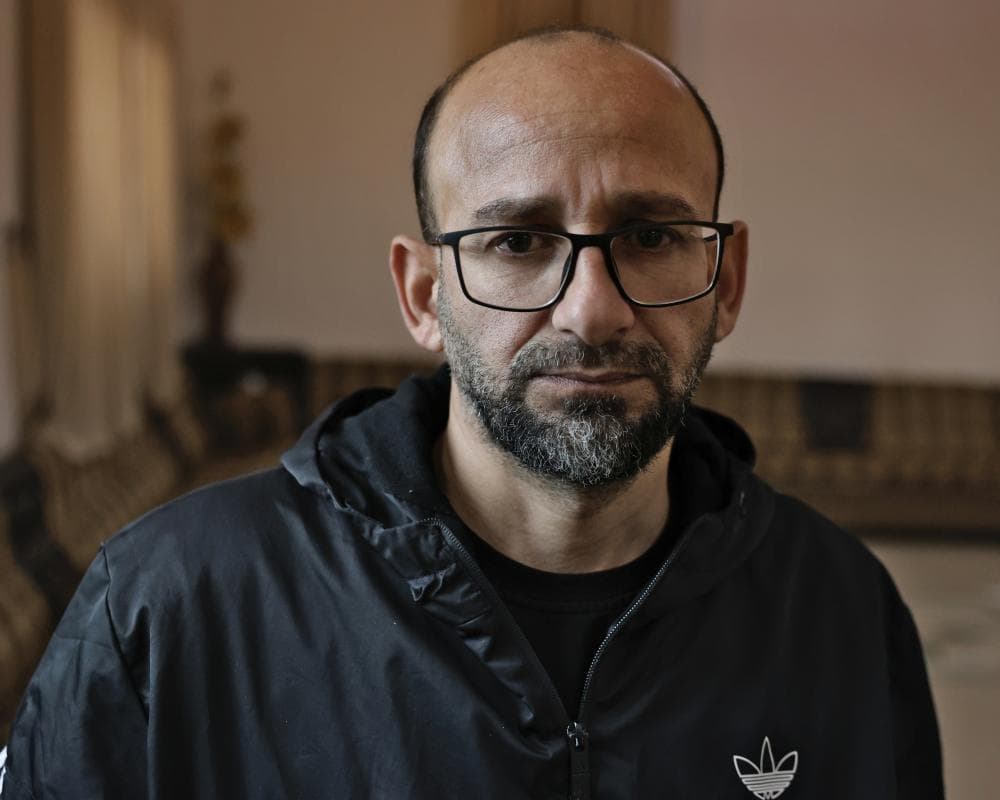
Sami al-Saei said he heard the Israeli prison guards who raped him laughing through the assault, before they left him lying blindfolded, handcuffed and in agony on the floor to take a cigarette break.
At least one of the group knew a crime was being committed and intervened, not to stop the torture but to prevent its documentation. Al-Saei said he heard the man warning others “don’t take a photo, don’t take a photo” as they attacked.
He bled from his rectum for more than three weeks after the assault, which happened soon after he was detained in February 2024. He described sexual torture that lasted more than 20 minutes including beatings on his buttocks, a guard applying extreme pressure to his genitals, and forced anal penetration with two different objects.
“I tried to prevent them by clenching my muscles (in my anus), but I could not. They forced it in very deep, it was extremely painful,” he said in an interview about his ordeal. “I don’t know how loudly I screamed from the pain.”
It left him in so much pain that he collapsed twice when ordered to stand up and walk afterwards. Moved to an overcrowded cell, al-Saei said he received no medical treatment and was forced to use wads of toilet paper to staunch the blood.
The 47-year-old father of six was held without charge or trial until June 2025. About 40 days after his release, he posted a video on TikTok detailing the attack, defying the extreme social stigma and Israeli warnings against going public about abuse in jails.
“I could not stay silent. I have a moral responsibility to say what happened to me and other prisoners,” he said.
Extensive and extreme sexual violence in Israel’s civilian and military jails has been documented by domestic and international observers including doctors, Israel’s military prosecutor, and the UN committee on torture.
The human rights group B’Tselem described a “grave pattern of sexual violence in detention facilities and prisons”, in a report released on Tuesday detailing abuse of Palestinians in Israeli jails.
It ranges from “threats of sexual assault, through forced stripping, to actual sexual assaults”, the report found. “These include beatings to the genitals that caused severe injuries, setting dogs on prisoners, and forced anal penetration with various objects.”
A spokesperson for the Israeli prison service said it “categorically rejects the false allegations presented in the [B’Tselem] report”, and was “not aware of the claims described” by al-Saei and other survivors of sexual violence.
“All inmates are held in lawful custody, with due regard for their rights, including access to medical care as required and the provision of living conditions in accordance with the law,” the spokesperson added.
Tamer Qarmut, 41, was detained by Israeli soldiers in November 2023 when they raided Kamal Adwan hospital in northern Gaza, where his family had taken shelter.
He said that in the first 24 hours he was accused of being a militant – even though he had been disabled by a leg injury in his teens – and was beaten so badly he sustained permanent damage to his hearing, attacked by a dog and then raped by a soldier.
“He shoved a wooden stick up my anus, left it there for about a minute, and pulled it out. Then he shoved it back in, even harder, and I screamed at the top of my lungs,” Qarmut said in testimony given to B’Tselem. “After a minute, he pulled the stick out again, told me to open my mouth, pushed the stick into my mouth and forced me to lick it.”
He was held for nearly two years, but never charged or put on trial before his release in October last year under the deal brokered by the US president, Donald Trump.
The Israel Defense Forces did not immediately respond to requests for comment.
B’Tselem’s report is its second on conditions in Israel’s civil and military prisons. After 7 October 2023, the detention centres were transformed into a network “dedicated to the abuse of inmates as policy”, where torture was an “accepted norm”, the report said. “A space of this kind, in which anyone who enters is condemned to deliberate, severe, and unrelenting pain and suffering, functions de facto as a torture camp.”
The abuse of Palestinians is not hidden. Prison authorities boast of mistreatment, which is publicly backed by Israeli politicians and the judicial system, reported with approval in Israeli media, and has been normalised in Israeli public opinion, B’Tselem said.
In 2024 Israeli military prosecutors charged several soldiers over a violent rape at the Sde Teiman military detention centre, the only attempt to prosecute Israeli guards for sexual violence in detention centres after October 2023.
Members of the government and Knesset backed the suspects and when video of the alleged attack was leaked, it produced little outcry in Israel about the abuse itself. Instead it led to the resignation and then arrest of the chief military lawyer. A single soldier has been convicted of abuse of Palestinian prisoners in that period.
Torture of Palestinian prisoners must be understood in the context of dehumanisation and a broader campaign of extreme violence, said B’Tselem’s executive director, Yuli Novak.
“The Israeli regime has turned its prisons into a network of torture camps for Palestinians, as part of a coordinated onslaught on Palestinian society intended to destroy their existence as a collective,” she said.
Beyond Israel there had been condemnations of torture but no effective intervention, she added. “The international community continues to grant this regime full immunity.”
In addition to sexual violence, the report details other forms of torture including electric shocks, use of teargas and stun grenades, jailers burning prisoners with boiling liquids and cigarettes, and setting dogs on them.
Prisoners are also systemically denied medical care, leading to irreversible harm including amputations, loss of sight and hearing, and in dozens of cases, loss of life. At least 98 Palestinians have died in Israeli jails since 7 October 2023, and the real toll is probably substantially higher.
Many of the dead were young and had no prior health conditions. Abdul Rahman Mirie, 34, was a carpenter who died in November 2023, leaving behind three young sons and a daughter.
He was detained on his way back from work in February 2023 and held without charge or trial. He was probably beaten to death, according to details from a prison autopsy and testimony from other prisoners. Men held in cells near him during his final hours told his mother, Aziza, that they heard him calling out in agony: “Brother, come help me, I’m being tortured.”
His family cannot confirm the cause of death, or move on without a burial, because Israel is holding his body hostage.
Ahead of the ceasefire deal for Gaza brokered by Trump last year, Aziza Mirie got a call from authorities asking if she wanted her son’s remains. “We said definitely yes, but never heard any more,” she told the Guardian at the family home.
Mirie’s broken-hearted father died soon after losing his son, Aziza said, and the rest of the family is struggling. “At night I keep imagining how they tortured Abdul Rahman, and what condition he was in before his death,” she said. “Sometimes I find his daughter crying alone, and she asks me, ‘why don’t I have a father?’.”
Israel last provided totals for Palestinian prisoners in detention before Trump’s ceasefire deal, but they indicate that by January Israel was detaining about 9,000 Palestinians from Gaza, the occupied West Bank and East Jerusalem. About half of them are jailed indefinitely without charge or trial.
Inhuman living conditions, including starvation rations, crowding and deprivation of basic hygiene needs such as showers and clean clothes, exacerbate the impact of violent assaults.
There is no independent oversight, with International Committee of the Red Cross visits halted from October 2023, and prisoners are denied contact with their families or any news from the outside world.
Al-Saei has paid a high price for speaking out. Forced to move away from gossiping neighbours, he has struggled to find work and is haunted by vivid nightmares about his children’s future.
But he does not regret his decision to become a voice for those who cannot face adding new pain to deep trauma. “It was my choice,” he said, adding that during 16 months in jail he saw clear evidence in the overcrowded cells that many other prisoners had been assaulted. “Even if the others didn’t speak about it, it was obvious they also had this experience.”