Loading...
Please wait for a bit
Please wait for a bit
Click any word to translate
Original article by Jennifer Rankin in Brussels
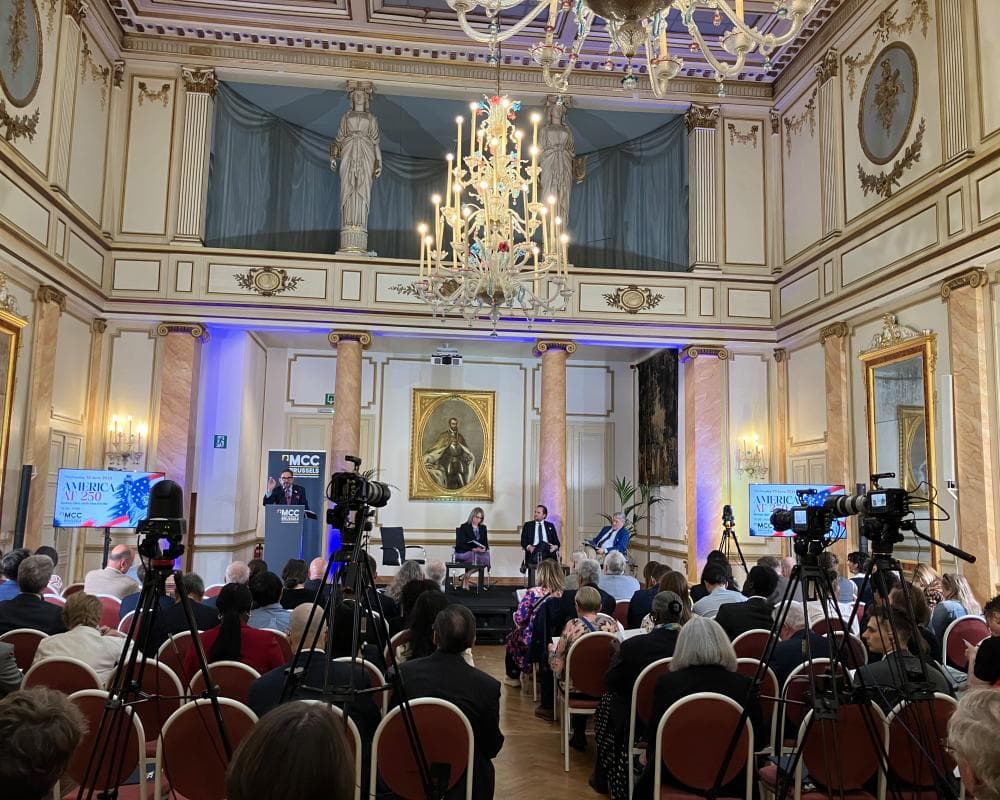
Under glittering chandeliers in a neoclassical ballroom, guests took their seats. It was 10am and scores of people had gathered at a private members’ club in Brussels for a conference to mark 250 years of American independence, organised by Viktor Orbán’s favourite thinktank in the EU capital, MCC Brussels.
Opening the one-day event, the MCC director, Frank Furedi, said the 250th anniversary had “really escaped the attention of a European audience” in a speech that lauded the founding fathers before launching a sweeping attack on Europe’s “incompetent political class”.
Beneath the glitz and bravado, MCC Brussels’ future is in doubt. The thinktank, which has previously co-sponsored an event featuring Nigel Farage and Suella Braverman and hosted the far-right Alternative für Deutschland MEP Alexander Jungbluth, is facing an urgent cash crunch as a result of Orbán’s political ousting in April. The man who beat him in a landslide victory, Péter Magyar, has said the state will no longer finance conservative gatherings and organisations including “the Mathias Corvinus Collegium and other affiliated organisations”.
Under Orbán, the MCC in Budapest, an educational institute with strong ties to his Fidesz party, benefited from a massive transfer of state assets. The new prime minister, however, has announced an investigation into the transfer, describing this state financing as a crime.
MCC Brussels launched in November 2022, an ostensibly independent offshoot of its parent institute in the Hungarian capital. It declared €6.37m (£5.45m) in annual funding in 2024 from MCC Budapest, making it one of the best-funded thinktanks in the EU capital.
That wealth was evident at the Cercle Royal Gaulois in June, where guests discussed the future of western civilisation in the elite club adorned with sculptures inspired by ancient Greece and portraits of Belgian royalty.
Furedi, once a member of a Marxist fringe party, now a leading ideologue for the new right, said that MCC Brussels would need alternative funding from September. “No matter what, we’ll continue in some shape or form,” he said, although in “a worst-case scenario … we have to have much more of an online presence than an offline one”.
He dismissed Magyar’s allegation of a criminal transfer of funds to MCC Budapest as “bullshit”, adding that MCC Brussels’ finances were “very transparent”. Magyar, he continued, was “entitled” as elected prime minister to “get his hands on the funding that MCC has received from the public purse … What he is not entitled to do is to close down an institution that is doing good work.”
MCC Brussels, he said, had “taken up themes that nobody else has touched”, contrasting its output with the “narrow conversation” in Brussels about the Green Deal and migration. As examples he cited an event about Romany and Jewish music in eastern Europe and forthcoming work on “psychology in the EU narrative”.
But it is not the MCC’s “musical journey through Transylvania” event that has earned the thinktank its controversial reputation. Critics accuse the group of defending Orbán’s corrupt rule in Hungary, in the face of widespread independent audits of graft and democratic backsliding. It has also been accused of a lack of transparency over its own funding.
In early 2024, MCC Brussels was an enthusiastic supporter of farmer protests in Brussels, capitalising on genuine anger with low prices and EU regulation across western Europe. The thinktank denied organising protests, saying it had participated in demonstrations and produced videos “to help farmers communicate their concerns”. It also published reports claiming that EU policy was “destroying” farming. Their interest came at a time when farmers’ protests across Europe were gaining vocal support from far-right groups and conspiracy theorists.
MCC has also accused the European Commission of “funnelling billions into a shadowy network of NGOs and thinktanks” in a report that fuelled a broader campaign from centre-right and far-right lawmakers against EU funding of civil society groups. MCC Brussels spotlighted 10 federalist organisations and thinktanks that it said had received funds under the EU’s Citizens, Equality, Rights and Values programme, which has a €1.55bn budget for 2021-27 that has so far been distributed to more than 6,500 organisations.
Petros Fassoulas, the secretary general of the European Movement International (EMI), one of the organisations highlighted, believes the MCC’s report contributed to “a climate, a mood, an impression” against NGOs. After years of stable funding, EMI’s application for a €650,000 annual EU grant was rejected in 2025, while funding from the European parliament for awareness-raising campaigns on European issues never materialised. Fassoulas said he had no proof that a rightwing campaign to cut EU funding for NGOs had led to that outcome, but described the timing as bizarre.
He added: “It is strange that at the very time the EU is under attack from Russian disinformation, US political campaigns and nationalist narratives, the commission cuts funding for an organisation that has traditionally supported the European project.”
Marieke Ehlers, an MEP with the far-right Dutch Party for Freedom, cited the MCC’s NGO report as an example of their “interesting” work. MCC Brussels played an important role, she added. “Do I use [their reports] to influence my political work? I don’t think so. Do I find it interesting to read? Yes. Do I think it’s important … to have thinktanks across the political spectrum? Yes.”
Not everyone thinks MCC Brussels is so benign. Roland Freudenstein, a longtime Hungary watcher, said MCC Brussels was “basically set up to defend Orbán’s corruption” with a broader mission to be the intellectual basis for the pan-European alt-right. An MCC spokesperson said: “We condemn the practice of corruption by all politicians and public servants.”
Freudenstein worked at the Wilfried Martens Centre, the official thinktank of the European People’s party (EPP), when the mainstream centre-right group was convulsed over whether to expel Orbán and his Fidesz party. Orbán eventually withdrew his party from EPP in 2021 before it was kicked out over concerns about growing authoritarianism in Hungary.
The following year, MCC Brussels was born. “The MCC became really important to Fidesz as something to counterbalance the political isolation that Fidesz felt in the European parliament and by extension in European politics,” Freudenstein said.
The change in government in Hungary is not the only problem for MCC Brussels. It was suspended last month from the EU Transparency Register, a move that raises questions about its credibility. Inclusion on the register, an official database of lobby groups, is required if an organisation wishes to meet senior EU officials.
The suspension followed a complaint from the NGO Corporate Europe Observatory (CEO) in February 2025 that accused MCC Brussels of failure to disclose its funding. MCC Brussels registered on the EU list in January 2024, but did not disclose its funding until August 2025. The MCC spokesperson said this was “was well within the time frame afforded to all new registrants”.
Olivier Hoedeman, a co-founder of CEO, said the complaint had been initiated when MCC Brussels was “leading the attack on civil society”, adding that “their failure and refusal to disclose their own budget was just glaringly hypocritical”.
More than 16 months after the complaint, Hoedeman said CEO was still awaiting the commission’s response. MCC Brussels claimed its suspension was “politically motivated” and had arisen over a dispute about whether MCC Brussels should be contained within the registration of its parent organisation.
The European Commission repeatedly declined to explain the reasons for the suspension. “We do not comment on ongoing administrative proceedings,” a spokesperson said, adding that “the relevant organisation” always had “the possibility to share their views in writing before any decision on eligibility is taken”.
For now MCC’s search for new funders continues. Looking back at the well-attended event in the mirrored ballroom at the Cercle Royal Gaulois, Freudenstein said: “If it hadn’t been for Orbán’s crushing defeat in April, they would be thriving.”