Loading...
Please wait for a bit
Please wait for a bit
Click any word to translate
Original article by Nick Visser
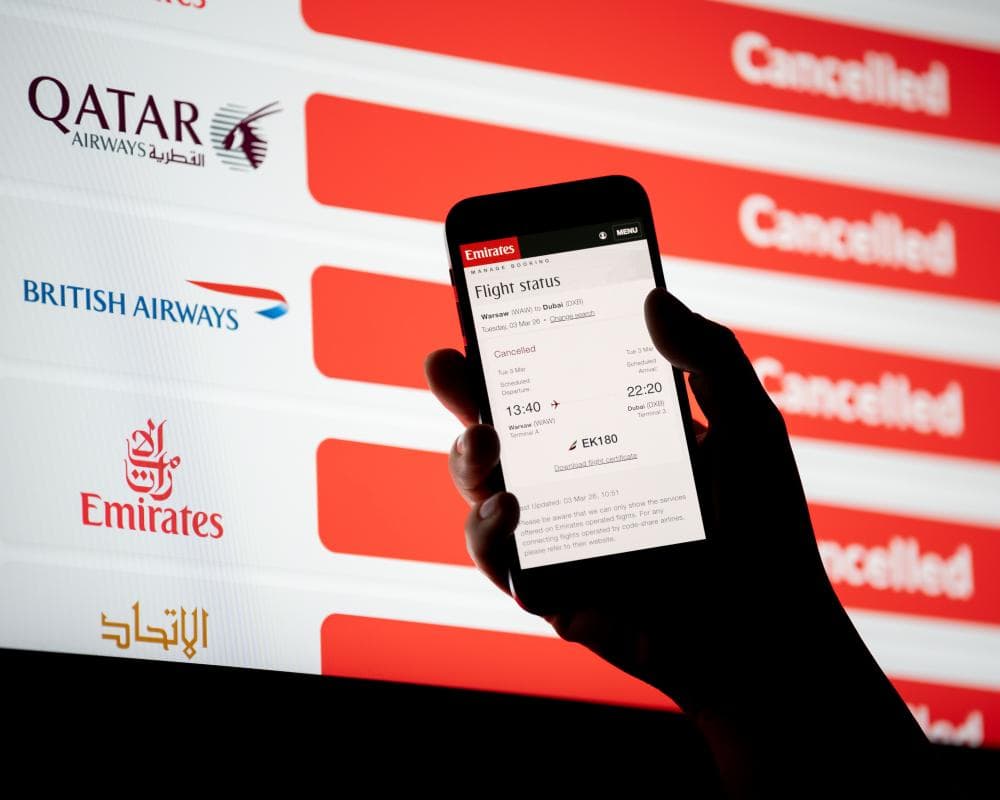
It will likely be a “messy” month for airlines operating throughout the Middle East as travellers stuck in major transit hubs are slowly rerouted and repatriated after days of turmoil due to the ongoing conflict in Iran.
Experts say airlines are well-versed in disruptions, with entire teams dedicated to what is known as “irregular operations”. But while minor issues can be resolved in a matter of days, the sheer scale of the airline industry that operates in the region will be a complex puzzle that will take much longer to work through.
Dubai international airport is one of the busiest in the world, with more than 95 million passengers transiting through in 2025 alone. Doha’s Hamad international airport handled more than 54 million. Both have been shuttered for days.
Sign up: AU Breaking News email
John Cox, an aviation expert and retired airline pilot with more than 14,000 hours of flight time, said there are processes for disruptions in flight plans. Teams coordinate behind the scenes to find aircraft, source the teams to fly them, make sure the planes undergo necessary maintenance and, ultimately, see passengers on their way.
“This is not unprecedented. The scale of it is,” Cox said.
The former pilot pointed to conditions in the United States, where weather events such as blizzards will regularly take out major airports for two or three days at a time. Operations centres will run for 24 hours a day, for days at a time, “reassembling the airlines” to get things back on track.
“With a two- or three-day blizzard it takes generally four or five days to return to regular operations,” he said. “But, you can generally, in 48 hours or so, have most of it put back together, meaning you’re starting to move passengers again and get them where they need to go.”
The situation in the Middle East, however, is much more complicated. Air travel is more popular than ever and many planes do not have many extra seats in the best of times.
“We’re talking about Abu Dhabi, Doha and Dubai, they’re major hubs internationally … with major airlines that move people from Europe to Asia,” Cox said, adding many travellers had no reason to be in those cities except to transit through large airports. Travellers are now stuck on either side of the Middle East with limited options to return home.
Some flights have begun to ferry some of those passengers on once more, although the situation could change at a moment’s notice. An Emirates plane took off on Wednesday morning, the first to leave Dubai to Sydney since Saturday. The airline is now running limited flights to deal with the backlog of stranded passengers.
And Qantas will operate a flight from Perth to London, usually a direct route, with a short fuel stop in Singapore instead. That will allow the plane to carry up to 60 more passengers. The flag carrier may continue to do so for the foreseeable future to help deal with a backlog.
Other airlines in the region, including Qatar Airways and Etihad, remain suspended until at least Thursday.
Dr Ian Douglas, an expert in aviation and airline management, said the situation will be “messy for the next month” at best as airlines work to rebook people, coordinate with partners and figure out other routes to avoid problematic airspace.
“There are people stuck in the Middle East, so you want to get rid of that problem first, you don’t want people sitting in the airport. Maybe it takes a week, or two, or three,” Douglas said, while noting the constraints that many airlines face.
“There aren’t many spare aircraft, there aren’t spare crews, so it really is down to what can I fit on my network.”
Douglas added the ongoing conflict would be hugely expensive for airlines.
“Just think about the crews who are dislocated, sitting in hotels,” he said. “Aircraft that are a couple of million dollars a month to lease that are sitting on the ground doing nothing, generating no income.
“All of the passengers who need accommodation and feeding, and just pulling the network back together. It’s enormously expensive.
“You look at the size and scale of Emirates or Qatar, they’re multibillion-dollar businesses. You’re talking millions of dollars an hour in fares that are not happening.”
Ahmed Abdelghany, a professor of operations management at Embry-Riddle Aeronautical University in the United States, said the closure of so much airspace, with effectively no alternatives for airlines to reroute, was an exceedingly unique situation.
“Nobody can predict when this war will end. So there’s a lot of uncertainty in the system, not only on the demand side but on the supply side. Airlines will be asking: can I put my airplane in danger?”
“They will test the market piece-by-piece, day by day … hour by hour actually.”
For passengers, the impact for Middle Eastern hubs and airlines could linger far beyond the end of the conflict, Abdelghany added.
“People might still say ‘I’m not going to travel in risky airspace, missiles are flying, you know? I’m going to stay home.’”
Cox said airlines are able to recover after periods of uncertainty, even though the process can be immensely frustrating for passengers. “Irregular ops” teams, he said, are experts at choreographing the web of decisions needed to get back to normal.
“These folks are so good at it,” Cox said. “They’re extremely professional … There’s a saying: ‘It’s the difficult we do immediately, the impossible takes slightly longer. We’re going to rebuild the airline and we’re going to rebuild it quickly.’”
He described the airline industry as a “a symphony of motion” that takes a dedicated workforce.
“Now, you’ve got everything out of tune.”