Loading...
Please wait for a bit
Please wait for a bit
Click any word to translate
Original article by Justin McCurry on Kasasa island
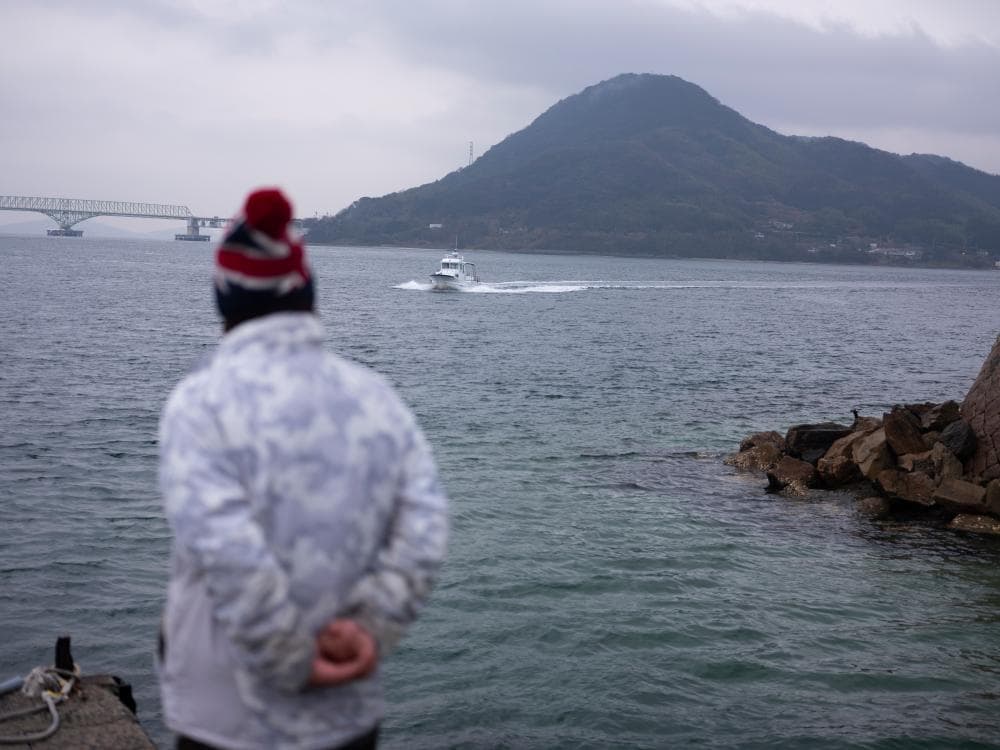
His island home is shrouded in mist, but his union jack woolly hat makes Hideya Yagi easy to spot as he greets the approaching boat. The 80-year-old, a former president of a construction company, is pleased to see the small group of passengers disembark, mainly because he is one of only seven registered residents at their destination, Kasasa island.
Kasasa is known as the “Hawaii” of Japan’s inland sea because of its warm climate and beautiful coastline. Yagi and his wife, Mihoko, eke out a quiet life alongside just one other couple and an elderly woman. The other two residents are almost always absent.
“You can stand on the quayside and just reel the fish in,” he says as he stands on the rudimentary quay and lets his mind wander towards the hobby that brought him to the island 25 years ago. “And you can eat what you catch straight away.”
But its idyllic, secluded location is attractive for other reasons, too. It sits at a sensitive spot for national security, close to two key military bases. Iwakuni US Marine Corps airbase is 20km away and a Japanese Maritime Self-Defence force base is 50km to the north, in the city of Kure.
When it emerged that wealthy Chinese developers had bought and then started to develop two plots of land, rumours that they could be used by Beijing for surveillance began to swirl, leading one councillor to claim that the island “could eventually become a Chinese island”.
Critics have pointed out that the same laws apply to landowners regardless of their nationality but the debate has continued inside Japan regardless.
In the space of a few months, the modest island – measuring less than one square kilometre – has become emblematic of the worsening ties between the two countries, as well as Japan’s fears about Beijing’s ambitions in the region.
Foreign ownership of land in politically sensitive parts of Japan is on the rise. In the 12 months to the end of March last year, Chinese investors were behind nearly half of hundreds of land and real estate acquisitions near locations deemed important for national security, the public broadcaster NHK reported. All the purchases were legal and approved by Japanese regulators.
Those residents who are worried now have a powerful ally in the prime minister, Sanae Takaichi, who has vowed to tighten regulations on the sale of land and other assets. The conservative leader has tapped into wider public unease about record levels of immigration, which Japan needs in order to fill large gaps in its workforce but which has also helped foster the rise of minor far-right parties such as Sanseito.
Tokyo’s relationship with Beijing has become increasingly shaky after Takaichi warned that her country’s forces could become militarily involved in the event of a conflict over Taiwan.
Those remarks prompted a furious response from China including a ban on exports of “dual-use” items to major Japanese conglomerates that Beijing says supply Japan’s military. The restrictions were designed to curb Japan’s “remilitarisation” and nuclear ambitions, the Chinese commerce ministry said. The move was condemned by Japan as “completely unacceptable”.
When two plots on the south-east coast of Kasasa were bought almost a decade ago, its residents expected that it would end up becoming a holiday home and jetty – but years went by without any sign of development.
Then late last year, a mechanical digger and cement mixer arrived by boat and began clearing the plots. Steel telegraph poles and high-voltage distribution lines were erected, and visitors were spotted in the area. According to local campaign group the Kasasa Island Preservation Association, the owners were Chinese investors who had bought it via a Japanese real estate company that owns additional plots on Kasasa. Their purchase and activities were entirely legal but their intentions remained unclear. Documents seen by the Guardian list a wide range of possible plans, from tourism facilities to cruises and restaurants.
Attempts to reach the investors in Shanghai, where they are based, were unsuccessful. Calls to the real estate company were unanswered.
“I don’t care where our neighbours are from, but we still don’t know who these people are and what they want to do here,” says Yagi, who has not met the Chinese investors, whose plot lies at the other end of the island. “Hardly anyone lives here, so new arrivals could do what they like and we would never know,” adds Yagi, who quit his job in his 50s to move from nearby Hiroshima prefecture.
In the warmer months, Kasasa bursts into life, its famously rich soil and natural water supply combine to produce watermelons, mikan oranges, blueberries and tomatoes. The crystal clear waters lapping against the shore offer rich pickings – sea bream, yellowtail and octopus – for even the most inexperienced anglers.
Today, though, the cleaners who disembarked from the ferry take refuge from the cold in a fishermen’s hut, their plastic bags filled with beach debris. A solitary dog walks up and down an empty road facing the coast, pausing outside wooden homes that have fallen into disrepair, and making friends with the few visitors who pass by.
Yagi spends his days fishing, the fruits of which cover the couple’s living room table, while Mihoko looks after their garden. Their nearest neighbours are away, their front door left unlocked.
“I’m worried about what will happen to the island’s atmosphere,” says Mihoko, as she cuddles the couple’s dog, Kuro-chan. “We’re being kept in the dark. I just want to carry on with life as it is, with my husband fishing and me growing fruit and vegetables.”
Now, a push by residents, local politicians and campaigners to protect the island’s way of life has snowballed into a discussion about how to protect the country’s assets against what some conservative commentators have called a “silent invasion” by a Chinese property vanguard.
Takashi Ishikawa, a conservative councillor in nearby Yamaguchi city, claimed that Kasasa “could eventually become a Chinese island”. He told the Sankei Shimbun newspaper: “It could even serve as a drone base. If islands in the Seto Inland Sea … are bought up collectively, it would be as if Japan were effectively being invaded.”
Hideki Miyagawa, who last year helped launch the Kasasa Island Preservation Association, says: “Ideally, we want to buy the land back, protect the island’s environment and persuade people to move here to live.” Kasasa was home to 100 people before the second world war.
The association, whose members recently repaired the island’s only Shinto shrine, plans to hold events to attract younger people to the island, where dozens of homes stand empty.
“This has got nothing to do with discriminating against foreigners,” says Miyagawa. “We just want the government to protect the interests of residents and for new residents to follow the rules. It’s hard to do that when we don’t even know the investors’ intentions. How do we know that they won’t use the location for something like surveillance?”
Kasasa is not the only location where local sentiment is turning against foreign investment in land and property – a right protected by law, but one that critics say needs more scrutiny.
In some parts of Japan, residents are taking matters into their own hands. In December last year, a landowner in Fukuoka, western Japan, agreed to abandon plans to build apartments aimed at foreign buyers – mainly Chinese and Taiwanese – after protests by residents.
In June last year, the authorities in Hokkaido prevented the construction of a villa in the town of Kutchan by a Chinese national, who had cut down an area of forest without permission.
But fears that foreign investors are snapping up and developing Japanese land with little scrutiny are wide of the mark, according to some experts, who say existing laws are enough to prevent illegal activity, regardless of the property owner’s nationality.
Restricting foreigners’ ability to acquire property won’t solve the problem,” says Hiroshi Matsuo, a professor at Keio University Law School. “There are effective legal measures in place to deal with illegal development, regardless of whether it’s by Japanese or foreign nationals. What we need is a mature approach to land use regulations, which currently allow unexpected developments to go ahead without the knowledge or consent of existing residents.”
The fear that foreign landowners are free to turn their property into something akin to an independent country confuses land ownership with territorial sovereignty, and has been encouraged by inaccurate information spread online, according to Matsuo. “It’s right to want a society in which it’s normal for foreigners to integrate into local communities. They and Japanese people must all follow the same rules.”
In China, some have used the controversy to provoke Japan’s rightwing in comments on the WeChat and RedNote social media platforms. One commenter described land purchases as a “good investment strategy: buy land in Japan, stir up Japanese nationalistic sentiment, and then sell it back to the Japanese at a high price.” Another implored their compatriots to take ownership of the entire island and “plant the Chinese flag after you buy it”. Another wondered: “Can we crowdfund to buy the whole of Japan?”
As the island’s day visitors prepare to leave on the last boat back to the mainland, Yagi’s thoughts are again turning to fishing.
“I would love people to come here to fish, eat and drink together and stay overnight,” he says. “I don’t care which country they’re from … I’d just like that to happen before I die.”
Additional research by Lillian Yang
This article was amended on 9 March 2026 to correct the area the island covers, to less than one square kilometre.