Loading...
Please wait for a bit
Please wait for a bit
Click any word to translate
Original article by Ruaridh Nicoll in Havana
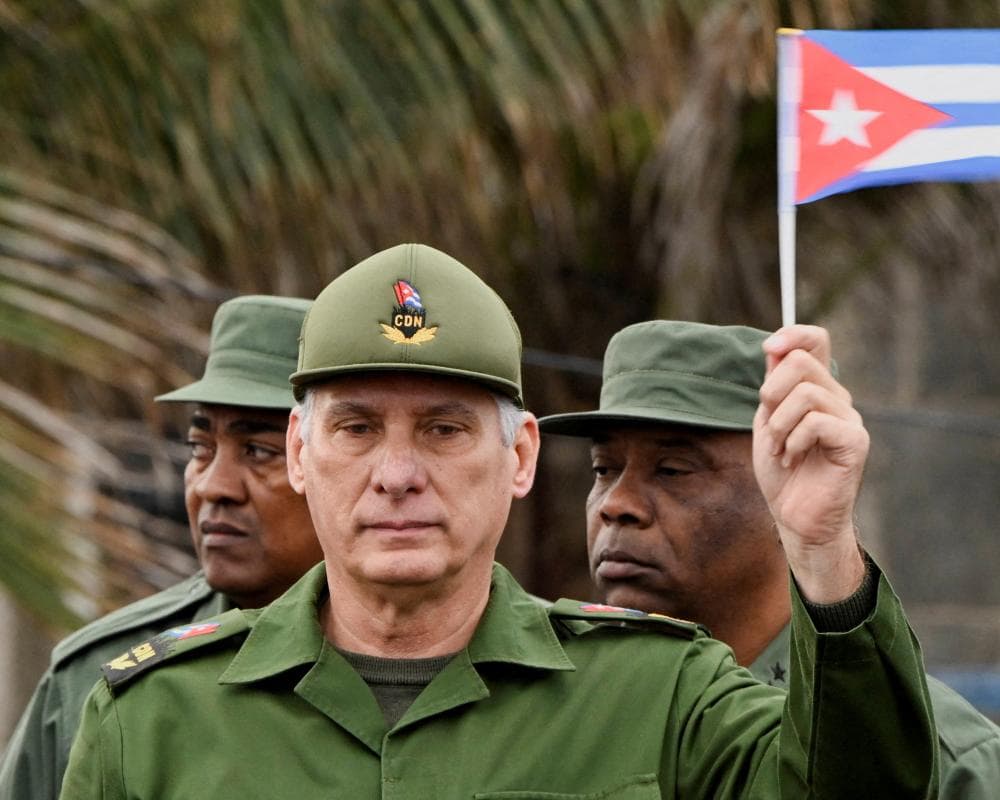
Cuban officials have held talks with the US government, the country’s president Miguel Díaz-Canel confirmed on Friday, amid growing pain inflicted by a punishing US fuel blockade and frequent power failures.
“These talks have been aimed at finding solutions through dialogue to the bilateral differences we have between the two nations,” Diaz-Canel said in a pre-recorded statement to senior Communist officials.
Those differences are stark and well known: Marco Rubio, the US secretary of state and son of Cuban immigrants, has made it clear he wants regime change in Havana, while Donald Trump this week repeated his calls for a “friendly takeover” – before then telling reporters: “It may not be a friendly takeover.”
After the US military’s successful abduction of Venezuelan president and Cuba ally Nicolás Maduro in January, Trump signed an executive order effectively placing the Caribbean island under an oil blockade. Diaz-Canel confirmed on Friday that no fuel has entered for three months.
In his remarks to the Communist party leaders, and subsequently to hand-picked reporters, Diaz-Canel was careful not to offer much more information, beyond efforts to increase domestic oil production and keep the electricity grid operating in some form.
Recently, large numbers of people have been banging pans on the streets at night to signal their frustration, and a group of students at Havana University staged a sit-in on the university steps.
“Whenever we have been in tense situations in relations with the United States, efforts have been made to find channels for dialogue,” Diaz Canel told the reporters. “I believe the most recent example were the talks with President Obama.”
Despite the lack of information, there were plenty of signs to read, most notably, the presence of Raúl Guillermo Rodríguez Castro, the 41-year-old grandson of the 94-year-old former president Raúl Castro, during the statement and the press conference.
Rodríguez Castro has no official role in government and until recently, he was best known as a businessman and his grandfather’s head of security. But in the past few weeks it has been widely leaked by Washington that “Raulito”, as he is often known, has been meeting with US officials, including during February’s Caricom meeting of Caribbean leaders in Saint Kitts.
Carlos Alzugaray, Cuba’s former ambassador to the EU, said it was a clear message of unity from the Cuban government. “It’s not the narrative that the US state department wants to project,” he said. “That narrative is that this is a government in panic and that the US is in talks with the Castro family – that Raúl Castro is negotiating his exit and is prepared to sacrifice Diaz-Canel. That is clearly not the case. The president made a point to say the talks were directed by Raúl Castro and himself.”
Cuba preceded its announcement with news that it will release 51 prisoners in the coming days, under an agreement with the Vatican. As yet, it has not announced who will be included. According to Prisoners Defenders, Cuba is holding 1,214 prisoners of conscience.
According to Michael Bustamante, chair of Cuban and Cuban-American Studies at the University of Miami, the names will be important, especially if it they include Luís Manuel Otero Alcántara, an artist and dissident who was arrested during protests that roiled Cuba in July 2021, and whose incarceration still offends many Cubans.
“That could be taken as a significant adjustment,” he said. “But the conditions under which they are released is important. If they have a Sword of Damocles over their heads and could be sent back to prison at any point that doesn’t really resolve the point.” He also pointed out that the 51 prisoners released are fewer than the 53 Cuba freed during the negotiations with Barack Obama’s administration in December 2014, at the beginning of the Obama’s administration’s thaw in relations.
He also suggested that Diaz-Canel blundered in comparing Cuba’s willingness to proceed in these talks with how they handled negotiations with Obama. “If you know nothing else about the Trump administration, you should know the president hates Obama, so if you’re trying to ratchet down the tension, comparing what you’re doing to what you did with Obama, is not the way you want to go.”
There was no immediate response to Cuba’s statement from the White House.