Loading...
Please wait for a bit
Please wait for a bit
Click any word to translate
Original article by Jennifer Rankin in Brussels and Flora Garamvolgyi in Budapest
The candidate leading the polls in Hungary’s upcoming elections has said the alleged sharing of confidential EU information between Budapest and Moscow should be investigated as possible treason, while the European Commission has called for “clarifications” over the alleged leaks.
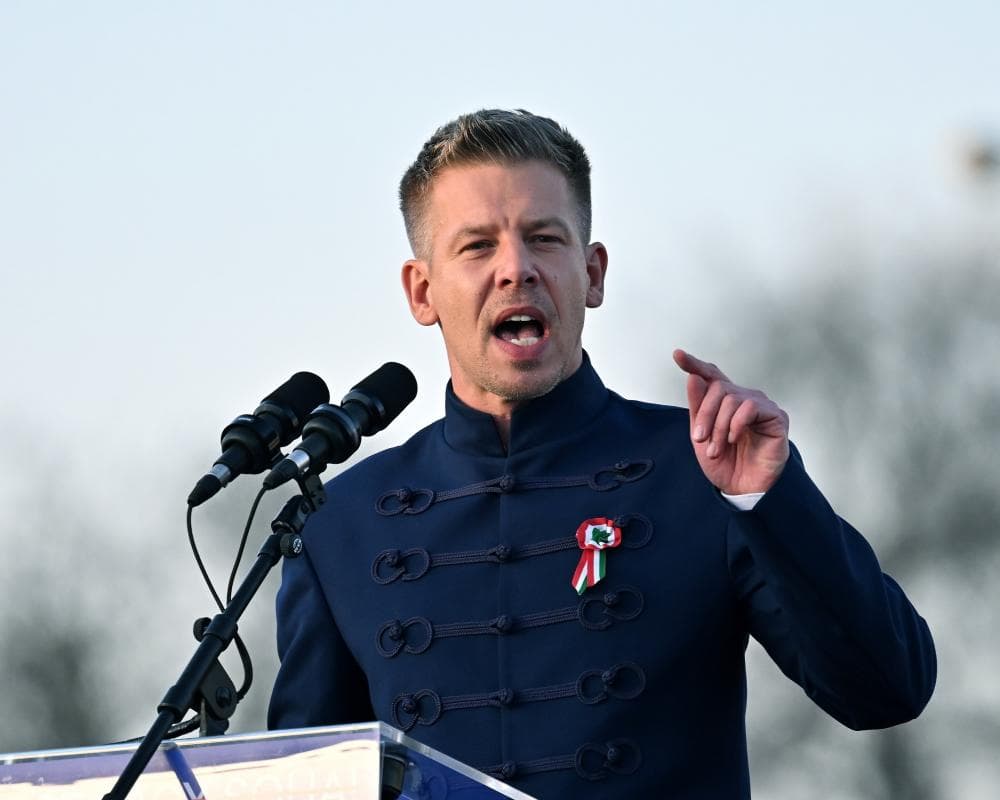
Péter Magyar, a conservative anti-corruption campaigner who is mounting the most serious challenge to Viktor Orbán’s 16-year-long grip on the Hungarian premiership, said the government appeared to be colluding with Russia, “thereby betraying Hungarian and European interests”.
A report in the Washington Post last week said Hungary’s foreign minister, Péter Szijjártó, routinely updated his Russian counterpart with the details of confidential EU meetings. Magyar wrote on X on Monday: “If confirmed, this would amount to treason, which carries a potential life sentence. A future Tisza government will immediately investigate the matter.”
Magyar, a former insider of the ruling Fidesz party, leads the rival Tisza party, which is ahead in the polls three weeks before the country goes to vote on 12 April.
The European Commission has called on Hungary’s government to provide clarity over the reported leaks. The commission’s spokesperson Anitta Hipper said reports that Szijjártó had disclosed information from closed-door EU meetings to his Russian counterpart, Sergei Lavrov, were “greatly concerning”.
She told reporters: “A relationship of trust between member states and between them and the institution is fundamental for the work of the EU and we expect the Hungarian government to provide the clarifications.”
Relations between Hungary and its EU neighbours, never the smoothest, have plummeted to new icy lows as Orbán enters election campaign mode. He blocked a €90bn EU loan for Ukraine last week.
Poland’s prime minister, Donald Tusk, tweeted over the weekend: “The news that Orbán’s people inform Moscow about EU council meetings in every detail shouldn’t come as a surprise to anyone. We’ve had our suspicions about that for a long time.”
Citing a European security official, the Washington Post reported that Szijjártó called Lavrov during EU meetings with “live reports on what’s being discussed”. Two diplomatic sources confirmed to the Guardian that the Hungarian foreign minister had shared information with Lavrov.
Szijjártó, who was given an award by Vladimir Putin in 2021, is a regular at the EU foreign affairs council, which has discussed the war on Ukraine every month since the full-scale invasion just over four years ago. He dismissed the allegations as “fake news”.
EU diplomats said they were not surprised by the reports and that tightening the circulation of information and documents could be required. Currently, there are no restrictions on Hungary’s access to information, although a diplomat from one EU member state said they were more guarded when a Hungarian representative was present.
A German foreign ministry spokesperson said on Monday that discussions within the EU were confidential and “we will not tolerate any violation of them”.
In the wake of the Washington Post report, Orbán ordered an investigation into what he called the “wire-tapping” of Szijjártó.
He announced the inquiry after a pro-government publication, Mandiner, published an article claiming that foreign intelligence agencies had eavesdropped on Szijjártó with the help of a Hungarian journalist, Szabolcs Panyi. The piece included a voice recording of Panyi sitting down with a source.
Panyi told the Guardian: “This is a smear campaign aimed at discrediting me. After they found out I was working on Szijjártó’s leak, they bugged [the room] and recorded my conversation.” He was meeting a source with the aim of finding out more about communication between Lavrov and Szijjártó after the Washington Post’s report, he said.
Panyi, one of Hungary’s leading investigative journalists, has reported extensively on Russian influence operations in his country. In 2024, Panyi revealed that the former Slovakian prime minister, Peter Pellegrini, had sought Orbán’s help in obtaining an invitation to Moscow four years earlier in what proved to be an ultimately unsuccessful bid by his left nationalist government to retain power.
Panyi’s report for VSquare in 2024 alleged that Orbán had tasked Szijjártó with conveying Pellegrini’s message to Lavrov. Pellegrini made an official visit to Moscow in an attempt to appeal to pro-Russian sentiment in Slovakia, but his government lost the 2020 election.
Panyi has previously found his phone infected with Pegasus spyware, in what he believed to be targeted hacking by the government to get ahead of his stories and identify his sources.
EU diplomats do not expect Orbán to change his mind on the €90bn loan for Ukraine before the 12 April elections. Nor is the EU likely to retaliate against Orbán for blocking the loan or the alleged leaks to Russia, for fear of handing him a campaign card.
Sweden’s prime minister, Ulf Kristersson, wrote on Sunday that criticism of Orbán at the EU summit had been “fierce” but added: “The rest of us won’t play along and become props in Orbán’s own Hungarian election campaign.”
The Washington Post also reported that Russian intelligence operatives proposed a staged assassination attempt on Orbán to motivate his supporters, once it became clear Magyar was leading the polls.
The Guardian has found that other disinformation networks with links to Russia, known as Operation Overload and Storm-1516, are also publishing content on platforms such as YouTube and X aimed at undermining the credibility of Magyar’s Tisza party and accusing Ukraine of meddling in the elections.