Loading...
Please wait for a bit
Please wait for a bit
Click any word to translate
Original article by Tom Ambrose (now) and Yohannes Lowe (earlier)
We are closing this blog but will be restarting coverage again tomorrow amid trilateral talks between Ukraine, Russia and the US in Abu Dhabi. A first round last month failed to yield a breakthrough and there are few hopes this week will be any different amid the latest attacks. You can read our report here
Here is a round-up of the day’s leading news stories from across the continent:
A Russian overnight attack damaged part of the Motherland monument in Kyiv, an iconic Soviet-era World War II memorial, Ukraine’s culture minister said on Tuesday. The gigantic statue of a woman holding a sword and shield towers over the Ukrainian capital, with a complex at its base housing the National Museum of the History of Ukraine in the Second World War.
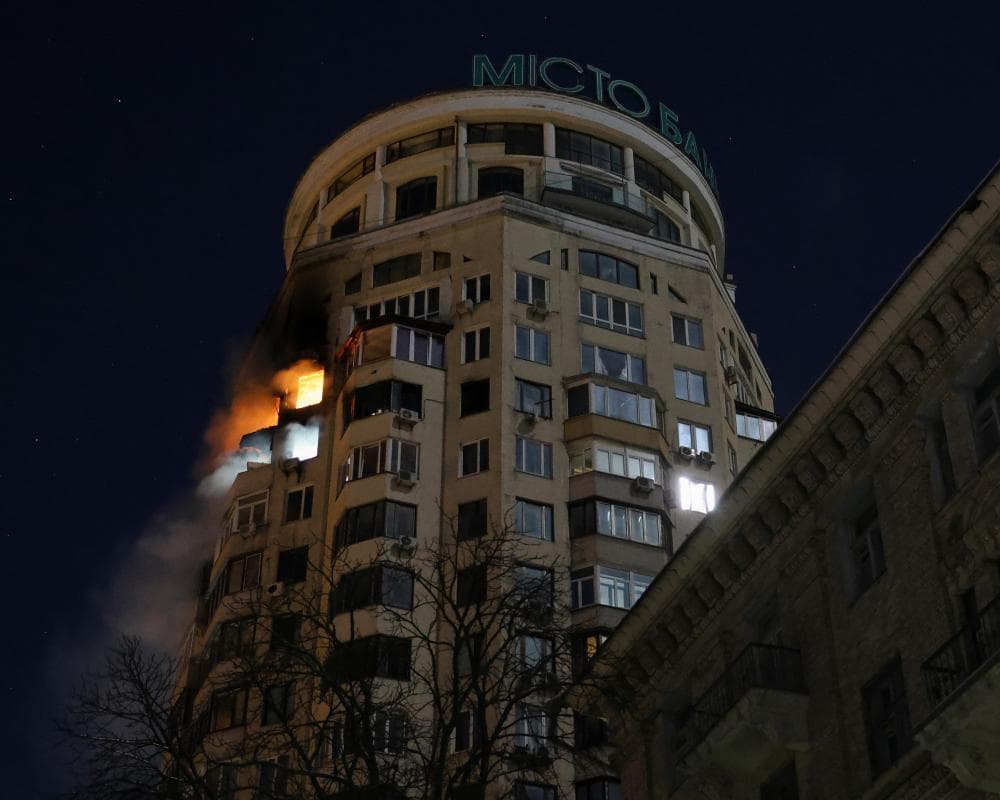
Volodymyr Zelenskyy said Russia’s latest attacks involved a “record number” of ballistic missiles and deliberately targeted energy infrastructure. Zelenskyy said there were 32 ballistic missiles, 28 cruise missiles, 11 missiles of “other types” and 450 attack drones used in the assualt that was launched as temperatures dropped to -20C and left many apartments in Kyiv without heating.
Nato secretary-general Mark Rutte visited Kyiv in a show of support. He said that the overnight strikes raise doubts about Moscow’s intentions on the eve of talks, calling them “a really bad signal.” He added that it was clear that the attacks only strengthen Ukrainians’ resolve.
An air alert warning of a possible Russian missile attack blared out across Kyiv on Tuesday during a visit by Nato chief Mark Rutte, AFP reporters heard. The Ukrainian air force warned there was a “threat of a ballistic” missile.
Sweden and Denmark will jointly procure and supply Ukraine with air defence systems worth 2.6 billion Swedish crowns ($290 million) to help it ward off Russian attacks, the countries’ defence ministers said on Tuesday. Sweden will fund 2.1 billion crowns of the purchase of Tridon air defence systems, developed by BAE Systems Bofors, the Swedish arm of the defence material group, while Denmark will contribute about 500 million crowns, Swedish defence minister Pal Jonson said.
Nato has started the military planning for an Arctic Sentry mission, a spokesperson for the alliance’s military headquarters Shape said on Tuesday. “Planning is underway for a Nato enhanced vigilance activity, named Arctic Sentry,” Colonel Martin L O’Donnell, spokesperson for the Supreme Headquarters Allied Powers Europe, said, confirming a report by German magazine Spiegel.
The European Commission would be “open-minded” to discussing closer trade ties with the UK, including a customs union, a senior EU official has said. The EU economy commissioner, Valdis Dombrovskis, told the BBC that the European bloc was “ready to engage with an open mind” when asked about a customs union.
Europe must keep control over key technologies that underpin the region’s economies, the European Union’s Financial Services Commissioner said on Tuesday, adding to growing calls for the bloc to be less reliant on US-based technology giants. Europe is increasingly focused on “digital sovereignty” - the idea that reliance on companies from an increasingly isolationist United States is a threat to Europe’s economy and security.
France is lacking in warships and accompanying missiles required to face an era that could lead to war, army chief Fabien Mandon said on Tuesday. “Today the number of warships is insufficient and the quantities of missiles on board [of ships] are especially insufficient,” Mandon told a naval conference in Paris.
Kyrgyzstan said on Tuesday the European Union’s sanctions envoy would visit on 26 February after a report that the EU was planning to ban some exports to the Central Asian country for allegedly facilitating Russian sanctions evasion. Bloomberg News reported last week that the EU was considering the first use of its “last resort” anti-sanctions evasion tool by banning exports of certain categories of goods to Kyrgyzstan.
The son of Norway’s crown princess has pleaded not guilty to four counts of rape on the first day of his trial for multiple offences, a legal saga that has embarrassed the royal family and raised questions over domestic abuse in Norway. Appearing in front of a packed courtroom at Oslo district court on Tuesday morning, Marius Borg Høiby also denied charges including abuse in close relationships and filming women’s genitals without their knowledge.
Spain will seek to ban under-16s from using social media platforms, the country’s prime minister Pedro Sánchez announced, following Australia’s ban for under-16s in December and French lawmakers last week passing a bill that would ban social media use by under-15s.
Prosecutors have raided the French headquarters of Elon Musk’s social media platform X and summoned the tech billionaire and the company’s former chief executive for questioning as part of an investigation into alleged cybercrime. “A search is under way by the cybercrime unit of the Paris prosecutor’s office, the national police cyber unit and Europol,” the Paris prosecutors’ office said in a post on X on Tuesday, adding that it would no longer be publishing on the network.
Europe must keep control over key technologies that underpin the region’s economies, the European Union’s Financial Services Commissioner said on Tuesday, adding to growing calls for the bloc to be less reliant on US-based technology giants.
Europe is increasingly focused on “digital sovereignty” - the idea that reliance on companies from an increasingly isolationist United States is a threat to Europe’s economy and security.
“Europe must retain control over the key technologies that underpin and drive our economies,” EU commissioner Maria Luís Albuquerque told a financial technology regulatory conference in Brussels.
A senior official at the Netherlands’ central bank also told the same event that Europe should be less reliant on technology firms based outside the region.
Nato has started the military planning for an Arctic Sentry mission, a spokesperson for the alliance’s military headquarters Shape said on Tuesday.
“Planning is underway for a Nato enhanced vigilance activity, named Arctic Sentry,” Colonel Martin L O’Donnell, spokesperson for the Supreme Headquarters Allied Powers Europe, said, confirming a report by German magazine Spiegel.
He refused to provide additional details as planning had only just begun.
A Russian overnight attack damaged part of the Motherland monument in Kyiv, an iconic Soviet-era World War II memorial, Ukraine’s culture minister said on Tuesday.
The gigantic statue of a woman holding a sword and shield towers over the Ukrainian capital, with a complex at its base housing the National Museum of the History of Ukraine in the Second World War.
The statue is a symbol of Kyiv. After Russia’s invasion, Ukraine replaced the Soviet hammer and sickle emblem on it with a Ukrainian trident.
Updated
Nato secretary general Mark Rutte and Volodymyr Zelenskyy held a joint press conference earlier and both gave statements to the press before taking questions. Here are the highlights:
Volodymyr Zelenskyy
Zelenskyy said there must be “consequences” for Russia’s overnight attack on Ukraine, which he said broke the terms of the temporary energy ceasefire announced by the US last week. He cautioned against “partners” remaining “silent” over the strikes.
Zelenskyy said licenses are needed so Europe can adequately protect itself, including for missiles crucial for air defence systems that the US has.
Zelenskyy said himself and Rutte agreed that a Ukrainian army with 800,000 personnel is an acceptable size. As a reminder, the Kremlin has said it will only feel safe when Ukraine’s army is capped at 600,000.
Zelenskyy said EU membership forms a key part of security guarantees but said the most important thing is what “Europeans would be ready to do if Russia will attack us again and what Americans will do”.
Mark Rutte
Rutte said Ukraine needs binding commitments and security guarantees in the case of future Russian aggression. He said this is what the ‘coalition of the willing’ brings, including the deployment of European forces and a “crucial” US “backstop”.
Rutte said he is confident that allies would allocate $15bn this year under the Prioritized Ukraine Requirements List (PURL) programme, under which Nato countries buy weapons from the US to give to Ukraine. He said two-thirds of Nato allies are participating in the initiative.
Rutte also urged for more equal “burden-sharing” as some allies “are doing a lot” and a few are “doing nothing”. He stressed the positive contributions of countries including Norway, Holland, Germany, Denmark, Canada and Sweden.
Rutte said Russia’s full-scale invasion, launched in February 2022, was “crazy” and said its continuing assault on Ukraine is targeting civilian infrastructure, creating “chaos” for innocent civilians.
Rutte said Ukraine is ready “to play ball” and come to a deal – acceptable to Kyiv – with the Russian side, but added that the massive Russian attack last night was a “really bad signal” ahead of future negotiations.
Updated
The European Commission would be “open-minded” to discussing closer trade ties with the UK, including a customs union, a senior EU official has said.
The EU economy commissioner, Valdis Dombrovskis, told the BBC that the European bloc was “ready to engage with an open mind” when asked about a customs union.
The comments come amid growing pressure within the Labour party to enter a customs union with the EU, as the government seeks to boost economic growth at a time of geopolitical turmoil.
Keir Starmer is looking for deeper economic links with the EU single market, having said the customs union “doesn’t now serve our purpose very well”.
A customs union with the EU would call into question UK trade deals with countries such as India, Australia and Japan, which add little to economic growth but are potent symbols of Brexit. In theory, inside a customs union, the UK would be under the umbrella of the EU’s 40-plus trade agreements with about 70 countries and regions.
You can read more here:
France is lacking in warships and accompanying missiles required to face an era that could lead to war, army chief Fabien Mandon said on Tuesday.
“Today the number of warships is insufficient and the quantities of missiles on board [of ships] are especially insufficient,” Mandon told a naval conference in Paris.
“Those are the areas of effort needed in the future because the battle will be difficult and so we need weapons and we need to have quantities,” he said.
He added that preparations now needed to be made for a possible return to war.
Updated
Kyrgyzstan said on Tuesday the European Union’s sanctions envoy would visit on 26 February after a report that the EU was planning to ban some exports to the Central Asian country for allegedly facilitating Russian sanctions evasion.
Bloomberg News reported last week that the EU was considering the first use of its “last resort” anti-sanctions evasion tool by banning exports of certain categories of goods to Kyrgyzstan.
In a statement, Kyrgyzstan’s government said deputy prime minister Daniyar Amangeldiev held a video call with EU envoy David O’Sullivan on Tuesday and they agreed on “constructive and substantive dialogue on sanctions-related issues“.
It said further talks would take place during O’Sullivan’s visit to Bishkek later this month.
An air alert warning of a possible Russian missile attack blared out across Kyiv on Tuesday during a visit by Nato chief Mark Rutte, AFP reporters heard.
The Ukrainian air force warned there was a “threat of a ballistic” missile.
Russia fired a record number of such missile at Ukraine in a massive overnight attack that knocked out heating and power for hundreds of thousands of people as temperatures dipped below minus 20C.
Updated
Sweden and Denmark will jointly procure and supply Ukraine with air defence systems worth 2.6 billion Swedish crowns ($290 million) to help it ward off Russian attacks, the countries’ defence ministers said on Tuesday.
Sweden will fund 2.1 billion crowns of the purchase of Tridon air defence systems, developed by BAE Systems Bofors, the Swedish arm of the defence material group, while Denmark will contribute about 500 million crowns, Swedish defence minister Pal Jonson said.
“This means that Ukraine can develop an air defence battalion if they so wish,” he told a joint press conference in Gothenburg, Sweden, with his Danish counterpart Troels Lund Poulsen.
“The purchase doesn’t just support Ukraine on the battlefield with more material, but also strengthens our production capacity in Sweden.“
According to a summary of the address, Mark Rutte also said:
President Trump and his team are determined to stop the bloodshed, with the support of America’s allies – and it is clear that Ukraine is committed.
Direct talks are now underway and this is important progress. But Russian attacks like those last night, do not signal seriousness about peace. We know Russia is paying a heavy price for this war with over one million casualties to date and rising.
Yet, despite Putin’s willingness to sacrifice countless of his own people, he’s not winning. Any gains on the battlefield are grindingly slow.
During Nato chief Mark Rutte’s address to the Ukrainian parliament earlier, he said:
The United States, Europe and Canada have affirmed their readiness to provide the assurance that Ukraine needs to be able to forge a peace with Russia. The members of the coalition of the willing made encouraging progress on these guarantees when they met last month in Paris. I was at that meeting and so was President Zelenskyy.
Some European allies have announced that they will deploy troops to Ukraine after a deal is reached. Troops on the ground, jets in the air, ships on the Black Sea. The United States will be the backstop, others have vowed to support in other ways.
The security guarantees are solid, and this is crucial – because we know that getting to an agreement to end this terrible war will require difficult choices.
Shifting our attention back to Ukraine now, where the country’s president, Volodymyr Zelenskyy, said Russia’s latest attacks involved a “record number” of ballistic missiles and deliberately targeted energy infrastructure.
Zelenskyy said there were 32 ballistic missiles, 28 cruise missiles, 11 missiles of “other types” and 450 attack drones used in the assualt that was launched as temperatures dropped to -20C and left many apartments in Kyiv without heating.
In a post on X, Zelenskyy wrote:
Energy infrastructure facilities in several regions were hit, with the greatest damage in the Kharkiv and Dnipro regions, Kyiv and the region, the Vinnytsia and Odesa regions, as well as in Zaporizhzhia…
The heating situation is particularly difficult in Kyiv, Kharkiv, and Dnipro, as well as Lozova in the Kharkiv region …
Each such Russian strike confirms that attitudes in Moscow have not changed: they continue to bet on war and the destruction of Ukraine, and they do not take diplomacy seriously. The work of our negotiating team will be adjusted accordingly.
The overnight Russian ballistic and drone attack came shortly before Nato chief Mark Rutte was in Kyiv to meet Zelenskyy and to address the national parliament. The latest round of talks between Russia, Ukraine and the US are due to be held on Wednesday and Thursday in Abu Dhabi. You can read more here.
Updated
Miranda Bryant is the Guardian’s Nordic correspondent
The son of Norway’s crown princess has pleaded not guilty to four counts of rape on the first day of his trial for multiple offences, a legal saga that has embarrassed the royal family and raised questions over domestic abuse in Norway.
Appearing in front of a packed courtroom at Oslo district court on Tuesday morning, Marius Borg Høiby also denied charges including abuse in close relationships and filming women’s genitals without their knowledge.
Høiby, 29, pleaded guilty to charges including sexually offensive behaviour, a serious drug offence, violation of a restraining order and several driving-related offences. He pleaded partially guilty to serious bodily harm, reckless behaviour and violation of a restraining order.
His pleas for two of the charges, bodily injury and two cases of damage, were inaudible. He faces 38 charges in total.
The lead prosecutor, Sturla Henriksbø, said that despite Høiby’s status there should be “equality before the law”. You can read more here:
The Guardian’s Europe correspondent, Jon Henley, has written a full report on why prosecutors have raided the French headquarters of Elon Musk’s social media platform X, which you can read here:
Updated
The EU’s foreign policy chief, Kajas Kallas, has been speaking as part of a panel on Arctic security. Kallas was asked if the EU was “too cautious” in taking action because of its dependence on the US for security, which has been exposed amid Russia’s war on Ukraine and the Trump administration’s threats on Greenland and erratic behaviour towards its longstanding western allies. Kallas, who has said Nato must “become more European” to maintain its strength, responded:
Of course, we are cautions because there is a lot at stake. There is a full-scale war going on the European continent and there are threats coming from economic coercion, big challenges from China that is influencing our economies.
If it is influencing our economies, it is influencing jobs and people’s salaries and then it is creating polarisation within our societies and more instability, so it is all very much interlinked.
So, we have to carefully walk this road and try to adapt and work. We don’t want conflict with anybody, we want a peaceful life and prosperity for our peoples.
But it is the situation where we are and if you have such big risks, also the military threats, then you also need to work on building the defence that is acting as a deterrence so we might not need it if the deterrence is strong enough.
Her comments come in the wake of the Donald Trump backing down over his repeated threats to use force or trade sanctions to take control of Greenland, an autonomous Danish territory, that arguably triggered the most serious crisis in Nato’s history. They also followed Nato chief, Mark Rutte, saying European lawmakers should “keep on dreaming” if they believed Europe could protect itself without the US.
Updated
In other news, Spain will seek to ban under-16s from using social media platforms, the country’s prime minister Pedro Sánchez announced this morning, following Australia’s ban for under-16s in December and French lawmakers last week passing a bill that would ban social media use by under-15s.
“Spain will ban access to social media for minors under the age of 16. Platforms will be required to implement effective age verification systems, not just checkboxes, but real barriers that work,” Sánchez said, speaking at a leaders summit in the UAE.
“Today, our children are exposed to a space they were never meant to navigate alone. Space of addiction, abuse, pornography, manipulation, violence. We will no longer accept that.”
To enforce the ban, the Spanish government will reportedly seek to order platforms to put stringent age verification methods in place. The government will introduce a new bill next week to hold social media executives accountable for illegal and hateful content.
Sánchez said Spain had joined five other European countries that he labelled the “Coalition of the Digitally Willing” to coordinate and enforce cross-border regulation.
The coalition will hold its first meeting in the coming days, he said, without specifying what countries would be involved.
Updated
The European Commission last month launched an investigation into Elon Musk’s X over the production of sexually explicit images and the spreading of possible child sexual abuse material by the platform’s AI chatbot, Grok.
The investigation extended a probe into X’s recommender systems, algorithms that help users discover new content, as my colleague Jennifer Rankin noted in this story.
It came after Grok caused outrage by allowing users through its AI image generation and editing capabilities to digitally strip people. Researchers said some images appeared to include children. Some governments subsequently banned the service or issued warnings.
Offices belonging to Elon Musk’s widely-used social media platform, X, in France are being raided by the Paris prosecutor’s office.
A search is being carried out at the French premises of X by the cybercrime unit of the Paris prosecutor’s office, a statement read, with the support of Europol.
The raid is linked to a year-long investigation into alleged abuse of algorithms and fraudulent data extraction by X or its executives.
Paris Prosecutor’s office said it was widening that investigation after complaints over the functioning of X’s artificial intelligence chatbot Grok.
According to the prosecutor’s office, both Musk and former X CEO Linda Yaccarino had been summoned to appear at hearings in April as part of its probe.
“At this stage, the conduct of this investigation is part of a constructive approach, with the aim of ultimately ensuring that the X platform complies with French laws, insofar as it operates on national territory,” the prosecutor’s office said. X has not issued an immediate response but has previously denied allegations it had manipulated its algorithm.
Poland’s defence ministry said this morning that one of its employees has been detained and charged with collaboration with a foreign intelligence service.
News website Onet had earlier reported that a defence ministry employee was detained for collaborating with Russian intelligence.
“The services have been monitoring this man’s activities for many months. His actions were thoroughly documented and analyzed. Therefore, the evidence gathered against him is very strong. This is one of our greatest successes,” a source familiar with the operation told Onet. We have not yet been able to independently verify the contents of the report.
Donald Trump has said his administration may have “some good news” soon on its efforts to end the war in Ukraine, something the US president boasted he could do within 24 hours of returning to office for his second term in the White House.
“I think we’re doing very well with Ukraine and Russia. For the first time, I’m saying that,” Trump told reporters in the Oval Office on Monday. “I think we’re going to, maybe, have some good news.”
As we mentioned in the opening post, Ukrainian talks with Russian and US officials are due to take place over two days from Wednesday in Abu Dhabi. A White House official said US envoy Steve Witkoff would attend the talks. Volodymyr Zelenskyy said the Ukrainian delegation would also hold bilateral meetings with US officials during the two days.
The Kremlin has insisted that any agreement has to involve Ukraine ceding the entire eastern Donbas region, including areas still under Ukrainian control.
As my colleague Pjotr Sauer notes in this story, Kyiv has strongly rejected those terms, although Zelenskyy has said he is willing to consider alternative arrangements, including the withdrawal of Ukrainian troops from parts of the east and the creation of a demilitarised zone.
The first round of trilateral talks in Abu Dhabi were held on 23-24 January, with no apparent breakthrough despite positive noise being made afterwards.
Nato secretary-general Mark Rutte has arrived in Kyiv. He will address the Rada, Ukraine’s parliament, according to the Kyiv Post.
The Ukrainian president, Volodymyr Zelenskyy, shared a video on X of himself and Rutte paying tribute to Ukrainian soldiers killed fighting for the country.
Maidan Nezalezhnosti. The People’s Memorial of National Remembrance. A memorial honoring our heroes, warriors, our people who defended Ukraine against the enemy, fought, and made the ultimate sacrifice in this war.
— Volodymyr Zelenskyy / Володимир Зеленський (@ZelenskyyUa) February 3, 2026
Together with @SecGenNATO Mark Rutte, we honored the memory of… pic.twitter.com/ugWsJChlAV
Nato did not issue an official announcement regarding Rutte’s diplomatic visit, but this is not unusual given the heightened security concerns stemming from the conflict.
Updated
A bit more detail on the brief energy ceasefire:
The Kremlin said on Friday it had agreed to halt strikes on energy infrastructure until Sunday at the request of Donald Trump, and Kyiv said it would reciprocate.
The Kremlin said Trump had made a personal request to Vladimir Putin to refrain from striking Kyiv until Sunday (1 February).
Volodymyr Zelenskyy said the truce was supposed to last for a week, starting Friday (30 January). Ukraine and Russia disagreed on the timeframe for the truce.
Updated
The latest Russian attacks on Ukraine indicate the end of a brief energy ceasefire, under which Russian President Vladimir Putin was said to have agreed to temporarily suspend strikes on Ukraine’s critical energy infrastructure.
The Ukrainian foreign minister, Andrii Sybiha, said the overnight Russian attack involved 450 drones and over 60 missiles, including ballistic ones, with the main targets being energy and residential houses in Kyiv, Dnipro, Kharkiv, Sumy and Odesa, alongside other regions. In a lengthy post on X, Sybiha wrote:
Putin waited for the temperatures to drop and stockpiled drones and missiles to continue his genocidal attacks against the Ukrainian people.
Neither anticipated diplomatic efforts in Abu Dhabi this week nor his promises to the United States kept him from continuing terror against ordinary people in the harshest winter.
We are dealing with terrorists who must be forced to stop violence. The world has the tools. Strengthen Ukraine’s air defense and energy resilience. Increase pressure on Moscow.
About 1,170 residential buildings in Kyiv have been left without heating, the city’s mayor, Vitali Klitschko, wrote in a Telegram post, as temperatures fell to -20C.
Volodymyr Zelenskyy said yesterday that Russia had not carried out any targeted missile or drone strikes on Ukrainian energy infrastructure in the past 24 hours, although Russian shelling hit energy facilities near the frontline.
Updated
Under a proposal discussed between Ukrainian, European and American officials, Kyiv has agreed with western allies that repeated breaches of any future ceasefire agreement from Russia would lead to a coordinated US-Europe military response, sources briefed on the discussions have told the Financial Times.
A Russian ceasefire violation would be met with a response within a day, starting with a “diplomatic warning” and a response from the Ukrainian army to stop the violation, three people familiar with the plan told the FT in a report which we are yet to independently verify.
If fighting continued, there would be a second phase of intervention using forces from the ‘coalition of the willing’, made up of over 20 of Ukraine’s allies who have agreed to provide Kyiv security guarantees once a ceasefire is brokered with Russia, which has so far been sticking to its maximalist demands.
If the ceasefire violation developed into a wider attack, three days after the initial breach, then a coordinated military response by a western-backed force involving the US military would be triggered, according to the officials.
American, European and Ukrainian officials discussed the proposals on several occasions in December and January, according to the FT.
British prime minister Keir Starmer – who has been at the forefront of the ‘coalition of the willing’ initiative – said last month after talks in Paris that the UK and France would send troops to Ukraine “in the event of a peace deal” with Russia.
Russia has repeated that it would regard the deployment of any foreign military forces or infrastructure in Ukraine as unacceptable foreign intervention and treat those forces as legitimate targets, the Russian foreign ministry said on Monday, citing foreign minister Sergei Lavrov
A second round of talks between Russian, Ukrainian and US officials on a US-drafted plan to end the war will begin on Wednesday, Ukraine’s president, Volodymyr Zelenskyy, said over the weekend.
Despite the continuing diplomatic efforts to bring Russia’s full-scale invasion of Ukraine to an end after nearly four years, attacks on Ukrainian towns and cities remain unabetted.
Russian forces attacked Ukraine’s capital of Kyiv, its second-largest city of Kharkiv and other centres early this morning, officials said, triggering fires and dealing new blows to energy infrastructure. The strikes injured at least four people, officials in the two largest cities said. Stick with us as we bring you the latest.
Updated