Loading...
Please wait for a bit
Please wait for a bit
Click any word to translate
Original article by Jakub Krupa
in Munich
… and on that note, it’s a wrap for today and for our coverage from the 2026 Munich Security Conference!
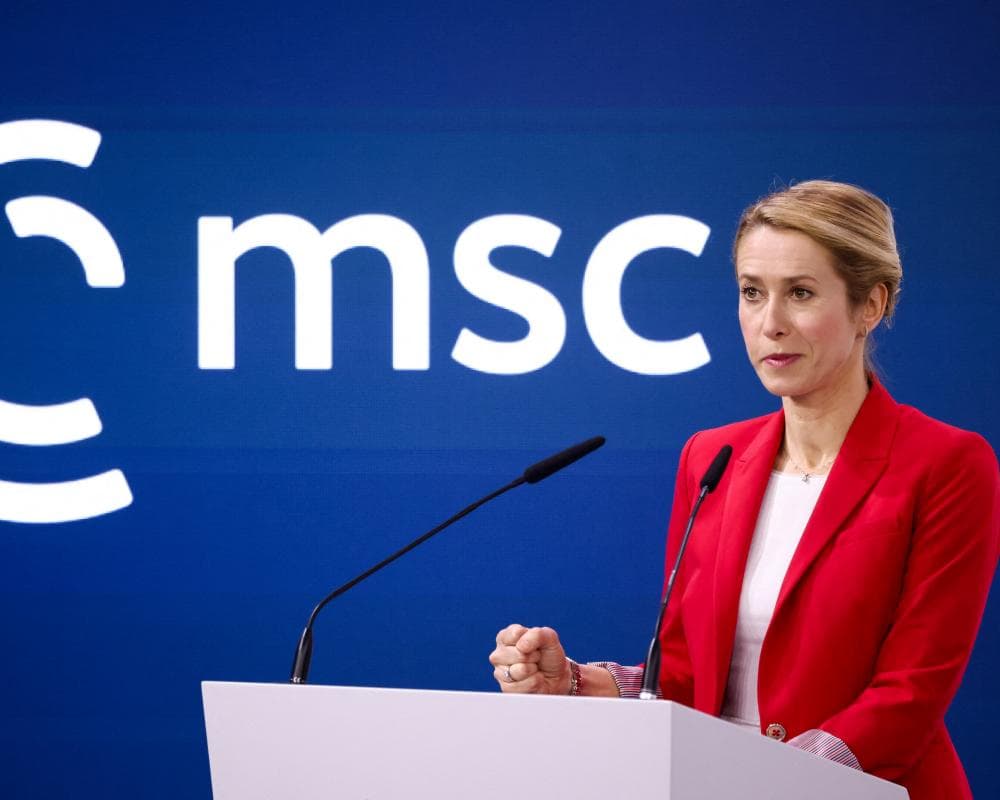
“Contrary to what some may say, woke decadent Europe is not facing civilizational erasure,” the EU’s top diplomat, Kaja Kallas, insisted as she appeared on stage on the final day of the conference (9:48).
But Kallas welcomed US secretary of state Marco Rubio’s speech from Saturday, saying that “we don’t see eye to eye in all the issues and that this will remain the case as well, but I think we can work from there” (9:51).
But other European leaders urged Europe to not “cling to love words” from the US, but focus on reforming itself, ramping up its defence production and strenghtening its strategic independence (9:52, 9:53, 9:58).
The European Central Bank president, Christine Lagarde, struck an upbeat tone that Europe always “gets better in crisis,” as she called for a reaction to “kick in butt by Trump” (10:40).
Meanwhile, former US secretary of state Hillary Clinton accused Donald Trump of “betraying the west” with his “disgraceful” policy of pressurising Ukraine to strike a peace deal with Russia (11:18).
Separately,
Both Kallas and Latvian president Edgars Rinkēvičs said that while the EU was broadly agreed on prioritising Ukraines’ accession to the bloc, they currently appeared “not ready” to commit to a specific date (10:06), as Ukraine’s Volodymyr Zelenskyy keeps pushing for a 2027 target.
Looking forward to the upcoming peace talks in Geneva, Kallas said the EU should focus on identifying its key asks of Russia (10:26).
The US secretary of state, Marco Rubio, has landed in Slovakia as he continues his European charm offensive tour, with a visit to Hungary expected on Monday (11:04).
And that’s all from me, Jakub Krupa.
Thank you for following our reporting from Munich.
If you have any tips, comments or suggestions, email me at jakub.krupa@theguardian.com.
I am also on Bluesky at @jakubkrupa.bsky.social and on X at @jakubkrupa.
Updated
Ex Nato secretary general Stoltenberg also briefly comes in on Greenland in the context of managing differences between Europe and the US.
He says:
“As friends and as allies, we have to be very clear when some core values are threatened or challenged.
For instance, on Greenland, many European countries and Norway said very clearly it is unacceptable to claim the territory of another country, and we said that to our strongest ally. I think that was the right thing to do.
Sometimes we have to be very clear, especially when these core values are challenged; but it’s not all about clarity and [simply] saying what we think, but it’s also about finding a way to address the problem.
The good news now is that we are in a better place now than we just were a few weeks ago because now there is actually an ongoing process between Greenland and Denmark and the United States to address the issues that have been raised and hopefully we’ll find a way to sort it out and continue to be together in this big transatlantic family.”
Brantner also talks about how the EU can benefit from what’s happening in the US as some scientists seek to relocate to Europe.
Responding to a question from an American member of the audience, she says:
“I am very happy we have a lot of American scientists coming to my home town, for example, Heidelberg, and helping us to work on Alzheimer and many things, because you have a health minister who believes in no science.
It will strengthen Europe, if I may say so, [even though] it’s a pity for the US.”
Alliance 90/Greens co-chair Franziska Brantner gets a round of applause as she says in response to a question from a Ukrainian MP:
“First of all, allow me to say that I want to thank all Ukrainians who are fighting for their freedom, but also for our freedom.”
Others on the panel chip in with their thanks, too.
in Munich
Okay, now Andrej says we need to defend free and independent press, “even if they are a bit annoying.”
We are friends again.
in Munich
Plenković says no young people buy papers any more, maybe except for sport newspapers, and now I feel kind of personally offended.
Try the Guardian, Andrej!
Updated
Speaking on values, Croatian prime minister Andrej Plenković says that “the most important political event that somehow swept across Europe happened 10 years ago, and that was the unprecedented migration crisis.”
“The 2015-2016 migration crisis changed political scenery across Europe.
It had an impact on every single member state – in some of them faster, in some of them maybe with a sort of delayed effect – but it had an impact on strengthening the political parties who were, let’s say, on the [extreme ends] of the political spectrum [and] the mainstream parties had to react, everybody gradually became more restrictive vis a vis migration.”
He says:
“I think we are still in the age where we are living on a daily basis, the consequences of that event, including in the country where we are today.”
Updated
Stoltenberg also says that “the most urgent challenge to the values of freedom and democracy is what we see now on the frontlines in Ukraine.”
“There’s no doubt that that that Ukraine has to prevail; military support to Ukraine is so obviously the right thing to do for everyone that believes in democracy and freedom.”
But he says he is open to a broader discussion on inconsistencies in how countries respond to global events, potentially muddling the understanding of their values.
“I think that one of the challenges we have seen is, for instance, the conflict in the Middle East compared to Ukraine.
There are huge differences, but it is about sovereignty and respecting international law and therefore my own country Norway, we have been very clear … in condemning Russia’s invasion of Ukraine and supporting Ukraine, but we’ve also been very clear that Israel is responsible for illegal occupation of the West Bank and Gaza.
Again, two very different situations, but it undermines our credibility that we believe in these values if we are not clear when international law is violated regardless of where it is, why and by whom. …
I think that of course any double standard weakens the credibility of our values and we need to be honest about ourselves because I think we all have demonstrated that we are not always consistent, also my own country.”
Speaking on values, former Nato secretary general Jens Stoltenberg has just offered this pragmatic view on how the alliance should work:
“So yes, the more we can agree on values, the better.
But fundamentally, what really matters when it comes to security, is that we are realising that we have a common interest to protect and defend each other.
And sometimes these issues are mixed, and of course, there is a relationship between values and interest, but I think the history of Nato and its friends demonstrates that there can be quite serious differences on values, but still we’re able to rally around our common interests.”
in Munich
Late panels are not always particularly popular, but last night’s discussion on the “west-west” divide and what remains of the shared EU-US values proved to be a hit with many Munich attendees.
During a wide-ranging discussion, one moment stood out in particular as former US secretary of state Hillary Clinton offered this brutal takedown of Donald Trump’s foreign policy on Ukraine.
She said:
“I think that the Trump administration’s position toward Ukraine is disgraceful. I think the effort to force Ukraine into a surrender deal with Putin is shameful. I think the effort that Putin and Trump are making to profit off the misery and death of the Ukrainian people is a historic error and corrupt to the nth degree.
I believe Ukraine is fighting for our democracy and our values of freedom and civilisation on the frontlines, losing thousands of people and having their country destroyed by one man’s mania to control them, and I think Trump either doesn’t understand or could [not] care less about that suffering.”
She continued on Trump:
“He has betrayed the west. He’s betrayed human values. He’s betrayed the Nato charter, the Atlantic Charter, the Universal Declaration of Human Rights.
A lot of what has been done before to try to make sense of how difficult it is to restrain people who want unaccountable power – and none of us in this room, including all of us on this panel, would choose to live under a regime that was so unaccountable that it could act with impunity the way that Putin does – except that’s who Trump is modeling himself on.”
Updated
Meanwhile, US secretary of state Marco Rubio has arrived in Slovakia as he continues his European charm offensive tour.
He was welcomed by Slovakia’s foreign minister Juraj Blanár, and will meet with both the country’s controversial prime minister, Robert Fico, and the president, Peter Pellegrini.
The local media reported they will be talking among the US-Slovak relations, regional security, and nuclear energy, among other things.
Rubio will later go on to Hungary, in a closely watched visit less than two months before the high-stakes parliamentary election that could see Viktor Orbán ousted from the office.
The top US diplomat’s decision to visit two countries governed by most pro-Russian countries governments in Europe – whose leaders continue to engage with Vladimir Putin and regularly oppose measures targeting Russia – raised some eyebrows in other parts Europe.
Let’s see what comes out of it.
Lagarde also offers her take on the European preference policy idea, as she says she is “a bit concerned” about it.
“I think that it’s an area where the policymakers must talk to the private sector, and they must understand whether the European preference will actually work for them to be as efficient as possible while keeping security as high as is necessary.
We are in this wonderful setting at the Munich Security Conference; you can talk to the militaries, you can talk to the people in the defence sector.
Many of them will tell you: yes, it’s fine, but the preference perimeter must be large enough to have the best technology brought into the equipment that they make – and you can define your parameter on the basis of the good partners and the real friends and exclude those that are not in that category.”
One of the things that dominated the conference in Munich yesterday was the disclosure by the UK and five other countries that the late Russian opposition leader Alexei Navalny was killed using a poison developed from a dart frog toxin administered by the Russian state two years ago.
UK foreign secretary Yvette Cooper spoke about it on Sky News this morning, as my colleague Yohannes Lowe reports over on the UK politics blog.
Here’s what she said:
“And that is why we have together found the evidence of this lethal toxin that was found in Alexei Navalny’s body at time he died.
And only the Russian regime had the motive, the means and the opportunity to administer this lethal posion while he was in prison in Russia.
They wanted to silence him because he was a critic of their regime and that is why we have exposed this barbaric Kremlin plot to do so and made sure that we have done so with evidence as well.
The reason as well that we have done this is was one of the things that Alexei Navalny himself said that. He said ‘tell the truth, spread the truth, that is the most dangerous weapon of all’. The Russian regime tried to stop him doing so, so we have done so instead.”
The European Central Bank president, Christine Lagarde, is now speaking on a panel about competitiveness and EU economy.
She says:
“If you read Jean Monnet, if you read Schuman, if you read the founding fathers, they all say the same thing: Europe grows in times of crisis. Europe is stronger, gets better together in times of crisis.”
She says that the EU is responding to a number of crises currently, including “the kick in the butt that we all received as a result of president Trump’s change of attitude towards Europe.”
“I’m just saying this is what is happening at the moment, and it does bring the leaders of Europe, the policymakers much closer together – that needs to continue.”
EU’s Kallas appears to be slightly sceptical about the idea of appointing an EU envoy for talks on ending the Russian invasion of Ukraine.
She earlier said that “what matters more than having a seat at the table is knowing what to ask [for] when you are sitting there.”
She now returns to this issue and says the focus should be on defining the key European asks.
“That’s why I proposed to the member states [a] concrete mandate [of] the asks that we would have to Russia. So whoever goes to that table, whether it’s individually or bilaterally, they should ask [for] these things from the Russians.
We have a saying in Estonian that if you demand a lot, you get little; if you demand little, you get nothing, and if you demand nothing, you pay on top.”
And that ends this panel.
in Munich
You can tell that we are quickly approaching the end of the conference as we just lost two of the four panellists as they had to run to catch their planes back home.
But don’t worry: your blogger’s plane is not until late evening, so I will bring you all the key lines here.
Latvia’s Rinkēvičs also gets asked about whether the upcoming election in Hungary could unblock the path for Ukraine, as Viktor Orbán – who continues to fiercely oppose Kyiv’s membership in the EU – could be ousted from power after 16 years.
He says:
“I would caution that both Olympic Games … and elections sometimes produce very unexpected results. Let’s not jump ahead of the curve. Let’s not assume something that only voters in each of our countries can decide. …
So let’s wait till things happen and let’s see how that happen.”
He says equally there will be elections in France and Poland next year that could change the dynamics in the other direction.
Latvian president Edgars Rinkēvičs offers his take on Ukraine and Volodymyr Zelenskyy’s push to be give a specific date for his country’s accession to the European Union as part of any future peace deal.
He says “we understand that we need Ukraine in the European Union,” but talking to other EU leaders he has “kind of feeling that at this point, as we speak today here in Munich in February, there is no readiness to [agree on] a date.”
He says the bloc “wants to see Ukraine [join] as soon as possible,” but it needs to address two other issues as part of that process.
Rinkēvičs has the EU “needs to look at western Balkans,” as the EU “has lots all the credibility in the region” by not progressing its accession prospects.
“We have been promising so many things in return for reforms, for name change of North Macedonia, for instance. We have been promising [them the] membership for so long.”
And he adds the EU cannot forget about Moldova.
“Yes, that’s a small country, but if Ukraine comes in, we can’t leave out Moldova out of this, so it’s not only about Ukraine any more,” he says, adding that would require “a very serious discussion” on how to manage the process.
He says “like it or not,” Ukraine’s EU membership is “very much tied to the peace deal,” but he says he is not optimistic about Russia genuinely engaging with the process, so it can be agreed.
“If Russia is not moving, then we are not going to have a deal,” he says.
The EU’s top diplomat, Kaja Kallas, agrees:
“My feeling is that the member states are not ready to give a concrete date. There’s a lot of work to be done, but I think the [sense of] priority … to move and to show that Ukraine is part of Europe is there,” says.
Updated
Nato’s deputy secretary general Radmila Šekerinska picks up Haddad’s point.
She says that the last Nato summit in The Hague agreed not just on increased defence spending, but also on ramping up own production.
She says:
“This will be repeated in Ankara now: we need to produce more, and we need to produce more everywhere.
We need more European production, we also need more production on the US side.
If you look at the numbers, and especially if you look at the numbers on key capabilities, which are urgent in Ukraine, like air defence, we don’t have enough, period.”
She adds:
“Unfortunately, most of our stockpiles are not up to the task. We went to industry, … and the only place where these capabilities were available was in the US stockpiles.
I was in Norway recently, I visited a company that does all of its exports to the US, and then the US has additional production and many of European countries buy it.
These are the links that defence companies have developed.If we try to dismantle them, we end up weaker and not stronger, so the call in the Ankara summit will be very much we need to produce more and for this, we need better regulation, we need speedier processes, and this is very much where Nato focuses on how do we make interoperability standards.”
France’s Haddad also pushes for “European preference” on defence purchases, arguing it’s just “common sense.”
He says when you’re increasing defence budgets – often by cutting other spejnding - you cannot then spend it abroad to “subsidise a factory in Kentucky” in the US.
“This makes no sense,” he says.
He says it’s also about the control of use, export, and technological knowhow that comes with it.
“We know that when you buy a weapon from another area, it comes with strings attached. It comes with [some] fine print on how and when you can use it. So all of this is absolutely critical.”
France’s Europe minister Benjamin Haddad has a slightly different take on the speech though, lamenting that four Europeans on a panel are expected to respond to Rubio’s speech a day later.
“We should not either be relieved or shocked by this or that speech. I think the worst lesson we could draw from this weekend is to say, well, I can cling to some love words that I heard in part of his speech and push the snooze button,” he says.
He says the EU should instead “focus on ourselves,” including on rearmament and improving its competitiveness.
“This is also the best way in the long run to reshape and maybe salvage the transatlantic relationship: to make it more balanced, more mature, with two pillars that are equal rather than looking for love or thinking about how the Americans are going to talk about us.”
Kallas, a former Estonian prime minister, also offers a bit more on Rubio’s speech, as she says “there were messages for us, and they were messages for the public in America.”
“For me, every time I hear this European bashing – it’s very in fashion right now – I’m thinking of what is the alternative and, and really, I mean, all the best or good things that we got from Europe, and all the good things that Europe actually represents.”
But she says she gets some reassurance from Rubio’s comments:
“The message that we heard from there is that America and Europe are intertwined; have been in the past and will be in the future. I think this is important. It is also clear that we don’t see eye to eye in all the issues and that this will remain the case as well, but I think we can work from there.”
She also takes a dig at the US, saying:
“Coming from a country that is #2 in the Press Freedom Index hearing criticism regarding press freedom coming from a country that is #58 on this list is interesting.”
Ouch.
Updated
EU’s Kallas is speaking on the main stage now.
In her first response to Rubio’s speech yesterday, she somewhat snarkily says that “contrary to what some may say woke decadent Europe is not facing civilizational erasure,” and says that many countries still “want to join our club – and not just fellow Europeans,” pointing to Canada.
She says that Russia continues to pose a significant challenge.
“This starts in Ukraine, but we know that Russia’s endgame is not Donbas,” she says, pointing to continuing attempts to sabotage or undermine EU countries.
She continues:
“But let’s be clear-eyed about Russia: Russia is no superpower. After more than a decade of a conflict, including 4 years of full-scale war in Ukraine. Russia has barely advanced beyond the 2014 lines, and the cost? 1.2 million casualties.
Today, Russia is broken, its economy is in shreds. It is disconnected from the European energy markets and its own citizens are fleeing.
In fact, the greatest threat Russia presents right now is that it gains more at the negotiation table, then it has achieved on the battlefield.”
Updated
in Munich
Guten Tag, as we open the third – and final – day of the Munich Security Conference.
We have a fairly short programme today, with Europeans reacting to US secretary of state Marco Rubio’s speech yesterday, and thinking about further reforms to the EU’s economy and competitiveness.
Can you think of a better Sunday morning?
We will hear from the EU foreign policy chief, Kaja Kallas, ECB president Christine Lagarde, and former Nato secretary general Jens Stoltenberg, among others.
It’s Sunday, 15 February 2026, it’s Jakub Krupa here, and this is Europe Live.
Good morning.