Loading...
Please wait for a bit
Please wait for a bit
Click any word to translate
Original article by Jakub Krupa
… and on that note, it’s a wrap for today!
Danish prime minister Mette Frederiksen said last night’s high-profile meeting with US representatives was “not easy,” warning that “there is a fundamental disagreement” over “the American ambition to take over Greenland” (12:07).
Frederiksen said Greenland’s defence was a “common concern” for the whole of Nato, as troops started arriving from across Europe as a result of Donald Trump’s threats to take the Arctic island by force (10:11, 10:44, 12:02, 13:05, 14:39).
Greenlandic prime minister Jens-Frederik Nielsen said “dialogue and diplomacy are the right way forward” on Greenland, as he reiterated that “Greenland is not for sale” and doesn’t want to be a part or governed by the US (13:42, 16:50).
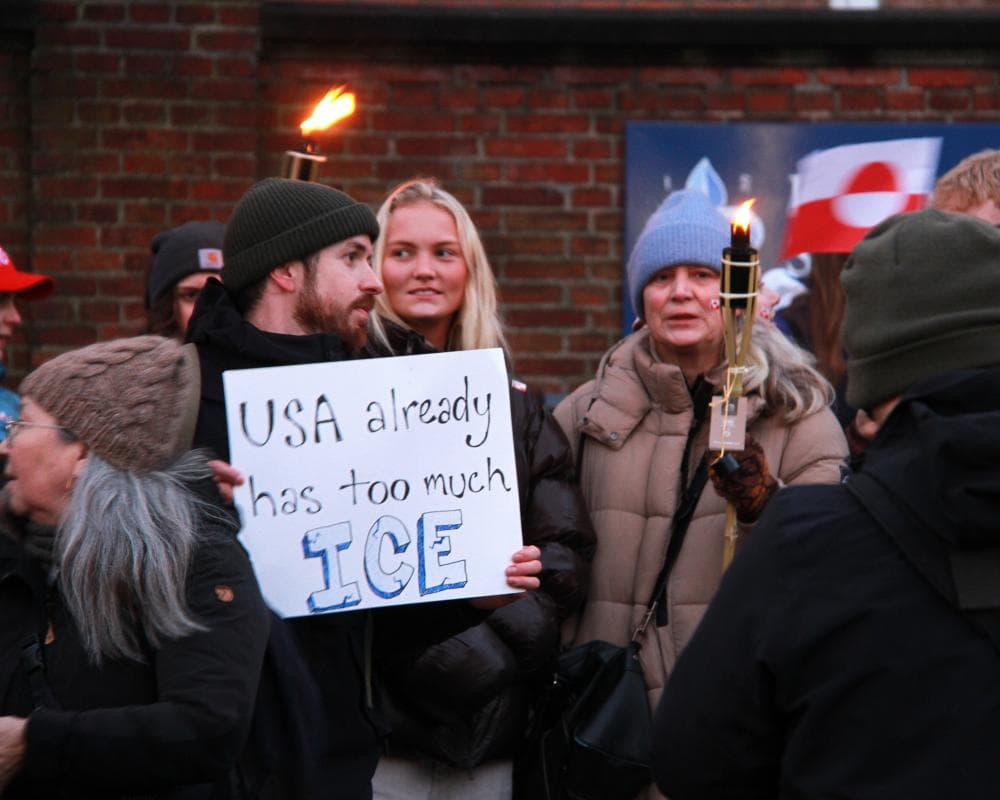
The Danish parliament has just announced it would fly the Greenlandic flag, Erfalasorput, on Friday to mark its support for the people of the semi-autonomous territory ahead of planned meetings between Danish, Greenlandic and US parliamentarians (15:15).
Separately, French president Emmanuel Macron has warned that “we live in a world where destabilising forces have awakened,” as he worried about “certainties that sometimes lasted for decades being called into question” and the standoff over Greenland (13:00, 13:05, 13:17)
Meanwhile, the European Commission president Ursula von der Leyen has promised a new security strategy for Europe, as part of its broader response against a backdrop of US threats to annex Greenland (17:15).
And that’s all from me, Jakub Krupa, for today.
If you have any tips, comments or suggestions, email me at jakub.krupa@theguardian.com.
I am also on Bluesky at @jakubkrupa.bsky.social and on X at @jakubkrupa.
Brussels correspondent
in Lemesos/Limassol, Cyprus
The president of the European Commission, Ursula von der Leyen, has promised a new security strategy for Europe, against a backdrop of US threats to annex Greenland.
Speaking to reporters in Cyprus, Ursula von der Leyen described the US as a partner when asked about the situation in Greenland.
She said the EU was doubling down in its economic support for Greenland:
“What is clear is that Greenland can count on us politically, economically and financially. And when it comes to its security, the discussions on Arctic security are first and foremost, a core issue of Nato.”
Arctic and Arctic security, she added, were both core topics for the EU.
She declined to go into detail about what a European security strategy could entail, days after the EU’s defence commissioner Andrius Kubilius floated the idea of a European army.
“We are starting to work on a new European security strategy and at the beginning of the work it is not wise to limit or expand the different topics.”
Investigations correspondent
One day during his first term, Donald Trump summoned a top aide to discuss a new idea.
“Trump called me down to the Oval Office,” John Bolton, national security adviser in 2018, told the Guardian. “He said a prominent businessman had just suggested the US buy Greenland.”
It was an extraordinary proposal. And it originated from a longtime friend of the president who would go on to acquire business interests in the Danish territory.
The businessman, Bolton learned, was Ronald Lauder. Heir to a makeup fortune – the global cosmetics brand Estée Lauder – he had known Trump, a fellow wealthy New Yorker, for more than 60 years.
Bolton said he discussed the Greenland proposition with Lauder. After the billionaire’s intervention, a White House team began to explore ways to increase US sway in the vast Arctic territory controlled by Denmark.
Trump’s renewed pursuit of Lauder’s idea during his second term is typical of how the president operates, Bolton said. “Bits of information that he hears from friends, he takes them as truth and you can’t shake his opinion.”
The proposal seems to have stirred Trump’s imperialist ambitions: eight years on, he is mulling not just buying Greenland but perhaps taking it by force.
Greenlandic prime minister Jens-Frederik Nielsen just had a brief speech at a New Year’s reception in Copenhagen, but he largely stuck to the main lines from his earlier statement (13:42).
In comments reported by Danish broadcaster DR, he said it was “time for us to stand together,” as he repeated that “Greenland is not for sale, and we do not want to be a part of the US.”
He also reiterated that Greenland is open to cooperation with the US, but it wants to see it territorial integrity and sovereignty respected.
Meanwhile, Czech president and retired Nato general Petr Pavel has visited Ukraine on Thursday, meeting with government officials in the western city of Lviv and discussing what further support European countries could offer to the wartorn country.
Pavel, who chaired the Nato military committee between 2015 and 2018, has been a vocal supporter of Ukraine as it continues to defend itself from Russian aggression.
The main purpose of his visit was to “express support for Ukraine,” and highlight the ongoing humanitarian aspect of the conflict given recent large-scale energy disruptions caused by Russian strikes on the country, iDnes.cz reported.
He is also expected to meet with Ukraine’s Volodymyr Zelenskyy later, ČTK reported.
Estonia has confirmed it would contribute to planning the joint European military exercise in Greenland and be “ready to put boots on the ground if requested,” the country’s foreign minister Margus Tsahkna said.
The Danish parliament has just announced it would fly the Greenlandic flag, Erfalasorput, on Friday to mark its support for the people of the semi-autonomous territory ahead of planned meetings between Danish, Greenlandic and US parliamentarians.
In a statement on its website, the parliament said the gesture is meant to “support the Greenlanders’ right to Greenland and show the Danish support given political pressure from the US.”
“This is a new reality … and this meeting is a special occasion,” the speaker, Søren Gade, said.
Updated
Meanwhile, the Netherlands is the latest country to confirm it will join Nato allies in a Danish-led military exercise in Greenland and will send one officer from the Dutch navy, Reuters reported.
I can’t recommend you checking the Greenland piece below strongly enough, even if just to take a look at these absolutely stunning (and very informative) visuals there. Helps a lot with understanding what the US interest in Greenland is all about.
By Ashley Kirk, Lucy Swan, Tural Ahmedzade, Harvey Symons and Oliver Holmes
Lying between the US and Russia, Greenland has become a critical frontline as the Arctic opens up because of global heating.
Its importance has been underscored by Donald Trump openly considering the US taking the island from its Nato partner Denmark, either by buying it, or by force.
The climate crisis is shrinking Greenland’s ice sheet, along with the wider Arctic sea ice, opening new sea routes and exposing valuable resources.
Trump’s threats, previously dismissed as bluster, are now being seen as an early signal of how melting ice is turning Greenland into a valuable geopolitical flashpoint.
Our maps and charts explain its importance.
Greenlandic prime minister Jens-Frederik Nielsen said “dialogue and diplomacy are the right way forward” on Greenland, as he reiterated that “Greenland is not for sale” and doesn’t want to be a part or governed by the US.
In a post on Facebook, Nielsen thanked the Danish and Greenlandic foreign ministers for their talks in Washington, which he said were conducted in “serious but constructive” tone.
He particularly welcomed the move to create a working group to “continue working on the disagreements between the parties.”
“Dialogue and diplomacy are the right way forward, even when the stakes are high and the pressure is palpable,” he said.
But Nielsen insisted that he needed to be “absolutely clear” that any discussion “requires respect for our constitutional position, for international law and for our right to our own country.”
He acknowledged that the “security situation is serious, and the geopolitical interests in our region are significant,” but called for “unity, calm and responsibility” in the face of these ongoing discussions.
Updated
It’s quite telling that despite repeatedly referring to Greenland as an emerging issue and various delicate hints about the ever-changing nature of alliances, Macron didn’t fully go in and name the US as the primary source of instability and concerns about the territory.
Macron ends his speech on a strong note, warning that “we live in a world where destabilising forces have awakened,” and will continue to pose threats, all while “certainties that sometimes lasted for decades are being called into question” with “competitors [Europe] never thought it would see.”
(Again, who could he possibly be thinking about?)
That ends the speech.
In a stark warning, Macron also warns that “peace is under threat” globally, as he insists that “France and the Europeans must continue to be present wherever their interests are threatened.”
He makes direct reference to Ukraine and to Greenland, although he stops short of naming who, ekhm, is threatening the semi-autonomous Danish territory.
But he stresses that “Europeans have a particular responsibility there,” stressing Denmark’s EU and Nato membership.
He says France has joined the Danish exercises planned as part of the Operation Arctic Endurance, and confirms that a first team is “already on site and will be reinforced in the coming days by land, air and sea assets.”
“This is the role that France must play: to be available when assessing the threat, to be able to adapt and to stand alongside a sovereign state to protect its territory,” he says.
Updated
French president Emmanuel Macron is now speaking in Istres, outlining the defence and security challenges facing the French and European armies.
In his annual speech to the army, he particularly focuses on the need for France and Europe to continue stepping up its defence capabilities and on-going on securing its sovereignty.
The French president speaks about the work on rearmament over the past decade, saying it is starting to “bear the fruit,” as he stresses that the changing nature of the world order requires more work in this area.
“To remain free, one must be feared. To be feared, one must be powerful. And to be powerful in this brutal world, one must act faster and stronger,” he says.
But Macron also recognises that France is behind Ukraine on some technologies, as drones, recognising the pace of innovation in the area.
In one particularly worth noting passage, he discusses the importance of the The European Long-range Strike Approach, or ELSA, coalition to develop European deep-strike capabilities, which he says is increasingly urgent given Russia’s recent use of the Oreshnik missile in Ukraine.
“This launch is a very clear signal from a power that already has such capabilities, and decided to acquire even more, and a message that is clear to all those who think Russia is not our concern,” he says.
He stresses that France is “within the range of these missiles,” and so Europeans need to “seize the opportunity” to work on new weapons, particularly with German and UK partners.
He says Europeans need to accelerate their production and deployment capacity to reduce external dependencies.
He also says there are clear signs of France and partners stepping up, pointing to the pace at which the Coalition of the Willing – under a Franco-British command – was able to discuss and offer significant security guarantees to Ukraine in case of a peace deal with Russia.
But more broadly he strikes a cautious tone as he warns against the rise of destabilising powers, including Russia and Iran, and the emergence of “a rhetoric that sometimes sows doubt, including among allies,” and what he calls a “new colonialism”.
(No prizes for guessing who he may be alluding to here.)
Danish prime minister Mette Frederiksen has responded to last night’s “not easy” meeting with US representatives in Washington, warning that “there is a fundamental disagreement” over “the American ambition to take over Greenland.”
In a post on Facebook, Frederiksen stressed the Danish government would “continue our efforts to prevent this scenario from becoming a reality.”
She noted that there is a growing consensus within Nato about strenghtening military presence in the Arctic as part of the broader European and transatlantic security.
She said that Denmark has invested “significantly” in new Arctic capabilities, and a number of allies were expected to contribute to joint exercises.
The defence and protection of Greenland is a common concern for the entire Nato alliance.
Frederiksen added that the government would brief the leaders of the other political parties on the talks on Friday.
Updated
Poland’s Tusk also said that Poland would not send troops to Greenland, despite the new European mission to strenghten the security of the Arctic.
Poland is heavily invested in strengthening its defence on the eastern flank as it faces an increasingly assertive Russia with continuing intense attacks on Ukraine.
The Polish prime minister, and former president of the European Council, said however that he would do everything he could to ensure that Europe remained united in support of Denmark and Greenland, Reuters reported.
Tusk also warned against any US intervention in Greenland, saying that “an attempt to take over [part of] a Nato member state by another Nato member state would be a political disaster,” and “the end of the world as we know it.”
Poland’s prime minister Donald Tusk said there were strong reasons to believe a group connected to Russian secret services was behind a significant cyber-attack on Poland’s energy in infrastructure towards the end of December, Reuters reported.
Chairing an emergency meeting on the attack, Tusk said the attack focused on systems managing renewable energy, but insisted that Poland’s defence systems worked well and critical infrastructure continued to work unaffected.
He noted that if the attack had been successful, its impact – affecting the operation of two combined heat and power plants and various windfarms – could have disrupted heat and energy supplies for 500,000 residents.
The disclosure of the attack comes amid broader Russian activities aimed at disrupting energy supplies in Ukraine, Poland’s neighbour and close ally.
Updated
Meanwhile, the Kremlin said that Russia agreed with US president Donald Trump that it was Ukrainian president Volodymyr Zelenskyy who was holding up a potential peace deal to end the war in Ukraine, Reuters reported.
Last night, Trump told Reuters that he believed Russia’s Putin was “ready to make a deal,” but pointed his finger at the Ukrainian president as the reason why the war has not ended.
Kremlin spokesperson Dmitry Peskov said Trump was right, and stressed that “president Putin and the Russian side remain open [to talk]”.
But numerous European allies would probably have a radically different view on that, pointing to Russia’s unwillingness to compromise on its maximalist demands, including about Ukraine’s territory, and its continuing nightly attacks, including the country’s critical infrastructure, which left hundreds of thousands of people without heat or energy.
Irregular border crossings at the EU’s external borders fell by over one-quarter (26%) in 2025 to almost 178 000, less than half the total recorded in 2023 and the lowest level since 2021.
While key routes were down – Northern Africa to Italy by 66% and western African to the Canary Islands by 63% – there was no commensurate drop on the English Channel to the UK.
There were 65,861 successful or attempted crossings of small boats from France to the UK, a fall of 3% year on year.
This underlines the continued success of smuggling gangs in Europe despite falls in irregular migration.
“The trend is moving in the right direction, but risks do not disappear,” said Frontex Executive Director Hans Leijtens.
“This drop shows that cooperation can deliver results. It is not an invitation to relax. Our responsibility is to stay alert, support Member States on the ground, and ensure Europe is ready for new challenges at its borders.”
While the decrease is “significant” according to Frontex, “the situation at Europe’s borders remains uncertain”.
It added:
“Migration pressure can shift quickly between routes, shaped by conflict, instability and smuggling networks.
“The European Union is also already coping with attempts by hostile actors to exploit migration flows to put pressure on the EU’s external borders.”
Danish defence minister Troels Lund Poulsen told broadcaster DR that the intention behind Operation Arctic Endurance was to “establish a more permanent military presence” in Greenland, drawing on Danish military and foreign allies, and to conduct joint exercises.
He said there would be “a rotation” of allied countries coming in and out of the territory.
Asked if the exercises were meant to be a signal to the Americans, he declined to comment, DR noted.
Meanwhile, Russia has said it was “seriously concerned” by the arrival of Nato military personnel in Greenland, after US president Donald Trump’s comments about the territory.
“The situation unfolding in the high latitudes is of serious concern to us,” the Russian embassy in Belgium, where Nato is headquartered, said in a statement published late Wednesday.
Nato is “building up its military presence there under the false pretext of a growing threat from Moscow and Beijing,” the embassy added.
in Paris
The French president, Emmanuel Macron, called an emergency defence cabinet meeting at the Élysée at 8am this morning to discuss Donald Trump’s stance on Greenland as well as the situation in Iran.
In an overnight message on social media, Macron said a first group of French military personnel were already headed to Greenland to participate in an exercise organised by Denmark and Greenland.
“At Denmark’s request, I have decided that France will participate in the joint exercises organised by Denmark in Greenland,” Macron wrote. “The first French military elements are already en route. Others will follow.”
On Thursday afternoon, Macron will deliver his traditional new year’s address to French armed forces, where he could speak further about joint military exercises in Greenland.
France is the latest country to confirm a military deployment to Greenland as Denmark and allies are desperate to show US president Donald Trump that they take the Arctic security seriously and are capable of defending it if needed.
Greenlandic deputy prime minister, Múte B. Egede, said that more soldiers were expected in the coming days, joined by “more military flights and ships” as part of hastily convened “Operation Convince Trump” “Operation Arctic Endurance.”
But Trump’s first public reaction, just hours after a high-stake meeting between Danish and Greenlandic foreign ministers and senior US officials, suggested he was far to be convinced.
Talking to reported in the Oval Office, he repeated that Greenland was “very important” for the US national security, and “the problem is that there is not a thing that Denmark can do about it if Russia or China wants to occupy Greenland, but there is everything we can do.”
I will bring you all the latest from Greenland and its European allies as they are expected to confirm more deployments to the semi-autonomous territory.
I will also look at the latest from Ukraine, and across the continent.
It’s Thursday, 15 January 2026, it’s Jakub Krupa here, and this is Europe Live.
Good morning.