Loading...
Please wait for a bit
Please wait for a bit
Click any word to translate
Original article by Jakub Krupa
We will be closing the blog for today, so here is your summary of the day so far:
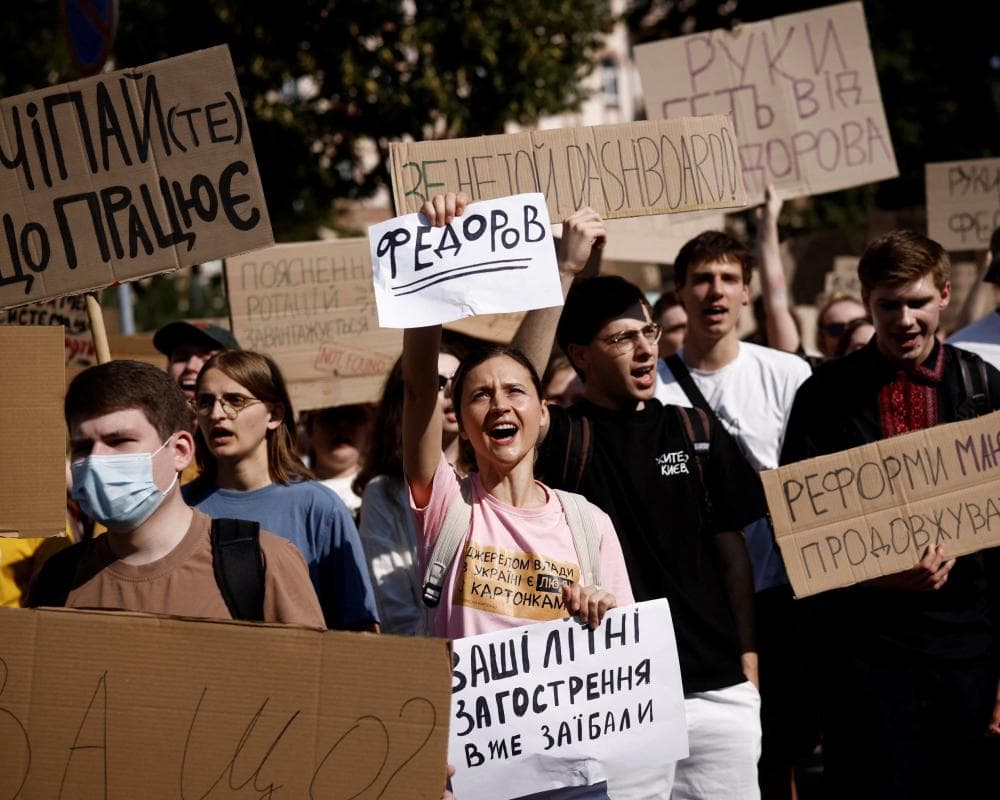
Thousands of people joined protests in Kyiv and other Ukrainian cities over president Volodymyr Zelenskyy’s decision to sack the country’s popular defence minister, Mykhailo Fedorov (9:59, 11:56, 13:29).
The growing domestic political crisis overshadowed Keir Starmer’s farewell visit to Kyiv (13:41), with both leaders stressing the strength of links between the UK and Ukraine (14:10, 14:33), and Zelenskyy saying he hoped to continue that relationship with the incoming prime minister, Andy Burnham (14:25).
Separately, Sergii Koretskyi has been confirmed by the Ukrainian parliament as the country’s new prime minister (11:24).
In other news,
The Ukrainian businessman who survived an assassination attempt in Monaco has accused Ukraine’s military intelligence agency of organising the attack (15:59).
The EU has failed to agree the latest round of sanctions against the Kremlin, with an interim decision to maintain the current price cap on Russian oil of $44.1o a barrel until 23 July pending another attempt at finalising the measures (10:25).
The EU’s top court has ruled that a controversial Spanish law that offered an amnesty to those who planned and participated in the failed and illegal push for Catalan independence does not violate the bloc’s rules (12:25).
Tourists in the Romanian capital, Bucharest, are staying in illegal accommodation listed on Airbnb and Booking.com in buildings considered so seismically vulnerable they could collapse in the event of a major earthquake, according to exclusive data shared with the Guardian (16:23).
If you have any tips, comments or suggestions, email me at jakub.krupa@theguardian.com.
I am also on Bluesky at @jakubkrupa.bsky.social and on X at @jakubkrupa.
The Ukrainian businessman who survived an assassination attempt in Monaco has accused Ukraine’s military intelligence agency of organising the attack.
In his first public statement since the bombing that shook the wealthy principality, Vadym Iermolaiev alleged that serving and former officers of the GUR military intelligence agency were behind the attempted killing, which left him injured but his partner critically wounded.
“Based on the investigative evidence available to us, we have no doubt that serving officers of the main intelligence directorate of the ministry of defence of Ukraine, commonly known as the GUR, were directly involved in this attempted assassination,” Iermolaiev said in a statement published by his lawyers.
French investigators have identified the suspected bomber as Anastasiia Berezovska, accusing the Ukrainian national of planting an explosive device in a public place with criminal intent. The bomb detonated as Iermolaiev emerged from a building with his partner and their 13-year-old child.
Days after the attack, Berezovska was found dead near Kyiv. Ukrainian authorities have arrested two suspects over her killing: Vladyslav Reut, an officer with the GUR, and former law enforcement officer Oleksandr Zhykovych.
Ukrainian prosecutors have sought to portray the case as the actions of a rogue intelligence officer, alleging that Reut concealed his contacts with Berezovska and acted without the knowledge or authorisation of the agency’s leadership.
in Kyiv
Ukraine’s president Volodymyr Zelenskyy has defended his decision to dismiss the country’s popular defence minister, Mykhailo Federov, and confirmed reports that relations had broken down between the ministry and the country’s top army leadership.
Speaking at a press conference in Kyiv with the British prime minister, Keir Starmer, Zelenskyy said there had been a “challenging dialogue” between Fedorov – widely seen as a reformist and moderniser – and the military’s commander in chief, Col Gen Oleksandr Syrskyi.
“I would very much like to see unity. The sides have not found it. And the problem lies not only with the sides, but with me as well,” Zelenskyy said. “But things are as they are. And in such a situation, you have a choice: either one side or the other,” he said.
Zelenskyy’s decision to back Syrskyi has outraged civil society and dismayed Ukraine’s foreign partners. More than a thousand protesters gathered outside the presidential office in Kyiv on Thursday, carrying placards in support of Federov. One read: “For what?”. Another said: “Is your head screwed on?” There were loud chants of “Syrskyi out”.
It was only the second time since Vladimir Putin’s 2022 invasion that large numbers of people have taken to the streets in anti-government protests. A year ago, Zelenskyy’s decision – later reversed – to close two anti-corruption agencies provoked a similar backlash.
The growing domestic political crisis overshadowed Starmer’s farewell visit to Kyiv, ahead of his departure on Monday from Downing Street. The two leaders laid wreathes at the Wall of Remembrance before holding one on one talks in the garden of the presidential palace, sitting together in a shady corner.
… and back to Ukraine…
Italy’s lower house of parliament approved a highly contested government plan to overhaul the electoral law, a move opponents denounced as an attempt to help prime minister Giorgia Meloni retain power in the next election due in 2027, Reuters reported.
The proposal by the ruling right-wing coalition, comprising Meloni’s Brothers of Italy, the League and Forza Italia, would introduce a fully proportional system while guaranteeing a majority to any bloc winning more than 42% of the vote.
Winners surpassing that threshold would receive a bonus of 70 seats in the 400-member lower house and 35 seats in the 200-member Senate. However, their total representation would be capped at 220 and 113 seats respectively, in a bid to avoid overly large majorities.
Debate over the reform exposed tensions within the alliance. On Tuesday, lawmakers rejected a government proposal to allow electors to express preference votes for candidates on party lists, partly due to coalition defections.
The bill still requires Senate approval, which the government hopes to secure after the summer recess.
Government supporters say the reform would guarantee that a stable majority comes out of the vote. Meloni is due to become Italy’s longest-serving postwar prime minister in early September, after presiding over an unusually prolonged period of stability, Reuters noted.
France and Morocco called for expressions of interest in an electricity interconnection project linking the two countries as part of broader efforts to strengthen energy ties between Europe and North Africa, French prime minister Sébastien Lecornu said.
The project was one of “ambitious economic projects that create new synergies between our companies and allow us to further integrate Morocco and France into shared value chains,” Lecornu told reporters at the end of a Franco-Moroccan high-level meeting in Rabat.
The project aims to identify commercially viable ways to export renewable electricity from Morocco to France, a French briefing document seen by Reuters said.
The two countries also signed cooperation deals covering finance, civil aviation, education, culture and diplomacy.
Polish prosecutors have charged a Ukrainian man with sabotage and diversionary activities on behalf of Russian intelligence, alleging he was paid to desecrate memorials honoring Polish victims of Ukrainian massacres in the second world war in an effort to inflame tensions between the two countries, AP reported.
Warsaw has long accused Russia of conducting hybrid operations aimed at driving a wedge between Poland and Ukraine.
Announcing the charges, Poland’s Internal Security Agency said the case had exposed “the mechanism of operation of Russian intelligence services, which pursued their own interests by inciting conflicts between the Polish and Ukrainian nations.”
According to Polish authorities, the 18-year-old Ukrainian national allegedly committed 47 criminal offenses between November 2024 and August 2025. In addition to allegedly desecrating memorial sites, he was charged with preparing a sabotage attack involving a drone, AP said.
Prosecutors said evidence suggested the suspect was recruited online and paid in cryptocurrency.
in Bucharest
and Carmen Aguilar García
Tourists in the Romanian capital, Bucharest, are staying in illegal accommodation listed on Airbnb and Booking.com in buildings considered so seismically vulnerable they could collapse in the event of a major earthquake, according to exclusive data shared with the Guardian.
Analysis of data collected by Re:Rise, a Romanian organisation working on seismic risk reduction, identified at least 207 illegal tourist rental properties advertised across the two platforms in Bucharest at the end of May, with a combined capacity to host more than 1,000 visitors each night.
Booking.com listed 116 of them, 47 were on Airbnb, and 44 listings were on both platforms. All were in buildings qualifying for the highest level of seismic risk.
Bucharest is the most seismically vulnerable capital in the EU, with two major earthquakes in the last century, the most recent of which, in 1977, killed more than 1,500 people, injured more than 10,000 and brought down 32 buildings in under a minute.
Experts believe another such quake is inevitable, warning that the damage could well exceed that of previous disasters because much of the city’s building stock has become structurally unsound in recent decades.
In an effort to clamp down on unsafe housing in 2024, Romania outlawed short- and long-term rentals in high-risk buildings, classified as RS1. As a result, the capital has at least 404 such buildings where renting of any kind is illegal, with violations carrying fines of €1,000 (£850) to €2,000.
As only a fraction of the city’s housing stock has been formally assessed for risk, experts believe the true scale of unsafe accommodation is probably greater.
in Palermo
Children and young adults raised in mafia families will be given a chance to break away from organised crime under new legislation in Italy that aims to stop the intergenerational recruitment of gangsters.
In an unprecedented effort to sever the family chain, the Italian state will offer children aged under 25 and other close relatives of mafia bosses a chance to start over: a new home in another city, a new school and, if necessary, a new identity.
On Wednesday, the “free to choose” bill won final approval in the senate. “Today, parliament is translating into law a dream that for years seemed impossible,” said Chiara Colosimo, the president of the parliamentary anti-mafia commission.
About 400 children born into mafia families are expected to enter the programme each year, according to Colosimo.
In many Italian mafia clans, power is passed from one generation to the next. While hereditary succession is not a fixed rule in Sicily’s Cosa Nostra or in the Neapolitan Camorra, it is deeply embedded in the culture of the Calabrian ’Ndrangheta, one of the world’s most powerful criminal organisations, where the son of a boss is often expected to inherit his father’s position as the head of the clan.
These blood ties have long made the ’Ndrangheta exceptionally difficult to penetrate and largely resistant to the system of pentiti – former mafia members who choose to cooperate with the authorities.
For many, confessing the crimes of their clan would mean betraying not only fellow gangsters, but their own fathers, grandfathers and uncles. Despite sweeping arrests and a succession of maxi trials involving hundreds of defendants, the organisation has proved remarkably resilient. As fathers and grandfathers serve life sentences, often in high-security prisons, sons and other younger relatives are increasingly taking their place, often while still in their teens.
After becoming president of the youth court in Reggio Calabria in 2011, Roberto Di Bella launched an unprecedented probation scheme allowing authorities to remove children from the most dangerous ’Ndrangheta families and relocate them until they turned 18. Supported by educators, social workers and psychologists, they were helped to complete their education and build a life away from organised crime. Parents who continued to draw their children into criminal activity risked losing parental rights. Di Bella called the programme Liberi di Scegliere – meaning free to choose.
Let’s take a quick look at other news stories from across Europe.
in Madrid
A court in Madrid has confirmed that Begoña Gómez, the wife of Spain’s prime minister, Pedro Sánchez, will face a jury trial on charges of alleged influence peddling and embezzlement.
Gómez has been the subject of a two-year investigation into her professional life that was sparked by a complaint from Manos Limpias (Clean Hands), a self-styled trade union with far-right links that has a history of using the courts to pursue those it deems a threat to Spain’s democratic interests.
She been accused of using her influence as the wife of the prime minister to secure and manage a post at Madrid’s Complutense University, and of using public resources and personal connections to further her private interests.
Gómez – who denies any wrongdoing – was charged in mid-April with embezzlement, influence peddling, corruption in business dealings and misappropriation of funds.
A provincial court in Madrid has just upheld the decision of the investigating judge, Juan Carlos Peinado, to send the case for a jury trial.
However, it has dropped two of the charges – corruption in business dealings and misappropriation of funds – and has also handed her back her passport, which Peinado had ordered her to surrender on the grounds that she might be a flight risk.
The decision comes two days after the prime minister’s brother, David Sánchez, was banned from holding public office for nine years after being convicted of administrative misconduct relating to his hiring by a socialist-led council in the south-western region of Extremadura nine years ago.
David Sánchez, who had denied the charges, was found guilty of administrative misconduct but cleared of influence peddling by a court in Badajoz on Tuesday.
The prime minister has previously accused his political and media enemies of launching a “harassment and bullying operation” against his family.
He has also openly questioned the independence of some members of Spain’s judiciary. “There’s no doubt that there are judges doing politics and there are politicians trying to do justice,” he said in a TV interview last September.
Government sources once again dismissed the case against Gómez as a politically motivated exercise.
“Begoña Gómez is innocent,” they said on Thursday. “Anyone familiar with the investigation knows this is a political case, stemming from a false accusation by a far-right organisation, based on fake news, and whose sole motivation is the harassment and persecution of the prime minister’s wife.”
Spain’s transport minister, Óscar Puente – who is known for his outspoken use of social media to defend the government – went further, suggesting the timing of the court’s decision had been intended to stop people focusing on the news that Europe’s top court had upheld Sánchez’s controversial Catalan amnesty law (see earlier entry here.)
“See, kids? It’s all just coincidences,” Puente wrote on X. “The provincial court just happens to decide today to send Begoña Gómez to trial by jury. Wouldn’t want you to focus on the European court of justice ruling and lose track of what’s important.”
In other news, there are more problems for Spain’s embattled prime minister Pedro Sánchez…
Let’s go over to Sam Jones in Madrid.
Ukraine’s army chief called for national focus on the war against Russia amid signs of a split in the military hierarchy over the dismissal of reformist defence minister Mykhailo Fedorov.
“We need to focus on the war and on an effective strategy,” commander-in-chief Oleksandr Syrskyi, who clashed with Fedorov, said on social media.
“And now in this city, briefings can be held, visions can be developed, and decisions can be made,” he said, appearing to mock Fedorov’s press conference hours earlier, Reuters said (13:32).
But one of Ukraine’s top soldiers, Joint Forces Commander Mykhailo Drapaty said the army “needs change” in a rare public intervention, as he thanked Fedorov for “not being afraid to tackle issues,” AFP reported.
in Kyiv
I just came out of the press conference with Keir Starmer and Volodymyr Zelenskyy. It was really quite interesting.
At the beginning, Zelenskyy gave Starmer an award called the Order of Freedom; it’s the highest honour that Ukraine can grant to a foreigner. Starmer looked generally moved; I thought he was almost tearing up. He said he was taken aback. Apparently, he didn’t know about it.
It was very bonhomous when they met – handshakes, arm pats – and I think beyond the politics of performance, there’s the sort of sense of they do actually genuinely like each other, and more than that, I think that Starmer is for real invested in Ukraine’s cause.
He was asked now he was off what would happen, and he was really emphasising the fact that that support for Ukraine was for ever, with the 100 year partnership signed last year; that it was enduring and it was cross party. He talked about Ukrainian flags flying on town halls, above Downing Street, churches, private gardens, and that this would continue (14:06).
Notably, Zelensky also said he would want to set up a meeting as soon as possible with Starmer’s successor, Andy Burnham, although he didn’t name him. So there’s a real sense of continuity (14:25).
One other aspect that was interesting is that Starmer was saying basically that the momentum has moved; that Ukraine with its mid- and long-range strikes on Russian positions was achieving success, and that it’s especially in the last six to seven months, and it was in its sort of strongest battlefield position ever. The corollary of that was to keep applying pressure to Putin, who was losing the war, with sanctions, with G7 outcomes, and with unity and resolve.
So quite kind of a rousing, quite heartfelt intervention from Starmer.
They also spent about 45 minutes talking in the presidential palace garden, one on one, under an awning in the shade, like two old friends shooting the breeze.
Starmer gets asked if he is disappointed he won’t see the end of the war while still in office.
He says that doesn’t matter as it’s not about him, but a country that continues its fight against an aggressor, showing “incredible” strength and resilience.
“One of the things I’m always struck by when I come to Kyiv is the simple acts of defiance of the civilians every single day … I take it as an act of defiance, of people getting upset: we are not going to give in to Putin.”
He adds that “a mere fact that I’m moving on as the PM,” it doesn’t mean he will lose any resolve “do to whatever I can to ensure that just, lasting peace comes for Ukraine as quickly as possible” – perhaps a hint of his international ambitions in the future?
Zelenskyy gets asked about another PM change in Britain, and how this uncertainty impacts Ukraine’s partnership with the UK.
He says he hopes to be able to build a new strong relationship with the new British PM, and a personal meeting “as soon as possible.”
Starmer gets asked how Europe can put more pressure on Russia’s Vladimir Putin.
He talks about “unity and resolve,” and “countries working together with a single purpose and with clarity.”
He says this needs to be worked on through formal alliances such as G7 and Nato, which “allowed us to bring together European allies along with allies farther afield Canada, Australia, New Zealand, Japan.”
“Putin thinks that our support will fall away. But he’s wrong about that and we need to demonstrate that every day.”
He repeats that it feels like there has been “a material change” in Ukraine’s ability to respond against Russia’s strikes, putting more pressure on Moscow.
We have a bit more detail on the announced €300m package for Ukraine (13:51).
It will “help deliver advanced Swedish Gripen fighter jets to Ukraine,” the UK government said, while supporting thousands of jobs in the UK.
“The construction of Gripen aircraft will support 5,000 highly skilled jobs across more than 50 UK-based companies which supply the global Gripen programme,” it added.
The government said the funding will help Ukraine field a squadron of 16 Gripen E fighter jets by 2029.
Zelenskyy in turn gets asked about his relations with the UK, his message for Starmer’s successor, Andy Burnham, and whether he is worried about losing his allies, be it in Starmer now or Macron next year.
In response, he highlights the importance of “strong personal relations” with other leaders, and says he is “very strong friends” with both leaders.
He says it means a lot that he knows he can call any time and will get a friendly reception.
On the second question, he says “of course I am afraid,” but stresses there is a strong foundation to build on.
“So I hope that we will not lose, never lose strong relations with United Kingdom - during and after the war,” he says.
“You won’t,” Starmer responds.
Starmer gets asked how can he be so confident that the UK’s support for Ukraine will continue.
He says he is sure it will “not waver,” because “the British people understand what is it being fought for here.”
“It is really significant that now in the fifth year of this conflict, the Ukrainian flag still flies above Downing Street. It still flies across churches and town halls across the country, and individual gardens,” he says.
“We know that this fight is our fight,” he says.
He says that unity was also clear in comments from other party leaders during his last PMQ yesterday.
The question of Fedorov and Zelenskyy’s government reshuffle came up in the very first question of the presser, and it’s clear that this is the main topic of the day in Kyiv.
As Luke said earlier, Starmer’s visit risks being – or simply is – very much overshadowed by that.
Zelenskyy gets asked about his sacking of Fedorov and significant protests against his decision this morning.
He says he is sure that Fedorov will remain in his team – despite Fedorov’s earlier refusal to become his aide – and he tries to strike a reassuring tone that a new minister will be appointed soon (11:56).
He says that as the president he should not be forced to get involved in resolving an internal conflict between different parts of the state. The army should work with the ministry together, he says.
He confirm outgoing interior minister Ihor Klymenko is among the candidates, but no official proposals had been made yet.
On ongoing protests, he says it’s right that those critical of his decision can express their views.
Starmer now turns to his legacy as he prepares to leave the post.
He says that he will “soon depart the stage,” but “the support of the United Kingdom for this course will never change.”
“It is in our bones. The flags are flying in churches and town halls across the country, as they have throughout the duration of this conflict. Your fight is our fight.”
And we move into the Q&A.
Updated
Starmer says that this summer “the mood is shifting,” with Putin “forced to admit that his illegal invasion is causing real problems at home for him.”
“This is the moment to increase the pressure,” he says.
Starmer talks about the importance of new funding agreed at last week’s Nato summit, and the UK’s decision to join the EU’s Ukraine Support Loan scheme.
He says the billions of euros going to help Ukraine “tell Putin we are not going anywhere, and it is only going to get harder for him.”
He announces the UK will provide €300m further support, together with Sweden, to provide 16 new advanced aircraft to defend Ukraine’s skies.
Starmer continues by saying that Ukraine’s experience helps Britain modernise its armed forces, working together on issues like drones.
“Our companies now work together, hand in glove,” he says.
He says he is proud to have built something “deeper” than a temporary partnership, but a strategic alliance with Ukraine for the next 100 years, “something totally unprecedented.”
He also talks about the importance of the Coalition of the Willing, which he co-led (co-leads, still, I guess) with France’s Emmanuel Macron.
Starmer says that “anyone who thinks that Ukraine is somehow a drain on European security is just plain wrong.”
“The truth is, Ukraine’s stand has preserved European security. It is now one of the most battle hardened, tech savvy, creative military forces in the world. It is a net contributor to our collective security and the best ally that we could hope to have.”
He says the Russian aggression of Ukraine “has made us reflect on what matters and whether we are prepared to stand up for things we hold dear, and reckon with forces of the kind that previously we would only read about in history book.”
Starmer thanks for Zelenskyy’s recognition and says he is grateful for all their conversations over the years.
He goes back to his first “harrowing” visit to Ukraine, to Bucha, in the aftermath of the massacre there by the Russian forces.
“And to think that that is happening, in Europe, during my lifetime, is something I will live with, forever,” he says.
“I will never forget the day I went there,” he says.
He says he will never forget meeting the ordinary Ukrainians in different places as he recalls some of his visits, as he praises their “incredible fortitude and resilience.”
Before the press conference, Zelenskyy awarded Starmer with the Ukrainian Order of Freedom, a senior Ukrainian award.
“Britain has always been, and remains, with Ukraine, and we value this immensely,” he said.
He joins two former British PMs, Boris Johnson and Rishi Sunak, whose help for Ukraine was also recognised in this way.
We are now hearing from Ukraine’s Zelenskyy and Britain’s Starmer.
It’s a re-broadcast of their press conference, which took place a bit earlier today, but wasn’t shown live due to security reasons.
It begins with Zelenskyy repeating his thanks to Starmer and the UK for their continued support for Ukraine.
You can watch along here:
Talking to reporters earlier today, dismissed defence minister Fedorov accused army chief Oleksandr Syrskyi that “instead of working out how to defeat Russia, he has figured out how to split the country.”
This topic – and the question of who could replace Fedorov – is not going anywhere anytime soon.
Thousands are still protesting in Kyiv and other Ukrainian cities after Zelenskyy’s decision to sack the country’s popular defence minister, Mykhailo Fedorov.
Meanwhile, European Commission president Ursula von der Leyen congratulated Ukraine’s new prime minister, Sergii Koretsky, on his appointment.
Fresh back from her trip to Kyiv, von der Leyen said in a statement:
“We look forward to continuing our excellent cooperation with Ukraine.
We are confident that you will place Ukraine’s European integration at the heart of the country’s transformation effort.
You can count on our full support as you advance your ambitious reform agenda. Notably in the areas of the rule of law, energy and other key sectors of the economy.”
Notably, there is no reference to Zelenskyy’s removal of the popular defence minister, which sparked rare wartime protests in Kyiv.
Updated
We are hoping to hear from Starmer and Zelenskyy at some point this afternoon, and I will obviously bring you the key lines when that happens.
Ukraine’s Volodymyr Zelenskyy said he and Starmer “paid tribute to the fallen Ukrainian warriors” as part of the UK prime minister’s final foreign trip, and thanked him and the UK for their support throughout the war.
“I thank Keir and the United Kingdom for their unwavering respect for our warriors, for all those who made the ultimate sacrifice to defend Ukraine and all of Europe.
It is important to always remember the heroism of all our people who stood up for Ukraine.
Eternal gratitude to every man and woman who defended Ukraine against Russian aggression.”
Updated
Back to Ukraine, the Kremlin said it had no immediate plans of resuming peace talks with Kyiv, Reuters reported.
“We are well aware of our Turkish friends’ readiness to continue facilitating a shift toward a peaceful resolution of the situation surrounding Ukraine,” Kremlin spokesman Dmitry Peskov told reporters.
“We are grateful to the Turkish side for this. At the moment, however, there are no immediate prospects for resuming the negotiation process; we do not see any such signs. Nevertheless, the Russian side certainly remains open to this path.”
Reuters recalled that three short rounds of peace talks took place in Istanbul in 2025, followed at the start of this year by two rounds in Abu Dhabi and one in Geneva with mediation by the United States.
Peskov also told reporters that the Kremlin was monitoring a major reshuffle of Ukrainian president Zelenskyy’s government but the naming of a new prime minister and defence minister would make no difference unless Kyiv was willing to make decisions leading to a peace settlement.
in Madrid
Meanwhile, the EU’s top court has ruled that a controversial Spanish law that offered an amnesty to those who planned and participated in the failed and illegal push for Catalan independence does not violate the bloc’s rules.
Thursday’s ruling was welcomed by Spain’s socialist-led government, which introduced the law two years ago in order to win the support of Catalan pro-independence parties in securing a return office following an inconclusive general election in July 2023.
Explaining its decision, the European court of justice noted that EU law does not preclude “the Spanish amnesty law for normalisation of the situation in Catalonia”, adding that the “adoption and application of an amnesty law falls within the competence of the member states”.
The amnesty law was designed to apply to about 400 people involved in the symbolic independence referendum of November 2014 and the illegal unilateral poll that followed three years later, which triggered Spain’s worst political crisis in four decades.
Its most high-profile beneficiary is the former Catalan regional president Carles Puigdemont, who fled to Belgium to avoid arrest over his role in masterminding the illegal push to secede in 2017, which culminated in a short-lived, unilateral declaration of regional independence. However, Puigdemont’s prospects of returning to Spain are still limited as he is still subject to an arrest warrant on a separate charge of embezzlement that is not covered by the scope of the amnesty.
Spain’s constitutional court is expected to rule over the coming months on whether that crime should also be covered by the amnesty.
Other beneficiaries of the law include headteachers who had faced criminal action for allowing their schools to be used as referendum polling stations, civil servants, firefighters, and dozens of the police officers who were dispatched to Catalonia to use force to stop people voting in the second independence poll.
The introduction of the amnesty law caused an outcry in Spain. The country’s socialist prime minister, Pedro Sánchez, had previously ruled out an amnesty and vowed to bring Puigdemont back to Spain to face justice. But he changed his mind after the July 2023 general election and agreed to the Catalan independence parties’ demands for an amnesty in order to win a return to power.
The decision led his his opponents to accused him of hypocrisy, cynical manoeuvring and putting his own political survival before the country’s interests.
While the conservative People’s party said it respected the court’s ruling, it renewed its attack on Sánchez, saying: “No prime minister should swamp impunity for power.”
Spain’s justice minister, Félix Bolaños, hailed the European court’s ruling, saying it had confirmed that the amnesty was “constitutional and compatible with European law”.
Oriol Junqueras, who served as Catalonia’s regional vice-president under Puigdemont and who was imprisoned and subsequently pardoned over his role in the independence push, welcomed the ruling.
“Today Europe has been clear,” he said. “The ruling strengthens the amnesty law and leaves only one option: to apply it in full. Restore rights. Bring back the exiles. And return politics to the place it should never have left: democracy.”
Meanwhile, we are getting more news from Ukraine, with the dismissed defence minister Mykhailo Fedorov saying he declined an offer to become president Zelenskyy’s advisor.
His firing sparked rare wartime protests in Kyiv, as reported earlier (9:59).
Fedorov also confirmed to reporters he had a dispute with Ukraine’s army chief Oleksandr Syrskyi, accusing him of blocking the defence ministry’s initiatives, Reuters reported.
Koretskyi’s appointment comes just as Britain’s Starmer is meeting with Ukraine’s Zelenskyy in Kyiv.
Here are first pictures from their first official engagements this morning:
Back to Ukraine, Sergii Koretskyi has just been confirmed by the Ukrainian parliament as the country’s new prime minister.
He is the third prime minister since the start of Russia’s full-scale invasion in 2022, replacing Yulia Svyrydenko, who resigned earlier this week.
Koretskyi told the parliament that Ukraine’s defence, economic stability and EU integration were among his key priorities, Reuters reported.
But Ukraine’s Volodymyr Zelenskyy explained his candidacy differently on Wednesday, telling reporters that “the priorities are clear – preparing for winter,” and Koretskyi – a former CEO the the state energy giant Naftogaz, was “the most prepared candidate” for the job.
Updated
Elsewhere, we have got some big news from Luxembourg.
Google may be held legally liable for content on Youtube when it is made by a commercial partner, the European Court of Justice has ruled.
The case follows Google decision to challenge a €750,000 fine imposed by an Italian court in 2022 in relation to content that promoted online gambling, in breach of Italian law.
The administrative court in Italy had ordered Google to remove the videos from the YouTube which the US tech firm owns.
The ECJ found that the legal premise for the fine did fall within EU law on electronic commerce.
In addition, it rejected arguments Google could be exempt from regulations concerning content in this case because the YouTube video did not arrive on the platform through “automated and passive activity excluding any knowledge or control over the information which is transmitted or stored”.
“That is not the case where an operator reviews, for the purpose of concluding a commercial partnership contract, the main theme of a video channel, that channel’s most viewed videos or newest videos and the associated metadata. The operator thus acquires specific knowledge of the essential content of a set of videos and cannot therefore claim to act as an intermediary service provider,” the judges ruled.
Ukraine’s military struck six Russian tankers and two tugboats in the Black Sea and Sea of Azov overnight, the military’s General Staff said, as reported by Reuters.
The tankers are being used to transport Russian oil and petroleum products in circumvention of international sanctions, as well as to transport fuel for Moscow’s military, the General Staff said on Telegram.
in Brussels
Meanwhile, the EU has failed to agree the latest round of sanctions against the Kremlin.
EU ambassadors agreed to maintain the current price cap on Russian oil of $44.1o a barrel until 23 July pending another attempt at finalising the measures. If the EU’s 27 countries do not reach an agreement soon, the price cap on Russian oil will automatically go up, boosting revenues for Russian president Vladimir Putin.
That would be a blow to the EU’s strategy and credibility when turmoil in the Middle East is already sending oil prices higher.
The deadline for the legal review was 15 July, but the new price cap does not come into force until later this summer.
The deadlock is a reminder that EU sanctions were never going to be sweet and simple to agree just because Moscow-friendly Viktor Orbán is no longer in power. The EU’s 27 member states have always had divergent interests over Russia sanctions, exemplified in the current proposals, the 21st round of restrictive measures since the full-scale invasion.
France and Italy have raised objections to a proposal to ban ex-Russian combatants from the EU. Germany objected to a proposal to ban Russian imports of cod and pollock, now scrapped. Bulgaria protected Patriarch Kirill from being sanctioned.
Ukraine’s president Volodymyr Zelenskyy said he wanted maximum sanctions pressure on Russia, as he urged the EU to see the big picture. “We must be very persistent and remember that it’s not only EU leaders who grow tired of adopting sanctions, of finding compromise and balance – Russia gets tired of every such package.”
The wide-ranging package also targets Russian banks, crypto firms, drone producers and refiners.
in Kyiv
I will give you a flavor of the demonstrations this morning in Kyiv against Volodymyr Zelenskyy and his bizarre decision to fire Mykhailo Fedorov, the defence minister.
There are maybe 1000 people, 1000 plus, people already here in the summer sunshine right under Zelensky’s presidential office, and I’ve been talking to them about this decision.
They have basically been saying that they are furious, they are bewildered. They say Fedorov essentially represents openness and innovation and transparency, he has been very successful, and that it’s the kind of old forces, Soviet-style forces, who’ve got rid of him, and that that at heart this is about two things.
One is a conflict with Oleksandr Syrskyi, the commander in chief, who they allege is involved in, or his generals are involved in, various kind of corruption schemes. People now saying Syrskyi out, keep Fedorov.
And the other is just personal rivalry; that Fedorov is very popular. He’s young, 35, and is regarded by some people here as a kind of future presidential leader. And that Zelensky has got rid of him for really just pretty blatant political reasons. At least that’s the critique here.
There are posters, cardboard placards saying: “for what?,” “Syrskyi out,” and so on.
It’s a young crowd here. This is only the second big demonstration since the full-scale invasion against Zelensky, right on his doorstep.
And one final thing: a lot of people have been saying that it’s embarrassing for Starmer, and that Starmer has to raise the Fedovor issue with Zelenskyy if he wants to become Nato secretary general in the future.
We’ll have to see if that’s the case.
and Artem Mazhulin
in Kyiv
Fedorov’s six months in office coincided with a dramatic improvement in Ukraine’s position on the battlefield. Kyiv has repeatedly hit Russian oil refineries with long-range drones, embarrassing Vladimir Putin and creating nationwide fuel shortages.
In his farewell message Fedorov, 35, listed his achievements. They included disabling Starlink for Russian troops and procuring more drones, used to destroy “enemy logistics” and to isolate occupied Crimea. He said he had “radically improved” the procurement system, saving the state budget “billions of dollars”.
On the day of his departure the minister revealed Ukraine’s military had successfully tested a ballistic missile. “We fundamentally revised the technical requirements and achieved maximum accuracy. We reduced the cost by 30%. Ukraine will enter a new league,” he said.
The sacking appeared likely to overshadow Keir Starmer’s visit to Kyiv. The British prime minister, who is due to leave office this week, arrived on Thursday to mark the country’s support for Ukraine during his premiership.
Volodymyr Zelenskyy is facing public outrage this morning over his decision to remove Ukraine’s popular defence minister, Mykhailo Fedorov, as he welcomes the UK’s departing prime minister Keir Starmer to Kyiv.
The Ukrainian president moves to oust Fedorov despite pleas from foreign partners and civil society for him to keep his job, as part of wide-ranging government reshuffle which also saw Yulia Svyrydenko leave the post of the prime minister.
The timing makes it a bit awkward for Starmer who is finishing his legacy tour and is keen to highlight Britain’s support for Ukraine under his premiership.
But Zelenskyy will be keen to portray it as a clear sign of continuing international support, a day after he welcomed the EU’s Ursula von der Leyen and several national leaders from south-eastern Europe.
I will also keep an eye on Emmanuel Macron’s visit to France’s historic Fontainebleau forest after days of raging fires, and his later engagement with Germany’s Friedrich Merz.
We will no doubt have plenty of updates from Kyiv and beyond to cover for you.
It’s Thursday, 16 July 2026, it’s Jakub Krupa here, and this is Europe Live.
Good morning.