Loading...
Please wait for a bit
Please wait for a bit
Click any word to translate
This liveblog is closing now but you can continue to follow live coverage of the Middle East crisis here. Thank you for reading.
Canada’s top general says allies are in talks about possibly helping Persian Gulf States defend themselves.
Defence chief General Jennie Carignan says a meeting is set for Friday to discuss such a proposal among allied militaries, and the Canadian Armed Forces would present a recommendation to the Canadian government.
She did not specify what type of support this might involve but said “any operation would have to be within that zone of self-defence”.
Canada is not taking part in the US bombing of Iran and confirmed the discussions are not about participating in Operation Epic Fury.
Australia’s prime minister Anthony Albanese has now confirmed that three Australians were on a US submarine that sank an Iranian warship.
As the Guardian’s Josh Butler and Ben Doherty write: the Australian government previously refused to disclose whether Australian sailors or officers were onboard the US attack submarine that torpedoed and sank an Iranian warship in the Indian Ocean on Wednesday, killing at least 87 people. But defence sources had told the Guardian they believed that two Australians were on the submarine.
Albanese said on Friday the Australian defence force personnel were on the submarine as part of an Aukus training program.
It’s one of the big pluses behind the Aukus arrangements, Australian personnel getting experience across a range of assets, including being onboard nuclear-powered submarines, but also the exchange that’s occurring across the board.
But he maintained that Australian forces were in compliance with international law, and said: “No Australian personnel have participated in any offensive action against Iran.”
Iranian missiles sparked a wave of explosions across Tel Aviv on Friday, with Israel’s emergency services saying they had visited several damaged sites but there had been no injuries.
Firefighters worked to contain a blaze at a residential building near the commercial hub, while residents at a building on the outskirts of Tel Aviv were evacuated after a projectile hit the building, AFP reported.
The blasts came after Israel launched massive strikes against the southern suburbs of Beirut, vowing retribution against Hezbollah which joined the conflict on Monday.
Iran’s state broadcaster said Tehran had fired missiles “against targets in the heart of Tel Aviv,” after Israel’s military said it was working to intercept incoming Iranian fire late Thursday.
One beneficiary of the chaos in the Persian Gulf appears to be Russia, since the US treasury secretary, Scott Bessent, just announced that the US has issued a temporary 30-day waiver “to allow Indian refiners to purchase Russian oil.”
“This deliberately short-term measure will not provide significant financial benefit to the Russian government as it only authorizes transactions involving oil already stranded at sea,” Bessent added.
The treasury secretary said the “stop-gap measure” was implemented in response to what he called “Iran’s attempt to take global energy hostage”.
On Tuesday, Donald Trump said the US navy would begin escorting tankers through the strait of Hormuz, which Iran has effectively closed off, “if necessary”.
As our colleague Dan Sabbagh explains, “about a fifth of the world’s crude oil passes through the strait of Hormuz. But that masks considerable regional and country variations – while countries in the Americas import 12.5% of their oil via the strait, the proportion rises to 45.7% for China, according to the data agency Kpler.”
The US state department has suspended operations at its embassy in Kuwait City, and staff have reportedly been ordered to evacuate.
While there have been no reported injuries to U.S. personnel, the safety of Americans abroad remains the highest priority of the U.S. Department of State.
Following the announcement, CBS News reported that staff had been ordered to evacuate, and were told to destroy sensitive information and wipe classified servers.
Iran is ready to face American troops, if there is a ground invasion, Iranian foreign minister Abbas Araghchi told NBC.
We are confident that we can confront them, and that would be a big disaster for them.
Trump has sent mixed signals about whether he is willing to deploy US forces in a “boots on the ground” capacity.
Araghchi said there would be “no winner in this war” and Iran is not asking for a ceasefire.
The fact is that we don’t have any positive experience of negotiating with the United States. You know, especially with this administration. We negotiated twice last year and this year, and then in the middle of negotiations, they attacked us.
On the issue of who will be chosen as a successor to the former Supreme leader Ayatollah Ali Khamenei, Araghchi said that would be up to the Assembly of Experts – an 88-seat Iranian governmental body – to decide, and not Trump, who has said he must “be involved”.
That is absolutely the business of Iranian people, and nobody can interfere.
Updated
Iran has targeted two hotels and a residential building in Manama, says Bahrain’s interior ministry. The buildings have suffered damage but no casualties have been reported.
Iran’s ambassador to Egypt, Mojtaba Ferdousi Pour, says Iran is not engaged any direct or indirect communication with the US to bring an end to the war, and says Trump’s comments that Iran wants to negotiate are untrue, AP reports.
Ferdousi Pour blamed a lack trust after the US twice attacked Iran amid negotiations of a possible nuclear deal, saying there “will be no trust in Trump”.
Meanwhile, Iranian Foreign Minister Abbas Araghchi said the US “bears full responsibility for bloodshed”, in a post to X.
Long prepared for this war, Iran’s Powerful Armed Forces are ensuring that it becomes a quagmire for whomever chooses to pursue it.
Donald Trump said he had rejected what he claimed was an attempt by Tehran to restart negotiations on Tuesday.
“Their air defense, Air Force, Navy and Leadership is gone. They want to talk. I said ‘Too Late!’,” the US president wrote on his Truth Social platform, saying the US was prepared “to go far longer” than a four to five-week war against Iran.
Updated
In his comments at the White House earlier, Donald Trump also renewed his call for Iran’s military to surrender and the Iranian people to rise up and overthrow the theocratic government that has ruled the country since the 1979 revolution that deposed the shah.
I’m once again calling on all members of the Iranian Revolutionary Guard, the military, and the police, to lay down their arms.
Now is the time to stand up for the Iranian people and help take back your country. You’re going to have a chance, after all these years, to take back your country. Accept immunity.
“We’ll give you immunity,” the president said, using a term more often associated with legal cases than war.
And we’ll be giving you- really the right side of history, because that’s what it is. So, you’ll be perfectly safe with total immunity or you’ll face absolutely guaranteed death. And I don’t want to see that.
We also urge Iranian diplomats around the world to request asylum and to help us shape a new and better Iran with great potential. It’s a country with great potential. There’s much better future for Iran. It’s now beginning. It’s going to be, I think, a great future.
Trump then reiterated that he intends to have a say in choosing the next leader of Iran.
The United States will ensure that whoever leads the country next, Iran will not threaten America or its neighbors, Israel, anybody.
“If you look at what happened, they had missiles aimed at all of these other countries, Qatar, Saudi Arabia, UAE, many others that weren’t really involved very much,” Trump said, without mentioning that all of those nations host US military bases or troops.
“And they had missiles aimed, well, they were aimed there long before this ever started,” the president said. “They were going after the entire Middle East. And then we came along. We blew up their party.”
US defence secretary Pete Hegseth also pushed back against criticisms that the US and Israel have created regional instability, saying “nothing could be further from the truth”.
He claimed that countries including the UAE, Qatar and Saudi Arabia are saying, “We’ll shoot with you, we’ll fly with you, we’ll defend with you”.
“It’s firming up the unity of the resistance,” he said.
This idea that [the war is] expanding … it’s actually simplifying in a number of ways.
Updated
Following Donald Trump’s criticism of the UK’s initial refusal to grant the US use of British bases in the Middle East to launch attacks on Iran, Hegseth said that it was “unfortunate” access wasn’t granted “from day one”.
But we got there. We got there, and that’s now part of the way that we’re operationalising bomber runs ... It’s more fighter squadrons, it’s more capabilities, it’s more defensive capabilities, and it’s more bomber pulses more frequently.
The amount of firepower over Iran and over Tehran is about to surge dramatically, and part of it is that we’re gonna have even more bases. And it’s not just the UK. We’ve had other friends step up, and we’re grateful for that.
Updated
Head of US Central Command, Adm Brad Cooper, said that in the last 72 hours, the US has struck nearly 200 targets in Iran.
He said Iranian ballistic missile attacks have fallen by 90% and drone attacks had decreased by 83% since the first day of the war.
The US has, at this point, sunk more than 30 Iranian ships, he added.
And in just the last few hours, we hit an Iranian drone carrier ship roughly the size of a World War II aircraft carrier. And as we speak, it’s on fire.
Updated
US defense secretary Pete Hegseth has been speaking during a briefing on the US-Israeli conflict with Iran at US Central Command.
The US mission in Iran is “advancing decisively”, he said.
Iran is hoping we cannot sustain this, which is a really bad calculation.
The US has “no shortage of munitions” and can sustain its campaign as long as it needs to, he added.
We have only just begun to fight, and fight decisively.
“Our munitions are full up and our will is iron-clad, which means our timeline is ours and ours alone to control,” he went on.
Updated
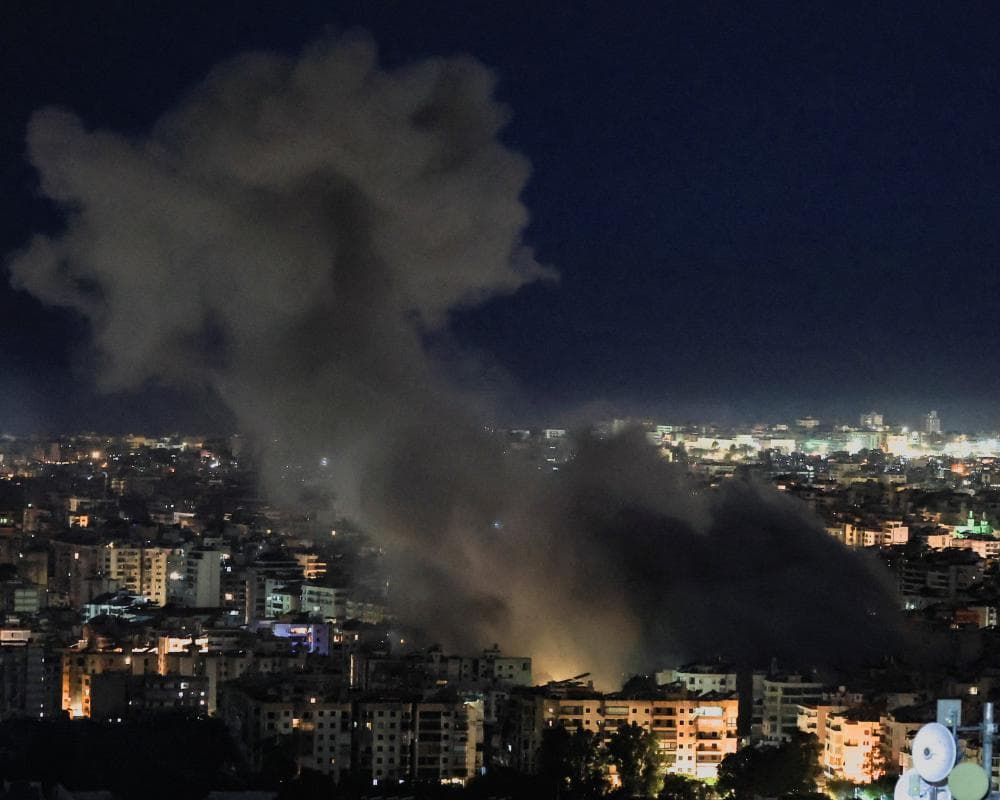
The IDF has begun striking what it describes as Hezbollah infrastructure in the Dahiya neighbourhood, a densely populated commercial and residential area in the southern suburbs of Beirut. The IDF had earlier issued forced evacuation orders for the whole population of Beirut’s southern suburbs – home to 500,000 people – sparking widespread panic and leading to huge queues of traffic as people tried to flee. It comes in spite of calls from world leaders including Emmanuel Macron urging Israel not to expand the war into Lebanon. According to the Lebanese health ministry, Israeli strikes have killed at least 123 people and injured 683 in Lebanon since Monday.
Donald Trump has claimed – without evidence – that Iran’s air force and navy are “gone”. Speaking during an event at the White House, the US president said: “We’re destroying more of Iran’s missile and drone capability every single hour – knocking them out.” He went on: “So [Iran] have no air force, they have no air defence. All of their airplanes are gone, their communications are gone. Other than that, they’re doing quite well. Their navy is gone, [they lost] 24 ships in three days, that’s a lot of ships,” he said, along with 60% of Iran’s missiles and 64% of its missile launchers.” Echoing comments he made earlier this week, Trump added that the US military and Israel are “totally demolish[ing]” Iranian targets “far ahead of schedule”.
Trump also said he must “be involved in the appointment” of Iran’s next leader as he was in Venezuela, and dismissed the idea of the assassinated ayatollah’s son, Mojtaba Khamenei, succeeding his father as supreme leader as “unacceptable”. More on that here.
Meanwhile, the US House of Representatives has voted down a Democratic-backed measure to halt hostilities with Iran, as Republicans cleared the way for Trump to continue the conflict that has drawn in countries across the Middle East, but criticized as having unclear goals. Our story here.
The UK’s defence secretary John Healey declined to rule out Britain joining US-Israeli strikes on Iran. More on that here.
Ukrainian president Volodymyr Zelenskyy said he received a request from the United States “for specific support” in dealing with Iran’s Shahed attack drones, as the US and its allies in the Middle East seek Ukraine’s expertise in countering such attacks from Russia. “I gave instructions to provide the necessary means and ensure the presence of Ukrainian specialists who can guarantee the required security,” Zelenskyy wrote on X. “Ukraine helps partners who help ensure our security and protect the lives of our people.” More on that here.
Updated
Donald Trump is currently speaking at the White House, and has just thanked “wonderful Israeli partners” who “continue to demolish the enemy totally ahead of schedule and at levels people have never seen before”.
We’re destroying more of Iran’s missile and drone capability every single hour – knocking them out.
The US president claimed, without evidence:
So [Iran] have no air force, they have no air defence. All of their airplanes are gone, their communications are gone. Other than that, they’re doing quite well.
“Their navy is gone, [they lost] 24 ships in three days, that’s a lot of ships,” he said, along with 60% of Iran’s missiles and 64% of its missile launchers.
Echoing comments he made earlier this week, Trump added that the US military and Israel are “totally demolish[ing]” Iranian targets “far ahead of schedule”.
Updated
The US House of Representatives has voted down a Democratic-backed measure to halt hostilities with Iran, as Republicans cleared the way for Donald Trump to continue the conflict that has drawn in countries across the Middle East, but criticized as having unclear goals.
By a vote of 212-219, the House voted to reject a war powers resolution that would have forced the US to withdraw from the conflict until Congress authorized military action.
The vote was largely along party lines, with two Republicans breaking with their party to support the resolution, and four Democrats voting against it.
Republicans control both chambers of Congress and their leaders have made clear that they believe Trump was authorized to initiate the air and naval campaign that began over the weekend, prompting Tehran to launch drones and missiles across the Middle East. Six US troops have been killed, as well as 1,230 people in Iran.
Updated
The IDF has said it is striking what it describes as Hezbollah infrastructure in the Dahiya neighbourhood, a densely populated commercial and residential area in the southern suburbs of Beirut.
The IDF had earlier issued forced evacuation orders for the whole population of Beirut’s southern suburbs – home to 500,000 people – sparking widespread panic and leading to huge queues of traffic as people tried to flee.
Per my colleague William Christou’s report, “traffic was at a standstill throughout the city and thousands of people resorted to walking, with women pushing strollers holding infants through bumper-to-bumper traffic. Families made appeals for rescue services to help extract elderly people who could not leave their homes on their own.”
Residents are also still scouring through the wreckage of residential buildings damaged by previous Israeli strikes on the Lebanese capital.
Indeed, Israel has been striking parts of Dahiya since Monday, but Israel’s far-right finance minister, Bezalel Smotrich, threatened widespread destruction in a video released on Thursday on social media.
Referring to a city in southern Gaza that Israel almost entirely destroyed during its military assault on the Palestinian territory, Smotrich said:
The Dahiya will look like Khan Younis. You wanted to give us hell, but you’ve brought hell upon yourself.
The evacuation order was issued just a day after the IDF ordered all residents to flee the area south of the Litani River, which compromises about 10% of Lebanon, raising concerns that it may be about to launch a ground invasion.
Per my last post, world leaders including Macron and Spanish PM Pedro Sánchez have been urging Israel to de-escalate and stop the US and Israel’s war from expanding into a new front in Lebanon.
Israel claims it is retaliating after Hezbollah fired several rockets towards northern Israel on Monday. According to the Lebanese health ministry, Israeli strikes have killed at least 123 people and injured 683 in Lebanon since then.
Updated
French president Emmanuel Macron has called on Israeli prime minister Benjamin Netanyahu “not to expand the war to Lebanon”.
“Hezbollah must immediately cease its fire toward Israel. Israel must refrain from any ground operations or large-scale actions in Lebanese territory,” Macron said on X.
“At this time of great danger, I call on the Prime Minister of Israel not to expand the war into Lebanon.”
He went on:
The Lebanese authorities have given me their commitment to take control of the positions held by Hezbollah and to fully assume responsibility for security across the entire national territory.
I give them my full support. France will strengthen its co-operation with the Lebanese armed forces and will provide them with armoured transport vehicles, as well as operational and logistical support.
“Everything must be done,” Macron said, to prevent Lebanon “once again being drawn into war”.
Updated
Donald Trump has brushed off concerns over any backlash sparked by the US-Israeli military operation against Iran, saying the public is “loving” it.
In an interview with Politico, the US president said: “People are loving what’s happening.”
He added: “We’re taking out a threat to the United States of America, major threat… and doing it like nobody’s ever seen before.”
Asked how much influence he expects to have over Iran’s future leadership, Trump replied:
I’m going to have a big impact, or they’re not going to have any settlement, because we’re not going to have to go do this again.
He suggested that Iran’s future leadership would be able to “nicely build Iran but without nuclear weapons”.
The IDF’s chief of staff has said it is “now moving to the next phase of the operation” against Iran.
Eyal Zamir explained that the new phase will involve “intensify strikes against the regime’s foundations and military capabilities”.
He continued: “We have additional surprise moves at our disposal that I do not intend to reveal.”
Nato has bolstered its “ballistic missile defence posture”, a spokesperson for the alliance has said.
The update comes after a ballistic missile reportedly launched from Iran and heading towards Turkish airspace was shot down by Nato air defence systems yesterday.
In a statement released on social media, Col Martin O’Donnell, a spokesperson for the Supreme Headquarters Allied Powers Europe, said:
While I cannot go into details about this posture change for operational security reasons, the adjustment gives the Supreme Allied Commander Europe exactly what he needs to defend the Alliance based upon the current threat and defend it he will!
He added that Nato’s ballistic missile defence posture will remain at a “heightened level until the threat from Iran’s continued indiscriminate attacks across the region subsides”.
Commenting on yesterday’s interception, O’Donnell said that in “less than 10 minutes”, Nato identified the threat of an incoming missile, confirmed its trajectory, alerted land- and sea-based missile defence systems, and launched an interceptor.
He added: “That is real strength!”
Updated
Operations at the American embassy in Kuwait City have been suspended, the US state department has announced.
In its latest update, the department said there have been no reported injuries to US personnel, but the “safety of Americans abroad remains the highest priority”.
It added:
US citizens in Kuwait should depart the country, if they can do so safely, using commercial or other available transportation options. US citizens unable to depart should shelter in place.
Israel’s air force carried out a “wave of strikes on over 200 targets” across Iran today, according to the IDF.
A statement posted on the IDF’s Telegram channel said:
These strikes join previous strikes that have taken place since the start of the operation, which are focused on dismantling the Iranian regime’s ballistic missile array.
Since the beginning of the operation, hundreds of launch sites across Iran have been struck - especially in western Iran - in order to reduce missile launches toward the State of Israel.
In a dramatic turn of the proverbial tables, Ukrainian president Volodymyr Zelenskyy has said he received a request from the United States “for specific support” in dealing with Iran’s Shahed attack drones, as the US and its allies in the Middle East seek Ukraine’s expertise in countering such attacks.
It follows reporting from my colleague Hugo Powell yesterday that top US military officials told lawmakers in a closed-door briefing on Tuesday that they may not be able to shoot down every Iranian drone being launched against US military installations and assets in retaliatory attacks.
Ukraine, meanwhile, has been countering Russian attacks using Shahed drones – one of Iran’s best known weapons - for the last four years. Last year alone, Russia launched over 50,000 of them into Ukraine, the majority of which were intercepted.
“I gave instructions to provide the necessary means and ensure the presence of Ukrainian specialists who can guarantee the required security,” Zelenskyy wrote on X. “Ukraine helps partners who help ensure our security and protect the lives of our people.”
Yesterday, Zelenskyy said he said he has spoken in recent days with the leaders of the United Arab Emirates, Qatar, Bahrain, Jordan and Kuwait about possible cooperation.
He has said that Ukrainian assistance in countering Iranian drones will be provided only if it does not weaken Ukraine’s own defenses, and if it adds leverage to Kyiv’s diplomatic efforts to stop the Russian invasion.
The irony of the Trump administration, which has for the last year held leverage over – and been highly erratic towards – Ukraine regarding military assistance and supplies of weapons, now needing help from the country whose leader it has publicly berated, is not lost on us – and will certainly not be lost on Zelenskyy.
Updated
This week on Politics Weekly America, my colleague Rachel Leingang speaks with foreign policy expert Ali Vaez about what it was like to take part in war game exercises for the Pentagon, and how they compare with what he has seen play out this week.
Then the Guardian’s Andrew Roth talks us through the inner chaos in the Trump administration and Congress over Trump’s decision to go to war with Iran.
The UK’s defence secretary John Healey earlier declined to rule out Britain joining US-Israeli strikes on Iran.
As we reported earlier, Healey flew into Cyprus to calm the diplomatic fallout over a drone that evaded detection and hit an RAF base, prompting fury from local ministers.
UK officials believe the drone evaded detection by flying low and slow when it was launched by pro-Iranian militia in Lebanon or western Iraq.
Speaking to Sky News, Healey was asked if he would rule out the UK joining the conflict in an offensive capacity. He replied:
As circumstances in any conflict change, you’ve got to be willing to adapt the action you take.
Pressed again on whether he would rule out British aircraft taking part in offensive operations over Iran, he said:
Everything that we have done is defensive, is legal, and is coordinated with other allies.
As my colleague Helena Smith reports, this is the first time the Cypriot political and diplomatic elite have expressed consternation over the dangers posed by the facilities, saying Britain has not done enough to protect the installations and surrounding areas where locals live.
Speaking to the media, Healey listed defensive measures that were being taken by the UK, including the use of anti-drone helicopters, deploying HMS Dragon to the eastern Mediterranean, and bringing in planners to co-ordinate an international response.
Per the BBC, he said the HMS Dragon would arrive “within the next couple of weeks”.
The UK has “got more jets in Cyprus than any other nation” and “400 air defence specialists on top of what we would normally have”, he said.
That’s because we want to make sure we can defend our British personnel, we can defend our British base, we can defend this island of Cyprus and we’re defending also allies across region.
In addition the defensive measures Healey outlined above, the British PM, Keir Starmer, has allowed the United States to use British airfields to carry out “defensive” missions.
Earlier this week, Starmer said the UK would not join in the initial US-Israeli offensive strikes, citing a lack of a “lawful basis” and stating that his government does not believe in “regime change from the skies”.
Updated
Donald Trump has said he must “be involved in the appointment” of Iran’s next leader as he was in Venezuela, and dismissed the idea of the assassinated ayatollah’s son, Mojtaba Khamenei, succeeding his father as supreme leader as “unacceptable”.
“They are wasting their time. Khamenei’s son is a lightweight. I have to be involved in the appointment, like with Delcy [Rodriguez] in Venezuela,” Trump told Axios today. You will remember that Rodriguez took over after US forces captured president Nicolás Maduro in January.
Trump added that he could not accept a new Iranian leader who would continue Khamenei’s policies.
“Khamenei’s son is unacceptable to me. We want someone that will bring harmony and peace to Iran,” he said.
Selecting a leader who followed the policies of the former supreme leader could force the US back to war “in five years”, he added.
It comes a day after Trump’s defense secretary Pete Hegseth insisted that regime change was not the primary goal of the US military operation in Iran. Other Trump administration officials have made the same claim since the US and Israel launched attacks on Iran last Saturday, which killed the former supreme leader Ali Khamenei .
This, even though Trump himself has pushed for Iranian regime change previously. His administration has pivoted its messaging in recent days to focus on destroying Iran’s nuclear and military capabilities.
Since the US-Israeli military assault began, Trump has suggested several times that he had a good idea who he wanted to succeed Khamenei in Iran.
But these latest comments to Axios come after he told reporters at the White House on Tuesday:
Most of the people we had in mind are dead.
No formal announcement has been made from Iran regarding the selection of a new leader, though Mojtaba Khamenei is considered the frontrunner.
As we’ve been reporting, intense waves of US-Israeli airstrikes have hit dozens of military positions, frontier posts and police stations along northern parts of Iran’s border with Iraq in what appears to be preparation by the US and Israel for a new front in their war.
Iran has warned “separatist groups” in this region against joining the widening conflict and launched strikes against Iraq-based Kurdish groups it described as “opposed to the revolution”.
In today’s edition of our Today in Focus: The Latest podcast, Nosheen Iqbal speaks to the Guardian’s deputy head of international news Devika Bhat to find out: could the involvement of these militant groups increase the risk of a civil war in Iran if the regime collapses?
Updated
Here are some images coming out of Lebanon, where an estimated tens of thousands have been displaced after the Israeli military issued evacuation orders for the suburbs south of Beirut on Thursday.
Marianne Samaha with the relief organisation Basmeh and Zeitooneh said in a statement that official figures show that more than 80,000 people have registered as displaced as of Wednesday, but aid workers in the region believe that the number is much higher because the official figure doesn’t take into account those who are not staying in collective shelters.
“We have been talking about a figure that’s more around 180,000 people,” Samaha said.
Aid workers have witnessed entire families still stuck on the roads, searching for a place to take shelter, Samaha said. “Some of them have found temporary shelters in schools that have been opened by the government, some have found temporary shelters with extended family members or in informal settings, but many, many people remain to this day sleeping on the streets, or in their cars,” she said.
Samaha added that even those who have found space for themselve sand their families in the collective shelters are still lacking mattresses, mats, pillows and blankets.
Updated
Lebanon’s Ministry of Public Health said 102 people have been killed and 638 wounded in Israeli strikes into the country that began Monday, the state-run Lebanese National News Agency reports.
On Thursday, the Israeli military said the Israeli Navy killed Wasim Attallah Ali, a Hamas commander, in the area of Tripoli.
The Guardian have not been able to independently verify this, or the figures from the Ministry of Public Health.
Updated
The US proposal to pull Kurdish fighters into the conflict with Iran would open a Pandora’s box that would risk fragmenting Iraq as well as Iran, said H A Hellyer, a senior associate fellow for geopolitics and security at the Royal United Services Institute.
“I’ve never seen such a resounding opposition to a policy idea in Washington from all sides of the political spectrum as I have when it came to this particular idea,” Hellyer said Thursday at a Chatham House seminar in London.
A US official with knowledge of the discussions between Washington and Kurdish officials told the Guardian earlier this week that the US was ready to provide air support if Kurdish fighters crossed the border from northern Iraq. On Wednesday, Khalil Nadiri, an official with the Kurdistan Freedom Party (PAK) said US officials have contacted Kurdish opposition group leaders regarding a potential operation, and that some of their forces had moved to areas near the Iranian border in Sulaymaniyah province and were on standby.
Hellyer said bringing the Kurds into this conflict risks drawing in other countries in the region, like Turkey. “And you also risk igniting something among other ethnic groups in Iran, including the Azeris, and the Baluchis,” Hellyer said.
“All of this, I think, is very risky, very dangerous, and the next order consequences could be very serious indeed,” he said.
Nechirvan Barzani, president of the Kurdistan region of Iraq, appeared to allude to the current conflict unfolding in the Middle East in a statement posted on social media to commemorate the 35th anniversary of the 1991 Kurdish uprising.
“In this commemoration, we reiterate that the Kurdistan region, as always, must remain a key factor in peace and stability and must not become part of any conflict or military escalation that harms the lives and security of our fellow citizens,” Barzani posted on social media.
“Protecting the territorial integrity of the Kurdistan region and our constitutional achievements can only be achieved through the unity, cohesion, and shared national responsibility of all political forces and components in Kurdistan.”
A Pakistani businessman accused of plotting to kill Donald Trump told a federal jury on Wednesday that he was coerced into the scheme by Iran’s Revolutionary Guard Corps, which he said had threatened his family to secure his participation.
On Wednesday, defense secretary Pete Hegseth said that the person who led a plot to assassinate Trump had been killed in the airstrikes on Iran.
The plot dates back to 2024, when federal prosecutors under the Biden administration charged 51-year-old Iranian national Farhad Shakeri and two New York men with running a murder-for-hire operation on behalf of Iran’s Revolutionary Guard Corps. The aim, the department of justice said at the time, was revenge for Trump’s killing of Iranian general Qasem Soleimani in 2020.
Read more here:
Oil prices have continued to rise as the crisis in the Middle East fails to show any signs of deescalation.
Iran has said it is halting all traffic through the strait of Hormuz, one of the busiest shipping corridors for oil and gas but the US president has tried to calm both constituents and businesses. Donald Trump said that the US will provide the risk insurance necessary for boats (many insurance providers have either doubled their premiums or canceled the policies) and also pledged that the US navy will escort ships through the strait if necessary.
There’s another line too, from White House press secretary Karoline Leavitt who in a post in on X, sought to reassure Americans on gas prices: “The Trump Administration will continue to unleash American energy dominance, and tap into our newfound oil in Venezuela.”
Azerbaijan has responded strongly to the alleged drone strike in the Nakhchivan region near the border of Iran. Though Iran has denied any involvement, Ilham Aliyev, the president of Azerbaijan, has ordered the country’s armed forces to be at “the highest level of readiness” for any retaliatory action and summoned Iran’s ambassador to the foreign ministry in Baku.
Iran claimed it had hit a US oil tanker in the northern Persian Gulf and that the vessel was on fire. There was no immediate confirmation of the incident or comment from the US. Iran’s Islamic Revolutionary Guard Corps (IRGC) said it maintains full control of the Strait of Hormuz and has effectively closed it to oil and gas exports.
UK defence secretary John Healey flew into Cyprus to calm the diplomatic fallout over a drone that evaded detection and hit an RAF base, prompting fury from local ministers. UK officials believe a drone that hit an RAF base in Cyprus evaded detection by flying low and slow when it was launched by pro-Iranian militia in Lebanon or western Iraq.
Iran continued to launch a wave of missiles at Israel, sending millions of residents into bomb shelters, just hours after moves to limit Donald Trump and his ability to prolong the war were blocked in Washington. Other countries in the Gulf region continued to deal with the fallout: six people were injured in Abu Dhabi in the United Arab Emirates from falling debris after air defences intercepted a drone and Qatar officials urged residents to stay inside as air defences worked to halt an attack. The ministry of defence in Bahrain said on Thursday that their air defences had destroyed 75 missiles and 123 drones since the start of the conflict.
The Israeli military said it was beginning a new widespread wave of attacks in Tehran. Israel also said it carried out strikes on Beirut targeting Hezbollah while Lebanese state media reported an Israeli drone strike killed a Hamas official.
The World Health Organization (WHO) said it has verified more than a dozen attacks on health infrastructure in Iran amid the US-Israeli campaign. Four healthcare workers have been killed and 25 others injured, according to the organisation.
The Israeli military has issued an evacuation order for all of the southern suburbs of Beirut, in an area called the Dahiyeh which it says is a Hezbollah stronghold.
There’s no definitive figure on how big the population is here but some estimates put it between 300,000 to 700,000. It is believed to be the first time the Israeli military has ordered large swathes of the Lebanese capital to flee, when before they would force people out of specific buildings that the Israel Defense Forces (IDF) would then strike.
The IDF’s Arabic-language spokesperson, Avichay Adraee, said the latest order covers four major neighbourhoods in the southern suburbs of Beirut – Bourj el-Barajneh, Hadath, Haret Hreik and Shiyyah.
“Save your lives and evacuate your homes immediately,” he said in a message posted on social media.
“Beware, heading south is prohibited. Any southward movement could endanger your lives.
“We will inform you of the safe time to return to your homes.”
Updated
UK prime minister Keir Starmer addressed the nation in a press conference this afternoon to give an update on the escalating conflict in the Middle East. Here are the main points from the briefing:
Starmer said he stands by his decision not to join the US-Israeli strikes on Iran. He added that the best way forward for both Iran and the world is a negotiated settlement.
Responding to questions on Trump’s remarks that he has “ruined the special relationship”, Starmer said it was “in operation right now”. He added that it was up to Trump to make the right decisions for the US, and for him to do the same for the UK. “There’s nothing controversial about that.”
The UK is sending four additional Typhoon jets to Qatar, as well as Wildcat helicopters with anti-drone capabilities being sent to Cyprus. Starmer said the US has been allowed to use British airfields to carry out defensive missions and that HMS Dragon is heading for the Mediterranean.
The first charter flight from Oman took off today. The prime minister said more than 4,000 people have arrived back in the UK on commercial flights from the UAE. This comes after a repatriation flight from Oman scheduled last night was delayed due to what officials said were “operational issues”.
There was no specific request from US to use UK bases until Saturday afternoon. When asked to responds to reports that he wanted to give the US permission to use UK airfields last week but was blocked by cabinet ministers, he said there was no request from the US on Friday and therefore there was no decision to be made. The US-Israeli strikes on Iran began on Saturday morning.
For more details on the news conference, head over to our UK politics blog here:
Updated
More than 2,000 people had arrived in the UK on Wednesday on eight flights from the UAE, MPs have been told by a Foreign Office minister, Hamish Falconer. A further eight flights are expected from the UAE today.
British Airways has also now agreed to lay on new flights from Muscat, the capital of Oman, which were expected to fly every day following talks with the government, he added.
However, there was criticism from MPs including the shadow foreign secretary, Priti Patel, who pressed the government on the failure of the first repatriation flight chartered by the UK government to take off via Oman on Wednesday evening. She asked why the Iranian ambassador had not been expelled when Falconer summoned him to the Foreign Office on Wednesday.
“This situation is shameful and embarrassing and never in the history of this great nation has government been so feeble when our people are under assault,” she said.
Concerns were also raised by Labour MPs, including Adam Jogee, who praised the government’s response but told of constituents whose flights through the Middle East had been cancelled and were now being asked to pay £1,000 a night in accommodation costs for the next three weeks.
He called on the government to “go further and faster in ensuring that airlines and travel agents don’t take advantage of people and let them down”.
The World Health Organization (WHO) said it has verified more than a dozen attacks on health infrastructure in Iran amid a US-Israeli campaign.
Four healthcare workers have been killed and 25 others injured, according to the organisation.
“WHO has verified 13 attacks on health care in Iran and one in Lebanon,” the organisation’s director-general Tedros Adhanom Ghebreyesus told a press conference, without attributing blame.
Regional directed Hanan Balkhy said four ambulances in Iran were also affected and that hospitals and other health sites suffered minor damage due to strikes nearby.
She said the WHO logistics hub in Dubai which provides health supplies to dozens of countries is temporarily out of service because of transport restrictions in the region.
Ilham Aliyev, the president of Azerbaijan, called a security meeting on Thursday regarding the alleged drone strike in the Nakhchivan region and delivered a speech stating that “any hostile force will feel the full might of our ‘Iron Fist’”.
The Iranian armed forces have denied launching drones into Azerbaijani territory. Nonetheless, Aliyev said Azerbaijan “strongly condemns this heinous terrorist act” and that his government has summoned Iran’s ambassador to the foreign ministry in Baku.
“Those responsible must be brought to justice without delay,” he said. “The Iranian side must provide an official explanation to Azerbaijan, issue an apology, and ensure that the perpetrators are held criminally accountable.”
Aliyev said Azerbaijan’s armed forces “have been placed at the highest level of combat readiness and are prepared to carry out any required operations”.
“We will not tolerate this unprovoked act of terror and aggression against Azerbaijan,” Aliyev said.
Updated
In the US, Senate Republicans voted down on Wednesday a war powers resolution that would have required Donald Trump to seek congressional approval before continuing the war with Iran.
The vote broke down along party lines, with John Fetterman of Pennsylvania as the sole Democrat to vote against the measure. On Wednesday, prior to the vote, Fetterman went on CNN News Central to voice his support of the US-Israeli strikes on Iran and say that this was a situation of “country over party”.
“What I’m trying to establish is that every single senator in the Congress says we should never allow Iran to acquire a nuclear weapon. That now has made that possible after that. And now they’ve eliminated this leadership,” Fetterman said. “Now, do you really want those things? Does it really matter? Were you really serious about that? Because if you were, why can’t we just acknowledge – I’m not with all of it – but this was a great development for the region.”
Anchor Kate Bolduan asked Fetterman if he thought the US and Israel were aligned in their war goals, specifically in regards to comments made by Israeli defence minister Israel Katz that “any leader appointed by the Iranian terror regime” would become “an unequivocal target for elimination”.
“Yeah just keep killing them until they’re gone,” Fetterman said. “I mean, absolutely. I’ve read that they’re (Israel is) going to target who they (Iran) ever elect to be their next leader and kill them. Absolutely. I fully support it. So, that’s what’s entirely appropriate.”
When Bolduan pushed further on the issue, asking Fetterman who should decide the leader of Iran“if you think the United State should take part in taking out every next leader going forward” if the leader doesn’t meet the right measure, he responded by saing he “absolutely” supports killing the leadership of Iran.
“Hey, I’m sorry, I absolutely support killing, you know, the leadership of the Iranian. Absolutely. I absolutely support that,” Fetterman said. “I think that’s entirely appropriate until hopefully they’ll pick someone that realizes that they need to live and coexist in peace in the region and stop trying to destroy Israel and to stabilize the region.”
The US House of Representatives is set to vote on a similar measure later today. For more, follow along with our live coverage here.
Updated
Azerbaijan vowed to respond after a drone attack on an airport in its territory, which the Baku government said came from the direction of Iran.
Iran denied involvement and has blamed the attack on Israel, but the Azerbaijani defence ministry placed the blame squarely on Iran.
“The Islamic Republic of Iran bears the entire responsibility for the incident,” the ministry said in a statement.
It added: “These acts of aggression will not remain unanswered.”
The ministry said it would “prepare necessary retaliatory measures” without specifying what they would be. It added that it would investigate the types of drones that were used in the attack in the Nakhchivan exclave close to the border with Iran, which injured four people.
Iran’s deputy foreign minister Kazem Gharibabadi denied Tehran had targeted Nakhchivan, telling the Azerbaijani outlet AnewZ that his country is “not targeting neighbouring countries”.
The newswires have uploaded images from a video appearing to show the damage at Nakhchivan airport after what Azerbaijani officials said was a drone attack carried out by Iran. Iran has denied involvement and blamed Israel.
Azerbaijan said one drone fell on the terminal building of the Nakhchivan airport, which is about six miles across the border from Iran, and another drone landed close to a school building in a nearby village.
The AP news agency has issued this photograph which it says shows damage to a school in Julfa, about 20 miles south of the airport and less than two miles from the Iranian border at the Aras river.
The Iranian armed forces denied launching a drone attack on Azerbaijan, following reports that two drones flying from the direction of Iran fell near the airport in the Azerbaijani exclave of Nakhchivan.
“The Islamic republic of Iran … denies its armed forces launched a drone toward the Republic of Azerbaijan,” the general staff of the armed forces said in a statement carried by Iran’s semi-official Tasnim news agency.
Blaming the attack on Israel, it said: “Such actions by the Zionist regime to disrupt relations between Muslim countries through various means are well documented.”
The Iranian warship that was sunk by a US submarine was on its way home after taking part in naval exercises hosted by India, officials in New Delhi have said.
The Iris Dena sank in international waters off the coast of Sri Lanka yesterday after a US torpedo attack, killing more than 80 people. Scores of people are still missing while 32 people were rescued by Sri Lankan authorities.
India’s defence ministry said the Iranian warship had participated in the International Fleet Review – a ceremonial event designed to showcase the maritime capabilities of the Indian navy and international partners – and the multilateral naval exercise Milan 2026 in the port of Visakhapatnam from 15 February to 25 February. The ministry said 74 countries had joined the events.
A second Iranian ship has been reported in waters close to Sri Lanka today and has sought emergency permission to dock. Sources told the Guardian the ship was a logistical pipe-laying vessel, which is not categorised as a warship. It may be as close as 10 nautical miles from the western coast of Sri Lanka, putting it within the country’s sovereign waters.
You can ready more on this story here:
Over in Cyprus, British defence minister John Healey has just wrapped up talks with his Cypriot counterpart.
Emphasizing the two countries’ long- standing friendship, Healey said talks had focused on “how the UK is further reinforcing our air defences to support our shared security,” following Sunday’s drone attack on the RAF Akrotiri airbase.
The presence of UK sovereign base areas - a remnant of British colonial rule - has long been a bone of contention among both Greek and Turkish Cypriots. The drone strike, which caused marginal damage to the military installation’s landing strip, has brought that disgruntlement out into the open at an official level as never before.
For the first time the island’s political and diplomatic elite has expressed consternation over the dangers posed by the facilities, saying Britain has not done enough to protect the installations and surrounding areas where locals live.
The UK, unlike Europe, is perceived to have dragged its feet in deciding to deploy military support.
“There’s a sense of there being too little too late,” one senior official told The Guardian this morning. “There’s been a lot of talking at the highest level and the defense minister’s visit is part of that. But now we’ve gone beyond words. Now is a time for serious cooperation regarding the bases. Now is the time for action.”
Bahrain air defences have destroyed 75 missiles and 123 drones since the start of the conflict, the Bahrain Defence Force said on Thursday.
The general command urged residents to stay home and not go out unless absolutely necessary.
The EU foreign policy chief Kaja Kallas has said Iran is exporting the war to as many countries as possible to cause chaos, ahead of talks with Gulf countries.
Kallas is hosting a virtual meeting with EU foreign ministers and Gulf counterparts to discuss the ongoing turmoil in the Middle East. She said she expected a common statement from the EU and Gulf Cooperation Council: “We want stability in the region, we want that this war does not go any further and we want the respect of international law.”
“Iran is exporting the war, trying to expand it to as many countries as they can to sow chaos. And we are calling for stability and seeing what we can do together.”
Without being drawn on specifics she said EU countries would discuss support for the Gulf. She stressed Ukraine could also help Gulf countries develop drone interceptors.
“In the Middle East, we see actually the same drones that are attacking Kyiv every day, now attacking also the Middle East,” she said in a reference to Iran’s Shahed drones that have been supplied to Russia to attack Ukraine.
The EU is concerned that the Middle East conflict will deplete Ukraine’s efforts to defend itself against Russia, as a result of rising oil prices that help Moscow fund its war effort and tighter supplies of drone interceptor technology.
“When it comes to drones and drone interceptor drones then Ukraine has really been able to produce a lot and can also share this knowledge with the Gulf countries to boost this production,” Kallas said. “So of course we are looking into this but I am worried that just the capabilities are limited and that’s why it will have an impact also on different wars.”
Updated
Six people were injured by falling debris in Abu Dhabi after air defences intercepted a drone, according to the Abu Dhabi media office.
The individuals injured were Pakistani and Nepalese nationals, the media office said. Their injuries were considered minor to moderate.
Abu Dhabi authorities have responded to an incident of debris falling in two locations in ICAD 2, following the successful interception of drones by air defence systems. The incident resulted in minor and moderate injuries to six Pakistani and Nepali nationals.
— مكتب أبوظبي الإعلامي (@ADMediaOffice) March 5, 2026
The public is…
The conflict in the Middle East has continued to escalate, with Israel announcing it had launched more strikes against Tehran and in Lebanon.
Iran has continued to fire retaliatory strikes against Israel and US targets in the region, prompting major airlines to cancel flights that has left thousands of people stranded.
If you’re living or working in the region and have been impacted by the US-Israel conflict with Iran, we would like to hear from you.
For more details on how to contact the Guardian, click here:
Air defences were working to intercept a missile attack targeting Qatar on Thursday, according to the state-run Qatar News Agency.
#وزارة_الدفاع تعلن عن تعرض دولة #قطر لهجوم صاروخي وأن الدفاعات الجوية تتصدى للهجمة #قنا pic.twitter.com/kwNbY4TNxi
— وكالة الأنباء القطرية (@QatarNewsAgency) March 5, 2026
The ministry of interior called on residents to stay indoors and away from windows and open areas, stating that the security threat level was high.
Updated
In retaliation for the US-Israeli missile attacks, Iran has launched what amounts to all-out economic warfare. Should the conflict continue even for another week, its impacts will start to be felt around the world as the third price surge since the pandemic washes through global markets.
For Britain, a further turn of the screw on living standards arrives just as political instability mounts at home, with the Labour and Conservative parties facing existential challenges to their left and right.
Keir Starmer’s half-cocked response to war reflects a deeper, strategic problem for the UK: an economy built over decades for a globalised world cannot fit into a world where globalisation is falling apart.
You can read James Meadway’s analysis here:
An Iranian drone struck an Azerbaijani airport near the two countries’ shared border, according to officials, marking the first time a state in the Caucasus has been targeted by Iran since the start of the US-Israel war against Tehran. Two people were reported injured after a drone hit the terminal building at an airport in Nakhchivan, an Azerbaijani exclave bordering Iran.
Nechirvan Barzani, president of the Kurdistan region of Iraq, said the Kurdish region “must not become part of any conflict”, after the Iranian military claimed it targeted the headquarters of Iranian Kurdish forces in northern Iraq. There are reports that Kurdish Iranian dissident groups based in Iraq are preparing for a cross-border military operation in Iran, creating a potential new front in an already expanding conflict.
The first repatriation flight from Oman to bring home stranded citizens had been rescheduled due to “operational issues”, including delays in getting passengers on board, a minister said.
Iran claimed it had hit a US oil tanker in the northern Persian Gulf and that the vessel was on fire. There was no immediate confirmation of the incident or comment from the US. Iran’s Islamic Revolutionary Guard Corps (IRGC) said it maintains full control of the Strait of Hormuz and has effectively closed it to oil and gas exports.
UK defence secretary John Healey flew into Cyprus on Wednesday night to calm the diplomatic fallout over a drone that evaded detection and hit an RAF base, prompting fury from local ministers. UK officials believe a drone that hit an RAF base in Cyprus evaded detection by flying low and slow when it was launched by pro-Iranian militia in Lebanon or western Iraq.
Sri Lanka said it is trying to “safeguard lives” on another Iranian ship off its coast. An official said the ship was in the economic zone beyond Sri Lanka’s territorial waters, a day after a US submarine destroyed an Iranian frigate, killing at least 87 people.
Iran continued to launch a wave of missiles at Israel, sending millions of residents into bomb shelters, just hours after moves to halt the US air assault were blocked in Washington.
The Israeli military said it was beginning a new widespread wave of attacks in Tehran. Israel also said it carried out strikes on Beirut targeting Hezbollah while Lebanese state media reported an Israeli drone strike killed a Hamas official.
Updated
Azerbaijan summoned the Iranian envoy after two people were wounded in a drone attack on an airport and near a school.
“One drone struck the terminal building of the airport in the Nakhchivan autonomous republic, while another drone fell near a school building in the village of Shakarabad,” Azerbaijan’s foreign ministry said in a statement.
“We strongly condemn these drone attacks launched from the territory of the Islamic Republic of Iran, which resulted in damage to the airport building and injuries of two civilians.”
Pictures: US-Israeli attacks continue in Iran amid escalating conflict
An Iranian drone is said to have struck an Azerbaijani airport near the two countries’ shared border, marking the first time a state in the Caucasus has been targeted by Iran since the start of the US-Israel war against Tehran.
Azerbaijan’s foreign ministry said the drone hit the terminal building at an airport in Nakhchivan, an Azerbaijani exclave bordering Iran, damaging part of the complex and injuring two civilians.
A second drone fell near a school in a nearby village. Baku said it reserved the right to take retaliatory measures.
Azerbaijan, an oil-rich authoritarian state that has adopted a neutral stance in the Middle East conflict, has recently developed closer ties with Israel and the Trump administration while gradually moving away from Moscow, the traditional power broker in the Caucasus.
The country hosts no US military bases, suggesting Iran may be expanding its strikes beyond targets directly linked to American forces.
Baku’s growing military cooperation with Israel has caused friction with Tehran, though the two neighbours have largely maintained pragmatic relations. Both countries are majority Shia Muslim, and Iran is home to millions of ethnic Azeris – estimates range from about 15 to more than 20 million – many living in the north-western provinces bordering Azerbaijan.
Updated
The first repatriation flight from Oman to bring home stranded citizens had been rescheduled due to “operational issues”, including delays in getting passengers on board, a minister said.
The UK government had chartered a flight last night from Muscat to London for British nationals and their spouses or partners and children, but the Foreign Office said this morning that the flight was not able to depart due to technical issues.
The flight was now expected to depart later today.
When asked why the flight did not leave as planned, Home Office minister Alex Norris told BBC Breakfast: “Well, there are operational reasons that can happen in circumstances where these things are being stood up quickly. I know that’s stressful for those people – that’s why there’s support on the ground.
“We made sure we got them hotel rooms for the night as well and we are facilitating and rebooking today’s flight.
“We hope that they do, and there’s multiple flights after it as well.”
During his media round this morning he told Sky News that there were also delays in getting passengers on board as part of the operational challenges.
British Airways, which is currently unable to fly from Dubai, Doha, Abu Dhabi, Bahrain, Amman and Tel Aviv, said it would run flights from Muscat on Thursday, Friday and Saturday, and that they were fully booked.
Updated
Nechirvan Barzani, president of the Kurdistan region of Iraq, has issued a statement commemorating the 35th anniversary of the 1991 Kurdish uprising, but in it he has also seemingly hinted at the current conflict unfolding in the Middle East.
In a statement posted on social media, he said:
In this commemoration, we reiterate that the Kurdistan region, as always, must remain a key factor in peace and stability and must not become part of any conflict or military escalation that harms the lives and security of our fellow citizens. Protecting the territorial integrity of the Kurdistan region and our constitutional achievements can only be achieved through the unity, cohesion, and shared national responsibility of all political forces and components in Kurdistan.
May this commemoration inspire us to overcome challenges, deepen our culture of coexistence and tolerance. Loyalty to the blood of the martyrs means standing together, hand in hand; let us work to preserve stability and build a better future for the generations to come.
His statement follows reports that the Iranian military targeted the headquarters of Iranian Kurdish forces in northern Iraq, as Tehran stepped up attacks on Kurdish regions in both Iran and Iraq.
Kurdish officials told the AP news agency that Kurdish Iranian dissident groups based in northern Iraq were preparing for a potential cross-border military operation in Iran, and the US has asked Iraqi Kurds to support them.
You can read more on this story here:
Reuters news agency has reported that missiles and drones flying from the direction of Iran fell near the airport in the Azerbaijani exclave of Nakhchivan, according to a source close to the government.
Nakhchivan airport is located about six miles from the border with Iran.
We will bring you more updates as we get them.
Updated
John Healey flew into Cyprus on Wednesday night to calm the diplomatic fallout over a drone that evaded detection and hit an RAF base, prompting fury from local ministers.
UK officials believe a drone that hit an RAF base in Cyprus evaded detection by flying low and slow when it was launched by pro-Iranian militia in Lebanon or western Iraq.
But an investigation has been unable to establish conclusively where the Shahed-type drone was launched from. The attack occurred during the Iranian retaliatory bombardment over the weekend after the US and Israel launched a wave of strikes on Iran, killing the country’s supreme leader, Ayatollah Ali Khamenei.
The defence secretary’s visit comes amid a backlash in Cyprus over the drone attack on RAF Akrotiri, which has led to the evacuation of families living on the bases and a bolstering of its defences.
Read the full report here:
Iran’s semi-official Tasnim news agency has reported that a US oil tanker in the northern Persian Gulf was hit by a missile launched by Iranian forces.
“The tanker was struck this morning in the northern Persian Gulf by forces of the Islamic Revolutionary Guard Corps and is currently on fire,” the news agency reported.
There was no immediate comment from the US. The IRGC previously said it maintains full control of the Strait of Hormuz and has effectively closed it to oil and gas exports. Trump said on Tuesday that he is prepared to deploy the US navy to escort tankers through the narrow passage of water, where about a fifth of the world’s oil is shipped through.
Italian prime minister Giorgia Meloni said her country is planning to send air defence aid to Gulf countries, following in the footsteps of the UK, France and Germany.
“This is not only because they are friendly nations, but above all because tens of thousands of Italians live in the region and around 2,000 Italian troops are deployed there – people we want, and must, protect,” she told the Italian radio station RTL 102.5.
Sri Lanka is trying to “safeguard lives” on another Iranian ship off its coast, the country’s cabinet spokesperson said.
The ship was in the economic zone beyond Sri Lanka’s territorial waters, Nalinda Jayatissa added.
“We are doing our utmost to safeguard lives,” he said, according to Reuters news agency.
His remarks come a day after the deadly US torpedo attack on an Iranian warship off the south coast of Sri Lanka which killed more than 80 people. Rescuers continued their search for survivors with more than 60 people believed missing. Thirty-two people were rescued from the Iris Dena by Sri Lankan authorities about 25 miles south of the southern port of Galle.
Updated
Israel’s defence minister, Israel Katz, said the US defence secretary, Pete Hegseth, told him to “continue to the end, we are with you”, according to a statement by his office.
Katz expressed his condolences over the deaths of US soldiers in the Iran conflict, and thanked Hegseth and US president Donald Trump for their “great support for Israel”.
“The cooperation between president Trump and prime minister [Benjamin] Netanyahu against Iran is changing regional and global history,” the statement from the Israeli defence minister’s office said, according to the Times of Israel.
In case you’re just joining us, here’s an overview of the latest news in the US-Israel war with Iran as the conflict entered its sixth day on Thursday and continues to expand across the Middle East and beyond.
Iran launched a wave of missiles at Israel early on Thursday, sending millions of residents into bomb shelters, just hours after moves to halt the US air assault were blocked in Washington.
The Israeli military said it was beginning a new widespread wave of attacks in Tehran. Israel also said it carried out strikes on Beirut targeting Hezbollah on Thursday while Lebanese state media reported an Israeli drone strike killed a Hamas official.
Republican senators in Washington voted against a motion aimed at stopping the US air campaign and requiring that military action be authorised by Congress.
Nato air defences destroyed an Iranian ballistic missile fired towards Turkey – the first time Turkey has been drawn into the conflict. But Iran armed forces later denied firing any missile towards Turkey’s territory and said it respected the country’s sovereignty.
A US submarine sank an Iranian warship off Sri Lanka on Wednesday, killing at least 80 people.
Iran said it had targeted Kurdish groups in Iraq and warned “separatist groups” against action in the widening war.
Mojtaba Khamenei, the son of Iran’s slain supreme leader, emerged as a frontrunner to succeed him, suggesting Tehran was not about to buckle to pressure from the US and Israel’s military campaign that has killed hundreds and convulsed global markets.
The war continued to paralyse shipping through the strait of Hormuz, choking off vital Middle East oil and gas flows, with oil prices rising on Thursday. The US navy would escort oil tankers through the strait of Hormuz “as soon as it can” but was focused on the conflict for now, US energy secretary Chris Wright said on Fox News.
Repatriation flights departed the Middle East on Wednesday as governments rushed to bring home tens of thousands of citizens stranded by the war. A British flight to repatriate UK nationals did not take off as scheduled from Oman and was rescheduled for later on Thursday, Sky News reported.
Plans were in doubt for a funeral for Iran’s slain supreme leader, Ayatollah Ali Khamenei, killed by Israeli forces on Saturday. The body had been expected to lie in state in a Tehran mosque from Wednesday evening but Iran said three days of farewell ceremonies had been indefinitely postponed and no funeral date had been announced.
With news agencies
Updated
Iran’s foreign minister has said the US will “bitterly regret” sinking an Iranian warship off the coast of Sri Lanka.
Abas Araghchi posted on X:
The U.S. has perpetrated an atrocity at sea, 2,000 miles away from Iran’s shores.
Frigate Dena, a guest of India’s Navy carrying almost 130 sailors, was struck in international waters without warning.
Mark my words: The U.S. will come to bitterly regret precedent it has set.
US defence secretary Pete Hegseth earlier confirmed that a US submarine sunk the Iranian warship in the Indian Ocean, saying the ship “thought it was safe in international waters”.
He said:
Instead it was sunk by a torpedo, a quiet death – the first sinking of an enemy ship by a torpedo since world war II. Like in that war, back when we were still the war department, we are fighting to win.
Israel has said it carried out strikes on Beirut targeting Hezbollah on Thursday while Lebanese state media reported an Israeli drone strike killed a Hamas official.
Lebanon’s state-run National News Agency (NNA) reported several strikes early in the day, including two in the Hezbollah stronghold of south Beirut, where smoke was seen rising.
Israel’s military, which earlier told residents to leave the suburbs where the strikes were reported, said its forces hit several “command centres” of the Iran-backed militant group in the city. There were no immediate reports of casualties, an Agence France-Presse report said.
The NNA said a pre-dawn Israeli drone strike hit an apartment in Beddawi, a Palestinian refugee camp near Tripoli, killing senior Hamas official Wassim Atallah al-Ali and his wife.
This is the first reported targeted killing of a Hamas official since the regional war began on Saturday.
The report noted that Ali’s brother, also a Hamas official from Beddawi, was killed in an Israeli airstrike during the war triggered by Hamas’s 2023 attack on Israel.
Iran says it has targeted Kurdish groups in Iraq and warned “separatist groups” against action in the widening war.
Tehran said on Thursday it had hit Iraq-based Kurdish groups “opposed to the revolution”, as reports said the US was looking to arm Kurdish militias to infiltrate Iran.
The strikes – which killed a member from an exiled Iranian Kurdish group, according to a representative – came after a warning from Iranian officials.
“Separatist groups should not think that a breeze has blown and try to take action,” said the secretary of Iran’s Supreme National Security Council, Ali Larijani, quoted by the AFP news agency.
We will not tolerate them in any way.
Updated
Iran’s armed forces respect Turkey’s sovereignty and deny firing any missile towards its territory, they were reported as saying in a statement carried by state media on Thursday.
Turkey’s defence ministry said on Wednesday that a ballistic missile fired from Iran toward Turkish airspace after passing Syria and Iraq was destroyed by Nato air and missile defence systems over the eastern Mediterranean.
Australia’s government has deployed military assets as part of contingency planning to assist Australians stranded in the Middle East.
As the conflict sparked by American and Israeli strikes on Iran spreads around the region, the government is planning contingencies to help tens of thousands of Australian citizens and permanent residents.
While the government is urging Australians to take up commercial options to get home, the defence department has launched Operation Beech, part of the consular effort to provide assistance.
A Royal Australian Air Force C-17A Globemaster heavy transport aircraft and KC-30A multi-role tanker transport have been deployed today as a precautionary measure.
The government will not discuss further specifics like their destination for operational security reasons.
As many as 24,000 Australians are stuck in the United Arab Emirates alone. Some commercial flights to Australia have already started to resume.
The New Zealand government announced on Thursday it would send two defence force aircraft to repatriate its citizens from the region.
Updated
The Israeli military has reportedly said it is beginning a new widespread wave of attacks in Tehran.
We’ll bring you more on this soon.
The US-Israel war with Iran could disrupt supplies of key semiconductor manufacturing materials, a South Korean ruling party lawmaker said on Thursday.
South Korea’s chip industry – which supplies around two-thirds of global memory chips – was also concerned that a prolonged conflict in Iran would lead to higher energy costs and prices, Kim Young-bae said after meeting executives from companies such as Samsung Electronics and trade groups.
“Officials raised a possibility that semiconductor production could be disrupted if some of these key materials cannot be sourced from the Middle East,” he said at a press briefing cited by Reuters. He added that South Korean firms sourced some key chip-making materials such as helium from the Middle East.
Helium is essential for heat management during semiconductor production and it has no viable alternatives currently. It is only produced in a handful of countries, with Qatar and the US among the leading players in the industry.
The caution comes as chipmakers grapple with severe supply bottlenecks due to surging chip demand from AI data centre operators that has tightened supplies to many other industries including smartphones, laptops and automobiles.
South Korean chipmaker SK Hynix said it had sufficient helium inventory and did not expect disruption to its procurement. Samsung declined to comment.
Updated
With most of the region’s airspace closed, tens of thousands of travellers have been left stranded by the conflict.
Airlines in the Middle East have been brought to a virtual standstill this week. Emirates and Etihad Airways are now operating a limited number of services from Dubai and Abu Dhabi.
Qatar Airways, based in Doha, has just put out a statement reiterating that its operations remained “temporarily suspended” due to the closure of Qatari airspace, but announcing a handful of relief flights.
Qatar Airways will start operating a limited number relief flights from 05 March to support passengers who are stranded due to the current situation across the region.
This included flights from Muscat to London Heathrow, Berlin, Copenhagen, Madrid, Rome and Amsterdam, and a flight from Riyadh to Frankfurt. Passengers would be contacted directly if assigned seats on these services, it said.
The airline is promising a further update on Friday.
Updated
A UK warship due to be sent to Cyprus amid the US-Israeli war with Iran will not set sail from Britain until next week, western officials have been cited by the AFP news agency as saying.
Prime minister Keir Starmer announced on Tuesday that he was deploying HMS Dragon – a Type 45 defence destroyer – to aid Britain’s “defensive operations” in the region. He also said he was sending two Wildcat helicopters with counter-drone capabilities.
The announcement came after several drone attacks from Iran targeted UK allies in the Middle East and after the UK Royal Air Force base Akrotiri was struck overnight from Sunday to Monday.
Opposition legislators have accused the government of being too slow to deploy additional resources after the war started on Saturday, with no British warship in the region.
HMS Dragon was being resupplied with ammunition and would sail next week, the officials told reporters in London on Wednesday.
“We’ve had to change weapon systems on it, finish welding, get it up and running, and get it sailing as fast as possible,” defence minister Al Carns told Sky News.
Its voyage to the eastern Mediterranean is expected to take several days.
Updated
A US government charter flight was bringing Americans to the US from the Middle East and additional flights were being arranged for locations across the region, the US State Department has said.
The agency on Wednesday provided no details on the number of passengers aboard the flight, the countries they were leaving or the departure and arrival times of the flight, Reuters is reporting.
Since US and Israeli forces launched initial strikes on Iran on Saturday, more than 17,500 Americans have safely returned to the US from the Middle East, including about 8,500 on Tuesday, the state department said. Many more had left the Middle East to other countries in Europe and Asia since Saturday, the department said.
On Monday the state department urged Americans across 14 countries in the Middle East to immediately depart the region using “available commercial transportation”. But many US citizens face challenges due to global air travel disruptions caused by the war.
The situation prompted sharp criticism from some US lawmakers, who accused the state department of inadequate planning and late warnings.
The department responded by saying it was “facilitating charter flights” from the United Arab Emirates, Saudi Arabia and Jordan for US citizens in need of such assistance.
Updated
Here are some of the latest images coming out of the Middle East amid the US-Israeli war with Iran.
Updated
Hello and welcome to our continuing live coverage of the US-Israeli war on Iran.
Canadian prime minister Mark Carney said on Thursday that he couldn’t rule out his country’s military participation in the escalating war in the Middle East.
“One can never categorically rule out participation,” he said alongside his Australian counterpart Anthony Albanese in Canberra. “We will stand by our allies,” added Carney, who had said the US-Israeli strikes on Iran were “inconsistent with international law”.
Iran launched a fresh round of missiles at Israel early on Thursday, according to the Israeli military and Tehran’s state media, as the war entered its sixth day. The launches triggered alerts in several areas including Tel Aviv. There were no immediate reports of casualties.
Here are the other main developments:
An airstrike hit the Hezbollah stronghold of south Beirut early on Thursday, after Israel had issued a warning to residents. Elsewhere, three people were killed in a pair of Israeli strikes on vehicles along Beirut’s airport highway, Lebanon’s health ministry said. Israel has urged people to leave the section of Lebanon south of the Litani river – an area of hundreds of square kilometres – as the army was “compelled to take military action”.
A US submarine torpedoed and sank an Iranian warship off the coast of Sri Lanka as the effects of the war in the Middle East spread to yet another country. The IRIS Dena frigate had been on a friendly visit to India when it was hit. Eighty-seven bodies had been collected, a Sri Lankan navy official said.
Benjamin Netanyahu’s office said Israel and the US had made “historic gains” in their war against Iran. A spokesperson for the prime minister also claimed the attack was needed as Iran was using “new underground bunkers” to rebuild its atomic bomb program.
Donald Trump hailed the US performance in the war, saying Iran’s leaders were rapidly being killed, and vowed to push on. “We’re doing well on the war front, to put it mildly. Somebody said on a scale of 10, where would you rate it? I said about a 15.”
A ballistic missile launched from Iran and heading towards Turkish airspace via Iraq and Syria was destroyed by Nato air defense systems, Turkish officials said.
US defence secretary Pete Hegseth offered few details and was evasive when asked about the deadly strike on a girls’ school in Iran, saying only that the US was “investigating” the incident. Iranian officials say the attack on Saturday killed at least 165 students
Intense waves of airstrikes have hit dozens of military positions, frontier posts and police stations along northern parts of Iran’s border with Iraq in what appears to be preparation by US and Israel for a new front in their war. A US official said the US was ready to provide air support if Kurdish peshmerga fighters crossed the border from northern Iraq.
A tanker at anchor off Kuwait reported seeing a large explosion on its port side and was taking on water, the United Kingdom Maritime Trade Operations said. The master observed a small craft leaving the area after the explosion, which occurred 30 nautical miles (56 km) south-east of Kuwait’s Mubarak Al Kabeer port in the Gulf, it said.
Spain doubled down on its opposition to Washington’s use of its bases against Iran after Trump’s threats of trade reprisals. The White House said Madrid had now agreed to cooperate, but Spanish foreign minister Jose Manuel Albares said its stance on “bases, on the war in the Middle East, on the bombardment of Iran, has not changed at all”.
Governments around the world are rushing to organise the return of their citizens from the Middle East and air traffic seems to be picking up slightly as travel across the region remains heavily disrupted by the crisis.
The Omani navy rescued 24 crew members of a container ship struck by missiles in the strait of Hormuz.
Stay with us for the latest news.
Updated