Loading...
Please wait for a bit
Please wait for a bit
Click any word to translate
Original article by Miranda Bryant Nordic correspondent
“Hi Ulf!” says a male voice from the Swedish prime minister’s answering machine. “Just wondering how many beers you have on a Saturday night?”
Another caller to Ulf Kristersson’s new podcast Ring statsministern! (Call the prime minister!), asks whether he is friends with Jimmie Åkesson, the leader of the far-right Sweden Democrats party who simultaneously backs his government and is a rival in the upcoming general election.
With the countdown on to the vote in September – and Kristersson’s polling not looking exactly favourable – the centre-right Moderates party launched a weekly podcast this week on Spotify and YouTube with the aim of offering voters a direct line to the prime minister. Listeners are invited to “pose questions, come with ideas and share experiences”.
In response to the calls, which also include questions on violence against women and his government’s decision to send 13-year-olds to prison, Kristersson tries to take a friendly conversational tone.
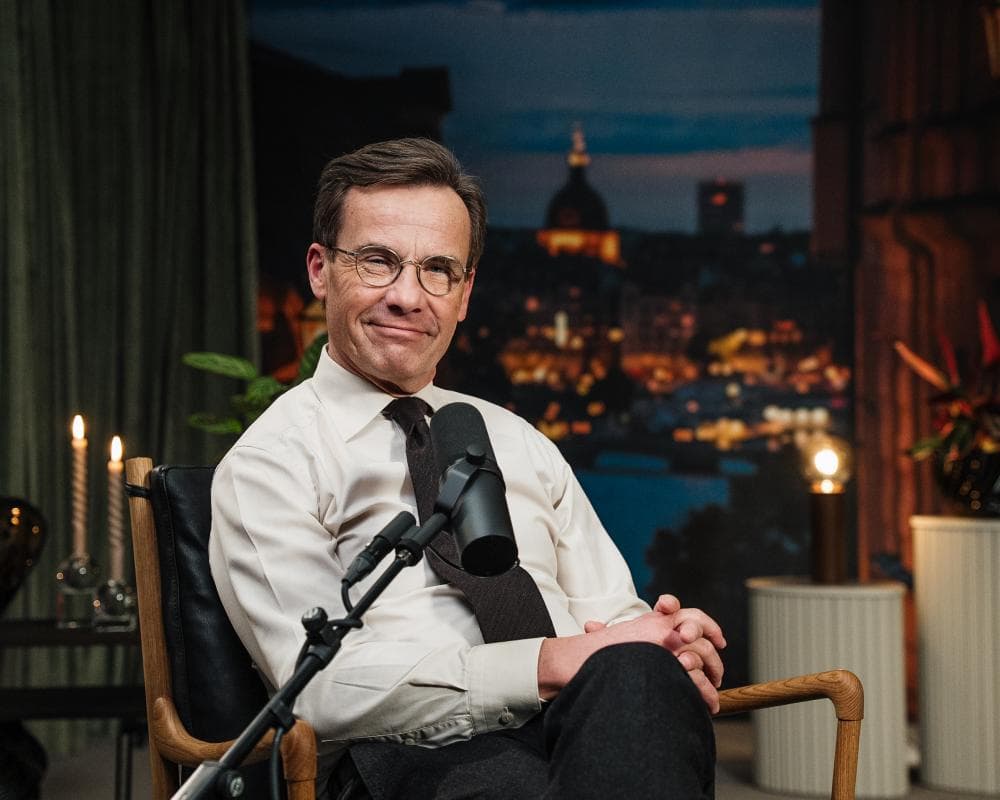
Dressed in a shirt and tie, and sat in a candlelit room, he laughs at the beer question and responds: “One of life’s important questions.” While he says he is not a big beer drinker, if he were to have a beer on a Saturday night, he would “probably drink one. Possibly two,” he says, adding that it would almost always be an IPA, before singing the praises of a particular Swedish brewery.
The Moderates say that the aim of the new podcast is “to create an environment for good conversation with Sweden’s prime minister – genuine, curious and straight talk about people’s reality”.
Participants can either phone the podcast as it is recorded to talk to the prime minister in person, or pose questions ahead of time in a voice mail or email. Before the first episode, the Moderates say there were so many calls the answer phone broke.
But critics say that if Kristersson is to do well in the next election he will have to do more than launch a podcast.
As he approaches four years in power as leader of a minority coalition that depends on the support of the Sweden Democrats, a December poll found that the gap is closing between Kristersson and Åkesson when it comes to trust, and he is far below the opposition Social Democrats leader, Magdalena Andersson.
“Ulf Kristersson is having a difficult time with his confidence poll numbers and I don’t think populist beer drinking is going to help him,” said Parisa Höglund, presenter of Det politiska spelet (the political game) podcast on public service broadcaster Sveriges Radio. She said the Sweden Democrats were his “biggest headache” because voters prefer them on his party’s traditional talking points such as law, justice and migration.
Höglund added that while the Ring statsministern! format is more fast-paced, friendlier and varied than the interviews he usually does, ultimately it is simply a new way of delivering the same politics and talking points. It is also, she said, a way of avoiding difficult questions from journalists.
“If you watch the episode on YouTube, you see the prime minister in a more relaxed environment, sitting in a leather armchair with candles in the background, answering normal people’s questions, it can give the impression that you get to see another side of the prime minister,” she said. “But one should remember that everything is staged so that the prime minister can control the narrative about himself as a politician and his politics ahead of the autumn election.”
Among the other questions asked in the first episode, which went live on Tuesday, included a suggestion to legally shorten the working week, and a woman asking for reasons to vote for his party.
When a caller asked whether they should address him as Mr Prime Minister, Kristersson answered: “Ulf works really well.”
Fredrik Furtenbach, a political commentator for Sveriges Radio Ekot, said of the podcast: “I doubt this will have any meaning. Firstly, the parties’ own communication is generally too boring, and secondly, there is a great risk that it will only reach those who […] already like Kristersson.”