Loading...
Please wait for a bit
Please wait for a bit
Click any word to translate
Original article by Eva Corlett in Wellington
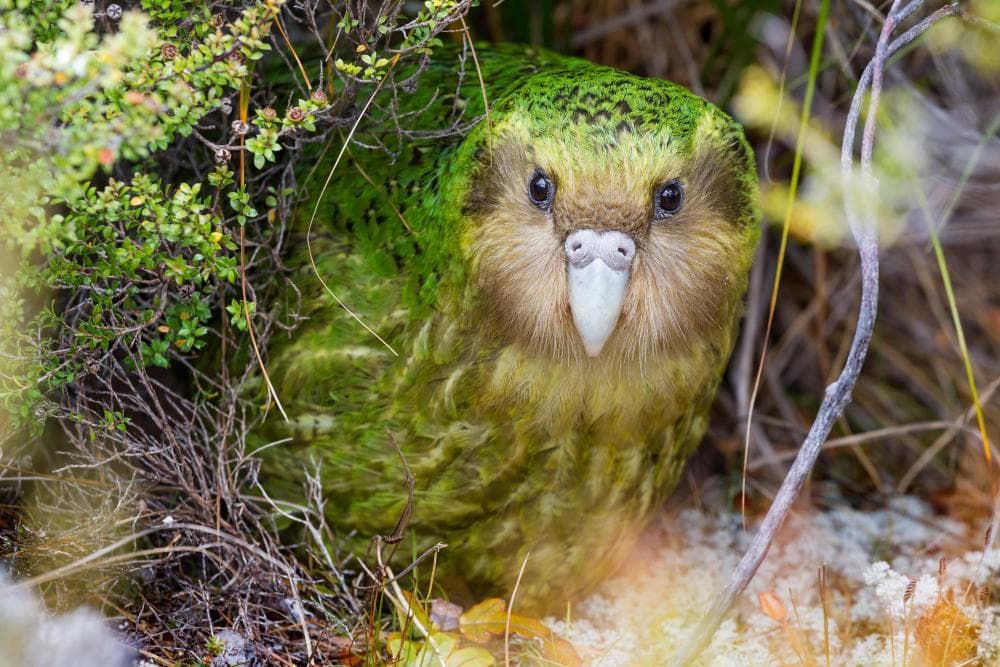
It has been four long years, but the world’s heaviest parrots, the kākāpō, are finally about to get it on again. The mass fruiting of a native New Zealand tree has triggered breeding season – a rare event conservationists hope will lead to a record number of chicks for the critically endangered bird.
Kākāpō, the world’s only nocturnal and flightless parrot, were once abundant across New Zealand. But their population plummeted after the introduction of predators such as cats and stoats, and by the 1900s they were nearly extinct.
A recovery programme established in 1995 rebuilt the population from 51 to 236 birds, including 83 breeding-age females.
Kākāpō breed only every two to four years when the native rimu trees “mast” and produce large numbers of berries, so repopulation is slow.
This year a “mega-mast” is expected, resulting in a bountiful harvest of rimu berries, which could prompt the birds to produce more eggs.
Deidre Vercoe, the Department of Conservation’s operations manager for kākāpō recovery, said it was an exciting moment for her team.
“We’ve got a really big rimu crop developing on the trees and the birds haven’t bred for four years so we’re hoping that they will all get into the action this summer,” she said.
Kākāpō are thought to live between 60-80 years, can weigh up to 4kgs and are famously entertaining. Their mating rituals are “crazy”, Vercoe said.
Male birds gather in a “lek” to produce a distinctive booming sound, emitted from air sacs in their chests while sitting in a dug-out bowl in the ground. The deep boom, which can travel up to 5km, sounds similar to a softly plucked cello string.
After choosing a partner and mating, females typically lay one to four eggs. The females become solely responsible for their eggs and hatched chicks for roughly six months.
Vercoe said it was a mystery how kākāpō know when rimu are likely to mast, or why they rely on that particular tree. But the fruit is nutritious and, when plentiful, provides enough food for the birds to raise two to three chicks.
Kākāpō are extremely good climbers and can easily scale the 20-30 metre high rimu to access berries, she said. “They are doing that over and over all night long for months – it’s really hard work, and quite amazing.”
Previous breeding seasons have on average led to the production of one chick per breeding female, and each season brings new challenges. This year, a higher number of younger females are ready to breed but they may not be as successful as older birds.
“I never like to count our chickens before they hatch, but we’re really hopeful that the majority of the females breed and we will get some good numbers of chicks through.”
There are three kākāpō breeding populations, all based on predator-free islands near the bottom of the South Island – one near Rakiura / Stewart Island, and two near Fiordland national park.
As the population steadily grows, so too does the issue of where to put the birds.
“We are actually running out of space for kākāpō and predator-free, good-quality habitat,” Vercoe said.
“It’s an exciting turning point for the programme – how do we keep growing the population, but how do we take steps back and where do we put them?” she said.
“It’s a challenge for New Zealand to grapple with.”