Loading...
Please wait for a bit
Please wait for a bit
Click any word to translate
Original article by Carlos Mureithi in Nairobi
Voting in Uganda’s general election has been delayed in many parts of the country because of technical and logistical issues, against the backdrop of an internet shutdown and crackdown on the opposition.
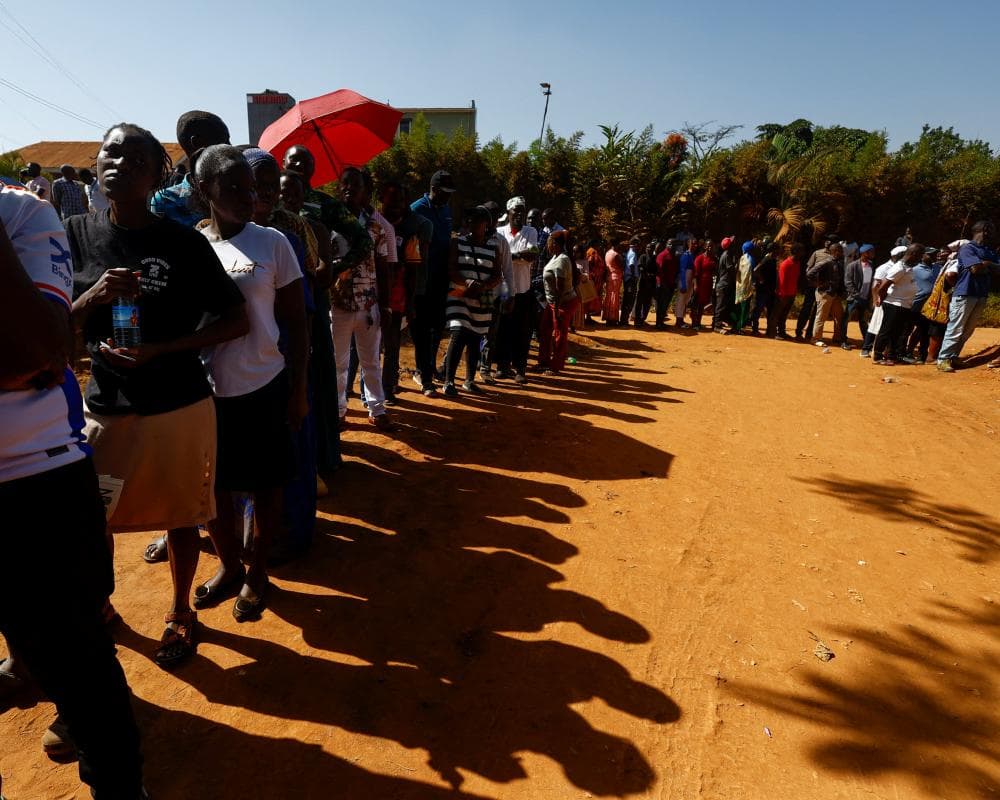
Some polling stations in the capital, Kampala, and the eastern city of Jinja remained closed nearly two hours after voting was supposed to start on Thursday. According to local reports, in some instance ballot papers had not been delivered and biometric machines used to check voters’ identities were not working. Anxious crowds at polling stations spoke of their concerns about the delay.
The election is expected to result in the east African country’s authoritarian president, Yoweri Museveni, extending his nearly four-decade grip on power after a campaign beset by violence.
Security forces – over which Museveni has total control – frequently clamped down on supporters of his main opponent, Bobi Wine, by teargassing and shooting bullets at events and detaining people. Authorities arrested civil society members and suspended rights groups. On Tuesday, they shut down internet access and limited mobile phone services countrywide.
Observers say the heightened repression could indicate that the ruling National Resistance Movement (NRM) was concerned about waning support. It has also prompted fears of a violent crackdown on dissent in the aftermath of the vote, as was seen in neighbouring Tanzania after its election in October.
Museveni is seeking his seventh term, and most Ugandans have not lived under another president. Younger people in particular have connected with Wine, a 43-year-old singer turned politician, and say they are concerned about their futures.
Museveni became Uganda’s ninth president in 1986 after leading rebels in a five-year civil war. He led the country to economic growth and democratic change after years of political decay by autocratic governments.
But hopes of enduring change dwindled amid accusations of corruption, authoritarianism, repression and curtailment of judicial independence. Critics have also condemned his extended stay in office, achieved by using tactics to lengthen his term indefinitely, including by twice changing the constitution.
“[Wine’s] challenge has brought to the surface the character of the regime in terms of tolerating political alternatives or dissent,” said Mwambutsya Ndebesa, a political historian. “The political class is getting more and more politically polarised. And that threatens the stability of the country because Uganda is prone to political instability.”
In the run-up to the election, police and the military frequently broke up Wine’s campaign events using teargas and gunshots and by bludgeoning his supporters. At least one person was killed and hundreds were arrested.
In December, police detained Sarah Bireete, a rights activist and government critic who had raised concerns about discrepancies in the registry of voters. On Tuesday, the government ordered several rights groups that had denounced violations during the campaign period to stop their work.
A report by the UN human rights office last week accused Ugandan authorities of using laws enacted or amended since 2021 to entrench repression and restrict rights before the election, which it said would take place in an environment marked by widespread repression and intimidation.
The government has said the actions of the security forces are in response to what it termed lawless conduct by opposition supporters. In a televised address on New Year’s Eve, Museveni advised security forces to use more teargas to break up the crowds of “the criminal opposition”.
Eron Kiiza, a human rights lawyer, said at a briefing on the election last week: “Everything is done to frustrate and annoy,” referring to disruption of opposition events by security agencies. Kiiza was allegedly tortured and detained without trial last year while representing the jailed opposition politician Kizza Besigye, who has been in prison for 14 months over what critics say are politically motivated charges, and Besigye’s aide Hajj Obeid Lutale.
Museveni, 81, often credits NRM with bringing peace and development to Uganda. Under the slogan “protecting the gains”, he is promising wealth and job creation and to grow the economy partly through value addition for agricultural exports and oil production, which is expected to start this year.
Festus Kezire, an NRM supporter in Serere district in eastern Uganda, said Museveni’s introduction of free primary and secondary education was one of the reasons he would vote for him. He said: “He has restored peace and stability in Uganda and this has helped end many years of civil strife.”
Museveni is campaigning against seven opposition candidates, the main challenger being Wine, whose real name is Robert Kyagulanyi, of the National Unity Platform (NUP). The two faced off in the last election in 2021, with Museveni winning with 58.38% of the vote and Wine garnering 35.08%.
Wine’s manifesto promises “a complete reset of Uganda”, including by upholding human rights and ending corruption.
Florence Naluyiba, an NUP supporter in Wakiso district in central Uganda, said she would vote for Wine because “Uganda needs change”. “Our dream is to have a president who will prioritise social service delivery. Bobi Wine has taken the risk to stand up for Ugandans at the expense of his freedom,” she said.
Ndebesa, the historian, said the incumbent’s stranglehold on state power, resources and infrastructure gave him organisational advantages over Wine. “The winning [of Museveni] in Uganda is almost a given,” he said.
However, observers are keen to see what the election will say about Museveni’s eventual succession. He has long been thought to be grooming his son, Gen Muhoozi Kainerugaba, as his successor, although he has denied this.
Across Uganda, 21.6 million people have registered to vote.
Additional reporting by Samuel Okiror and Agence France-Presse