Loading...
Please wait for a bit
Please wait for a bit
Click any word to translate
Original article by Aram Roston
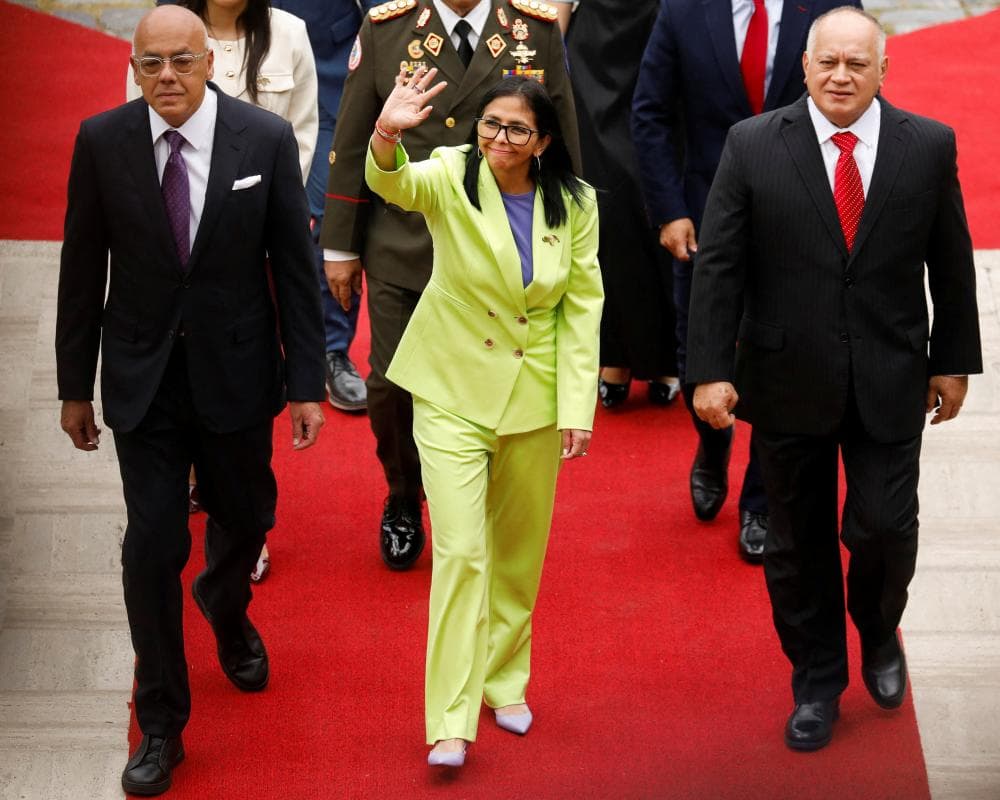
Before the US military snatched Venezuela’s president, Nicolás Maduro, earlier this month, Delcy Rodríguez and her powerful brother pledged to cooperate with the Trump administration once the strongman was gone, four sources involved at high levels with the discussions told the Guardian.
Rodríguez, who was sworn in on 5 January as acting president to replace Maduro, and her brother Jorge, the head of the national assembly, secretly assured US and Qatari officials through intermediaries ahead of time that they would welcome Maduro’s departure, according to the sources.
The communications between US officials from Delcy Rodríguez, who was then Maduro’s vice-president, began in the fall and continued after Trump and Maduro spoke in a crucial phone call in late November, the Guardian has learned, in which Trump insisted that Maduro leave Venezuela. Maduro rejected the demand.
By December, one American who was involved told the Guardian that Delcy Rodríguez told the US government she was ready: “Delcy was communicating ‘Maduro needs to go.’
“She said, ‘I’ll work with whatever is the aftermath,’” another person familiar with the messages said.
The sources say Marco Rubio, Trump’s secretary of state and national security adviser, at first a skeptic about working with regime elements, came to believe that Delcy Rodríguez’s promises were the best way to prevent chaos once Maduro was gone.
The pledge of cooperation by Delcy and Jorge Rodríguez before the Maduro raid has not been previously reported. In October, the Miami Herald reported on abortive negotiations via Qatar, in which Delcy offered to act as a transitional government chief if Maduro stepped down.
Reuters reported on Sunday that Diosdado Cabello,the powerful Venezuela interior minister, who controls police and security forces, had also been in discussions with the US at a point months before the Maduro operation.
All the sources say there was a fine distinction to the agreement by Delcy Rodríguez: while the Rodríguez family promised to assist the US once Maduro was gone, they did not agree to actively help the US to topple him. The sources insist this was not a coup engineered against Maduro by the Rodríguez siblings.
Hours after the raid, Trump appeared to confirm the talks. He told the New York Post that Delcy Rodríguez was onboard. “We’ve spoken to her numerous times, and she understands, she understands.”
The Venezuelan government did not respond to emailed questions concerning this story. The White House did not respond to detailed questions.
There were many official talks between Trump officials and the Maduro-led Venezuelan government happening on top of the backchannel conversations.
Maduro himself met with Ric Grenell, a top Trump aide, just 10 days after Trump’s inauguration, to discuss US prisoners, who were quickly released.
Key Trump aides continued official talks with Jorge and Delcy Rodríguez quite often, to coordinate, for example, the bi-weekly flights of Venezuelans deported from the US, according to two sources familiar with the talks. There was a barrage of issues that had to be solved: where the deportation flights would land, the status of Venezuelans imprisoned in El Salvador and political prisoners that could be released.
Meanwhile Delcy Rodríguez retained very close personal ties with Qatar, where members of the ruling family considered her a friend, according to sources familiar with their relationship. Qatar, a key ally of the US, donated a $400m luxury jet for Trump’s use in an unprecedented gift from a foreign country to a president. It used the good will it had in Trump’s White House to open more doors for Rodríguez in secret negotiations, two of the sources said.
As the Miami Herald reported in October, Rodríguez tried to propose a transition government, led by her, that would rule Venezuela if Maduro agreed to a prearranged retirement in a presumed safe-haven. The plan fell through, and Rodríguez fiercely denounced the story, but key Americans began to think she was far from a two-dimensional dogmatic leader.
Those who know her describe a figure with disarming quirks that help her form bonds easily. She drinks champagne, has a private ping-pong coach and a tendency to challenge foreign dignitaries to games.
By October, sources say, in secret, even the Americans who were most aggressive against Maduro were open to working with her.
One factor was her promise to work with American oil, and her acquaintance with Americans in the oil business. “Delcy is the most committed to working with US oil,” an ally of hers said.
The sources said Mauricio Claver-Carone, a former Trump special envoy for Latin America who still had the ear of Marco Rubio despite being out of government, was one key backer.
Claver-Carone declined to comment.
The main goal for the US was stability once Maduro was out, given the predictions of civil war and chaos. Another of the sources said “the biggest thing was trying to avoid a failed state”.
It wasn’t until late fall that Delcy Rodríguez and her brother actually engaged in discussions with the US behind Maduro’s back.
Maduro spoke to Trump on the phone in November, and by the next week it was clear Maduro would not leave.
For Delcy Rodríguez it was a delicate dance. At the same time they made the offer, the sources say she did not agree to actively betray Maduro. “She feared him,” said one official familiar with the events.
When the US attack helicopters flew into Caracas in early January, Delcy Rodríguez was nowhere to be found. Rumors spread that she had fled to Moscow, but two sources say she was on Margarita Island, a Venezuelan vacation spot.