Loading...
Please wait for a bit
Please wait for a bit
Click any word to translate
Original article by Tom Phillips in Caracas, Sam Jones and agencies
Four Venezuelan police officers have been arrested and are facing dismissal after being accused of looting cash from the rubble of a building that collapsed during last week’s devastating twin earthquakes.
Local people and national and international rescue teams continue to search for survivors in the aftermath of the back-to-back quakes, which have killed almost 2,000 people, injured more than 10,000, and left tens of thousands missing.
Videos on social media showed angry people trying to stop members of the scientific, penal and criminalistic investigation service corps (CICPC) helping themselves to a safe full of dollars from a ruined building in the hard-hit state of La Guaira.
In a statement, the CICPC said four officers had been arrested and relieved of their duties, and disciplinary action for their “immediate dismissal” had begun.
“In light of the recent events in the areas affected by the earthquakes in La Guaira state, it was confirmed that a group of officers, deviating from their duties and taking advantage of the rescue and humanitarian aid efforts, acted improperly by appropriating valuables found among the rubble,” the statement said.
“This individual conduct, reprehensible and contrary to the fundamental values of our doctrine, directly undermines the institution’s prestige and public respect.”
Although a three-year-old boy was pulled alive from the rubble of a building in La Guaira on Tuesday, hopes of finding more survivors are dwindling. Meanwhile, public anger over the slow pace of the government’s rescue effort – and over the conduct of some members of the military and police – is growing.
Volunteers, many equipped with little more than with shovels, ropes and their bare hands, say they are doing everything they can to locate survivors while, they say, some Venezuelan military and police personnel are looting, blocking aid and co-opting donations.
On Wednesday hundreds of volunteers were still streaming into La Guaira, the disaster’s ground zero, to offer their support.
“We want to do everything we can to help,” said Fabiano Nadales, 35, a volunteer from the city of Valencia who was travelling on the back of a pickup truck with a team of about 15 medical students and amateur searchers.
Nadales said he still had hope that more survivors could be found. “Miracles happen. Some people can survive 10 days,” he said as his convoy waited in a huge traffic jam.
“It’s really tough … but we are just trying to help,” said Estefania Callejas, 25, a third-year medical student from Valencia who was also among those battling to reach the scene in the hope of helping treat the thousands of walking wounded.
Senior government officials have blamed misinformation for the growing civilian anger and reports of military personnel involvement in looting and slow aid. They have urged the public to ignore “manipulation strategies on social networks” and rely on official information.
But some of the volunteer rescuers say they see little evidence of the authorities rushing to help, a week after the disaster hit.
“You see the firefighters and [Mexican rescue team] Los Topos,” Alexander Delgado, a teacher from the central Venezuelan state of Aragua, told Reuters. “But you don’t see the state, per se.”
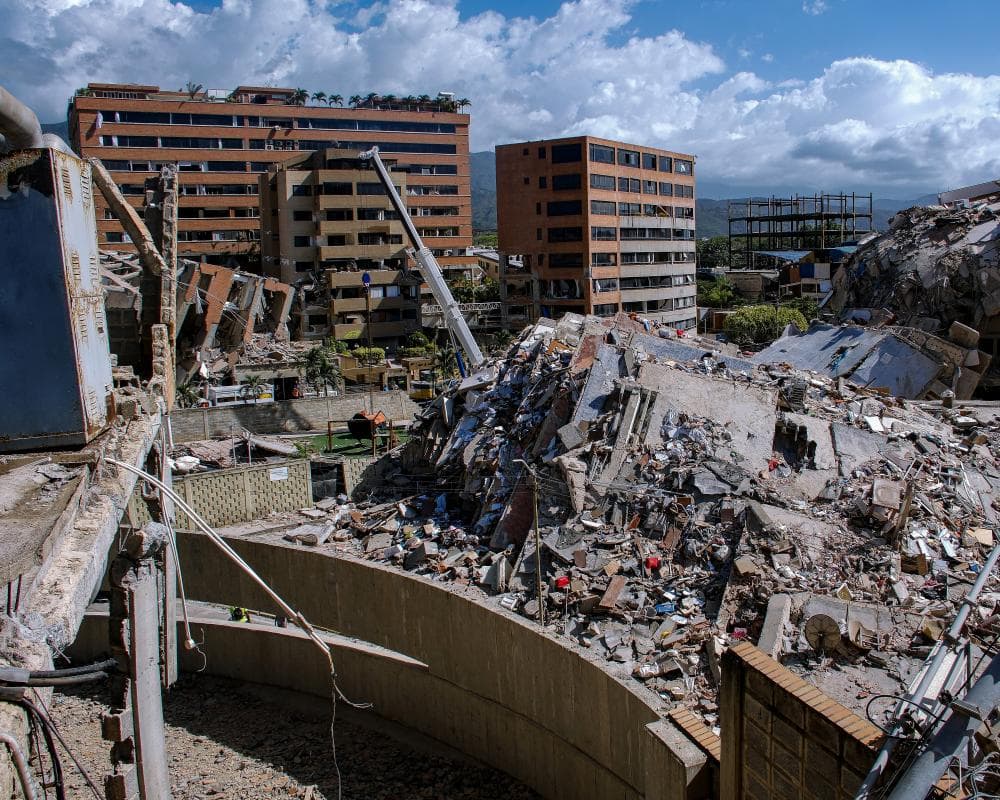
His team has spent five days shifting rubble and listening intently for sounds of life under the hot Caribbean sun in La Guaira. They are supported by other local volunteers, who bring water, face masks, ice and knowledge about the eight-tower Hugo Chávez housing development, where six towers are now debris.
Venezuela’s ministry of communications, which handles media inquiries for the military and police, did not immediately respond to requests for comment.
By Tuesday, six days in, there were two international rescue teams and some local firefighters, as well as one truck from Venezuela’s forensic service, but they still lacked heavy equipment, said Delgado.
Mijaed Díaz, a veterinarian who had joined other volunteers, also said more help was needed from the Venezuelan authorities. “I would like more presence of public entities, who really are those responsible for this,” he said as he looked for body bags for four cadavers that had just been pulled from the rubble. “But in the end we’re used to making do with almost nothing.”
Daniela Armas, who was waiting to get food in an emergency shelter in La Guaira, said the situation was desperate. “They give out supplies here, but sometimes people nearly kill each other for food,” she told Agence France-Presse. “It’s like a cockfight.”
After initially thanking civilian volunteers, the government on Friday restricted public access to La Guaira, enraging people trying to help find survivors.
One government employee stationed at a checkpoint in La Guaira on Sunday told Reuters they had witnessed police officers and military personnel commandeer aid from three trucks carrying supplies, bragging about what they had managed to “score”.
The acting Venezuelan president, Delcy Rodríguez, is trying to shore up her power after the US snatched her predecessor, Nicolás Maduro, in January.
“Delcy and company have been in charge for 26 years and they only have one script,” said James Story, who was the US ambassador to Venezuela until 2023. “They take credit for anything positive, push blame for anything negative and try to control the narrative.”
Donald Trump, however, has hailed the US relationship with Rodríguez, and American companies have expressed interest in everything from oil to gold.
The US embassy’s charge d’affaires, John Barrett, also vouched for Rodriguez’s handling of the disaster, telling Univision on Monday that he had “a great deal of confidence” in local authorities.
The 7.2 and 7.5 magnitude shocks – one of the worst earthquake disasters in Latin American history – collapsed whole residential complexes on 24 June.
Preliminary analysis of satellite data suggests that more than 58,000 buildings may have been damaged or destroyed in the quake, dwarfing official estimates of the devastation. On Monday, Jorge Rodríguez, the president of the National Assembly, said 855 buildings had been damaged, including 189 “total collapses”.
Reuters and Agence France-Presse contributed to this report