Loading...
Please wait for a bit
Please wait for a bit
Click any word to translate
Original article by Philip Oltermann European culture editor
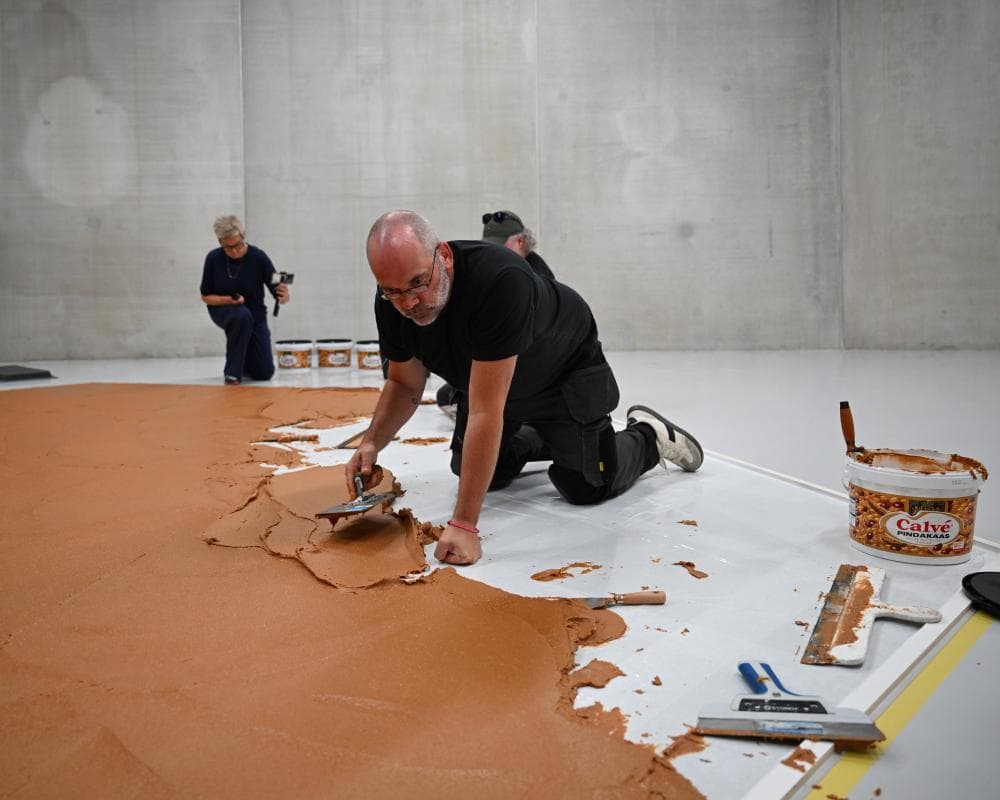
A museum in Rotterdam has paid tribute to the idiosyncratic character of one of the most influential figures in the Dutch arts by spreading 800lb of peanut butter across the floor of one of its galleries.
The hexagonal floor installation, called Pindakaasvloer (Peanut Butter Floor), is a recreation of a work by Wim T Schippers conceived of in 1962 and first exhibited in 1969.
It is displayed alongside detailed instructions Schippers left behind after his death last month aged 83. They stipulate that curators should apply 15.6kg of non-chunky peanut butter to every square metre of the floor and spread it as “smoothly and monotonously as possible”. The work should not be stood or lied upon and not be approached “with any educational purpose”.
“Peanut butter floor still raises questions like, is this art? Am I allowed to like this?” said Sandra Kisters, the acting director of Museum Boijmans van Beuningen. “And it is this sense of bewilderment that makes this piece so special. We regard it as a great honour to be able to present this unique artwork in his memory.’’
Born Willem Theodoor Schippers in Groningen, Schippers was a unique figure in the cultural life of the Netherlands. His dadaist mischief and love of the absurd proved influential far beyond the refined world of galleries and museums.
In the early 1960s, he was the co-founder of the A-dynamische groep art collective that railed against commercialisation, seriousness and, above all, boredom in art with stunts that included shaving cactuses and filling galleries with shards of glass or salt.
Food was a popular medium: as well as spreading peanut butter across floors, Schippers also upholstered a chair with canned noodles and covered a table in peas.
From the late 60s, he branched out into television. His music show Hoepla was discontinued after it featured the first completely naked woman on live Dutch television. He later conceived of the cult comedy character Sjef van Oekel, a Belgian frites salesman in a tuxedo played by the comedian and opera singer Dolf Brouwers.
To Dutch people, Schippers is best known as the voice of Ernie, Kermit the frog and Count von Count on the Netherlands’ version of Sesame Street.
“You could compare his status and influence to Monty Python,” said Kisters. “He believed that life and art were always entirely serious and entirely non-serious at the same time.”
He continued to make conceptual art until his death in June. For his seemingly gravity-defying 1999 work Het Is Me Wat (That Is Quite Something), he made a large stone float above a pedestal through large electromagnets.
Hilversum’s Media Park continues to showcases his 4 metre-high sculpture representing a pile of excrement, entitled Stationnement Gênant (Unauthorised parking), unveiled in 2011.
In April this year, he told Dutch media he was working on his last artwork, which would be titled Wim is Gone. “I keep putting it off, because then I think I’m going to die,” he said.
Schippers’ peanut butter floor has been installed numerous times in Dutch museums. When Pindakaasvloer was showcased at Utrecht’s Centraal Museum in 1997, it was vandalised by schoolchildren who covered it with chocolate sprinkles and slices of bread – recreating a popular Dutch childhood snack. Schippers was reportedly not dissatisfied with the result.
When the peanut butter floor was last in place at the Museum Boijmans van Beuningen in 2011, it was damaged when an inattentive visitor walked over and slipped on the installation. Visitors submitted 648 questions about the work to the artist, each of which he answered in writing.
Schippers’ work will be shown until 6 September and the museum’s restaurant will have a peanut butter sandwich on its menu during that time, with optional additions of cheese and spicy sambal relish. Kisters said the museum shop would also sell smooth peanut butter, so visitors “can make their own art at home”.