Loading...
Please wait for a bit
Please wait for a bit
Click any word to translate
Original article by Carlos Mureithi in Nairobi
A French-African summit held every few years since 1973 is taking place in a non-francophone country for the first time as Emmanuel Macron tries to rebuild France’s role on the continent after setbacks in its former colonies.
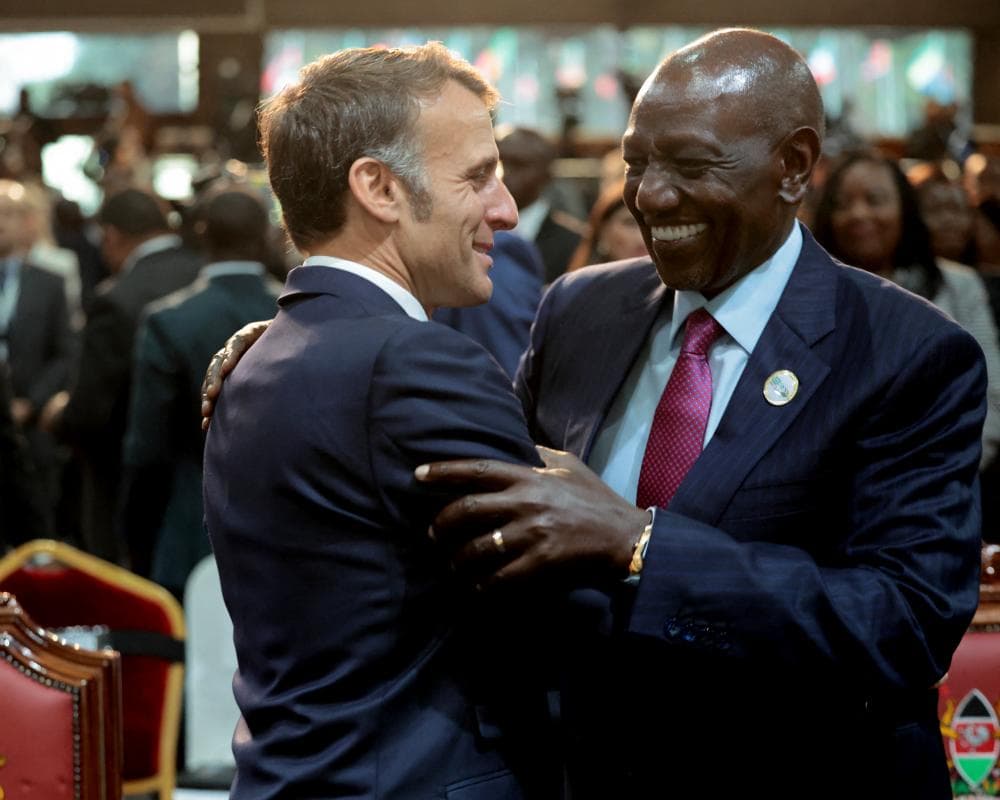
More than 30 heads of state and government are meeting in Kenya’s capital, Nairobi, for this year’s iteration of the summit. Named Africa Forward, it is being seen by analysts as an attempt by France to court new allies.
Speaking at the summit on Tuesday, the French president announced new investments and said sovereignty would be key in the new partnership that France is hoping to build with Africa.
Macron said Paris would be respectful of each African country’s independence, adding that “sovereignty and autonomy is shared, and your success is our success”. France’s new strategy, according to Macron, would be based on a shared agenda and that the “days of offering assistance are behind us”. “I’d like to focus on co-investment,” he said.
The leaders joined representatives of the African Union, financial institutions and the development sector to discuss themes including energy transition, peace and security and reform of the international financial architecture.
The summit was preceded on Monday by networking, matchmaking and workshop events on youth, creative and cultural industries and sport. Organisers say the event represents “a paradigm shift” in the relationship between Africa and France.
The Kenyan president, William Ruto, referred to sovereignty eight times in his speech. He reiterated that the days of European dependency were over for Africa in favour of mutual respect between cooperating nations. New partnerships between the African nations and France “must not be built on dependency but on sovereign equality, not on aid or charity but on mutually beneficial investment, and not on extraction or exploitation but on win-win engagements,” he said.
France had for decades used a policy called Françafrique in its former colonies to maintain political, economic and military influence. But it has faced repeated setbacks in francophone countries in west and central Africa, where its relations with its former colonies have deteriorated.
Coups in the region have been underpinned by anti-France sentiment, with Paris being accused of neocolonialism and of trying to influence military and other affairs.
Since 2022, France has been forced to withdraw its troops from countries including Mali, Niger and Chad. Some terminated their defence agreements with Paris and others requested a military withdrawal.
Mikhail Nyamweya, an international relations analyst, said holding the summit in a non-francophone country signalled that France was trying to move “beyond its old francophone comfort zone … after losing ground in its traditional sphere of influence”.
He added: “France is trying to repackage its Africa policy through an anglophone diplomatic hub, and to present the relationship as broader, more economic, and less tied to its colonial past.”
The summit also fits in with Ruto’s ambition to position Kenya as a reliable international partner and a convening hub. During Ruto’s term, Kenya has led a security mission in Haiti and hosted the inaugural Africa Climate Summit.
Prof Macharia Munene, a history and international relations scholar, said Macron had been trying to establish himself in a global leadership role and was looking for companions in Africa. “There was a convergence of interests,” he said of Macron and Ruto.
France and Kenya entered a defence agreement last year that opposition and civil society groups in the east African country have criticised, saying it compromised sovereignty and gave French soldiers legal immunity. In March, 800 French military personnel arrived in Kenya for training and security exercises.
At a joint press briefing with Ruto in Nairobi on Sunday, Macron remarked on the changing dynamics for his country in west Africa, downplaying the absence from the event of leaders from Mali, Burkina Faso and Niger and highlighting the number of academics, artists and entrepreneurs in attendance from those countries.
“We can disagree with some of these governments, but we never disagree with people. We love these people,” he said.