Putin says Russia not seeking war with Europe but is ‘ready’ to fight amid peace talks – as it happened
Click any word to translate
Original article by Lucy Campbell, Fran Lawther, Jakub Krupa, Yohannes Lowe and Adam Fulton
The day so far
Vladimir Putin accused European powers of preventing peace in Ukraine and threatened that Russia was ready for war as Donald Trump’s envoy Steve Witkoff and his son-in-law, Jared Kushner, arrived for talks at the Kremlin on Tuesday evening. It’s been over three hours and those talks appear to have not yet concluded.
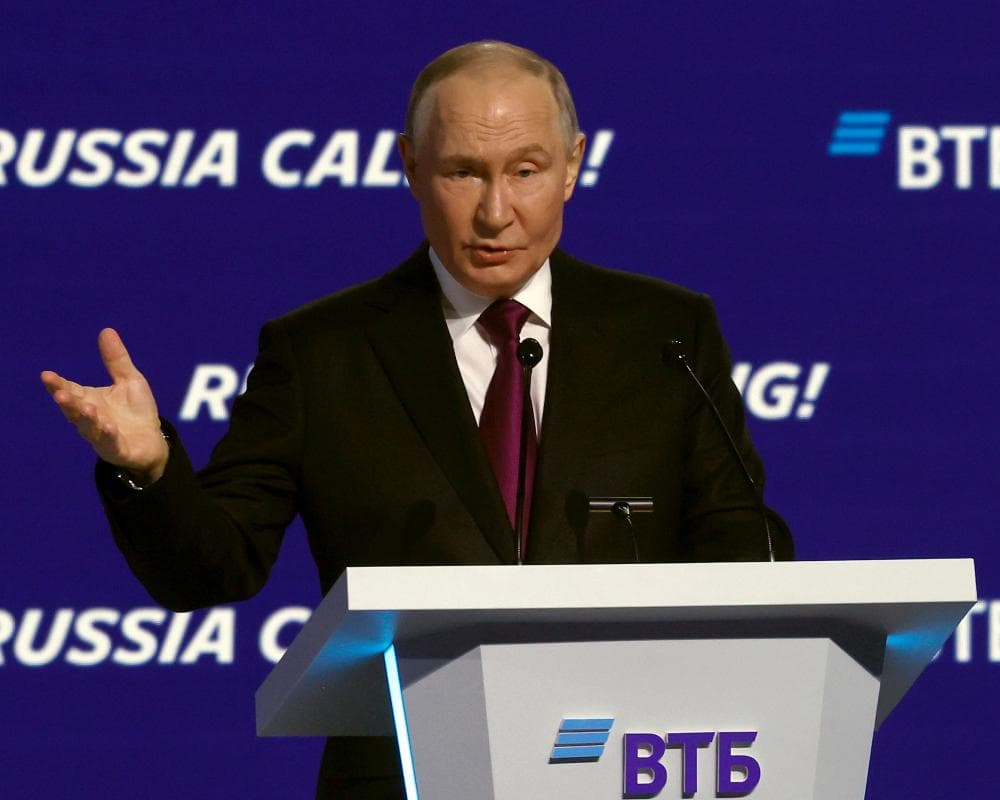
Moments before the closed-door meeting with Witkoff and Kushner, Putin made a series of hawkish remarks to reporters in which he accused European governments of sabotaging the peace process and said that “European demands” on ending the war in Ukraine were “not acceptable to Russia”. “Europe is preventing the US administration from achieving peace on Ukraine,” Putin said, adding: “Russia does not intend to fight Europe, but if Europe starts, we are ready right now.” Putin did not clarify which European demands he found unacceptable. “They are on the side of war,” Putin said of European powers.
Meanwhile, the Ukrainian president, Volodymyr Zelenskyy, said he was “awaiting signals” from the US delegation after its meeting with Putin.
During a trip to Dublin, Zelenskyy said the speed of the peace talks and the United States’ interest in finding a solution was cause for optimism, but he feared the US could lose interest in the peace efforts. If somebody from our allies is tired, I’m afraid,” he said. “It’s the goal of Russia to withdraw the interest of America from this situation.”
On Putin’s comments (see above), Zelenskyy said it’s difficult to comment on his words, but noted that Putin probably doesn’t want to end the war as he has failed to meet his goals in Ukraine. “Now he is thinking how to find new reasons not to [end] this war,” he said. Zelenskyy also said he counts on “pressure from the US” and others to advance the peace talks further.
Ukrainian authorities have arrested a British military instructor accused of spying for Russia and plotting assassinations.
Ross David Cutmore, 40, from Dunfermline, was allegedly recruited by Russia’s intelligence service, the FSB, to “carry out targeted killings on the territory of Ukraine” between 2024 and 2025.
The Kyiv prosecutor’s office said: “In May 2025, he passed on the coordinates of the locations of Ukrainian units, photographs of the training facility and information about military personnel that could be used to identify them.
“In addition, analysis of his correspondence confirmed that he had carried out other tasks for the benefit of the Russian special services.”
As we wait to hear news of the US-Russian meeting in Moscow, Ukraine’s president Volodymyr Zelenskyy said he was ready to meet Donald Trump again depending on what “signals” emerge from the discussions in Moscow.
Writing on X, Zelenskyy said: “Ukraine will be waiting for signals from the American delegation after its meetings in Russia. The US delegation intends to brief us directly immediately after those meetings. The next steps will depend on those signals. We will receive signals of one kind or another.
“If the signals work out in a certain way – if it is fair play with our partners – then we may meet with the American delegation very quickly. At what level – we will see, depending on the signals. If the signals open the possibility and the chance for global but swift decisions, then the meeting will take place at a higher level.
“I am ready to receive all the signals and ready for a meeting with President Trump. Everything depends on today’s discussions.”
Here’s my colleague Pjotr Sauer’s report on Putin’s earlier comments accusing Europe of standing in the way of US efforts to end the war in Ukraine.
To recap, moments before the closed-door meeting with US envoys Steve Witkoff and Jared Kushner several hours ago, Putin made a series of hard-edged remarks, accusing European governments of sabotaging the peace process and said that “European demands” on ending the war in Ukraine were “not acceptable to Russia”.
“Europe is preventing the US administration from achieving peace on Ukraine,” the Russian president said, adding: “Russia does not intend to fight Europe, but if Europe starts, we are ready right now.”
He didn’t clarify which European demands he found unacceptable.
“They are on the side of war,” he said of European powers.
As Pjotr notes in his report, Putin’s comments appeared aimed at driving a wedge between Washington and European capitals. European officials have had some success in pushing back against the original US plan, though it remains unclear to what extent Washington is taking their concerns into account.
Updated
Rubio says conflict in Ukraine is 'not our war'
In his remarks, Rubio also said of Trump and the war in Ukraine: “That’s not our war, that’s not the president’s war.”
Praising Trump’s efforts, he added that the US president is trying to end” the war despite having a “million things to focus on”.
Updated
Rubio praises Trump's involvement in peace talks
Rounding out comments today in Trump’s two-hour-long cabinet meeting, US secretary of state Marco Rubio said that Trump is the “only leader in the world” that can help end the war in Ukraine as he praised the US president’s foreign policy efforts.
“Even as we speak to you now, Steve Witkoff is in Moscow trying to find a way to end this war,” Rubio added, referring to the ongoing summit between Putin and the US delegation that’s been going on for more than two hours.
Updated
The closed-door US-Russia meeting has been under way for over two hours now, we’ll bring you any updates out of the meeting as soon as we get them.
Per a video posted by Russian news agency RIA earlier, pleasantries were exchanged between Vladimir Putin and Steve Witkoff and Jared Kushner at the beginning of the discussion, with the Russian president telling the American envoys through an interpreter that he is “so pleased to see you”, and asking about their stroll through Moscow.
Witkoff replied that it was “a beautiful walk” and “a magnificent city”. The Russian president thanked him and praised the local Moscow authorities’ work in recent years to develop the Russian capital.
Updated
Zelenskyy 'afraid' US might lose interest in peace process
Back in Dublin, Volodymyr Zelenskyy said the speed of the peace talks and the United States’ interest in finding a solution was cause for optimism, but he feared the US could lose interest in the peace efforts.
“A little bit optimism was in my words because of some speed of negotiations, and from the American side, their interest in it. It showed that America is not withdrawing now from any kind of diplomatic way of dialogue and it is good,” the Ukrainian president said.
But later asked if he was afraid that the US might lose interest in the process, Zelesnkyy replied: “Yes I am afraid. If somebody from our allies is tired, I’m afraid.”
“It’s the goal of Russia to withdraw the interest of America from this situation,” he said.
Updated
That’s all from me, Jakub Krupa in London, but Lucy Campbell is here to guide you through the evening in Europe and afternoon in the US with the latest on Ukraine.
Ireland visit offers comfort to Zelenskyy on difficult day as peace talks continue — analysis
in Dublin
Ireland is a geopolitical and military lightweight but it offered comfort to Volodymyr Zelenskyy on a difficult day.
US envoys made another foray to Moscow and Vladimir Putin claimed a battlefield victory but in Dublin, at least, Zelenskyy found solidarity and reassurance.
The Irish government pledged €125m in extra support and, more importantly, gave full-throated support for a European loan and Ukrainian membership of the EU.
The Ukrainian president was feted by the taoiseach, Micheál Martin, and received a hero’s welcome when he addressed a joint session of the Oireachtas, the Irish legislature, on his first official visit to Ireland.
The ruling coalition and opposition parties forged a rare unity to give standing ovations to Zelenskyy, who held the chamber rapt.
“Thank you for not losing faith in us,” he said, speaking English. Ireland understood the price of freedom more than most and remained steadfast despite war fatigue, he said. “We do not feel that your voice is turning quieter.”
The speech capped a visit that will have pleased both sides.
Ireland, despite military neutrality and meagre capacity, showed it was doing its bit. Zelenskyy shored up an alliance with Ireland, which holds the EU presidency next year, and reminded Washington and Moscow that there could be no peace without justice.
Awkward topics, such as Ireland’s fraying welcome for Ukrainian refugees and President Catherine Connolly’s critique of western “militarism”, were nimbly sidestepped.
Ending Ukraine war 'not easy' and 'mess,' Trump says
Trump is now speaking at the beginning of his cabinet meeting.
He briefly mentions the Ukraine war, as he talks about the US being “strong and respected again on the world stage,” and his visit at the Nato summit in the Hague earlier this year.
But he admits “we have a problem with a war that our people are trying to settle now, with Russia and Ukraine.”
He says the US is no longer “monetarily involved,” only sells weapons to Nato, but it’s still trying to “get that settled.”
“I’ve settled eight wars. This would be the ninth, and our people are over in Russia right now to see if we can get it settled. Not an easy situation, let me tell you, what a mess. It’s a war that never would have happened if I were president, not even a chance.”
He then also jokingly (?) suggests once again that he should get the Nobel peace prize if he ends this war (or, indeed, for “every war” he settled).
Updated
Putin 'thinking how to find new reasons not to finish war,' Zelenskyy says
Zelenskyy’s latest point in Dublin is a discussion on Ukrainian-Irish economic cooperation, and he immediately gets asked about Putin’s words earlier today (16:14, 16:31).
He says it’s difficult to comment on his words, but notes that Putin probably doesn’t want to end the war as he has failed to meet his goals in Ukraine.
“Now he is thinking how to find new reasons not to [end] this war,” he says.
Zelenskyy says he counts on “pressure from the US” and others to advance the peace talks further.
He also notes that by pitting Russia against “Europe” Putin “underlines by these words that he’s not European.”
Russia's economy may be facing greater problems than thought — analysis
Diplomatic Editor
Russia’s economy may have experienced a recession since the full scale invasion of Ukraine, contrary to the official consensus that Russia has built a robust war economy, according to a new report published by LSE Ideas, a foreign policy think-tank at the London School of Economics and Political Science.
The paper, produced in collaboration with Ukrainian Industry Expertise and the PeaceRep programme, suggests Russia’s inflation rate has been higher than official figures and the government lacks sources for further financing that would not push it even higher.
The authors estimate that inflation is likely running at approximately 20 -25% – double the official estimates – over the course of the full-scale invasion, leading to a significant downgrade in reported economic growth.
Official data shows that between 2021–2024, Russia’s GDP grew by +7.1%, and real household income grew by an unprecedented +24.8%. But the LSE Ideas report claims these figures are based on questionable official estimates of inflation at between 7.4% and 11.9% per annum in 2022–2024.
Moreover, Russia is believed to have run down reserves in its sovereign wealth fund to finance the war, and the latest oil sanctions significantly affect the economy’s capacity to generate further revenues from oil – and that is only going to get worse.
The report says the National Welfare Fund (NWF) stood at $148bn at the war’s outset, but since then $113bn was spent, in line with the increase in military spending over this period (circa $135bn).
The war has also driven a wedge in living standards, dramatically improving incomes for a fifth of Russians at the expense of the large majority. The report claims that for the bulk of Russians, real incomes have fallen by 16–42%, with the greatest decline among retired people, social workers, education and healthcare professionals.
The annualised budget deficit is also set to reach 7–8tn rubles (or 18% of budget expenditures) by the end of the year. Moscow is struggling to convert its gold reserves into hard currency as a result of sanctions imposed on Russia.
The intervention comes at an important moment as EU leaders insist that it would be a fatal mistake for the US to abandon Ukraine and instead forge a new economic partnership with Russia, just as economic sanctions passed during the four years of the war are starting to weaken Russia’s ability to conduct military operations.
Kaja Kallas, the EU’s foreign policy chief, last year predicted the Russian economy would be at breaking point by the turn of the year.
Dr Volodymyr Vlasiuk, director of Ukrainian Industry Expertise and one of the report’s authors, says:
“It is highly likely that the Russian economy is smaller today than it was in February 2022.
Our research shows why the official rate of inflation looks suspect. Our alternative estimate of inflation means that Russian GDP should be downgraded, exposing the significant costs that the war has imposed on the Russian economy and the limits of its use of military Keynesianism.”
Key US-Russia talks get under way at Kremlin
We are now getting first pictures from inside that US-Russia meeting at the Kremlin.
The Russian president, Vladimir Putin, is joined by its two senior aides, Kirill Dmitriev and Yuri Ushakov, as he begins his talks with Donald Trump’s special envoy Steve Witkoff and Trump’s son-in-law Jared Kushner.
'Just' peace deal is needed to stop this and prevent next war, Zelenskyy warns — snap analysis
A very clear message from Zelenskyy there as he repeats Ukraine’s determination to secure a just peace deal – not just to stop the current war, but also to include strong guarantees to prevent another one in the future.
He put it very elegantly, warning: “Without a just peace, hatred will not fade” (17:20).
There was an extensive part of the speech warning against reverting to “business as usual” with Russia in the future, and the need to keep Moscow accountable for the war crimes in Ukraine (17:17).
But with a clear and repeated commitment to the peace process, the difference between Zelenskyy’s tone compared to Putin’s earlier comments (16:31) could not be starker.
Updated
'Without just peace, hatred will not fade,' Zelenskyy warns, calling stressing need for just peace deal
Zelenskyy ends with another warning on this point:
“This has gone on far too long to simply close our eyes and turn the page on Russia. Without a just peace, hatred will not fade. It will continue to smoulder and provoke new violence.
History has seen this before, and this time, it must be different. We need real peace. Help us achieve it and never lose your faith in Ukraine.”
His words are met with rapturous applause from the Irish parliament.
Updated
'Europe cannot run away from its values, it must stand up for them,' Zelenskyy says
In a strong passage about Russia, Zelenskyy says that people’s “memory is often short, and attention can be fleeting.”
“So please remind the world every time it is needed that Russia’s invasion of Ukraine is a criminal and unprovoked act of aggression …
It happened for one reason only: because Russia wants to treat Ukraine at its property and Ukrainians as if they belong in its back yard like livestock.”
He urges Irish parliamentarians to keep putting pressure on Russia, and keep demanding accountability for Russia’s crimes during the war.
“We must protect the unity that has existed since 2022, a unity of different nations, united in the protection of life and justice. … There is no good future for Europe without this unity,” he says.
He also pointedly talks about Ukraine’s plan to join the EU, saying “Europe cannot run away from its values – it must stand up for them and Ukraine is doing exactly that today, on Europe’s behalf.”
But talking about the future, he also warns against “amnesia” among politicians, as he warns them to not fold back to “business as usual,” “appeasement of the killers,” or “turning a blind eye to what has happened.”
The aggressor must be held accountable for what was done.
'No one can break world alone, not even Russia,' Zelenskyy says as Ukraine 'closer to peace than ever before'
Zelenskyy begins his speech by thanking Ireland for its continuing support and for welcoming Ukrainian refugees “when they needed it most.”
“Our peoples, the Ukrainians and the Irish, are among the few in Europe who spent centuries, fighting for the right to remain themselves,” he says.
He says that the war with Russia is “the most devastating war for freedom” since the second world war.
He then turns to the on-going peace negotiations, repeating earlier lines that Ukraine is “fully engaged in negotiations,” and the key point that “Ukraine is closer to peace than ever before.”
“There is a real, real chance, but we must seize this chance,” he says.
He makes a moral point that “no one can break the world alone – not even Russia,” stressing the strength of support behind Ukraine.
Updated
'Our neutrality is commitment to peace, not indifference,' Irish parliament speaker says
Verona Murphy, the speaker of Dáil Éireann, welcomes Zelenskyy to the parliament, as she says “we gather in solidarity and admiration for you and your people.”
But she says:
“Our own history teaches us that dialogue, however difficult, can bring peace, the Good Friday agreement was born from decades of pain and division, yet it proved that even the deepest wounds can heal when people choose negotiation over violence.”
She says “that lesson gives us hope for Ukraine” as the country continues to face “an illegal attack” by Russia.
She says:
As a militarily neutral country, Ireland is not and never will be morally neutral in the face of atrocity. Our neutrality is a commitment to peace, not indifference.
She stresses that Ireland “will stand firm” behind Ukraine.
After a smaller private meeting, Ukraine’s Zelenskyy has now arrived inside the Irish parliament’s chamber, receiving a very warm applause from the members of both chambers.
The main event with his speech is now getting under way.
Updated
Obviously, we will also be keeping an eye on the latest from Moscow and the expected US-Russia meeting on Ukraine.
Back to Dublin, Ukraine’s Zelenskyy has now arrived at Leinster House, so we should hear his address to the Irish parliament fairly soon.
Putin's hawkish remarks dial up pressure before key talks with US on Ukraine — snap analysis
Russian affairs reporter
Russian president Vladimir Putin on Tuesday insisted he was not seeking a war with Europe, but warned that “if Europe wants to fight, we are ready right now.”
In a series of hawkish remarks delivered to reporters moments before his scheduled meeting with Donald Trump’s envoys Steve Witkoff and Jared Kushner in the Kremlin, Putin accused European governments of sabotaging the peace process and declared that “European demands are not acceptable to Russia.”
“Europe is preventing the US administration from achieving peace on Ukraine,” he said.
Putin did not clarify which European demands on Ukraine he found unacceptable.
But his comments appeared aimed at driving a wedge between Washington and European capitals, which have backed Kyiv in proposing revisions to a 28-point peace plan developed in earlier US–Russia contacts that dramatically favoured Moscow.
The Russian leader also threatened retaliation against Ukraine’s ports and ships after Kyiv in recent days struck several vessels in Russia’s so-called “shadow fleet” in the Black Sea.
Russia, he warned, would “step up strikes on Ukrainian ports and on any ships entering them” in response to attacks on Russian tankers, which he described as “piracy.”
Putin attacks Europe for unacceptable demands, hindering peace talks
We are also getting some other strong lines from Russia’s Putin, with the Russian leader quoted as rejecting the European proposals as “not acceptable to Russia.”
He also accused European leaders for “hindering” US proposals and insisted they “do not have a peaceful agenda.” (sic!)
He added that Russia did not want a war with Europe, but “if Europe wants to fight war, we are ready now,” he is reported by Reuters as saying.
I will bring you more on these lines in a moment.
As always with Putin, there is always a bit (or a fair bit more that that) of posturing, but it’s a clear and direct warning towards Europe as the talks with the US are about to get under way.
Updated
Russia's Putin says Pokrovsk holds 'special significance' for army goals
And right on cue, Russia’s Vladimir Putin is quoted by Reuters as saying that the city is “of a special significance, that’s a great base for fulfilling goals.”
He repeated the earlier claim that the city was “fully in Russian army’s control.”
Let’s take a look at the map to see what’s going on there.
Updated
The slow death of Pokrovsk — profile
Earlier today, I brought you a few lines on the importance of the key Ukrainian city of Pokrovsk, which sees intense fighting between Russia and Ukraine and appears to be used by Russia to claim it is gaining the momentum on the battlefield (11:02, 11:27, 11:42).
Our Dan Sabbagh has this brilliant profile on the 18-month battle that has left “the strategically important Ukrainian town in ruins.”
For a time Pokrovsk was a haven, a wartime Ukrainian boom town because of its strategic position in the east, 30 miles (48km) from the front. But that was before the summer of 2024, when a rapid Russian advance engulfed the industrial centre in a shattering conflict, a duel only now reaching its endgame.
The 18-month battle for Pokrovsk epitomises the current state of the Ukraine war: an attritional struggle in which gradual Russian advances have been made at extraordinary human cost. Though it demonstrates Russia cannot easily capture urban areas, the fight has also drained Ukraine, and consequences are emerging elsewhere.
Such has been the level of destruction that Pokrovsk is no longer even strategically significant. Its population is decimated, its industry destroyed and supply routes are re-routed; instead it has become a bloody signpost as peace negotiations restart.
Photographs by Julia Kochetova.
Updated
Next up in Zelenskyy’s schedule is his address to the Irish parliament.
He addressed in virtually in 2022 as part of his diplomatic push to galvanise support for Kyiv in the immediate aftermath of Russia’s invasion on the country, but this time he will be able to deliver his remarks in person.
I will keep an eye on this and bring you the key lines when it starts.
Updated
Zelenskyy's comments in Dublin — summary
Speaking in Dublin, Ukraine’s Volodymyr Zelenskyy has said that “now, more than ever, there is a chance to end this war,” with a 20 points peace plan, even as “some things still need to be worked out” (15:12).
Answering media questions alongside Irish prime minister Micheál Martin, he listed territory discussions, the use of frozen assets, and future security guarantees for Ukraine as the three key issues in the talks (15:28).
The Ukrainian president stressed that Kyiv wanted to “stop the war in such a manner that in one year, Russia would not come back with a third invasion” (15:24).
Meanwhile, Ireland’s Martin has declared that Russia’s Vladimir Putin “must never be allowed to succeed” in his war on Ukraine (15:07), as he backed the EU’s plans to use frozen Russian assets for supporting Ukraine’s defence and reconstruction needs (15:20), after Zelenskyy said it was “high time” for Europe to move on this issue (15:14).
Martin also mounted a passionate defence of the argument in favour of welcoming Ukraine into the European Union, telling Zelenskyy that “your struggle is our struggle” and that he wanted Ukraine to make the most of the same opportunities that Ireland has benefited from (15:09).
Zelenskyy declines to criticise Ireland for changes to refugee support rules
Zelenskyy also gets asked about changes to the way the Irish government supports Ukrainian refugees in the country.
He declines to criticise Dublin saying “the way I was brought up, … I can’t criticise for help – whether they’re getting more or less – we should be grateful.”
He stresses the shared values that underpin “the choice” the Irish people have made to offer that assistance to the Ukrainians in need in the first place.
And that concludes the press conference.
Ireland ready to take part in peacekeeping forces, Martin says
Asked about Ireland’s willingness to get involved in a peacekeeping force, Martin confirms the political will to “monitoring any ceasefire or indeed aspects of a peace settlement,” drawing on Ireland’s experience in Lebanon, and Africa.
“We are also, obviously, willing to help in reconstruction,” he says.
Territory, frozen assets, security guarantees key part of peace talks, Zelenskyy says
Asked about the latest on peace talks, Zelenskyy switches to English for the first time as he repeats the main point from earlier.
He says Ukraine will “wait for the results in US-Russia negotiations,” and will react accordingly, with potential follow-up meetings.
But he says he wants to see the actual results of these talks.
He says he is not prepared to discuss all parts of the deal publicly, but says “you saw a lot of things in the media.”
He says the most sensitive issues are about Ukraine’s territories, the use of frozen Russian assets, and security guarantees for Ukraine, from the US, Europe and other countries.
“I think these three topics the most sensitive and the most important. And I think that our teams will continue to work on it,” he says.
Zelenskyy says 'no simple solutions' to end war
Zelenskyy insists that “nothing should be decided about Ukraine without Ukraine,” even as he admits there are “no simple solutions” to end the war.
He says the peace negotiations are “not an experiment” for Ukraine, but something that will define the future of the country and the nation, and there should be no escaping the fact that Russia has been the aggressor.
“We have to stop the war in such a manner that in one year, Russia would not come back with a third invasion,” he says.
Ireland's Martin backs plans to use frozen Russian assets for Ukraine's reconstruction
Martin gets asked about the use of frozen Russian assets, and he says that Ireland continue to support the use of these assets “to fund the reconstruction of Ukraine,” and backs the European Commission’s proposal for a collateral loan.
He says:
“The principle underpinning our position is that when the UN Charter is violated in such a brutal manner, when there is devastation of civilian infrastructure, energy infrastructure, of cities and so forth, there has to be a deterrence against such behaviour into the future.”
He adds:
“I hope that the December meeting will come to a conclusion, we fully respect the concerns of the Belgium government, fully respect, and these issues have to be ironed out and it has to be a collective agreement across the European Union.
Yes, it will be challenging to get that collective agreement but Ireland’s very clearly, supportive of the Commission’s position.”
Zelenskyy says Ukraine will be looking out for signals from today’s US-Russia meeting in Moscow, and “based on these signals, what they will say, will decide our next steps.”
He says Ukraine could meet with the US delegation next, depending on the outcome of these talks.
Zelenskyy also talks about the need to hold Russia “accountable for the aggression and war crimes,” with a special tribunal working on this issue.
He ends with special thanks to all communities in Ireland that welcomed the Ukrainian refugees.
'High time to transfer them to Ukraine,' Zelenskyy says on frozen Russian assets
Zelenskyy thanks for Ireland’s new aid package for non-lethal weapons and energy, but also picks up on European efforts to fund Ukraine with frozen Russian assets.
He says “it is high time to transfer them to Ukraine, so we can reliably ensure both our defence and our recovery.”
“This will benefit not only us, but also our partners. We will give more orders to countries that help us,” he says.
Ukraine's Zelenskyy says 'more than ever' there is chance to end war, but 'some things still need to be worked out'
Zelenskyy says his visit comes “one of the most challenging and yet optimistic moments at the same time,” as he says “now, more than ever, there is a chance to end this war.”
He says the latest peace plan draft has 20 points, that have been worked on in Geneva and Florida.
But “some things still need to be worked out,” he says.
'Your struggle is our struggle,' Martin says as he declares Ireland's support for Ukraine's EU path
Martin also makes it very clear that Ireland will support Ukraine’s ambition of joining the European Union, despite some opposition within the bloc (ekhm, Hungary).
“We will continue to work, including when we hold the EU presidency next year, to advance negotiations on its membership as much as we can.
The people of Ukraine are working extremely hard to achieve their EU ambitions, and they deserve our backing.
EU membership transformed our country and underpins our prosperity, and we want the same for our Ukrainian friends.”
He ends with a clear declaration:
“Know that for as long as Ukraine needs our help and support, Ireland will be there for you. Your struggle is our struggle. Your success will be our success.
We are with you for as long as it takes.”
Putin 'must never be allowed to succeed,' Martin says, as Zelenskyy's visit comes at 'critical' time for Ukraine
Opening, Martin extends “100,000 welcomes” to Zelenskyy as he stresses its his – or indeed any Ukrainian president’s – first visit to Ireland.
He highlights Olena Zelenska’s work on securing the return of the Ukrainian children abducted by Russia.
He says “we all wish that your visit here was under different, happier circumstances,” and adds “we hope that we will soon be able to welcome you back when peace has come to Ukraine and its people.”
But he notes that the visit “comes at a critical moment for Ukraine and for Europe,” as Ukraine continues to defend itself against “the brutal and illegal war” waged by Russia.
Condemning Russia’s Vladimir Putin, Martin says “he seeks to gain advantage at the negotiating table by intensifying Russia’s relentless onslaught on the frontline and on Ukrainians, on Ukrainian cities and infrastructure.”
“He must never be allowed to succeed,” he stresses.
“It is shocking that the people of Ukraine are subject to nightly onslaughts of Russian missiles and drones. The people of Ukraine deserve to be safe in their own homes. Their children deserve to sleep safely in their own beds. Ireland will continue to support the people of Ukraine for as long as it takes,” he says.
He then confirms the new funding we reported on earlier (12:39), and stresses the need to support Ukraine’s energy infrastructure.
Looking forward, he continues:
“The focus for now must be on how Ireland can help Ukraine defend itself and its people, but peace will come to Ukraine.
I profoundly hope that day will be soon, and Ireland will be ready to work with Ukraine and our international partners to help underpin that peace and to support Ukraine in its journey of recovery and reconstruction.”
Coming up next is Zelenskyy’s press conference in Dublin with Ireland’s prime minister Micheál Martin.
I will bring you the key lines here.
Nato secretary general Rutte 'confident' efforts will 'eventually restore peace' in Europe
Meanwhile, Nato’s secretary general Mark Rutte has been briefing the media ahead of tomorrow’s Nato ministerial meeting in Brussels.
In his opening comments, he welcomed the US efforts to end the war and said he was “confident that these sustained efforts will eventually restore peace in Europe.”
(Eventually appears to be doing a lot of heavy lifting here.)
He also repeatedly criticised Russia for “systematically targeting civilian infrastructure” through its attacks on Ukraine.
Rutte also said he was expecting allies to “announce new contributions” to Nato’s Priorities Ukraine Requirements List – that’s essentially a scheme for Nato purchases of US weapons for Ukraine – in the coming days, further adding to “billions of dollars” already committed.
In the Q&A, he was asked a number of questions on the state of the Ukraine talks, and Nato’s role in them given that most discussions are happening through national channels between the US, Russia and Ukraine.
Rutte insisted that “when it comes to the Nato elements of the deal … that will be dealt with separately, and will obviously include Nato,” while generally repeatedly backing the US efforts.
Asked about Ukraine’s Nato membership, he repeated the alliance’s openness to it joining the alliance, but stressed that it requires a consensus from all Nato allies, and there was currently no agreement on that point.
He said the original 28 plan was a starting point, but “we have moved on” from that point with new drafts.
“We want the war to end, but with a sovereign Ukraine and a situation where Russia will never, ever try again to attack Ukraine, that’s key. The talks are now under way,” he said.
Rutte was also asked about US state secretary Marco Rubio’s absence at tomorrow’s meeting – which critics said was unprecedented – but he played down its significance.
“Marco Rubio is very much involved, of course, in all of this when it comes to ending the war in Ukraine … He’s working extremely hard, having to take care not only of the situation in Ukraine, but, of course, many other issues which are on his plate. So I totally accept him not being able to be here tomorrow, and I would not read anything to it,” he said, adding the US will be represented by Rubio’s deputy, Chris Landau.
Updated
Zelenskyy's visit to Government Buildings in Dublin — in pictures
After a brief meeting with the Irish president, Ukraine’s Zelenskyy has now moved on to Government Buildings in Dublin for his meetings with taisoeach Micheál Martin and his ministers.
The visit begins with a short formal ceremony and a guard of honour.
Updated
We now have more pictures from Zelenskyy’s meetings at Áras an Uachtaráin in Dublin, and his message in the visitor book quoted earlier (12:17).
Ireland promises €125m in funding for Ukraine on non-lethal military support, energy
in Dublin
Ireland has promised an extra €125m in financial support for Ukraine, including €25m to help restore and protect its fragile energy supply.
The taoiseach, Micheál Martin, said Ireland wanted to offer Volodymyr Zelenskyy not just words of assurance on his visit to Dublin but practical assistance.
“An additional €100m in non-lethal military support will be made available, to help Ukraine withstand the indiscriminate nightly onslaught of Russian missiles and drones. Ireland will also provide €25m for Ukraine’s energy supplies to help to counter Russia’s cynical and callous attacks,” said Martin.
Later on Tuesday the two leaders will sign an agreement titled the 2030 Roadmap on Ukraine-Ireland Partnership, which builds on a previous agreement from September 2024. The roadmap includes political and security cooperation as well as initiatives in reconstruction, education and culture.
After meeting with Connolly – called a “courtesy call,” because it’s expected to be very brief – Zelenskyy will meet with the Irish government.
We are expecting some announcements there, so let’s go to our Ireland correspondent Rory Carroll for more on that.
Updated
Zelenskyy begins his Ireland trip - in pictures
In fact, it looks like it’s two (or more?!) phones.
Arriving for his first meeting with Ireland’s new president Catherine Connolly, Zelenskyy was caught with his phone in hand, quickly passing it to one of his security circle as he got out of the car.
Can’t blame him given everything there’s lots to keep an eye on with so much happening today, including the key US-Russia talks in Moscow.
Fortunately, we have the Europe Live blog for you, and we will bring you all the latest.
Zelenskyy begins Ireland visit
Here we go.
Zelenskyy has just arrived at Áras an Uachtaráin for his meeting with the Irish president, Catherine Connolly, beginning with a moment to sign the guest book, with a note of thanks to the Irish people for their “steadfast support”, stressing that Ukraine “values its friendship with Ireland,” and talking about the commitment to closer cooperation in “pursuit of a just and lasting peace.”
This formally begins his visit in Ireland, with more to come today.
Updated
It’s Zelenskyy’s first official visit in Ireland – he addressed the Irish parliament virtually in 2022 – but RTÉ says he had visited the country in 2017, as an actor on tour, and even got an Irish flag, which he took with him back to Kyiv.
Today’s visit will be, obviously, very different though.
Zelenskyy's job during Ireland trip is to stop things fraying as first cracks in position towards Ukraine appear — analysis
in Dublin
The Irish government is feting Volodymyr Zelenskyy with full pomp on his first official visit to Ireland but there are fissures in Irish solidarity with Ukraine.
On the surface all is positive. The taoiseach, Micheál Martin, lauded the visitor as a bulwark against Russian aggression. “Our support for the people of Ukraine as they defend their freedom and democracy remains unwavering.”
After meeting President Catherine Connolly Zelenskyy will have a bilateral with Martin and is expected to get a rousing welcome when he addresses the joint houses of the Oireachtas, the Irish legislature. The government will announce extra funding for Ukraine, inaugurate an Ireland-Ukraine Economic Forum and introduce Zelenskyy to some of the tens of thousands of Ukrainians who have settled here.
There are, however, cracks. Ireland’s warmth towards Ukrainian arrivals – state-funded accommodation and generous welfare payments – has cooled amid a backlash against immigrants and refugees. Benefits are no longer quite so generous.
The Irish presidency is a largely ceremonial post but the newly elected Connolly is an outspoken critic of Nato and western “militarism”. She has compared German arms spending to the Nazi era. The government’s desire to participate in European security arrangements – and possibly a peacekeeping role in Ukraine – is expected to cause friction with Connolly, who cherishes Irish military neutrality.
Amid the smiles and handshakes and applause for Zelenskyy in Dublin, his job is to stop things fraying.
Zelenskyy says Ukraine takes peace talks with 'utmost seriousness' as he gets debrief on progress so far
Before his meetings in Ireland, Ukraine’s Volodymyr Zelenskyy said he was briefed on the state of the peace talks, stressing that Ukraine was taking the diplomatic work with “utmost seriousness.”
His post comes after a meeting in person with Rustem Umerov and other participants in the negotiations in Florida and Geneva “about the matters that cannot be discussed over the phone.”
Curiously, he said that “the Russians have already launched new disinformation campaigns in view of preparations for their upcoming meetings with the American side,” presumably referring to the Russian narrative on the situation on battlefield, including Pokrovsk.
“I gave instructions to continue the most constructive work possible with President Trump’s team, as well as with our European partners. Ukrainian intelligence will provide partners with all available information regarding Russia’s true intentions and its attempts to use diplomatic engagement as cover to weaken sanctions and block important collective European decisions,” he said.
Russian claims on taking control of Pokrovsk 'overexaggeration' even as situation is difficult, Ukrainian MP says
Ukrainian opposition MP Inna Sovsun was just speaking on RTÉ radio, explaining the importance of Pokrovsk to Ukraine’s defence of the Donetsk region.
She called the Russian claims that it’s taken over the city “overexaggeration,” even as she admitted that the situation there was difficult for the Ukrainian forces.
She stressed that “if the Russians capture Pokrovsk – which they have not … – they would have pretty easy access to other parts of both the Donetsk region and also to move forward to the Dnipropetrovsk region.”
But she said that the Ukrainian forces “have been protecting those cities for 11 years now,” and the Russians “still couldn’t get the whole territory.”
But asked about Russia’s attempt to create a narrative of inevitability on the battlefield, she said she was also concerned about the collective west – and the US in particular – buying into this logic to put more pressure on Kyiv.
“What we’re seeing over the last week is … America primarily pushing Ukraine towards making a deal, but they’re not pushing Russia so much. They are not actually putting pressure on them to make sure they are willing to compromise,” she said.
She repeatedly urged European leaders to speed up their decision on the use of frozen Russian assets, which she called “the strongest leverage that Europe has.”
“That is why Ukraine’s position right now in the negotiations is, of course, weak … but it’s not only because of the situation the front line, but because of what our friends and allies are doing or not doing to help,” she said.
Asked about the upcoming US-Russia talks in Moscow, she expressed concerns about Witkoff’s reputation as “being on super friendly terms with the Russians.”
She added:
“I’m worried that we have to negotiate our sovereign rights with the Americans, with the country that is supposed to be holding [up] … he rule based order, that is the major problem here.”
All eyes on key city of Pokrovsk as US-Russia talks on Ukraine continue
Ahead of Putin-Witkoff meeting in Moscow, lots of attention is focusing on the Ukrainian city of Pokrovsk, an important logistics hub in the eastern Donetsk region, which Moscow claimed to have captured, AFP noted.
But the Ukrainian military says the fighting in the city continues, with Ukrainians reportedly controlling the northern part of the city, and Russians – the souther part.
“Search and assault operations and the elimination of the enemy in urban areas continue in Pokrovsk,” the Ukrainian military’s eastern command wrote on social media, claiming Russian troops that planted a flag in the town’s centre had been beaten back.
The fight over the city comes amid Russian attempts to argue that its forces are making inevitable progress on the battlefield, putting more pressure on Kyiv to agree to a peace deal.
Reuters noted that Russia wants to take the whole of the Donbas region, which comprises the Luhansk and Donetsk provinces. Ukraine still controls about 10% of Donbas – an area of about 5,000 sq km (1,930 sq miles) in mostly northern Donetsk.
Capturing Pokrovsk and Kostiantynivka to its northeast, which Russian forces are also trying to envelop, would give Moscow a platform to drive north towards the two biggest remaining Ukrainian-controlled cities in Donetsk – Kramatorsk and Sloviansk.
The agency noted that Pokrovsk would be Moscow’s most important single territorial gain inside Ukraine since it took the ruined city of Avdiivka in early 2024.
But Russia has been threatening Pokrovsk for more than a year. Instead of its full-frontal assaults in earlier battles, such as the bloody campaign for the similar-sized city of Bakhmut, Russia’s military has been using a pincer movement to gradually encircle Pokrovsk and threaten Ukrainian supply lines, Reuters noted.
Ireland's Harris pays tribute to country's Ukrainian community
Deputy prime minister and finance minister Simon Harris stressed the significance of Zelenskyy’s visit for the Ukrainian community in the country.
He told RTÉ:
“There is many, many tens of thousands of people from Ukraine – 125,000 over the duration of the war so far – who’ve come to Ireland to seek refuge here.
Our communities have opened their hearts, they have opened their homes.
Many Ukrainian people are making a really important contribution to our economy today, working in many sectors of the Irish economy. Many Ukrainian children in our schools today and making a positive contribution to our schools as well, and for them today, for the Ukrainian people living in Ireland, it must be an emotional and significant day too.”
Irish prime minister Micheál Martin briefly chatted with reporters this morning ahead of his meeting with Ukraine’s Volodymyr Zelenskyy this lunchtime.
He told them that Zelenskyy’s visit is “an opportunity to get an update in terms of the current state of the negotiations in relation to a ceasefire and to a peace settlement in Ukraine,” Irish public broadcaster RTÉ reported.
He also stressed the need for the EU’s unity in talks, adding that Ireland has “supported Ukraine from the outset.”
Zelenskyy makes first visit to Ireland
In parallel to Witkoff’s meeting in Moscow, we will also follow Volodymyr Zelenskyy’s first visit to Ireland.
He has arrived in Dublin last night, and has a busy schedule today, paying a brief visit to the country’s new president Catherine Connolly, before meeting with key government figures including the taisoeach, Micheál Martin, and addressing both chambers of the Irish parliament in the afternoon.
He will also take part in some economic side events to mark the cooperation between the two countries.
Welcoming him at the airport last night, Martin stressed that “our support for the people of Ukraine as they defend their freedom and democracy remains unwavering.”
I will follow his visit and bring you the key lines here.
It’s Tuesday, 2 December 2025, it’s Jakub Krupa here, and this is Europe Live.
Good morning.
Vladimir Putin’s invasion of Ukraine has resulted in Russia taking Ukrainian children out of their country so that they can be raised as Russian.
The Associated Press documented the seizing of Ukrainian children in 2022, after which the international criminal court said it had issued an arrest warrant for Putin for war crimes, accusing him of personal responsibility for the abductions of children from Ukraine.
During a high-level meeting in Paris yesterday, Ukraine’s first lady Olena Zelenska said that, as part of Zelenskyy’s Bring Kids Back UA initiative, Ukraine has returned 1,859 children who were abducted and taken to Russian-held territory.
Ukraine’s foreign minister, Andrii Sybiha, said that nearly 700 children have been killed by Russia since the full-scale invasion was launched in February 2022. He said over 19,000 have been deported or forcibly transferred and 2,245 remain missing (see Ukraine’s national “Children of War” database for more information).
“Russia’s forced deportation of Ukrainian children is one of the most painful crimes of this war,” Sybiha wrote in a post on X.
Updated
Volodymyr Zelenskyy said that after revisions the plan to end the war – that has been circulating between Ukraine, Russia and the US – “looks better” and the work will continue on it.
But he maintains that the “territorial issue is the most difficult” element of the deal as Russia wants Ukraine to give up territory in the east it still controls, something Zelenskyy says he won’t agree to.
Speaking on Monday, the white house press secretary Karoline Leavitt said the draft deal had “been very much refined”, adding: “I think the administration feels very optimistic.”
Updated
Russia claims full capture of Pokrovsk
Vladimir Putin has hailed what his commanders told him was Russia’s full capture of the eastern Ukrainian town of Pokrovsk as an important victory after a prolonged campaign, saying it would help Moscow fulfil its wider war aims.
The town’s fall, if confirmed, gives Moscow a platform to drive north towards the two biggest remaining Ukrainian-controlled cities in the Donetsk region: Kramatorsk and Sloviansk.
Reuters reports there was no immediate comment on Pokrovsk from Ukraine, which has said in recent weeks it has been holding back Russian forces in the town’s north. And the news agency could not immediately independently verify the assertions of either side, though maps from both have long shown the town under intense Russian pressure, with Moscow’s forces deep inside it.
Russia, which uses the Soviet-era name of Krasnoarmeysk to refer to the town, has faced fierce Ukrainian resistance in its battle since mid-2024 to capture Pokrovsk, once a strategic logistics hub for the Ukrainian army.
“I want to thank you,” Putin, dressed in military uniform and sitting in a command centre, told the army’s top brass in a video released by the Kremlin late on Monday. “This is an important direction. We all understand just how important.”
Updated
Finland and Sweden have announced increased collaboration between the neighbouring Nordic countries including on defence, civil preparedness and cyber security.
In a joint statement, the Swedish prime minister, Ulf Kristersson, and his Finnish counterpart, Petteri Orpo, said they would be deepening bilateral cooperation in response to “Russia’s offensive war against Ukraine and increasing geopolitical and economic challenges”.
The statement said:
This work is done with a clear focus on interoperability and being able to act jointly in the face of external threats.
Since last year, Sweden has also assumed the role of the framework nation for Nato’s forward-looking ground force FLF Finland [Nato’s forward land forces], a step in our joint commitment to security in the region.
Who is Steve Witkoff? The American property developer turned loyal envoy to the US president has had a friendship with Donald Trump dating back to a late-night encounter in a New York deli.
Now Witkoff is key to Trump’s efforts to secure a deal to end the war in Ukraine – and earlier helped broker the ceasefire in the Israel-Gaza war.
Witkoff and Trump go back nearly 40 years. And as Julian Borger writes in this Witkoff profile early in the year, that is what gives the 67-year-old businessman his clout. America’s interlocutors know he is the genial emissary of a volatile leader capable of swinging from fulsome support to public vituperation in a heartbeat, depending in large part on who has Trump’s ear.
You can read the full profile here:
Updated
Today’s talks between Vladimir Putin and Trump envoy Steve Witkoff come as Russian forces control more than 19% of Ukraine – or 115,600 square km – up one percentage point from two years ago, according to Reuters.
And Russian forces have advanced in 2025 at the fastest pace since 2022, according to pro-Ukrainian maps.
As mentioned earlier, Russian military commanders told Putin on Monday that Russian forces had captured the frontline Ukrainian towns of Pokrovsk and Vovchansk.
Pokrovsk has been dubbed the “gateway to Donetsk” and has been in Moscow’s sights for more than a year as it pushes to control the whole eastern Donetsk region.
Ukrainian officials have issued no confirmation that either town has fallen into Russian hands.
US officials say more than 1.2 million men have been killed or injured in the near four-year-old war. Neither Ukraine nor Russia discloses their losses.
Updated
Amid the intensified diplomatic push to end the Ukraine war, Volodymyr Zelenskyy has said the Kremlin’s claims of battlefield advances are exaggerated and that Kyiv’s priorities remain security guarantees, sovereignty and territorial integrity.
The Ukrainian president also insisted that Russia must not get rewards for its aggression on Ukraine.
As Warren Murray reports in today’s Ukraine war briefing, Zelenskyy said in Paris that he hoped to have talks with Donald Trump to discuss next steps once Steve Witkoff was back from his talks in Russia.
Zelenskyy also said that after revisions the peace plan circulating between Ukraine, Russia and Washington “looks better” and the work would continue.
But as mentioned, the European Union is warning that the Putin-Wifkoff talks will again pile pressure on Ukraine to make concessions. The EU’s foreign policy chief, Kaja Kallas, said:
In order to have peace, we shouldn’t lose focus that it’s actually Russia who has started this war and Russia that is continuing this war and Russia that is really targeting civilians, civilian infrastructure every single day to cause as much damage as possible.
You can read the full war briefing here:
Updated
The Kremlin has said Vladimir Putin will meet Steve Witkoff for their talks on Tuesday afternoon. It’s now approaching 9.10am local time in Moscow.
Their meeting would take “in the second half of the day”, Kremlin spokesperson Dmitry Peskov said, while refusing to be drawn on Russia’s red lines, saying megaphone diplomacy was not helpful.
As a reminder, the talks also come against the backdrop of Witkoff coming under fire recently after reportedly advising a Kremlin official that achieving peace in Ukraine would require Russia gaining control of Donetsk and potentially a separate territorial exchange, according to a recording of their conversation obtained by Bloomberg.
In the 14 October phone call with Yuri Ushakov, the top foreign policy aide to Putin, Witkoff said he believed the land concessions were necessary while advising Ushakov to congratulate Trump and frame discussions more optimistically.
As Joseph Gedeon and Hugo Lowell reported, the recording provided a direct insight into Witkoff’s negotiating approach and appeared to reveal the origins of the controversial US 28-point peace proposal that emerged earlier in November.
Their story can be seen here:
Updated
Opening summary
Hello and welcome to our live coverage of war in Ukraine as Donald Trump’s special envoy Steve Witkoff is to meet Russian president Vladimir Putin in Moscow amid Washington’s push to reach a peace deal.
Witkoff’s trip comes after he led a US delegation in talks with Ukraine at the weekend in Florida, three and a half years after Russia’s full-scale invasion.
The US has been upbeat about the prospects of reaching a deal to end the war, with White House press secretary Karoline Leavitt telling reporters on Monday: “I think the administration feels very optimistic.”
But Kyiv’s European allies have expressed concern that the US peace plan gives too much to Moscow’s maximalist demands. The EU’s foreign policy chief, Kaja Kallas, said she feared the Putin-Witkoff talks on Tuesday would pile pressure on Ukraine to make concessions.
Witkoff – Trump’s business partner turned roving envoy – was expected to arrive in Russia with Trump’s son-in-law, Jared Kushner. The Kremlin did not say if Kushner would also attend the meeting with Putin.
In other developments:
Russian military commanders told Putin in comments reported on Monday that Russian forces had captured the frontline Ukrainian towns of Pokrovsk – a key logistics hub – and Vovchansk and were advancing elsewhere, which the Russian president hailed as successes to enable further gains. Ukrainian officials have made no acknowledgement that either place has fallen into Russian hands.
Zelenskyy said on Monday that Russia must not be rewarded for its invasion. “We also need to ensure that Russia itself does not perceive anything it could consider as a reward for this war,” he said a press conference with the French president, Emmanuel Macron.
Zelenskyy also held calls with a dozen other leaders, including the UK prime minister, Keir Starmer, and the German chancellor, Friedrich Merz, as he sought to rally support from European allies. “Peace must become truly durable,” the Ukrainian president wrote on X. “The war must end as soon as possible.”
Ukraine’s negotiator Rustem Umerov said “significant progress” had been achieved in the two days of talks with Witkoff and other US officials in Florida but that more work was needed on “challenging” issues.
The Moscow talks also come as Kyiv has faced headwinds from a corruption scandal that has rocked Zelenskyy’s inner circle and forced the dismissal last week of his top negotiator and chief of staff, Andriy Yermak.
A Russian missile attack killed four people and wounded nearly two dozen others on Monday in the central Ukrainian city of Dnipro, the regional governor said.
Updated