Loading...
Please wait for a bit
Please wait for a bit
Click any word to translate
Original article by Adam Fulton, Lucy Campbell, Aneesa Ahmed and Fran Singh
We’re closing this blog now but our coverage continues on a new liveblog here, including a recap of the latest developments. Thanks for following along.
The Middle East war has claimed its second victim from the Philippines, the country has said, when a missile struck the home of a Filipina living in Israel.
The woman was killed in the port city of Haifa on Sunday “alongside her Israeli husband and elderly parents-in-law”, the Philippine foreign affairs department said on Tuesday, without naming the victims.
Israeli rescue services said on Monday that the bodies of four people had been recovered from the rubble of a residential building in the city after it was struck by an Iranian missile the previous day.
Israeli news outlets said the Filipina victim and her family had been pulled from the rubble of their collapsed residence after an hours-long rescue effort.
The foreign affairs department said on Tuesday that the Philippine embassy in Tel Aviv was assisting with arrangements for the “earliest possible repatriation of her remains despite the current travel situation in the region”, AFP reported.
A 32-year-old caregiver, Mary Ann Velasquez De Vera, became the war’s first Philippine fatality on 1 March as she attempted to escort her elderly ward to an Israeli bomb shelter.
Updated
New Zealand’s prime minister has described Donald Trump’s recent threats against Iranian civilian infrastructure as “unhelpful”.
“Unhelpful because more military action’s not necessary,” Christopher Luxon told Radio New Zealand on Tuesday, cited by the AP.
He also said:
I think the bottom line is that the focus needs to be on not seeing this conflict expand any further.
We got threats from the president over the weekend. Any of those actions, including bombing bridges and reservoirs and civilian infrastructure, would be unacceptable as well.
New Zealand foreign minister Winston Peters’s message to US secretary of state Marco Rubio at a meeting in Washington – scheduled this week – would be to de-escalate the conflict “quickly”, Luxon said.
Updated
Donald Trump has been asked at a press conference whether his war on Iran is winding down or ramping up and he responded: “I can’t tell you.”
The president’s comments come as diplomatic negotiations aimed at halting the war in the Middle East appear to be faltering.
Trump also said Iran “can be taken out in one night, and that might be tomorrow night”, while reiterating his Tuesday deadline of 8pm Eastern Time for the regime to reopen the strait of Hormuz or face a barrage of strikes on energy facilities and bridges.
Defence secretary Pete Hegseth said that under Trump’s direction, “today will be the largest volume of strikes since day one of this operation”. He added: “Tomorrow, even more than today.”
As our fresh summary of the day’s key Trump administration stories says, the president also claimed on Monday that Iranian civilians were actively welcoming US strikes on their country’s infrastructure, saying they would be “willing to suffer” the loss of power and basic services in order to achieve freedom from the Islamic republic.
The claims came as some Democratic lawmakers accused the Trump administration of preparing to commit war crimes by targeting bridges and power plants.
The wrap is here:
Two blasts have been heard near the Erbil airport – which hosts advisers from the US-led anti-jihadist coalition – in Iraq’s northern Kurdistan region, an Agence France-Presse journalist said on Monday.
Some hours earlier, air defence systems downed four missiles headed towards the US consulate in Erbil, a security source told the news agency.
Local authorities also reported a separate deadly drone incident in a civilian area in the early hours of Tuesday.
The autonomous region’s counter-terrorism service said a “bomb-laden drone coming from Iran” crashed into a home in the Dara Shakran subdistrict of Erbil province after midnight, killing a couple.
Since the Middle East war erupted, shadowy Iraq-based groups have been claiming near daily attacks on US interests in the country and beyond. These groups have in turn come under attacks blamed on the US and Israel.
Updated
Oil prices extended their rises on Tuesday as Donald Trump heightened his rhetoric against Iran, saying “the entire country can be taken out in one night” if it doesn’t reopen the strait of Hormuz by his Tuesday deadline of 8pm Eastern Time.
Brent crude futures rose 57c, or 0.5%, to $110.34 a barrel by 1202 GMT, while US West Texas Intermediate crude futures were up $1.26, or 1.1%, at $113.67, Reuters reports.
The Israeli military is saying missiles were launched from Iran at Israel a short time ago and defensive systems are operating to incept them.
The military said in another post on Telegram a few minutes earlier that it had completed an “air strike wave” aimed at damaging Iranian regime infrastructure in Tehran and additional areas across Iran.
Updated
In Syria, explosions have been heard in Damascus and the capital’s surrounding countryside that were caused by Israeli interception of Iranian missiles, Syrian state television has reportedly said.
Explosions have been heard in parts of Tehran and Iran’s nearby city of Karaj, Iranian media is reportedly saying.
We’ve got vision here of Donald Trump lashing out at Australia, Japan and South Korea for what he says is a lack of help during the war in Iran.
At the White House media conference, Trump continues to take a hard line against Tehran, says he believes the US military is doing “unbelievably well” in the Middle East and adds that he remains frustrated with Nato.
“They haven’t helped at all,” the US president says. “It’s not just Nato. You know who else didn’t help us? South Korea didn’t help us. You know who else didn’t help us? Australia didn’t help us. You know who else didn’t help us? Japan.”
The video is here:
Saudi Arabia has intercepted seven ballistic missiles launched towards its eastern region and debris has fallen in the vicinity of energy facilities, the ministry of defence is saying.
An assessment of damage is ongoing, it says in the post on X.
The post didn’t mention Iran but the country has continued launching strikes against US allies around the Gulf.
Updated
The UN security council is expected to vote on Tuesday on a resolution to protect commercial shipping in the strait of Hormuz but in significantly watered-down form after veto-wielding China opposed authorising force, Reuters is reporting, citing diplomats.
Efforts by Bahrain – the current chair of the 15-member council – to secure a resolution have involved multiple drafts seeking to overcome opposition from China, Russia and others. The latest iteration, seen by Reuters, drops any explicit authorisation of the use of force.
Instead the text “strongly encourages States interested in the use of commercial maritime routes in the Strait of Hormuz to coordinate efforts, defensive in nature, commensurate to the circumstances, to contribute to ensuring the safety and security of navigation across the Strait of Hormuz”.
It says such contributions could include “the escort of merchant and commercial vessels”, and the text also endorses efforts “to deter attempts to close, obstruct or otherwise interfere with international navigation through the Strait of Hormuz”.
Diplomats said the watered-down version had a better chance of passing, but it remained unclear if it would succeed. It requires at least nine votes in favour and no vetoes from the five permanent members: Britain, China, France, Russia and the US.
Oil prices have surged since the US and Israel launched war on Iran in late February, prompting Tehran to largely close the strait, a vital artery for global oil and gas supplies.
Updated
More now on the World Health Organization suspending medical evacuations from Gaza after a contractor was killed on Monday.
The head of the UN agency, Tedros Adhanom Ghebreyesus, posted on X:
@WHO is devastated to confirm that a person contracted to provide services to the Organization in Gaza was killed today during a security incident.
Two staff members were present when it happened but were not injured, he said.
Following the incident, WHO suspended today’s medical evacuation of patients from Gaza via Rafah to Egypt. Medical evacuations will remain suspended until further notice.
Tedros didn’t give details of what occurred but said “relevant authorities” were investigating.
He added:
We are deeply grateful to our colleagues who work day and night despite the risks to ensure that the people of Gaza can access the health care they need.
We call for the protection of civilians and humanitarian workers.
Updated
In Gaza, an Israeli airstrike killed at least 10 people outside a school housing displaced Palestinians, health officials said.
Before the strikes, some Palestinians had clashed with members of an Israeli-backed militia, who they said attacked the school in an attempt to abduct some people, medics and residents said.
In the midst of the clashes, east of the Maghazi refugee camp in central Gaza, Israeli drones fired two missiles into the area, killing at least 10 people and wounding several others on Monday, they added.
It was not immediately clear how many civilians had been killed in the strikes, which hit in a closely packed neighbourhood of mostly displaced Palestinians, Reuters is reporting.
Witness Ahmed al-Maghazi said their area was attacked by members of the Israeli-backed militia who operate in the territory adjacent to where the Israeli forces are in control, before the militia opened fire.
Later on Monday, a leader of one of the Israeli-backed militias said in a video that they killed about five Hamas members.
The World Health Organisation’s chief, Tedros Adhanom Ghebreyesus, said a contractor in Gaza was killed during a security incident, prompting the organisation to suspend medical evacuations from Gaza via Rafah to Egypt until further notice.
The violence is the latest to overshadow the fragile US-backed Gaza ceasefire deal that began in October.
Updated
An Iranian drone strike on Ali al-Salem Air Base in Kuwait overnight injured 15 Americans, two US officials have told CBS News.
The majority of them have returned to duty, one of the sources said.
In total, 373 US military personnel have been injured since the US-Israeli war on Iran began - including 330 who have returned to duty and five who remain seriously wounded, a spokesperson for US Central Command also told the outlet.
The spokesperson for Iran’s top joint military command has called Trump’s threats “delusional”.
In a statement carried by state media and quoted by Al Jazeera, the spokesperson for Khatam al-Anbiya Central Headquarters also said the threats will not make up for the “disgrace and humiliation” of the US in the region.
AFP also quotes Tehran’s army as saying that Trump’s “arrogant rhetoric” on the war is not hindering Iran’s soldiers, after the US president repeated threats on Monday to raze Iran’s infrastructure.
The rude, arrogant rhetoric and baseless threats of the delusional US president ... have no effect on the continuation of the offensive and crushing operations of the warriors of Islam against the American and Zionist enemies.
Updated
The Iranian army said four of its officers were killed in the central Isfahan province yesterday during an operation to counter invading US aircraft, according to the semi-official Fars news agency.
The army said the officers engaged in “direct combat with enemy fighter jets, helicopters, armed drones and support aircraft” in the Mahyar area of Isfahan before they were hit.
Updated
Donald Trump’s threats to carry out mass bombing of civilian infrastructure in Iran present US military officers with a dilemma: disobey orders or help commit war crimes.
It is an urgent matter for the US chain of command. In an expletive-laden threat, Trump set a Tuesday 8pm Washington time deadline for the Iranian government to open the strait of Hormuz or face “Power Plant Day, and Bridge Day, all wrapped up in one”.
He wrote on his Truth Social platform on Sunday: “There will be nothing like it!!! Open the Fuckin’ Strait, you crazy bastards, or you’ll be living in Hell.”
Three days earlier, the president had made clear what he meant by “Power Day”. “We are going to hit each and every one of their electric generating plants very hard and probably simultaneously,” he said in prepared remarks that were amplified by the state department’s social media accounts.
There is little debate among legal experts that such an attack on the life-supporting infrastructure for 93 million Iranians would constitute a war crime.
“Such rhetorical statements – if followed through – would amount to the most serious war crimes – and thus the president’s statements place service members in a profoundly challenging situation,” two former judge advocate general (JAG) officers, Margaret Donovan and Rachel VanLandingham wrote on the website Just Security on Monday.
“As former uniformed military lawyers who advised targeting operations, we know the president’s words run counter to decades of legal training of military personnel and risk placing our warfighters on a path of no return.”
They noted that Trump’s boast that he would bomb Iran “back to the Stone Ages”, and the order by his defence secretary, Pete Hegseth, to show “no quarter, no mercy” were not just “plainly illegal” but they also represented a rupture from the moral and legal principles that US military personnel had been “trained to follow their entire careers”.
Read Julian’s full analysis here:
Updated
Donald Trump re-upped his threat to Iran, saying that the country could be “taken out in one night”, which “might be tomorrow night”, if it doesn’t meet his 8pm ET Tuesday deadline for reopening the strait of Hormuz. He brushed off questions over whether he was concerned that deliberately attacking Iran’s civilian, transport and energy infrastructure would amount to war crimes, and refused to say whether the war was winding down or ramping up, telling reporters this was a “critical period” and it all depends on what Tehran does next. He said the US was ready to strike all of Iran’s bridges and power plants and suggested it would only take four hours – “I mean complete decimation by 12 o’clock”. He also claimed – with no evidence – that the Iranian people would be “willing to suffer” the US bombing civilian targets if it meant securing their freedom.
Meanwhile, Tehran formally rejected a US ceasefire proposal and called for an immediate, permanent end to the war. Iranian state media reported that Tehran had issued at 10-clause response calling for a “definitive” end to the conflict “in line with Iran’s considerations”, with other demands including “ending regional hostilities, establishing a protocol for safe passage through the strait of Hormuz, as well as reconstruction, and the lifting of sanctions.” IRNA added that “by extending the repeated deadline once more, [Trump] has stepped back from his previous threats.”
Iran’s supreme leader Mojtaba Khamenei earlier expressed his condolences over the killing of the Islamic Revolutionary Guard’s intelligence chief, Majid Khademi.
In a written social media post, Khamenei said Major General Majid Khademi joined a “steadfast line of warriors and fighters” to sacrifice their lives.
He said the deaths of commanders would not cause any “disruption” to the ideology of Iranian forces because the “ranks are vast”.
Israel has claimed responsibility for targeting Khademi, with the IDF saying he was “eliminated” in a strike in Tehran on Sunday.
There have been several written messages published with attribution to Khamenei, but he has not been seen or heard in public since succeeding his assassinated father as supreme leader last month.
Updated
The war in the Middle East will lead to “higher inflation and slower global growth”, the head of the International Monetary Fund told Reuters, dashing an expected upgrade of its global growth projections had the region-wide conflict not started.
The IMF had expected a small upgrade in its projection for global growth of 3.3% in 2026 and 3.2% in 2027 if the war not been started.
“Had we not had this war we would have seen a small upgrade of our growth projections. Instead, all roads now lead to higher prices and slower growth,” said Kristalina Georgieva, managing director of the IMF.
Even a rapid end to hostilities and a fairly rapid recovery would result in a “relatively small” downward revision of the growth forecast and an upward revision of its inflation forecast, she said. If the war was protracted, the effect on inflation and growth would be greater, she said.
Georgieva said the IMF had received requests for financing assistance from some countries, but did not name them. She said the IMF could augment some existing lending programs to meet countries’ needs.
Reuters reports that four officers of the Iranian Army ground forces were killed on Sunday in a military operation to counter US aircraft in Iran’s Isfahan, citing the semi-official Fars news agency.
Trump also suggested that his growing rift with Nato began with is musings about taking over Greenland.
It all began with, if you want to know the truth, Greenland. We want Greenland. They don’t want to give it to us. And I said, ‘bye, bye.’
His remarks came ahead of a planned visit to the White House later this week from Nato’s secretary-general Mark Rutte – for what it’s worth, Trump calls Rutte a “wonderful guy” and “great person”.
Nato is a paper tiger. We didn’t need them, obviously, because they haven’t helped at all.
Trump earlier warned that if Iran does not meet his deadline, it will have “no bridges” and “no power plants” and it will be like “the Stone Ages”, reaffirming his previous threat to send Iran “back to the Stone Ages”.
He later doubled down on his threat to strike all of Iran’s bridges and power plants from 8pm ET on Tuesday, suggesting it would only take four hours, if Iran doesn’t reach a deal to end the war “that’s acceptable to me”.
Every power plant in Iran will be out of business, burning, exploding and never to be used again … I mean complete demolition by 12 o’clock. And it will happen over a period of four hours if we wanted to. We don’t want that to happen.
However, he also said he’s still open to a deal, adding that Iran is an “active, willing participant” in negotiations to potentially end the war.
“We may even get involved with helping them rebuild their nation,” he said.
Updated
Asked to clarify his comments from earlier in the day regarding his views about seizing Iranian oil, Trump says he would like to seize Iran’s oil.
To the victor belong the spoils … If I had my choice, yeah, because I’m a businessman first.
Referring to Venezuela, where the US captured former leader Nicolás Maduro and the interim leadership has shown a willingness to sell oil to the US and work with the US more closely, he adds:
And we have great people running Venezuela, very good people. I mean, the relationship is good, and we are a partner with Venezuela, and we’ve taken hundreds of millions of barrels, hundreds of millions.
Trump said earlier today he wasn’t sure if Americans would be supportive of him doing similar with Iran’s oil.
Updated
Trump also once again criticises Nato for not getting involved in his war, and also names other countries including Australia, South Korea and Japan who “didn’t help us”.
Some countries in the Gulf have helped, though, he adds.
Asked about critics of his expletive-laden Truth Social post – in which he called the Iranians “crazy bastards” and demanded they “open the fuckin’ strait” – who have suggested he should have his mental health examined, Trump says:
I don’t care about critics … I haven’t heard that.
He adds that the US was being ripped off for many years before he came to office and that there should be “more people” like him.
Updated
Reopening the strait of Hormuz is a “very big priority” and must be part of a proposal to end the war, Trump says.
We have to have a deal that’s acceptable to me, and part of that deal is going to be we want free traffic of oil and everything.
Updated
Asked whether he would consider ending the war with Tehran charging tolls for passage of vessels and cargo ships through the strait of Hormuz, Trump says he would prefer for the US to charge tolls to vessels.
What about us charging tolls? I’d rather do that than let them have them.
Why shouldn’t we? We’re the winner. We won, okay? They are militarily defeated ... We have a concept where we’ll charge tolls.
He didn’t elaborate further.
When asked about the role of Kurdish forces in the war with Iran, Trump says he would rather the Kurds stay away.
Updated
Asked by a New York Times reporter whether he is concerned about possibly committing war crimes and violating the Geneva convention by deliberately bombing civilian infrastructure like energy facilities and bridges, Trump says:
I hope I don’t have to do it. If you think I’m going to allow them to be powerful and rich, and to have a nuclear weapon, you can tell your friends at the New York Times not going to happen.
Later, pressed to clarify whether the war was winding down or ramping up, Trump replies:
I can’t tell you, depends what they do. This is a critical period.
He says he extended his initial deadline of Monday, since it “was inappropriate the day after Easter. I want to be a nice person.”
Now we’ll see what happens. I can tell you they’re negotiating. We think in good faith. We’re going to find out.
Updated
Trump claims that the Iranian people would be “willing to suffer” from his threatened attacks on civilian and energy infrastructure if it eventually secured their freedom from the regime.
Asked if attacking infrastructure inside Iran would be punishing the civilian population, Trump claims:
They would be willing to suffer that in order to have freedom.
The president also claims that the Iranian people want the US to continue its bombing campaign.
We’ve had numerous intercepts, ‘Please keep bombing.’ Bombs that are dropping near their homes, ‘Please keep bombing. Do it.’ And these are people that are living where the bombs are exploding. And when we leave and we’re not hitting those areas, they’re saying, ‘Please come back, come back, come back.’
He goes on:
All I can tell you is they want freedom. They have lived in a world that you know nothing about. It’s a violent, horrible world.
A reminder that attacking civilian and energy infrastructure, as Trump has threatened to do, could constitute war crimes under international law.
Updated
Trump tells reporters today that not every senior US military official was on board with the mission over the weekend to rescue two crew members. He notes that some warned him against the operation.
Trump asks the chair of the joint chiefs of staff, Dan Caine, how many officers he sent into Iran for the rescue mission.
“I’d love to keep that a secret,” Caine says, before the briefing room erupted with laughter, including from the president.
“I was told that this is a very dangerous mission,” the US president says. “They said, you know, we’re going to be sacrificing hundreds of people do this.”
Updated
Trump returns to the podium.
Asked about the possibility of regime change in Iran, he insists that his administration has a strategy for the ongoing operation - despite concerns that there is no clear plan – and that Americans should trust him.
He tells reporters:
I have the best plan of all, but I’m not going to tell you what my plan is. Every every single thing has been thought out by all of us. But I can’t reveal the plan to the media.
Updated
Caine says that the US A-10 aircraft that was shot down by Iran on Friday was part of the “air armada” making up the rescue operation for the two crew members from the F-15E fighter that was downed hours earlier.
The A-10 aircraft came under fire from Iranian gunmen, forcing it to fly into another country where the pilot safely ejected from the plane over friendly territory, he explains.
After the first F-15 pilot was recovered, the search for the second crew member continued even as Iranian forces also embarked on their own mission to capture the stranded airman, he goes on.
Both crew members are now safely back with the US military, he says, adding:
The United States of America will recover our war fighters, anywhere in the world, under any conditions when we want to.
Next up is Caine, who says straight off that they can’t share all the specific details about the mission, for “operational security” reasons.
Per Trump’s direction, the United States will launch more intense strikes on Iran, Hegseth says.
Per the president’s direction, today will be the largest volume of strikes since day one of this operation.
Tomorrow, even more than today. And then Iran has a choice. Choose wisely, because this president does not play around.
Updated
Hegseth speaks now.
He begins by touting Trump’s leadership during the mission, which was “deep” in Iran, and says the airman activated his transponder to send the message “God is good”.
“Iran’s military is embarrassed and humiliated and they should be,” he says.
Hegseth, an outspoken Christian, then draws comparison to the biblical story of Easter and the rescue mission happening over the Easter weekend.
Shot down on a Friday: Good Friday. Hidden in a cave, a crevice, all of Saturday. And rescued on Sunday. Flown out of Iran as the sun was rising on Easter Sunday, a pilot reborn. All home and accounted for, a nation rejoicing. God is good.
Ratcliffe speaks next.
He says the rescue operation in Iran was a “no-fail mission”, as his agency was determined to bring the “aviator, buried deep behind enemy lines” back home.
While, he says, he cannot share all details about the operation, both “human” assets and “exquisite technologies” were deployed to locate the missing airman as quickly as possible while “keeping our enemies misdirected”.
He says finding the airman was comparable to “hunting for a single grain of sand in the middle of a desert”.
The operation was a “race against the clock”, he says, and relied on a “deception campaign” to confuse Iranians “desperately hunting for our airman”.
Trump had earlier said a lot of the mission was “subterfuge”. “We wanted to have [Iran] think he was in a different location, because they had a vast military force out there - thousands of people were looking,” he said.
Ratcliffe says agents received confirmation on Saturday night that the missing service member was alive and was concealed in a mountain crevice.
[The missing airman was] still invisible to the enemy, but not to the CIA.
He claims that Iranians are “embarrassed and ultimately humiliated” by the success of the rescue mission and stresses again that no American will be left behind.
Updated
It’s worth noting that Trump has gone into detail about the rescue mission itself but hasn’t said anything about the circumstances surrounding how the plane went down.
He’s accompanied by his defence secretary Pete Hegseth, General Dan Caine, the chairman of the joint chiefs of staff, and CIA director John Ratcliffe. We’ll see if they offer up any details on that.
Trump is once again angry at news media, and says US authorities are trying to identify the journalist who “leaked” information that a second airman was stranded in Iran after the first one was rescued.
He says Iran wasn’t aware of the status of the second pilot prior to the report, which made the US rescue operation “much more difficult”.
Trump says US authorities would demand the media company that published the story to provide the identity of the “leaker” – whom he called “a sick person” – or face prosecution.
We’re looking very hard to find that leaker. We think we’ll be able to find it out because we’re going to go to the media company that released it and we’re going to say: ‘National security – give it up or go to jail’.
“They put this mission at great risk,” he says.
It isn’t clear which publication Trump is threatening.
Updated
US forces had to leave cargo planes behind that got stuck on the ground after rescuing the airman, Trump acknowledges, owing to the “sand, wet sand”.
But rather than let Iran get hold of the aircraft, the US military “blew [the planes] up to smithereens”.
The search-and-rescue forces were then removed by “faster, lighter planes”, he says.
Oil prices have begun to rise since Trump began his address. US crude oil leapt from $112 to about $114 per barrel, while Brent crude, the international oil benchmark, which had been roughly flat for the day, rose too, though less so.
The Dow, Nasdaq and S&P 500 stock indexes also gave up their gains and turned lower for the day.
Updated
Trump repeats his usual claims about how well the war is going and how well the US military is doing (“unbelievably well”, he says), and celebrates the “very historic” rescue of the second crew member of the US F-15 fighter jet downed over Iran last week.
Turning to his latest deadline for Tehran to open the strait of Hormuz (8pm ET on Tuesday), he adds:
The entire country can be taken out in one night, and that night might be tomorrow night.
Going back to the “massive operation” that was mobilised to rescue the stranded second airman, Trump says he ordered US armed forces to do whatever was necessary to bring him home. “We leave no American behind,” he says.
Both members of the crew ejected from the aircraft, and landed on Iranian soil, he says.
Rescue teams were under “very heavy enemy fire” and a helicopter now has “bullets in it”, he says.
“The flight crews and war fighters aboard those aircraft took extraordinary risks to rescue their fellow service members,” the president adds, noting that the second airman was injured “quite badly” and “stranded in an area teeming with terrorists from the Islamic Revolutionary Guard Corps (IRGC)”.
The airman scaled cliff faces while bleeding profusely to transmit his location, Trump says.
He says that as part of the rescue mission the military deployed 155 aircraft, four bombers, 64 fighters, 48 refuelling tankers and 13 rescue aircraft.
He says they exited the territory with the airman, who had been stranded for almost 48 hours, without taking any casualties.
We are the most powerful military anywhere in the world by far.
Updated
An on-time Donald Trump is speaking now.
Earlier, Iran submitted its response to a ceasefire proposal put forward by several countries and conveyed through Pakistan, according to Iran’s state-run Islamic Republic News Agency (IRNA).
Iran’s 10-clause response calls for what it described as a permanent end to the war “in line with Iran’s considerations”, IRNA said.
Tehran’s other demands include “ending regional hostilities, establishing a protocol for safe passage through the strait of Hormuz, reconstruction, and the lifting of sanctions”, IRNA added.
Donald Trump is due to give a press conference at the White House shortly at 1pm ET, though he usually runs late. I’ll bring you all the key lines from that when it gets under way.
The press briefing room is packed with journalists, with many present noting it is far busier than usual, given the high stakes and huge international interest in the war.
Updated
Mirjana Spoljaric, president of the International Committee of the Red Cross (ICRC) has urged governments to “respect for the rules of war” after Donald Trump ramped up his rhetoric against Iran by threatening to rain down “hell” on Tehran.
“States must respect and ensure respect for the rules of war in both what they say and what they do,” she said in a statement. “The world cannot succumb to a political culture that prioritises death over life.”
She also said deliberate threats, in rhetoric or action, against essential civilian infrastructure and nuclear facilities must not become the new norm in warfare.
The ICRC statement referred to hostilities in the Middle East but did not name any governments.
Responding to a reporter who asked why the US was still at war with Iran, despite Trump’s claims that the US military had already “obliterated” the country, the president said: “It’s a big country. They can’t fight back. They have no capability. I mean, they have some missiles left, they have some drones left, but essentially they have no capability.”
The president also said he is not worried about concerns over targeting civilian infrastructure and called the shooting down of US aircraft last week “a lucky shot”.
Updated
Trump said Iran has not taken the chances he has given them to end the conflict.
Updated
Trump claims Iran would like a ceasefire because they’re “getting obliterated”.
Updated
Trump said that military action is ultimately helping the people of Iran because “they want to hear bombs because they want to be free”, in response to a question from PBS News’ Liz Landers.
Trump added that the only reason that Iranians aren’t in the street protesting is because “they will be shot immediately” by the regime, as opposed to the ongoing strikes by the US and Israel across the country.
“The Iranian people will fight back as soon as they know they’re not going to be shot, and as soon as they can get weapons,” Trump added. “If they had weapons … Iran would give up in two seconds because they wouldn’t be able to take it.”
The president also added that the regime had a “lucky shot” when it downed a US F-15 fighter jet on Friday, but said the rescue of the airman who sustained injuries was “incredible”.
Updated
Trump said that he is upset with the Iranian government and that they are going to pay a big price for it.
Updated
Speaking to reporters at the White House during the Easter egg roll, Donald Trump said that he only used profanities in a social media post threatening to strike bridges and energy facilities in Iran “to make my point”.
He reiterated that Iran can’t have a nuclear weapon, but the bombing campaign will continue because [the regime] “they just don’t want to say ‘uncle’,” and surrender.
“If they don’t, they’ll have no bridges, they’ll have no power plants, no anything,” he said.
My colleague Shrai Popat has been following Trump’s speech at the White House on the US politics liveblog here:
Updated
Donald Trump has said the Tuesday deadline he has set for Iran to make a deal is final, adding that Iran’s proposal was significant but not good enough, Reuters reports.
Threats, whether in rhetoric or in action, against essential civilian infrastructure and nuclear facilities must not become the new norm in warfare, said the president of The International Committee of the Red Cross (ICRC).
ICRC president Mirjana Spoljaric argues that any war fought without limits is incompatible with the law, saying it is “indefensible, inhumane and devastating for entire populations.”
This comes as president Donald Trump said on social media that American forces would attack Iranian power plants and bridges from Tuesday if Tehran did not reopen the vital shipping route through the strait of Hormuz.
Spoljaric added: “Across the Middle East, our teams are seeing the destruction of infrastructure essential for civilian life. Power plants, water systems, hospitals, roads, bridges, homes, schools and universities have come under fire.
“Most alarming are potential threats to nuclear facilities. Any miscalculation can cause irreversible consequences for generations to come.
“I urgently call on parties to spare civilians and civilian objects in all military operations. It is their obligation under international humanitarian law.
“States must respect and ensure respect for the rules of war in both what they say and what they do. The world cannot succumb to a political culture that prioritizes death over life.”
Earlier today, Rafael Grossi, director of the International Atomic Energy Agency (IAEA) said that any strikes near nuclear power plants “could cause a severe radiological accident with harmful consequences for people and the environment in Iran and beyond.”
Similarly, EU chief António Costa said in a social media post on Monday: “Any targeting of civilian infrastructure, namely energy facilities, is illegal and unacceptable.”
Iran will continue the war with the United States and Israel for as long as its political leaders deem necessary, a spokesperson from the army said on Monday.
“We can continue the war as long as the political authorities see fit,” Mohammad Akraminia told ISNA news agency, as reported by AFP, adding that “the enemy must definitely regret it because, after this war, we need to reach a point of security and not witness another war”.
The UK will not be engaging in any offensive operations against Iran, a cabinet minister has said.
This comes after president Donald Trump said on social media that American forces would attack Iranian power plants and bridges from Tuesday if Tehran did not reopen the vital shipping route through the strait of Hormuz.
Now, the UK’s education secretary Bridget Phillipson said it was up to Trump to explain his choice of words and his approach to the conflict.
She said: “It is not language or an approach that this government would be taking.”
Phillipson added: “Our approach as a UK Government, the approach that the prime minister, Keir Starmer, has set out, is that we are not getting involved in offensive action, we won’t be getting involved in offensive action.”
Trump’s social media post received criticism and allegations of threatening war crimes.
So far, the UK has limited its involvement in the Iran conflict to defensive action, with RAF jets flying sorties to protect Gulf allies against drone attacks.
Starmer has also given permission for the US to use British bases to launch strikes against Iranian missile sites threatening allies in the region, or shipping in the Strait of Hormuz.
The Lebanese ministry of health say a paramedic was killed and four others were injured in an Israeli attack on the town of Siddiqin, in the south of the country – according to Al Jazeera.
More than 1,497 people have been killed and 4,639 wounded since Israel increased attacks in Lebanon on 2 March.
The International Atomic Energy Agency (IAEA) has said that the strikes near Iran’s Bushehr atomic power plant “pose a very real danger to nuclear safety and must stop”.
The nuclear plant, which is located in the south of the country and equipped with a 1,000-megawatt reactor, has been targeted four times since the US-Israeli war on Iran began.
Rafael Grossi, director of the IAEA, said that any strikes around the area “could cause a severe radiological accident with harmful consequences for people and the environment in Iran and beyond.”
He added that one strike hit just 75 metres (246 feet) from the plant perimeter. “A nuclear facility and surrounding areas should never be struck,” he said.
Israel attacked a key petrochemical plant at Iran’s massive South Pars natural gas field, according to several news agencies.
Israel’s defence minister Israel Katz confirmed what he called “a powerful strike on the largest petrochemical facility in Iran” that’s responsible for half of the country’s petrochemical production. Israel’s military spokesperson, Lt. Col. Nadav Shoshani, said there would be “no immunity” for Iran as talks progress.
Katz’s statement on an Israeli attack on a petrochemical facility follows an earlier report from the Fars news agency that “several explosions” had been heard from the South Pars petrochemical plant in Asaluyeh.
It puts into question the negotiations aimed at getting the US and Tehran to reach a ceasefire. The gas field shared with Qatar is the world’s largest and sits under the waters of the Persian Gulf. The strikes come weeks after international outcry over Israel’s attack on Iran’s South Pars gas field on 18 March.
The White House did not immediately respond when asked about the strike. After Israel’s attack in March on South Pars, Trump said Israel would not attack it again but warned that if Iran continued striking Qatar’s energy infrastructure, the United States would retaliate and “massively blow up the entirety” of the field.
Trump’s deadline for Tehran to reopen the Strait of Hormuz looms while mediators scramble to get the US and Iran to agree to a new ceasefire proposal.
Explosions rang out in Tehran and low-flying jets could be heard for hours as the capital was pounded. Thick black smoke rose near the city’s Azadi Square after one airstrike hit the grounds of the Sharif University of Technology.
Among those killed in one of the attacks on Tehran was the head of intelligence for Iran’s paramilitary Revolutionary Guards, Maj Gen Majid Khademi, according to Iranian state media and Israel’s defense minister.
Israel’s military said it also killed the leader of the Iranian paramilitary Revolutionary Guard’s undercover unit in its expeditionary Quds Force, Asghar Bakeri.
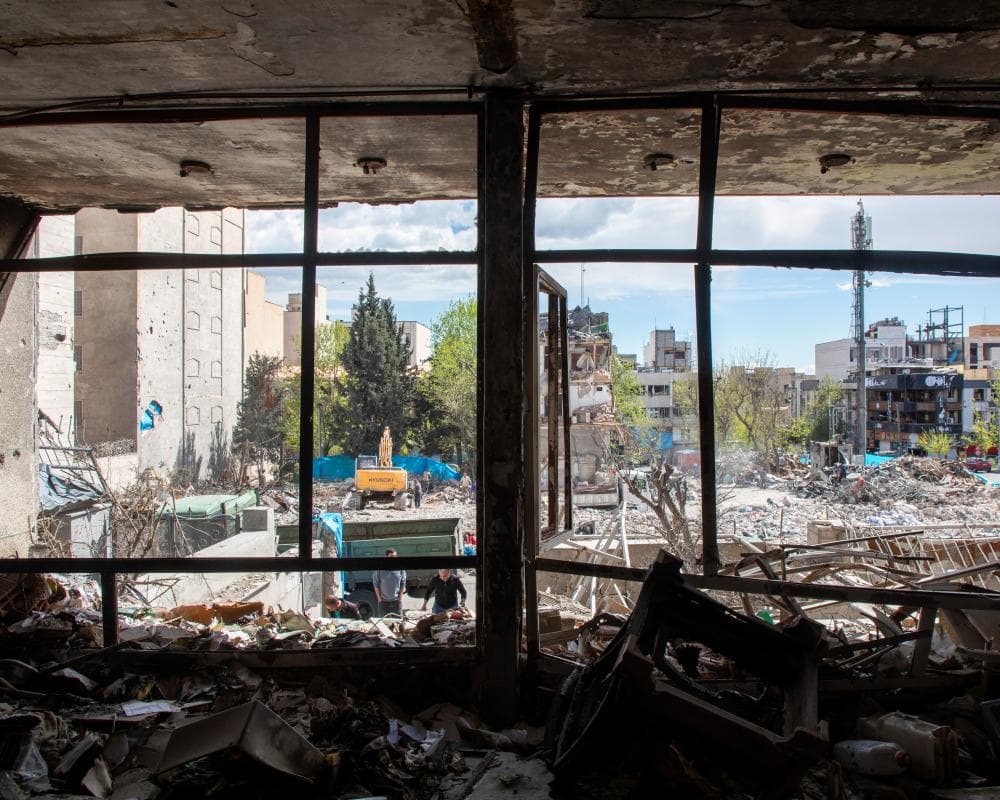
Iranian missiles hit the northern Israeli city of Haifa, where four people were found dead in the rubble of a residential building.
Kuwait, the United Arab Emirates and Saudi Arabia all activated their air defenses to intercept incoming Iranian missiles and drones, as Tehran kept up the pressure on its Gulf neighbors. Iran’s regular attacks on regional energy infrastructure and its stranglehold on the strait of Hormuz, through which a fifth of the world’s oil is shipped in peacetime, has sent global energy prices soaring .
Updated
US president Donald Trump is going to be holding a press confernece today alongside military officials following the weekend rescue operation to retrieve an F-15 crew member from Iran after his aircraft was downed on Friday.
It is scheduled to for 1pm EDT (6pm BST) and we will cover the latest lines here in our live coverage.
The briefing also comes ahead of Tuesday’s 8pm EDT deadline for Iran to reopen the strait of Hormuz, after which Trump has threatened military action against nuclear and infrastructure targets.
Updated
The EU council chief has said that striking civilian infrastructure installations during war is illegal, which comes as president Donald Trump threatened to devastate civilian infrastructure in Iran if it did not reopen the strait of Hormuz.
EU chief António Costa said in a social media post on Monday: “Any targeting of civilian infrastructure, namely energy facilities, is illegal and unacceptable.
“This applies to Russia’s war in Ukraine and it applies everywhere. The Iranian civilian population is the main victim of the Iranian regime. It would also be the main victim of a widening of the military campaign.
“The European Union urges Iran to immediately put an end to its attacks against countries in the region and to allow for the reestablishment of full freedom of navigation through the strait of Hormuz.
“After five weeks of war in the Middle East, it is clear that only a diplomatic solution will settle its root causes.”
Israel’s ambulance service Magen David Adom has confirmed that four people were killed after a residential building in Haifa was hit by an Iranian missile.
The service reports all four missing people have been recovered, including a 35-year-old woman, a man and a woman in their 80s and a man in his 40s.
Updated
Israeli ambulance services have confirmed that two people have been killed after a residential building in the northern city of Haifa was struck by an Iranian missile.
This comes as firefighters were searching for two other people who were believed to be missing. The emergency services “rescued two trapped individuals who were found under the rubble without signs of life” after hours of efforts.
According to the military and fire and rescue service, the missile directly hit a seven-storey building and tore through sections of the structure, causing it to partially collapse. An Israeli air force probe found that the missile was not intercepted because it broke up in the air, Times of Israel reports.
Residents in the area described a huge bang and a mushroom cloud followed ten minutes later by a gas explosion.
Iran has formulated its positions and demands in response to recent ceasefire proposals conveyed via intermediaries, a foreign ministry spokesperson said on Monday, Reuters reports, adding that negotiations were “incompatible with ultimatums and threats to commit war crimes.”
Spokesperson Esmaeil Baghaei said Tehran had a set of requirements based on its national interests that had already been conveyed via intermediary channels, adding that earlier US demands such as the 15-point plan were rejected for being “excessive.“
“Iran does not hesitate to clearly express what it considers its legitimate demands and doing so should not be interpreted as a sign of compromise, but rather as a reflection of its confidence in defending its positions,” Baghaei said in a press conference.
“We have formulated our own responses” and will announce details in due time, he added in response to an Iranian journalist’s question regarding ongoing efforts to bring about a ceasefire between Iran and the US.
Updated
The US, Iran and a group of regional mediators discussed the terms for a potential 45-day ceasefire that could lead to a permanent end to the war, according to a report from Axios that cites “four US, Israeli and regional sources with knowledge of the talks”.
Now, a senior Iranian official has now confirmed to the Reuters news agency that Tehran has received the two-tier ceasefire plan from Pakistan, and is reviewing the proposal.
The Guardian could not independently verify the report but other news agencies such as AP and Reuters also now say the US and Iran have received the proposals.
However, Iran won’t reopen the strait of Hormuz in exchange for a “temporary ceasefire”, while the US lacks the readiness for a permanent ceasefire, the official was quoted as saying. Tehran will not be pressured into accepting deadlines and making a decision, the official added.
Over the weekend, Donald Trump threatened to obliterate Iranian power plants and bridges if it doesn’t agree by 8pm Tuesday (US Eastern Time) to fully reopen the strait of Hormuz.
About a fifth of the world’s oil supply usually passes through the Hormuz strait and its effective closure is having a crippling effect on the global economy.
Iran’s deputy foreign minister has claimed Donald Trump’s threats to destroy Iranian power plants and bridges could amount to war crimes. “The American president, as the highest official of his country, has publicly threatened to commit war crimes,” Kazem Gharibabadi said on X, citing provisions of international law that could be breache.
Iran’s central military command has warned of “much more devastating” retaliation if the US hits civilian targets.
Earlier today US-Israeli strikes killed the intelligence chief of Iran’s Revolutionary Guards on Monday, according to Iran’s Islamic Revolutionary Guard Corps (IRGC).
“Major General Majid Khademi, the powerful and educated head of the Intelligence Organisation of the Islamic Revolutionary Guard Corps, was martyred in the criminal terrorist attack by the American-Zionist enemy... at dawn today,” said the Guards in a post on their Telegram channel.
Updated
Here are some of the latest images from Tehran coming through our wires.
AFP reports that US-Israeli strikes killed the intelligence chief of Iran’s Revolutionary Guards on Monday, according to Iran’s Islamic Revolutionary Guard Corps (IRGC).
“Major General Majid Khademi, the powerful and educated head of the Intelligence Organisation of the Islamic Revolutionary Guard Corps, was martyred in the criminal terrorist attack by the American-Zionist enemy... at dawn today,” said the Guards in a post on their Telegram channel.
Updated
US congresswoman Yassamin Ansari criticised the reported bombing of Sharif University of Technology in Tehran.
“Sharif University is Iran’s MIT. They’ve produced a huge number of engineers who’ve gone on to Silicon Valley and founded some of the most successful American tech companies,” the Arizona congresswoman said in a post on X.
“Why are we bombing a university in a city of 10 million people?”
Ansari is the daughter of two Iranian parents who fled their homeland – her father as a student in the 1970s who couldn’t return after the 1979 revolution, her mother as a 17-year-old in 1981 escaping the new regime’s restrictions on women.
Speaking to the Guardian in 2025 about US and Iran policy, she said: “When it comes to US-Iran policy – especially during the Trump administration – I think there has been a significant lack of knowledge. And even within Congress, there’s often limited information about the historical and political context – not just since 1979, but also what led up to that point and how we arrived at the current situation.”
Here’s a snapshot of the latest news from the US-Israel war on Iran to bring you up to speed. It’s 10.30am in Tehran, 10am in Tel Aviv and Beirut and 3am in Washington DC.
Iran’s deputy foreign minister has claimed Donald Trump’s threats to destroy Iranian power plants and bridges could amount to war crimes. “The American president, as the highest official of his country, has publicly threatened to commit war crimes,” Kazem Gharibabadi said on X, citing provisions of international law that could be breached.
Trump used expletive-laden language to demand Iran agree – by Tuesday evening US time – to fully open the strait of Hormuz or face the destruction of Iranian energy sites and bridges. The US president posted on Truth Social: “Open the Fuckin’ Strait, you crazy bastards, or you’ll be living in Hell.” He was sharply rebuked by US politicians, with Republican former ally Marjorie Taylor Greene decrying “Trump’s madness”, Bernie Sanders calling it “dangerous and mentally unbalanced” and top Senate Democrat Chuck Schumer saying Trump was “ranting like an unhinged madman on social media”.
Iran’s central military command has warned of “much more devastating” retaliation if the US hits civilian targets.
The US, Iran and a group of regional mediators are discussing the terms for a potential 45-day ceasefire that could lead to a permanent end to the war, according to a report from Axios that cites “four US, Israeli and regional sources with knowledge of the talks”.
Benjamin Netanyahu suggested Israel assisted the US with its weekend rescue of a second downed air crew member in Iran. The Israeli PM said he had congratulated Trump on “a perfectly executed American mission” and that “the president expressed his appreciation for Israel’s help”.
Israel’s military said it completed a fresh wave of strikes against “regime targets” in Tehran on Monday.
Israeli search-and-rescue teams were searching for two missing people in the rubble of a residential building in the northern Israeli city of Haifa after it was struck by an Iranian missile that killed two others, authorities said on Monday.
Iran has executed a man convicted over an attempt to storm a military facility and access an armoury during the unrest in January, state media said on Monday, after the supreme court upheld his sentence.
A Japanese shipping firm said an Indian-flagged tanker owned by its subsidiary had passed through the strait of Hormuz and was en route to India. Japanese prime minister Sanae Takaichi said her government was preparing to hold talks with Iran against the backdrop of the global energy crisis.
Falling debris from an intercepted attack injured a person in an industrial area of Abu Dhabi, UAE authorities said on Monday. Authorities in the UAE emirate of Fujairah said a drone launched from Iran targeted a du Telecom building.
Iran expanded attacks on Gulf energy infrastructure over the weekend, launching drone and missile strikes on petrochemical facilities in Kuwait, Bahrain and the UAE. The Revolutionary Guards also said they hit an Israeli-linked vessel at Dubai’s Jebel Ali port.
Updated
Iran’s deputy foreign minister has claimed Donald Trump’s threats to destroy power plants and bridges in Iran could amount to war crimes.
“The American president, as the highest official of his country, has publicly threatened to commit war crimes,” Kazem Gharibabadi said in a post on X, citing provisions of international law that could be breached.
“The threat to attack power plants and bridges (civilian infrastructure) is a war crime under Article 8(2)(b) of the Rome Statute of the International Criminal Court,” he said, cited by AFP.
Gharibabadi also warned that Iran would “deliver a decisive, immediate and regret-inducing response to any aggression or imminent threat”.
A Japanese shipping firm said on Monday that an Indian-flagged tanker owned by its subsidiary had passed through the strait of Hormuz and was en route to India.
A spokeswoman for Mitsui O.S.K. Lines told AFP that the Green Asha – a liquefied petroleum gas tanker – had crossed the waterway.
“Both the crew and the cargo are safe,” she said.
The vessel was the third Japan-linked ship to transit the Hormuz strait – the vital oil shipping route whose effective blockade by Iran has prompted Donald Trump to threaten to pummel Iranian energy and transport infrastructure if it isn’t fully opened.
Elsewhere in the United Arab Emirates, falling debris from an intercepted attack injured a person in an industrial area of Abu Dhabi, UAE authorities said.
Debris fell on the Raneen Systems company in the Musaffah area after an interception by air defence systems, the Abu Dhabi government’s media office said on X on Monday.
“The incident resulted in moderate injuries to a Ghanaian national,” the post said.
The injury comes a day after authorities in the Emirati city of Sharjah said they were “dealing with an incident that targeted Khor Fakkan” after the port was targeted in the Gulf of Oman.
Pakistani nationals were reportedly wounded when a projectile was intercepted, prompting the Pakistani prime minister to post on X on Monday that he was “deeply concerned”. Shehbaz Sharif said:
Pakistan stands in solidarity with the brotherly people of the UAE and reiterates the urgent need for restraint and de-escalation in the region.
The UAE and other Gulf states have faced relentless retaliatory attacks from Iran since US-Israeli strikes five weeks ago kicked off a regional war.
Updated
Authorities in the UAE emirate of Fujairah have said they are responding after a drone launched from Iran targeted a du Telecom building, the state news agency (Wam) reported.
Fujairah’s media office said no injuries had been reported, the report on Monday said.
Updated
Iran has executed a man convicted over an attempt to storm a military facility and access an armoury during unrest in January, state media said on Monday, after the supreme court upheld his sentence.
The man was named as Ali Fahim, Reuters is reporting.
Iran has already executed three others linked to the incident, including Amirhossein Hatami earlier last week and Mohammadamin Biglari and Shahin Vahedparast on Sunday, the report said.
Another man linked to the same case is believed to face execution in the coming days, according to Amnesty International.
The rights group said in a statement last week it was unconscionable that even as Iranians reeled from the war, Iran continued to “weaponise the death penalty to eradicate dissenting voices and further terrify people”.
The nationwide anti-government protests in January were repressed in the biggest crackdown in the Islamic republic’s history, with some estimates suggesting more than 30,000 people were killed.
Authorities said the defendants had tried to seize weapons and military equipment during protests, describing them as “rioters” acting against national security.
Amnesty International said several defendants were facing execution over the unrest, adding in a recent report that detainees in such cases had been subjected to torture and “grossly unfair trials”.
Updated
The Israeli military has just said it identified missiles launched from Iran and that defensive systems are operating to intercept them.
The IDF’s message on Telegram also said alerts had been sent to people in relevant areas directing them to go to shelters and “remain there until further notice”.
More now on the Haifa strike: Israeli search-and-rescue teams were searching for two missing people in the rubble of a residential building in the northern Israeli city after it was struck by an Iranian missile that killed two others, authorities said on Monday.
The direct hit on a seven-storey building tore through sections of the structure, which has partially collapsed, the military and rescue services said.
Footage from Agence France-Presse showed rescuers using flashlights to search through rubble and scattered concrete blocks.
The strike took place minutes after the military warned it had detected a new round of missiles fired from Iran about 15.00 GMT.
“We have a major destruction site,” said Elad Edri, chief of staff of Israel’s home front command.
Israel’s fire and rescue services said later that two of four people trapped under the rubble had been found dead.
The building was hit by a “direct impact of a missile”, a military spokesperson told AFP, confirming it was fired from Iran.
Israel’s Magen David Adom emergency service said four people were wounded in the strike, including a 10-month-old baby who suffered a head injury. An 82-year-old man was also in a serious condition, it said. A hospital later said he was stable.
On Monday the military detected fresh waves of missiles fired from Iran, and each time it said its “defensive systems are operating to intercept the threat”.
Updated
Israel’s military says it has completed a fresh wave of strikes against “regime targets” in Tehran.
The short statement – in a Monday post on Telegram – came after Iranian media reports of attacks on residential areas in the Iranian capital earlier in the day.
Japan’s prime minister, Sanae Takaichi, said on Monday her government was preparing to hold talks with Iran against the backdrop of the global energy crisis.
“We are preparing dialogues at the leadership level at an appropriate time,” she told a parliamentary committee.” She did not say with whom in Iran she planned to hold talks.
About 90% of Japan’s crude oil comes from the Middle East, making it particularly vulnerable to the closure of the waterway. Last month, the government approved the release of 15 days’ worth of oil from private-sector depots, the biggest-ever release of oil from its strategic reserves.
Updated
Iran’s central military command has warned of “much more devastating” retaliation if the US hits civilian targets.
If attacks on civilian targets are repeated, the next stages of our offensive and retaliatory operations will be much more devastating and widespread.
The warning came after Donald Trump threatened to destroy Iran’s civilian infrastructure, demanding Tehran bow to his demands for a deal to reopen the Gulf to shipping.
Trump vowed on social media to hit Iran’s power plants and bridges and said the country would be “living in hell” if the strait of Hormuz – crucial for global trade – wasn’t opened. He ended with “Praise be to Allah”.
Updated
Welcome to the Guardian’s continuing coverage of the crisis in the Middle East.
Iran’s parliamentary speaker Mohammad Baqer Qalibaf has condemned Donald Trump’s threats to target energy and transport infrastructure, saying he was being misled by Israel’s prime minister Benjamin Netanyahu.
“Your reckless moves are dragging the United States into a living HELL for every single family, and our whole region is going to burn because you insist on following Netanyahu’s commands,” Qalibaf posted on X.
Late on Sunday, Netanyahu suggested Israel assisted the US with its rescue of the downed airman in Iran. The Israeli prime minister said he had spoken to Trump and “congratulated him on his bold decision and a perfectly executed American mission”. “The president expressed his appreciation for Israel’s help,” Netanyahu said.
On Sunday, the US president used expletive-laden language to call on Iran to let ships through the strait of Hormuz as he threatened to further attack Iranian energy and transport infrastructure. Writing on Truth Social, Trump said: “Open the Fuckin’ Strait, you crazy bastards, or you’ll be living in Hell.”
Showing it still had the ability to cause damage despite the US-Israeli pounding, Iran expanded attacks on Gulf energy infrastructure over the weekend, launching drone and missile strikes on petrochemical facilities in Kuwait, Bahrain and the United Arab Emirates.
The Revolutionary Guards also said they hit an Israeli-linked vessel at Dubai’s Jebel Ali port.
In other key developments:
Trump was sharply rebuked by US politicians, including Republican former ally Marjorie Taylor Greene, who called on the administration to “intervene in Trump’s madness”, adding the president “has gone insane, and all of you are complicit”. Top Senate Democrat Chuck Schumer wrote that “the President of the United States is ranting like an unhinged madman on social media”. Schumer added: “He’s threatening possible war crimes and alienating allies. This is who he is, but this is not who we are. Our country deserves so much better.”
Crude oil prices opened higher on Monday after Trump’s threats to Iran. West Texas Intermediate – the US benchmark – rose 1.86% to $113.62 a barrel while North Sea Brent crude was also higher at the week’s market opening, climbing 1.16% to $110.30 a barrel.
The second crew member of a downed F-15E fighter jet was rescued by the US overnight, ending a two-day search after the warplane crashed in south-west Iran. Trump said the crew member was “seriously wounded” but “safe and sound” after a mission that was reportedly made possible with the help of CIA subterfuge.
At least five people were reported to have been killed in US-Israeli attacks in south-west Iran during the rescue operations.
Israeli rescuers recovered the bodies of two people killed after an Iranian ballistic missile hit a residential building in the northern Israeli city of Haifa, Israeli media reported. Rescue efforts were continuing on Monday morning to reach two other missing.
On Sunday, Iran said it struck a petrochemicals complex in Bahrain. Video footage showed thick black smoke rising from the site.
The Kuwait Petroleum Corporation said a number of its facilities had been targeted by Iranian drone attacks, resulting in fires and “significant material losses”. Kuwait also reported that two power and water desalination plants sustained “significant material damage” after being attacked by Iranian drones.
Israeli attacks in Lebanon on Sunday killed at least 15 people, the country’s health ministry said, while Israel’s military chief visited troops in southern Lebanon and pledged to intensify strikes against Hezbollah. One of Israel’s strikes in Beirut on Sunday killed at least five people and wounded 52 in the Jnah neighbourhood, the Lebanese ministry said.
Updated