Loading...
Please wait for a bit
Please wait for a bit
Click any word to translate
Original article by Jakub Krupa
… and on that note, it’s a wrap for today!
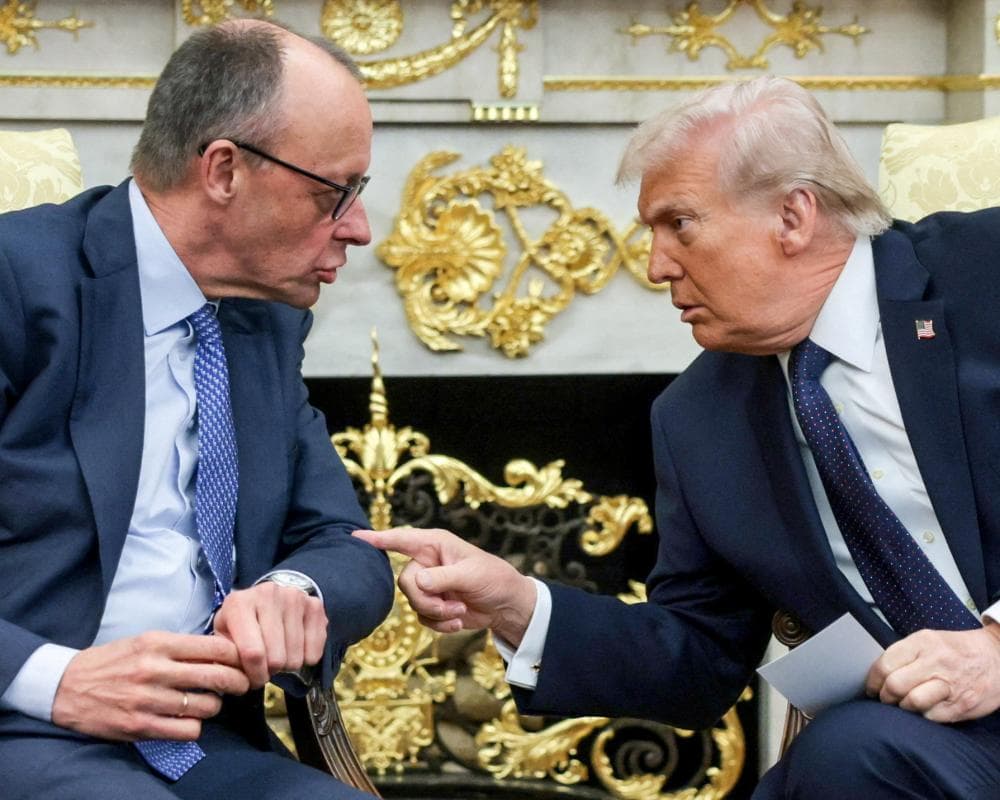
US president Donald Trump has doubled down on his criticism of German chancellor Friedrich Merz, telling him to “spend more time on ending the war with Russia/Ukraine” and “fixing his broken country” after Merz’s criticism of the US war against Iran (15:46).
Trump’s latest outburst comes a day after he suggested the US military presence in Germany was being reviewed with a “possible reduction” under consideration and a decision expected to be made shortly (10:01).
The falling out between the two leaders appears to have been caused by Merz’s unusually blunt comments earlier this week in which he said the US is being “humiliated” by Iran’s leadership, and criticised the US for no exit strategy from the war.
Without offering a direct response to Trump’s comments, the German chancellor sought to strike a notably different and more conciliatory tone at a visit to a German military base in Munster, stressing the importance of ties with Nato and the US, and criticising Iran for refusing to take part in peace negotiations (12:44).
Trump’s renewed attack on Merz’s record in government comes just days before his first anniversary in office (15:46).
If you have any tips, comments or suggestions, email me at jakub.krupa@theguardian.com.
I am also on Bluesky at @jakubkrupa.bsky.social and on X at @jakubkrupa.
Meanwhile, Germany’s foreign minister Johann Wadephul insisted that Germany was prepared for any decision from the US amid Donald Trump’s threats he could pull out some troops from the country and harsh criticism of the chancellor, Friedrich Merz.
Speaking during his visit to Morocco, he said in comments reported by AFP:
“We are prepared for that, we are discussing it closely and in a spirit of trust in all Nato bodies, and we are expecting decisions from the Americans about this.”
Any such decisions would “be discussed with us and with others, as is proper among allies”, he said.
While saying he was “relaxed” about the idea of fewer US troops in Germany, Wadephul said that large American bases in Germany are “not up for discussion at all”.
He said for example that the Ramstein airbase had “an irreplaceable function for the United States and for us alike”.
Since we didn’t hear much more from Merz on Trump and his threats of moving US soldiers out of Germany, we need to turn to our colleague, Jon Henley, to help us understand this latest crisis.
In his helpful expainer, he answers key questions on how US soldiers ended up in Germany, just how many of them are there, and why they are important.
But he also crucially note that this is not the first time Trump makes similar comments about Germany; in fact, he has done it more than once before.
“In 2020 during his first term in the White House, apparently infuriated by Germany’s low defence spending and support for the Nord Stream 2 gas pipeline, he called Germany “delinquent” and said he would slash US troop numbers there by a third.
Trump’s announcement gave no details whatsoever and appeared to take both the Pentagon and the state department, not to mention their counterparts in Berlin and senior Nato officials, completely by surprise. None were reportedly informed of the decision.
Trump’s plan was to send some of the troops home and redeploy others to countries such as Poland and Italy. But it faced bipartisan pushback in Congress, and huge logistical hurdles. President Joe Biden froze the putative plan in February 2021 and later officially cancelled it.”
You can read Jon’s full briefing here:
Looks like Merz’s notably softer tone during his visit to the Germany army (12:44) didn’t really work as intended, and Trump is still clearly angry with his earlier comments on Iran (10:01).
The US president has now repeated his broader attack on Merz’s record in office, which will no doubt be widely quoted as he comes up to his first anniversary as the German chancellor next week.
Updated
Awkward.
Just as Merz wrapped up his event, Donald Trump has launched a fresh attack on him, claiming the German chancellor should be spending more time on resolving the Ukraine conflict (where “he has been totally ineffective,” ouch) rather than “interfering with those that are getting rid of the Iran Nuclear threat”.
In a post on his Truth Social platform, the US president wrote:
The Chancellor of Germany should spend more time on ending the war with Russia/Ukraine (Where he has been totally ineffective!), and fixing his broken Country, especially Immigration and Energy, and less time on interfering with those that are getting rid of the Iran Nuclear threat, thereby making the World, including Germany, a safer place! President DJT.”
Updated
Back to Merz, he got asked about ways in which he has actually improved the lives of Germans as in his first year as chancellor with the anniversary of him taking power coming up next week.
In response, he says “it is too early” for a final assessment; a classic politician’s answer.
But then he goes on to make a big sweeping claim that “in this one year we have managed to save Nato” through increased defence spending, and kept the EU together.
But “you may not regard this as being as significant as I do,” he accepts.
He admits that in general he would want his government to move faster, but “implementation takes time” and he hopes to push ahead with the government’s programme of reforms now.
The event then ends with a quick fire of questions in which he puts jazz and classical music over rock and pop, says he doesn’t use WhatsApp for security reasons, he would love to be able to figure skate on ice, and he prefers to spend time outside big cities.
Oh, he also says he prefers print newspapers over e-paper on tablets (except when it comes to reading European blogs on the Guardian’s website, surely).
And that ends this event.
(Let me, in advance, wish everyone a happy local journalism day next week!)
Updated
Germany’s foreign minister has said the country is “prepared” for any reduction of US troop numbers there, Agence France-Presse reports, after Donald Trump threatened such a move in a row with Friedrich Merz.
“We are prepared for that,” Johann Wadephul said when asked about the issue during a visit to Morocco.
“We are discussing it closely and in a spirit of trust in all Nato bodies, and we are expecting decisions from the Americans about this.”
Meanwhile, if you are planning your summer holidays in Europe this year and you are from a non-EU country – like, say, erm, Britain – you may face some potential issues during border checks.
My colleagues Alfie Packham and Nicola Slawson are reporting that some travellers passing through the new EU entry-exit system (EES) have faced huge delays at border checks, with some waiting for up to three hours, airports say.
The new rules have gradually been introduced in Europe since October 2025, and came into effect on Friday in the Schengen countries – 25 of the EU’s 27 states plus Iceland, Norway, Liechtenstein and Switzerland.
Hundreds of people responded to a Guardian online callout to share their experiences of travelling to Europe since the rules came into effect. Though some said they had a problem-free journey, many reported severe delays, which have caused some to miss their flights.
You can read more on this here:
Responding to the interception, Italy has condemned the move and demanded the immediate release of all Italians who have been “unlawfully detained,” Reuters reported.
In a statement, Rome urged Israel to respect international law and guarantee the safety of those on board. It did not say how many Italians had been detained.
“The government reaffirms its commitment to continuing to provide humanitarian aid to Gaza within the framework of our cooperation and in accordance with international law,” the Italian government said in a statement.
Lorenzo Tondo in Palermo and Caitlin Cassidy
Israeli forces have intercepted and detained the crews of at least 22 boats near the Greek island of Crete from a flotilla that is attempting to break Israel’s maritime blockade of the Gaza Strip to deliver humanitarian aid.
The Global Sumud Flotilla, consisting of about 58 vessels carrying people from across 70 countries, departed from Italy on Sunday.
Flotilla organisers said in a press release:
“Israel’s actions … mark a dangerous and unprecedented escalation, the abduction of civilians in the middle of the Mediterranean, over 600 miles from Gaza, in full view of the world.”
After early exchanges on VAT reductions and digital levies, Merz briefly strayes into a topic of interest for us, as he talks about the situation in the Middle East and the risk of energy shortages in Europe.
He says that “the supply problem is currently not so severe,” as “relatively little of Europe’s supply” comes from the closed strait of Hormuz.
But he says that the focus and all efforts should be on reopening the strait, both diplomatically and through the EU offering military security after a deal can be agreed.
And then we go back to farmers and domestic agricultural policy.
I will keep listening to this event, but in the meantime let me bring you some other news from around Europe.
I am keeping an eye on Merz’s planned appearance at the Local Journalism Day event (11:30), which should be starting soon.
Unlike at the army event earlier (12:44), he is likely to face questions and follow ups, which makes it potentially a bit more interesting – let’s see if some of them stray slightly beyond local journalism.
I will bring you all interesting lines here.
Updated
In other news, the Norwegian Nobel Institute on Thursday announced that 287 nominations had been submitted for this year’s Nobel Peace Prize.
The list comprised 208 individuals and 79 organisations, it said, without identifying them.
“In an increasingly conflictual world, there is no lack of candidates whose principled commitment and innovative action points towards a brighter future,” the institute said in a statement quoted by AFP.
The exact names of nominees are not public, but AFP notes that those eligible to nominate – former laureates, lawmakers and cabinet ministers from any country in the world – may choose to make their candidates public.
And so looking at other people’s statements we can reasonably assume that Ukraine’s Volodymyr Zelenskyy, Sweden’s Greta Thunberg, and – yes – US president Donald Trump are somewhere on that list.
The winner will be announced on 9 October.
Meanwhile, the EU’s foreign policy chief Kaja Kallas responded to last night’s Trump-Putin phone call, saying that their discussions always appear to leave some questions unanswered.
Appearing at the NB8 meeting – that’s Nordic and Baltic foreign ministers – in Estonia, Kallas deeply sighed even before walking up to the podium to answer a question on the phone call, not exactly hiding what she thinks of these talks.
Kallas said that the peace talks on Ukraine appeared to be “stalling,” and she wasn’t clear if any meaningful progress was made in Trump’s call with Putin either.
“When we see these calls between president Trump and president Putin, always there are a lot of questions unanswered,” she said.
She also noted the paradox of these talks given “Russia is openly praising the heroic [fight] of Iran against America.”
She said the EU would like more pressure to be put on Russia and “we didn’t see that in that call.”
Earlier, she said the EU was looking into “what are the requests that we have for Russia for after this war is over” before it can conduct meaningful negotiations with Moscow.
In other Hungarian issues, my Brussels colleague Jennifer Rankin has asked the commission for its response to the European parliament’s blistering criticism of Hungary’s commissioner Olivér Várhelyi (Europe Live, Wednesday).
Várhelyi was nominated for the post by the outgoing government led by Viktor Orbán, and given the incoming administration’s view of such appointments, his future could be uncertain.
But asked if the commission had confidence in him in light of the parliament’s criticism, the chief spokeperson Paula Pinho insisted that was the case.
“I can say that the president has confidence in all the members of the college. So there’s no news.”
The Commission was also asked about yesterday’s meeting of Hungary’s incoming prime minister, Péter Magyar.
But we didn’t get much more than what we saw in yesterday’s social media posts from Magyar and the EU’s Ursula von der Leyen.
The pair focused on “the steps which are necessary to unlock the EU funds which are earmarked to Hungary and have been frozen until now due to corruption issues and rule of law concerns,” the commission’s chief spokesperson Paula Pinho said, with other topics – like the EU’s enlargement – parked for now.
She said the commission saw Hungary dropping its veto on the €90bn loan for Ukraine as “a very welcome” step.
Meanwhile, the issue of the US deployment in Europe also came up during the European Commission’s daily briefing in Brussels.
“The deployment of US troops in Europe is also in the US interest in support of its global role,” the commission’s lead security and foreign affairs spokesperson Anitta Hipper said.
She added that the US is “a vital partner in contributing to Europe’s security and defence.”
Hipper also pointed out that Germany and other European Nato allies are “increasing their defence spending in an unprecedented pace.”
In the last half hour, Merz gave a brief press statement after his visit to the German army in Munster, in which he called for “a reliable transatlantic partnership” – without offering a direct response to Trump’s comments overnight.
But indirectly there was a lot there that will be read as his indirect response, as he repeatedly stressed the importance of the partnership with the US, of Nato, and of common transatlantic goals.
Merz talked at length about the task of reforming the Bundeswehr to be ready to “fight tonight,” and “prepare for the challenges of tomorrow and the day after.”
He repeatedly and pointedly stressed Germany’s commitment to “a strong, united Nato,” and noted joint work conducted with the US and other Nato allies. A senior US Armed Forces commander was in Muster just yesterday, he noted.
On Iran, he struck a notably different tone than earlier this week (10:01, 10:18), putting the pressure solely on the regime, and saying it “must come to the negotiating table” and “must no longer take the region and ultimately the world hostage” to its interests.
On Iran, he said, Germany worked “in close contact with our partners,” including – again, specifically singed out – Washington and the US.
“We do this in our common transatlantic interest, with mutual respect and fair burden sharing,” he said.
He added that the German position was aligned with the focus on “a strong Nato and a reliable transatlantic partnership,” which he stressed was “particularly close to my heart.”
Updated
As we are waiting for Merz’s speech later, I am looking at some recent stories in the German press about Trump’s (repeated) threats to pull out of Germany.
And Süddeutsche Zeitung has this brilliant report from Ramstein, with a local entrepreneur giving them this amazing quote that “without Americans, we would be milking cows again.”
The base has some 8,500 service members – more than the population of the neighbouring town it’s named after – and the US military is the third-largest employer in the Rhineland-Palatinate state, showing the importance of the local economy, too.
Talking to SZ, the local mayor is pretty confident about the future as he points out to the importance of the base and the €1bn US military hospital being built just 10 or so kilometers away.
Well, let’s see.
For what it’s worth, Germany’s Merz is expected to visit the German army this morning and then appear at a public event in Salzwedel later today – around 2pm local time – where he will be taking questions at an event marking the upcoming Local Journalism Day.
But safe to say we can expect some questions to be very much, erm, not local.
I will bring you his lines when we have them.
Updated
But Trump’s threats to pull US soldiers from Germany may have limited impact (for now?) given that he has been saying these things for years.
Die Welt notes this morning that he made similar comments already during his first term 2017 to 2021.
It adds that the latest US figures suggested there were some 86,000 US soldiers in Europe, of which some 36,000 to 39,000 in Germany – with 20 bases, the largest of which are in Stuttgart and Ramstein – but these numbers tend to change due to rotations and exercises.
The latest DMDC location report from December had the number at 36,436. That’s easily the largest active duty deployment in Europe, ahead of Italy (12,662), the UK (10,156), and Spain (3,814).
But all of this could change soon as the US is conducting a “global posture review,” which could recommend some movements.
Updated
Not that it matters for Trump, but Merz isn’t exactly wrong pointing to the Iran war as at least one of the reasons why the German economy is performing a bit worse than expected.
Just this morning, Germany recorded 0.3% growth for the first quarter of 2026, slightly ahead of the expected 0.2%, with 0.5% forecast for the full year. But as Handelsblatt notes, before the war started, some expectations had been closer to 1% or even higher.
Experts fear that some of the energy cost impacts, for example, are yet to be fully felt.
And the other significant source of, erm, uncertainty is Trump-linked, too – and that’s obviously the continued threat of US tariffs, which affected the automotive industry in particular.
“Wars, geopolitical tensions, trade barriers, tighter regulation, and intense competition are creating headwinds,” Volkswagen’s CEO Oliver Blume explained this morning, AFP reported.
But there is also another part of the equation, with growing focus on Merz government’s track record, as he continues to face criticism over slow pace of domestic reforms.
Germany’s finance minister Lars Klingbeil wrote about the government’s plans in the Guardian last week.
But as the government comes up to its first anniversary in office next week, expect lots of commentary on and scrutiny of what has been actually done.
If you want to catch up with what caused the latest spat between Germany and the US, here’s the video of Merz’s controversial comments from earlier this week.
Which reminds me that he also said the Americans “clearly have no exit strategy.”
Ouch.
Meanwhile, Ukraine’s president Volodymyr Zelenskyy has responded to Trump’s comments after his phone call with Russia’s Vladimir Putin.
In a post on social media, he said he instructed his team to contact Trump’s aides to “clarify the details of Russia’s proposal for a short-term ceasefire.”
“Ukraine seeks peace and is doing the necessary diplomatic work to bring this war to a real end. We will clarify what exactly this is about – a few hours of security for a parade in Moscow, or something more.”
This, obviously, is a swipe at Moscow’s decision to hold Victory Day parade next week with no military hardware because of fears of a long-range attack by Ukrainian drones.
Zelenskyy continued:
“Our proposal is a long-term ceasefire, reliable and guaranteed security for people, and a lasting peace. Ukraine is ready to work toward this in any dignified and effective format.”
US president Donald Trump threatened to reduce the number of troops deployed in Germany last night, after chancellor Friedrich Merz said this week that the US was being “humilitated” by Iran.
Trump said the US was “studying and reviewing the possible reduction of troops in Germany, with a determination to be made over the next short period of time.”
Earlier yesterday, he posted a separate criticism of Merz’s Germany, saying:
“The Chancellor of Germany, Friedrich Merz, thinks it’s OK for Iran to have a Nuclear Weapon. He doesn’t know what he’s talking about! If Iran had a Nuclear Weapon, the whole World would be held hostage. I am doing something with Iran, right now, that other Nations, or Presidents, should have done long ago. No wonder Germany is doing so poorly, both Economically, and otherwise! President DONALD J. TRUMP”
His comments come just hours after Trump’s phone call with Russia’s Vladimir Putin, and – which is likely to be of significance - after Merz repeatedly criticised Trump’s decision to start the Iran war and partially blamed it for Germany’s worse than expected economic results.
At a recent meeting with high school students, Merz said that the US was “being humiliated” by Iran’s leadership through taking part in negotiations that come to nothing, and that the war “is costing us a lot of money … and a lot of economic strength.”
“This war against Iran has a direct impact on our economic performance, and for that reason it must be brought to an end as soon as possible,” he said.
Ouch.
He still insisted that his relationship with Trump was good though, but not sure that’s the case any more.
Let’s see if we are going to hear a reaction from Germany today.
Elsewhere, I will look out for comments on Trump’s phone call with Putin – including his suggestions that Ukraine is “defeated” and that Putin was working on some sort of temporary ceasefire.
It’s Thursday, 30 April 2026, it’s Jakub Krupa here, and this is Europe Live.
Good morning.