Loading...
Please wait for a bit
Please wait for a bit
Click any word to translate
Original article by Jakub Krupa
… and on that note, it’s a wrap for today!
Join us tomorrow for our coverage of the US summit on Greenland and other news across Europe.
Here is your today’s summary:
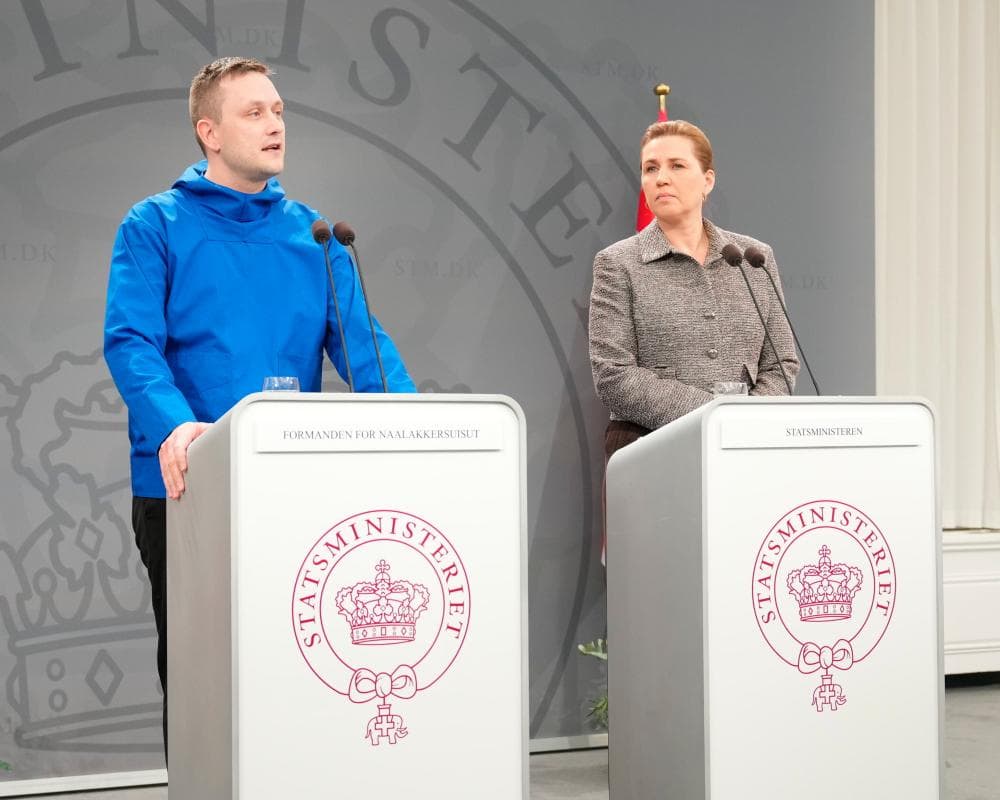
Greenland’s prime minister has said “we choose Denmark” at a joint press conference with Danish prime minister Mette Frederiksen in a show of unity ahead of high-stakes talks at the White House about Donald Trump’s intention to take control of the Arctic territory (15:08, 15:13, 15:27).
The US vice-president, JD Vance, will unexpectedly host a crunch meeting with the foreign ministers of Greenland and Denmark and the US secretary of state, in Washington on Wednesday, raising the profile of the meeting (11:50).
Their comments came after a day of hectic diplomacy, with the foreign affairs committee of the Danish parliament convening a session to discuss the US interest in the territory (10:25), and ahead of further talks with Greenland and Faroe Islands (12:44).
Greenland’s business and mineral resources ministers told UK lawmakers that the “offensive” and “bewildering” US rhetoric on Greenland caused “quite a bit of worry” among the local population, as she hoped for “more clarity” after talks in the US (17:32).
And that’s all from me, Jakub Krupa, for today.
If you have any tips, comments or suggestions, email me at jakub.krupa@theguardian.com.
I am also on Bluesky at @jakubkrupa.bsky.social and on X at @jakubkrupa.
Chief executive and chief economist at the European Policy Centre
Donald Trump’s intervention in Venezuela is not a one-off shock. It epitomises his approach of interventionist isolationism based on a revisionist, neo-nationalist agenda in which power is exercised bluntly, international rules are optional and alliances are transactional.
In such a dog-eat-dog world, hesitation and ambiguity do not stabilise the system; they become vulnerabilities to be exploited by a volatile and predatory Washington.
Europe can’t prevent Trump from making destructive choices. But it can shape the incentives. If Washington moves on Greenland – or pursues similar acts of coercion – there must be costs. Not symbolic gestures, but measures that resonate domestically in the US and hurt Trump and his policy choices where it matters most: with his political base. Greenland is Europe’s credibility litmus test.
Greenland’s business, mineral resources minister Naaja Nathanielsen is in London today, and she took some questions from the media in the last half hour.
She referred to Frederiksen and Nielsen’s statements earlier, but also indicated there are some contingency plans being considered by the territory, without offering much detail.
She said that the situation was directly affecting the people of Greenland with “quite a bit of worry” and “a lot of uncertainty about the future” with residents reporting problems with sleep and anxiety.
Nathanielsen said Greenland felt “betrayed” with “offensive” rhetoric coming from the US, and it was “bewildering” to see Greenland in this position.
“This is not something we sought, or something we deserved. I think we have been good partners,” she said.
She also said that Greenland had no intention of becoming a US territory, but backed the ramped-up monitoring of the Arctic to counter the Chinese and Russian interest in the region.
She added that she hoped the Washington meeting on Wednesday would bring “more clarity” to understand “the differences that might be between us” and to consider “how we can move forward in a way that does not include force.”
Updated
Meanwhile, a Danish government official says Denmark provided the US with support seizing an oil tanker violating sanctions amid the dispute over Greenland, AP reported.
The official, who was not authorized to comment publicly on the sensitive matter and spoke on the condition of anonymity, declined to provide details about what the support entailed.
But acknowledgment of Danish support for the US operation comes after tensions spiraled between the Nato allies as President Donald Trump renewed calls for the U.S. to take over Greenland, AP noted.
Rutte then gets asked by a Danish MEP about Greenland, as she warns him that the people of Greenland are growing concerned about the situation in the region and the US rhetoric. She says there is not a single Russian or Chinese ships in the area.
Rutte says his role is to solve issues, and not to comment on ongoing debates between allies.
He repeats his general lines that allies need to work together on the Arctic.
Asked if he could rule out an attack by one Nato ally on another, he stresses his role is not to comment in public, but work behind the scenes.
He then gets another question, pointedly asking him if – in principle – it’s acceptable for one Nato ally to threaten the use of force to take the territory of another.
He says it’s essentially the same question as earlier and effectively declines to answer.
Nato’s secretary general Mark Rutte is now speaking at the at Renew Europe Global Europe Forum in Belgium, and, unsurprisingly, he gets asked about Greenland.
He takes a very long-winded route to answer the question, reminding the audience that Trump had been talking about the need to step up the protection of the Arctic already during his previous term as the US president.
“As you know, we have eight High North countries in the Arctic. One is Russia, outside Nato, and seven are inside Nato. … These seven countries are basically bordering on the Arctic, and it was President Trump in his first term, as I said, who basically alerted us to the fact that sea lanes are opening up, that Russia and China are more active and that you have to do more there together.”
He then says:
“We had a very good discussion in Nato. It was around summer. We are now taking next steps to build on that. Because we all agree in Nato, we all agree that when it comes to the protection of the Arctic, we have to work together. And that’s exactly what we are doing.
Then, of course, I’m never commenting when there are discussions between allies. That’s not up for me to comment on.
But I can assure you that there is complete agreement that when it comes to the assessment of the urgency of the security situation…”
When gets pushed again to answer the actual question on Greenland and specifically on how the US invasion would improve the situation and he once again tries to be as evasive as possible by talking more generally about the need to strengthen the regional security.
“When it comes now to the next steps, we also all agree that we have to take those next steps and we are working on that diligently at the moment.”
He says Denmark has stepped up its defence investments, “and all these capabilities you need, not only to keep Denmark safe, to keep Nato as a whole safe, but also to make sure that when it comes to the Arctic region, and for them, of course, a special priority when it comes to Greenland, to stay as safe as possible.”
He eventually reluctantly says he expects more discussions “over the coming weeks” on how to step up Nato security initiatives in the High North and “how we will take the next step.”
Frederiksen gets also asked what Denmark can offer to the US, and she points to the long history of alliances between the two countries.
She also says that different countries in Europe find themselves on various “flanks”: with the threat from Russia to the east, territorism to the south, and now also a northern flank, with questions about maintaining security of the Arctic, and a role for Nato.
Greenland’s Nielsen stresses that “we stand together with Denmark.”
He repeatedly stresses that Greenland cannot be bought, and its future must be decided by the Greenlanders, and “that is also the message we will be taking with us to the US tomorrow.”
Frederiksen adds that the situation is having impact on the Greenlandic population, causing unnecessary uncertainty, “which is in itself unacceptable, because Greenland never sought to be in conflict with anyone.”
She also defends her decision not to join the talks personally, saying it was agreed with the US to be held at the level of foreign ministers and that doesn’t change despite JD Vance’s apparent decision to join the meeting.
She says that the message stays the same: Greenland is not for sale, and Denmark will do whatever it takes to ensure security in the Arctic region, working with Nato allies.
And that ends the presser.
Updated
Speaking after Frederiksen, Greenland’s prime minister Jens-Frederik Nielsen reiterates that Greenland is not for sale, and insists that if the territory was to choose, it would “choose Denmark over the US.”
In a striking passage, he says:
“One thing must be clear to everyone: Greenland does not want to be owned by the US, Greenland does not want to be governed by the US, Greenland does not want to be part of the US. …
We choose the Greenland we know today, which is a part of the Kingdon of Denmark.”
Updated
In her opening comments, Denmark’s Frederiksen says that “it has not been easy” for Denmark to “stand up to completely unacceptable pressure from our closest ally for a generation.”
But she darkly warns that “there is much evidence the hardest part now lies ahead of us.”
She also says that “something more fundamental” is at stake, as Denmark faces the need to defend the principles of “not being able to change borders by force … or buying another people, and small countries not having to fear large countries.”
She says that Denmark is “not looking for conflict, but the message is clear: Greenland is not for sale.”
She adds that Nato has to “defend Greenland just as much as every other millimeter of Nato territory.”
Denmark’s Frederiksen is now speaking at a briefing alongside Greenland’s prime minister.
I will bring you the key lines here shortly.
Updated
In other news, Hungary’s high-stakes parliamentary election has been confirmed for 12 April, with the country’s prime minister Viktor Orbán expected to face his toughest challenge in 16 years, AP noted.
Reuters said that Orbán’s reelection bid will be watched far beyond Hungary. The nationalist leader counts US president Donald Trump as an anti-European Union ally and has maintained close ties with Moscow despite the war in Ukraine, the agency noted.
Orban will face Péter Magyar, a former government insider whose centre-right Tisza party has shaken up Hungary’s political scene since its entry in 2024, and most polls currently put the opposition leader in narrow lead.
In a post on X, Magyar said:
“It is now official: in 89 days, on April 12, there will be a parliamentary election in Hungary. To victory we go!”
Updated
Nordic correspondent
in Nuuk, Greenland
And here’s the latest from Nuuk, Greenland this morning, ahead of what looks like a few very busy days of political talks on Greenland.
Nordic correspondent
in Nuuk, Greenland
Ahead of Wednesday’s high stakes meeting between the foreign ministers of Denmark and Greenland in Washington with Marco Rubio and JD Vance, the Danish prime minister’s office has announced that she will deliver an update on the situation today.
Mette Frederiksen and the Greenlandic prime minister, Jens-Frederik Nielsen, will give a statement at 3pm Danish time in Copenhagen.
Updated
in Paris
Elsewhere, the French far-right party leader Marine Le Pen will face a fresh trial on appeal on Tuesday over the embezzlement of European parliament funds in a case that will determine whether or not she can run in the 2027 presidential election.
Le Pen, 57, who leads the far-right, anti-immigration National Rally (RN), was considered to be a contender for next year’s election until she was barred from running for public office last March after being found guilty of an extensive and long-running fake jobs scam.
Le Pen appealed, alongside 10 of the 24 party members who were convicted last year, and now faces a new trial which will run until 12 February.
The verdict and sentence, expected before the summer, will determine Le Pen’s political future and whether she can make a fourth presidential attempt next year. If not, she would be replaced by her young protege and party president, Jordan Bardella, 30.
Bardella appears to have benefited from Le Pen’s legal drama. Polling by Verian for Le Monde and L’Hémicycle published over the weekend found that 49% of French people thought Bardella had the greatest chance of winning the election, compared with 18% for Marine Le Pen.
An Odoxa poll last autumn found that Bardella would win the presidency no matter who his opponent in the second round was.
Analysts have cautioned that, with candidates from across the political spectrum yet to be decided, it is too early for a clear picture of how the 2027 election race may shape up.
Le Pen has said she is innocent and still wants to lead France. She has attacked what she called a “tyranny of judges” who wanted to stop her running in a presidential race she said she could otherwise win.
Nordic correspondent
in Nuuk, Greenland
In Nuuk, Pele Broberg, leader of opposition party Naleraq, which came second in last year’s election, said the preferable outcome is to reach a deal with the US.
“They want to do a deal the easy way or the hard way: who wants the hard way? I don’t understand why that’s a subject. If there is a deal to be made great, but we haven’t heard about it, we have no clue what he is talking about. So that will be interesting after Wednesday.”
Broberg criticised the Greenlandic government’s decision to release a statement on Monday in which it said it would increase its efforts to ensure its defence took place “in the Nato framework” so soon before Wednesday’s meeting.
“I don’t know why they don’t just wait until that to see what is up and down with this,” he told the Guardian.
He also questioned the inclusion of the Danish foreign minister.
“It’s a little bit strange that it is not a meeting between the US and Greenlandic foreign ministers, but that the Danish foreign minister is in on that meeting. The reason why it doesn’t make sense for me is it has nothing to do with Danish foreign politics and everything to do with the Greenlandic peoples’ future.”
He accused Copenhagen of “using Nato and the Danish ownership of Greenland” to have a say in Greenland’s future. “It shows they are still not ready to actually let us go.”
He called on the governments to be open about what is said in the meeting to stop speculation.
“I hope they have a meeting where they go out with a press conference afterwards and say ‘this has been talked about’. ‘Offers of free association or not’, ‘offers of annexation or not’ or whatever they talked about.”
And in what is a rather curious coincidence, the Danish government has just announced that it will host the biannual talks and the meeting of the foreign, security and defence policy contact committee with the Faroese and the Greenlandic governments, erm, tomorrow.
The meeting will be attended by Greenland’s prime minister, Jens Frederik-Nielsen, alongside, obviously, the Danish prime minister, Mette Frederiksen.
“The three countries will have the opportunity to discuss the political and economic situation,” the government’s statement said.
The meeting will be effectively taking place in parallel to the US talks with JD Vance and Rubio.
US vice-president JD Vance will join tomorrow’s meeting between Danish and Greenlandic foreign ministers and US state secretary Marco Rubio, Danish foreign minister Lars Løkke Rasmussen told reporters.
Speaking after a meeting of the Danish parliament’s foreign affairs committee, he said that JD Vance wanted to participate in the talks and will host them at the White House.
Rasmussen said that Denmark and Greenland requested the meeting to discuss in person the latest on Greenland after increasingly assertive comments from US officials, including US president Donald Trump, about their ambition to control the territory.
Defence minister Troels Lund Poulsen added that he would also meeting with the Nato secretary general Mark Rutte on Monday to discuss “issues regarding security in and around the Arctic,” and he will also be joined by Greenland’s foreign minister Vivian Motzfeldt.
Meanwhile, a number of airports in central and eastern Europe faced delays and disruptions due to difficult weather conditions this morning.
Budapest airport was temporarily closed as a precaution due to black ice and extreme icing, the airport said on Facebook.
Airports in Bratislava, Prague, and Vienna were also affected, Reuters added.
According to FlightRadar24’s disruption meter, Vienna has seen most disruption, with delays up to two hours of both arrivals and departures.
The EU has warned Elon Musk’s X to urgently “fix” the “horrendous” AI tool allowing users to “undress” women and children or face urgent acton.
The blunt warning comes as the European Commission has extended a retention order sent to Elon Musk’s X last year to retain and preserve all internal documents and data related to Grok until the end of 2026, amid a global outcry over Grok-generated “undressed” images.
“X now has to fix its AI tool in the EU, and they have to do it quickly. If not, we will not hesitate to put the DSA to its full use to protect EU citizens,” the EU tech commissioner Henna Virkunnen said last night.
“X offering the use of Grok to create and share pictures of undressed women and children is horrendous,” she added in a post on X.
Governments and regulators from Europe to Asia are cracking down on sexually explicit content generated by Elon Musk’s xAI chatbot Grok on X, launching probes, imposing bans and demanding safeguards, in a growing global push to curb illegal material.
Separately, Malaysia’s communications regulator said on Tuesday it will take legal action against social media platform X due to concerns over user safety in relation to artificial intelligence feature Grok
• This post was amended on 13 January 2026 to correct a misspelling of Henna Virkkunen.
Updated
Meanwhile, the foreign affairs committee of the Danish parliament is scheduled to meet this morning to discuss the latest on Greenland as the US president, Donald Trump, shows no signs of losing interest in the territory.
Foreign minister Lars Løkke Rasmussen and defence minister Troels Lund Poulsen will represent the government, as it consults on the issue ahead of tomorrow’s high-stake meeting with US state secretary Marco Rubio.
Meanwhile, a number of protests against the US policy are expected to be held later this week across Denmark, according to DR.
Ukrainian president Volodymyr Zelenskyy said that Russia hit Ukraine overnight with “almost 300 attack drones” and 25 missiles as it continues to target energy infrastructure across the country, already suffering from extensive electricity and heat outages amid a harsh winter.
Zelenskyy said the overnight attacks caused “extensive destruction of residential and civilian infrastructure” across the country, including in the capital Kyiv, Dnipro, Kharkiv and Donetsk.
Zelenskyy said that “several hundred thousand households” in the Kyiv region remain without power, and the situation “is not easy,” with temperatures as low as -12 Celsius this morning.
“As always, wherever Russia tries to destroy, Ukrainians support one another, and internal resilience is what is most needed right now,” he said.
Zelenskyy also added that “with no military purpose whatsoever, Russia lobbed missiles at a postal terminal in Korotych, Kharkiv region, killing 4 people.”
He said:
“Every such strike against life is a reminder that support for Ukraine cannot be stopped. Missiles for air defense systems are needed every day, and especially during winter.
The world can respond to this Russian terror with new assistance packages for Ukraine. We expect the acceleration of deliveries already agreed with America and Europe.
Russia must come to learn that cold will not help it win the war. Thank you to everyone who is helping.
Updated